
Verwandte Artikel zu Responsible Grace: John Wesley's Practical Theology...
Inhaltsangabe
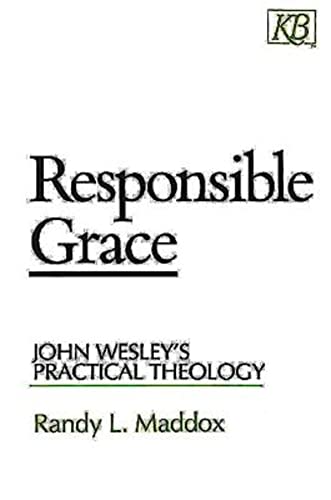
Of special focus in this reflective overview of Wesley's theological convictions is highlighting the practical-theological dynamics of Wesley's work and suggesting possible implications for contemporary attempts to recover theology as a practical discipline. Another distinctive focus of this work is a systematic consideration of the integration of theological emphases traditionally divergent in Eastern and Western Christianity. The author also closely examines the consistency of Wesley's thought throughout his career.
Die Inhaltsangabe kann sich auf eine andere Ausgabe dieses Titels beziehen.
Über die Autorin bzw. den Autor
Randy L. Maddox is William Kellon Quick Professor Emeritus of Wesleyan and Methodist Studies at Duke Divinity School in Durham, NC, and general editor of the Bicentennial Edition of The Works of John Wesley.
Auszug. © Genehmigter Nachdruck. Alle Rechte vorbehalten.
Responsible Grace
John Wesley's Practical Theology
By Randy L. MaddoxAbingdon Press
Copyright © 1994 Abingdon Press
All rights reserved.
ISBN: 978-0-687-00334-1All rights reserved.
Contents
Acknowledgments,
Introduction,
Chapter 1: Human Knowledge of the God of Responsible Grace,
Chapter 2: The God of Responsible Grace,
Chapter 3: Humanity's Need and God's Initial Restoring Grace,
Chapter 4: Christ—The Initiative of Responsible Grace,
Chapter 5: Holy Spirit—The Presence of Responsible Grace,
Chapter 6: Grace and Response—The Nature of Human Salvation,
Chapter 7: The Way of Salvation—Grace Upon Grace,
Chapter 8: The Means of Grace and Response,
Chapter 9: The Triumph of Responsible Grace,
Concluding Reflections,
Notes,
Selected Bibliography,
Index of Selected Names,
Index of Selected Subjects,
CHAPTER 1
Human Knowledge of the God of Responsible Grace
Whenever Christians articulate, inculcate, reformulate, or defend primary theological convictions, they operate (implicitly or explicitly) with assumptions about where one can obtain reliable input regarding these issues and how one should draw upon this input to insure truly Christian convictions. That is, they operate with assumptions about the manner of revelation and the criteria of doctrinal decisions. This chapter will assess Wesley's assumptions about these "meta-theological" issues.
An initial caveat is in order. I have chosen to discuss these issues prior to consideration of Wesley's theological worldview only because it provides a helpful context for understanding some of his doctrinal decisions. I am not meaning to imply that Wesley developed explicit stances on these issues prior to engaging in doctrinal reflection. He was not subject to the "paralysis of analysis" that plagues modern theologians, leaving them hesitant to engage in actual doctrinal reflection until they have solved all methodological puzzles. Indeed, Wesley seldom provided extended articulations of his methodological assumptions. He postulated them in passing, or exemplified them in the process of actual theological activity. I will be gathering these scattered insights, while watching for any developments or tensions.
The Fount of Knowledge—God's Gracious Self-Revelation
One set of meta-theological assumptions concerns the sources of theological knowledge. How and where can we have access to knowledge about God and God's will for us? The best way to approach Wesley's answer to this question is in light of his general epistemological commitments.
Excursus: Wesley's Epistemology
Discussions of epistemology, which inquires into the sources of human knowledge, had divided into two major camps in the Western intellectual traditions by Wesley's time. The rationalist camp (hailing back to Plato) stressed the role of reason in providing the most important knowledge, particularly through innate ideas—ideas resident in our minds prior to any experience. By contrast, empiricists (championing Aristotle) denied that there were innate ideas, arguing that experience was the source of all foundational human knowledge. Where did Wesley fit in this debate?
The issue of Wesley's epistemological commitments has attracted considerable scholarly interest recently. What has become clear through this study is that Wesley self-consciously sided with the empiricist denial of innate ideas. He frequently quoted the slogan nihil est in intellectu quod non fuit prius in sensu, "nothing is in the mind that is not first in the senses". He embraced the Aristotelian logical tradition at Oxford. He commented favorably on John Locke's Essay on Human Understanding, and he appended an abridgement of Peter Browne's The Procedure, Extent, and Limits of Human Understanding to his compendium of natural philosophy.
This is not to say that Wesley agreed totally with (then current) Lockean empiricism. He dissented from this tradition in two significant ways. In the first place, Wesley was epistemologically more optimistic than Locke. He considered Locke much too prone to believe that our senses could mislead us, or that the abstractions which our minds form based on our experience might not correspond to the way things really are.
Wesley's second divergence from contemporary empiricists dealt specifically with the issue of knowledge of God. Most contemporary empiricists assumed that knowledge of God was available only by inference from our experience of the world or by assent to the external testimony of Scripture. While Wesley allowed a role for such indirect knowledge of God, he desired more direct knowledge as well. Yet, since he agreed with empiricists that direct knowledge must come through the senses, he postulated (in conscious contrast with Locke and Browne) that God provided humans with spiritual senses to sense spiritual realities, just as our physical senses sense physical realities.
Where could Wesley have found such a notion of spiritual senses? One possible source was his reading of John Norris, who espoused a form of Malebranchean Platonism that included an important role for spiritual senses as the means of our perception of God. Another likely source was his study of early Eastern Christian writers. In particular, this theme was common in the Macarian Homilies. The theme can also be found in Western spiritualist, Pietist, and Puritan writers.
Whatever its source, Wesley called upon this notion of spiritual senses in two distinct contexts. Sometimes he was primarily concerned to explain how Christians could have an assurance that they are accepted by God. At other times he further credited the spiritual senses with providing immediate perceptual access to such spiritual realities as the existence of our soul, angels, and the afterlife. It is the latter appeal that will be of most interest as we turn now to considering how Wesley's basic epistemological commitments found expression in his understanding of the nature of revelation.
The Gracious Character of All Revelation
There has been an ongoing debate in recent Wesley scholarship over whether Wesley believed that human beings could have knowledge of God apart from God's definitive revelation in Jesus Christ. This debate appears to result more from an inappropriate framing of the question than from ambiguities in Wesley. The debate has typically been framed in terms of whether Wesley affirmed a "natural revelation" or a "natural theology." Behind such designations is the assumption that any universal knowledge of God available through consideration of the world and human life would necessarily be "natural" knowledge rather than "gracious" knowledge.
It is not surprising that the question is frequently framed this way, because the polarization of nature and grace increasingly characterized Western theology, becoming definitive of much of Protestantism. Thus when Wesley is read in a Protestant paradigm (as is most common), he is forced toward one or the other of opposing alternatives: either he is assumed to affirm that humans can have some knowledge of God apart from grace, or he is read to deny the existence of any significant knowledge outside of definitive Christian revelation.
By contrast with later Western theology, early Greek theologians and the continuing Eastern Orthodox tradition have rejected such polarization. They make no absolute separation between general and Christian revelation, but they see both as based in God's grace, with God's revelation in Christ...
„Über diesen Titel“ kann sich auf eine andere Ausgabe dieses Titels beziehen.
Suchergebnisse für Responsible Grace: John Wesley's Practical Theology...

Beispielbild für diese ISBN
Responsible Grace: John Wesley's Practical Theology
Anbieter: World of Books (was SecondSale), Montgomery, IL, USA
Verkäuferbewertung 5 von 5 Sternen

Paperback. Zustand: Good. Of special focus in this reflective overview of Wesley's theological convictions is highlighting the practical-theological dynamics of Wesley's work and suggesting possible implications for contemporary attempts to recover theology as a practical discipline. Another distinctive focus of this work is a systematic consideration of the integration of theological emphases traditionally divergent in Eastern and Western Christianity. The author also closely examines the consistency of Wesley's thought throughout his career. Artikel-Nr. 00108335944
Gebraucht kaufen
EUR 6,25
Versand gratis
Versand innerhalb von USA
Versand innerhalb von USA
Anzahl: 3 verfügbar
Beispielbild für diese ISBN
Responsible Grace
Anbieter: ThriftBooks-Dallas, Dallas, TX, USA
Verkäuferbewertung 5 von 5 Sternen
Paperback. Zustand: Good. No Jacket. Pages can have notes/highlighting. Spine may show signs of wear. ~ ThriftBooks: Read More, Spend Less. Artikel-Nr. G0687003342I3N00
Gebraucht kaufen
EUR 6,35
Versand gratis
Versand innerhalb von USA
Versand innerhalb von USA
Anzahl: 1 verfügbar
Beispielbild für diese ISBN
Responsible Grace: John Wesley's Practical Theology (Kingswood Series)
Verlag:
Kingswood Books (edition ), 1994
ISBN 10: 0687003342
ISBN 13: 9780687003341
Gebraucht
Paperback
Anbieter: BooksRun, Philadelphia, PA, USA
Verkäuferbewertung 5 von 5 Sternen
Paperback. Zustand: Very Good. It's a well-cared-for item that has seen limited use. The item may show minor signs of wear. All the text is legible, with all pages included. It may have slight markings and/or highlighting. Artikel-Nr. 0687003342-11-1
Gebraucht kaufen
EUR 6,88
Versand gratis
Versand innerhalb von USA
Versand innerhalb von USA
Anzahl: 1 verfügbar
Beispielbild für diese ISBN
Responsible Grace: John Wesley's Practical Theology (Kingswood Series)
Anbieter: Wonder Book, Frederick, MD, USA
Verkäuferbewertung 5 von 5 Sternen
Zustand: Good. Good condition. A copy that has been read but remains intact. May contain markings such as bookplates, stamps, limited notes and highlighting, or a few light stains. Artikel-Nr. Q15R-0006
Gebraucht kaufen
EUR 10,77
Versand gratis
Versand innerhalb von USA
Versand innerhalb von USA
Anzahl: 1 verfügbar
Beispielbild für diese ISBN
Responsible Grace: John Wesley's Practical Theology (Kingswood Series)
Anbieter: Ria Christie Collections, Uxbridge, Vereinigtes Königreich
Verkäuferbewertung 5 von 5 Sternen
Zustand: New. In English. Artikel-Nr. ria9780687003341_new
Neu kaufen
EUR 35,92
EUR 13,25 Versand
Versand von Vereinigtes Königreich nach USA
Versand von Vereinigtes Königreich nach USA
Anzahl: Mehr als 20 verfügbar
Beispielbild für diese ISBN
Responsible Grace: John Wesley's Practical Theology
Anbieter: Revaluation Books, Exeter, Vereinigtes Königreich
Verkäuferbewertung 5 von 5 Sternen
Paperback. Zustand: Brand New. 416 pages. 9.00x6.00x1.00 inches. In Stock. Artikel-Nr. x-0687003342
Neu kaufen
EUR 42,25
EUR 14,67 Versand
Versand von Vereinigtes Königreich nach USA
Versand von Vereinigtes Königreich nach USA
Anzahl: 2 verfügbar