
Verwandte Artikel zu The Educated Child: A Parents Guide From Preschool...
Inhaltsangabe
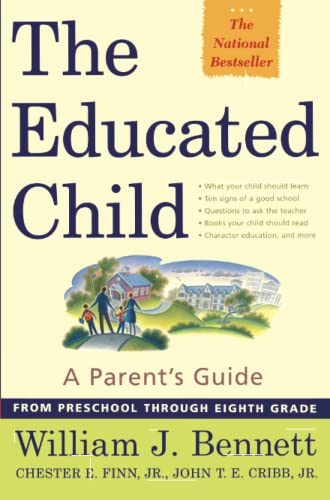
The Educated Child defines a good education and offers parents a plan of action for ensuring that their children achieve it.
The Educated Child defines a good education and offers parents a plan of action for ensuring that their children achieve it. Combining the goals that William Bennett enumerated as Secretary of Education, key excerpts from E. D. Hirsch's Core Knowledge Sequence, and the latest research, it sets forth clear curricula and specific objectives for children from kindergarten through the eighth grade, including:
-What children should be studying and the kind of work they should be doing
-Important facts to learn and essential reading lists
-When children should master specific math skills, spelling and grammar basics, and scientific facts
-Test preparation, homework, and other areas that require parental involvement
The Educated Child also examines timely issues such as school choice, sex education, character education, and the phonics/whole language debate. Perhaps most important, it encourages parents to become advocates for their children by learning what to look for in a good school, how to talk to educators, and how, when necessary, to push for needed changes. For parents concerned about their children's current education and future lives, it is the ultimate handbook.
Die Inhaltsangabe kann sich auf eine andere Ausgabe dieses Titels beziehen.
Über die Autorinnen und Autoren
Dr. William J. Bennett is one of America’s most influential and respected voices on cultural, political, and educational issues. Host of The Bill Bennett Show podcast, he is also the Washington Fellow of the American Strategy Group. He is the author and editor of more than twenty-five books. Dr. Bennett served as the secretary of education and chairman of the National Endowment for the Humanities under President Ronald Reagan and as director of the Office of National Drug Control Policy under President George Herbert Walker Bush.
Chester E. Finn Jr. is a scholar, educator, and public servant who is Distinguished Senior Fellow and President Emeritus of Fordham. His is an educational policy analyst and formally served as the United States Assistant Secretary of Education.
Auszug. © Genehmigter Nachdruck. Alle Rechte vorbehalten.
Introduction
The purpose of this book is to help you secure a good education for your child from early childhood through the eighth grade. As far as learning goes, these years are far and away the most important. They are the time when children acquire the bricks and mortar of a solid education -- the knowledge, skills, habits, and ideals that will serve as the foundation of learning and character throughout their lives. If that edifice is solid by the end of eighth grade, then a student's future is bright indeed. If poorly constructed, the outlook is much dimmer.
Our aim is three-fold. First, we hope to remind parents of their own responsibilities in educating their children. There are few secrets to raising good students. What needs to be done is mostly a matter of common sense. But there is much you can do, and a few things that you must do, to see that your child learns well.
Second, this book will help you determine whether your school is doing a good job. Many parents assume that their children's schools maintain high expectations and offer a quality education. They naturally want to believe that the academic program is strong. Our message to you is: "Trust but verify." The reality is that too many American schools are not doing right by their pupils. In the coming chapters, you'll find some tools you can use to figure out whether your child is truly getting a good education, and some suggestions about how to correct problems at school.
Third, this book paints a fairly detailed picture of what a well-educated child knows and can do. For much of American history, there existed the idea of a "good education." It meant possessing certain knowledge and skills, and behaving in a certain way. Today, regrettably, such a vision is missing from many schools. They are reluctant to specify the lessons that all children should learn. This is a shame, because some things are more important to know than others.
This book helps you know what to look for in a good education. It reminds you of what to stand for as a parent, and what you should not stand for. It draws on common sense, the experience of many teachers and parents, the wisdom of the ages, and much of the best available research. We can all use allies in our efforts to raise children. Think of this book as an ally to help you keep yourself, your child, and your school on track.
You Are Your Child's Most Important Teacher
There is an old saying that a parent's heart is the child's schoolroom. Your dreams, your efforts, your examples and loving exhortations -- these set the boundaries of your child's education. The seminal lessons taught in the home stay with children as they make their way through school and life, shaping their interests, ideals, and enthusiasm for learning. Parents are children's first and most important teachers. Raising your child is your number one job. Seeing that he gets a good education is, in many respects, the crux of that task.
The pressures of time, work, and competing interests tempt us to hand more and more of our educational responsibilities to others. Parents often get a subtle, alluring, but deeply damaging message from today's culture: your role is not quite so important after all. You can delegate. You can outsource. Children will suffer no harm -- in fact, they may reap some benefits -- when they get more of their care and guidance from others. Specialists and experts can fill in for you, pay attention for you, make decisions for you, give guidance where you cannot. Let others take charge of education: curriculum directors, counselors, child care professionals, even children themselves. It is a seductive siren song. It gives the green light for surrendering part of a sacred duty.
You must resist these temptations. For good or ill, you are always your child's most influential teacher. Even when he reaches school age, you are still the dean-at-home, the chief academic officer. The more involved you are, the better your child's chances of getting a good education. If you begin to remove yourself from the learning process, those chances start to plummet. If you turn over your most important responsibilities to others, you may doom his school career. That amounts to educational abandonment, a pernicious form of child neglect. You need to be in charge of your child's education. So take charge.
Several critical elements can come only from you. First among these is your love. The psychologist Urie Bronfenbrenner says that the one indispensable condition for a child's successful upbringing is that at least one adult must have a deep and irrational attachment to him. In other words, someone must be absolutely crazy about that child. Children are put on this earth to be loved. They need unconditional devotion (not unconditional approval). When they grow up knowing that an adult is always there as guardian angel and guide, they thrive. When they sense that such devotion is missing, things can begin to go terribly wrong with their educations and their lives.
Your attitude about education is another key predictor of academic success. Your child looks to you for cues about what is important in life. He is always watching for your approval or disapproval, for your interest or indifference. If you care, he cares. If he sees that you value learning, he will probably do the same. If he observes you putting education second or third, he may not take his schoolwork seriously. Consistent reinforcement means everything. The messages you send determine in no small way how well your child reads, writes, and thinks. Every morning, you must send him off to school with a good night's sleep, a decent breakfast, and a positive attitude toward learning.
Instilling the highest ideals is crucial: Belief in the value of hard work. A strong sense of responsibility. A willingness to keep trying until success finally comes. Respect for legitimate authority. Such traits are the engines that power learning at school, in college, and in life. Academic success depends on them. Transmission of these virtues is more than just part of the territory of parenthood. It is a fundamental obligation.
Your expectations are all important. Children strive to clear the bars that their parents set. So long as those standards are fair and reasonable, they help kids flourish. Parents' expectations determine whether children finish homework on time and study for tests. They separate good students from bad. They help set the course of life. It is said that Abraham Lincoln's mother told him over and over again what kind of good, hardworking man she hoped he would become. Many years later Lincoln observed, "All that I am, and all that I hope to be, I owe to my angel mother." Setting standards for children is not placing a burden on them. It is an expression of love and confidence.
Good students usually come from homes where moms and dads have tried to create a rich learning environment. They've stimulated their children's curiosity by showing them that the world is a fascinating place and helping them explore it. This does not require you to spend lots of money or have a degree in education. It mostly consists of seeing that your child grows up with interesting things to do. It means reading aloud to him, and listening to him read aloud. It means playing games, asking and answering questions, explaining things as best you can. It means exposing him to varied experiences and visiting places together -- taking walks in the woods, working in the garden, occasionally going to a museum or monument. Such activities turn children into curious students.
Education success comes from putting enough time into the right work. What one spends time on is what one ends up knowing. If your child spends endless hours playing video games, he will know all the ins and outs of video games. If he spends...
„Über diesen Titel“ kann sich auf eine andere Ausgabe dieses Titels beziehen.
Suchergebnisse für The Educated Child: A Parents Guide From Preschool...

Beispielbild für diese ISBN
Educated Child
Anbieter: World of Books (was SecondSale), Montgomery, IL, USA
Verkäuferbewertung 5 von 5 Sternen

Paperback. Zustand: Good. The Educated Child defines a good education and offers parents a plan of action for ensuring that their children achieve it. The Educated Child defines a good education and offers parents a plan of action for ensuring that their children achieve it. Combining the goals that William Bennett enumerated as Secretary of Education, key excerpts from E. D. Hirsch's Core Knowledge Sequence, and the latest research, it sets forth clear curricula and specific objectives for children from kindergarten through the eighth grade, including: -What children should be studying and the kind of work they should be doing -Important facts to learn and essential reading lists -When children should master specific math skills, spelling and grammar basics, and scientific facts -Test preparation, homework, and other areas that require parental involvement The Educated Child also examines timely issues such as school choice, sex education, character education, and the phonics/whole language debate. Perhaps most important, it encourages parents to become advocates for their children by learning what to look for in a good school, how to talk to educators, and how, when necessary, to push for needed changes. For parents concerned about their children's current education and future lives, it is the ultimate handbook. Artikel-Nr. 00085853193
Gebraucht kaufen
EUR 4,00
Versand gratis
Versand innerhalb von USA
Versand innerhalb von USA
Anzahl: 20 verfügbar
Beispielbild für diese ISBN
Educated Child
Anbieter: World of Books (was SecondSale), Montgomery, IL, USA
Verkäuferbewertung 5 von 5 Sternen
Paperback. Zustand: Fair. The Educated Child defines a good education and offers parents a plan of action for ensuring that their children achieve it. The Educated Child defines a good education and offers parents a plan of action for ensuring that their children achieve it. Combining the goals that William Bennett enumerated as Secretary of Education, key excerpts from E. D. Hirsch's Core Knowledge Sequence, and the latest research, it sets forth clear curricula and specific objectives for children from kindergarten through the eighth grade, including: -What children should be studying and the kind of work they should be doing -Important facts to learn and essential reading lists -When children should master specific math skills, spelling and grammar basics, and scientific facts -Test preparation, homework, and other areas that require parental involvement The Educated Child also examines timely issues such as school choice, sex education, character education, and the phonics/whole language debate. Perhaps most important, it encourages parents to become advocates for their children by learning what to look for in a good school, how to talk to educators, and how, when necessary, to push for needed changes. For parents concerned about their children's current education and future lives, it is the ultimate handbook. Artikel-Nr. 00083493899
Gebraucht kaufen
EUR 4,00
Versand gratis
Versand innerhalb von USA
Versand innerhalb von USA
Anzahl: 8 verfügbar
Foto des Verkäufers
The Educated Child: A Parents Guide From Preschool Through Eighth Grade
Anbieter: Dream Books Co., Denver, CO, USA
Verkäuferbewertung 5 von 5 Sternen
Zustand: good. Gently used with minimal wear on the corners and cover. A few pages may contain light highlighting or writing, but the text remains fully legible. Dust jacket may be missing, and supplemental materials like CDs or codes may not be included. May be ex-library with library markings. Ships promptly! Artikel-Nr. DBV.0684872722.G
Gebraucht kaufen
EUR 4,01
Versand gratis
Versand innerhalb von USA
Versand innerhalb von USA
Anzahl: 1 verfügbar
Beispielbild für diese ISBN
The Educated Child: A Parents Guide From Preschool Through Eighth Grade
Anbieter: BooksRun, Philadelphia, PA, USA
Verkäuferbewertung 5 von 5 Sternen
Paperback. Zustand: Very Good. It's a well-cared-for item that has seen limited use. The item may show minor signs of wear. All the text is legible, with all pages included. It may have slight markings and/or highlighting. Artikel-Nr. 0684872722-11-1
Gebraucht kaufen
EUR 5,79
Versand gratis
Versand innerhalb von USA
Versand innerhalb von USA
Anzahl: 1 verfügbar
Beispielbild für diese ISBN
The Educated Child: A Parents Guide From Preschool Through Eighth Grade
Anbieter: BooksRun, Philadelphia, PA, USA
Verkäuferbewertung 5 von 5 Sternen
Paperback. Zustand: Very Good. It's a well-cared-for item that has seen limited use. The item may show minor signs of wear. All the text is legible, with all pages included. It may have slight markings and/or highlighting. Artikel-Nr. 0684872722-11-6
Gebraucht kaufen
EUR 5,91
Versand gratis
Versand innerhalb von USA
Versand innerhalb von USA
Anzahl: 1 verfügbar
Beispielbild für diese ISBN
The Educated Child: A Parents Guide from Preschool Through Eighth Grade
Anbieter: ThriftBooks-Reno, Reno, NV, USA
Verkäuferbewertung 5 von 5 Sternen
Paperback. Zustand: Very Good. No Jacket. May have limited writing in cover pages. Pages are unmarked. ~ ThriftBooks: Read More, Spend Less. Artikel-Nr. G0684872722I4N00
Gebraucht kaufen
EUR 6,00
Versand gratis
Versand innerhalb von USA
Versand innerhalb von USA
Anzahl: 1 verfügbar
Beispielbild für diese ISBN
The Educated Child: A Parents Guide from Preschool Through Eighth Grade
Anbieter: ThriftBooks-Dallas, Dallas, TX, USA
Verkäuferbewertung 5 von 5 Sternen
Paperback. Zustand: Very Good. No Jacket. Former library book; May have limited writing in cover pages. Pages are unmarked. ~ ThriftBooks: Read More, Spend Less. Artikel-Nr. G0684872722I4N10
Gebraucht kaufen
EUR 6,04
Versand gratis
Versand innerhalb von USA
Versand innerhalb von USA
Anzahl: 1 verfügbar
Beispielbild für diese ISBN
The Educated Child: A Parents Guide from Preschool Through Eighth Grade
Anbieter: ThriftBooks-Atlanta, AUSTELL, GA, USA
Verkäuferbewertung 5 von 5 Sternen
Paperback. Zustand: Fair. No Jacket. Readable copy. Pages may have considerable notes/highlighting. ~ ThriftBooks: Read More, Spend Less. Artikel-Nr. G0684872722I5N00
Gebraucht kaufen
EUR 6,04
Versand gratis
Versand innerhalb von USA
Versand innerhalb von USA
Anzahl: 1 verfügbar
Beispielbild für diese ISBN
The Educated Child: A Parents Guide from Preschool Through Eighth Grade
Anbieter: ThriftBooks-Atlanta, AUSTELL, GA, USA
Verkäuferbewertung 5 von 5 Sternen
Paperback. Zustand: Very Good. No Jacket. May have limited writing in cover pages. Pages are unmarked. ~ ThriftBooks: Read More, Spend Less. Artikel-Nr. G0684872722I4N00
Gebraucht kaufen
EUR 6,04
Versand gratis
Versand innerhalb von USA
Versand innerhalb von USA
Anzahl: 1 verfügbar
Beispielbild für diese ISBN
The Educated Child: A Parents Guide from Preschool Through Eighth Grade
Anbieter: ThriftBooks-Dallas, Dallas, TX, USA
Verkäuferbewertung 5 von 5 Sternen
Paperback. Zustand: Very Good. No Jacket. May have limited writing in cover pages. Pages are unmarked. ~ ThriftBooks: Read More, Spend Less. Artikel-Nr. G0684872722I4N00
Gebraucht kaufen
EUR 6,04
Versand gratis
Versand innerhalb von USA
Versand innerhalb von USA
Anzahl: 1 verfügbar