
Inhaltsangabe
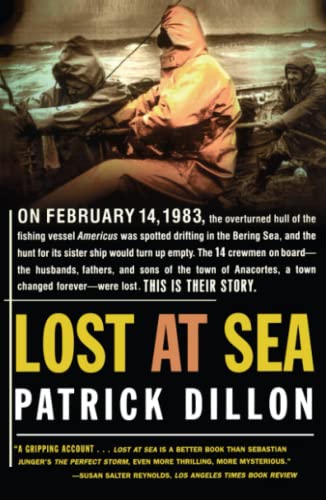
On February 3, 1983, the men aboard Americus and Altair, two state-of-the-art crabbing vessels, docked in their home port of Anacortes, Washington, prepared to begin a grueling three-month season fishing in the notorious Bering Sea. Eleven days later, on Valentine's Day, the overturned hull of the Americus was found drifting in calm seas, with no record of even a single distress call or trace of its seven-man crew. The Altair vanished altogether. Despite the desperate search that followed, no evidence of the vessel or its crew would ever be found. Fourteen men were lost. And the tragedy would mark the worst disaster in the history of U.S. commercial fishing.
With painstaking research and spellbinding prose, acclaimed journalist Patrick Dillon brings to life the men who were lost, the dangers that commercial fishermen face, the haunting memories of the families left behind...and reconstructs the intense investigation that ensued, which for the first time exposed the dangers of an industry that would never again be the same.
Die Inhaltsangabe kann sich auf eine andere Ausgabe dieses Titels beziehen.
Über die Autorin bzw. den Autor
Patrick Dillon is the Adventure and Sailing Events Programming Director at QuokkaSports, Digital Sports Entertainment. He has won numerous awards, including a share of the Pulitzer Prize in 1989. His columns and essays have appeared in many publications throughout the nation, including the Los Angeles Times, the Chicago Tribune, and Fast Company.
Auszug. © Genehmigter Nachdruck. Alle Rechte vorbehalten.
Lost at Sea
By Patrick DillonTouchstone Books
Copyright © 2000 Patrick DillonAll right reserved.
ISBN: 9780684869094
Chapter One
On a clear March day in 1982, just off False Pass threehundred miles west of the Alaskan Peninsula, an alarm sounded inthe engine room of the fishing vessel Antares. She was out ofAnacortes, Washington, two thousand miles to the south. Steve Carr,the twenty-five-year-old engineer, climbed down the stairs to investigate.When he reached the engine room it was filled with smoke.He could tell by the thick, oily smell that the fire was coming fromthe hydraulic system that supplied power to run the winches ondeck. He called the wheelhouse on the vessel's intercom and reportedthis to Kevin Kirkpatrick, also twenty-five, the captain and alifelong friend. Kirkpatrick immediately throttled back and thenshut down the work on deck, directing the crew of five to go to theirfire-fighting stations. Carr donned a mask and an oxygen tank,armed himself with a carbon dioxide extinguisher, and plunged backinto the engine room. Gradually, on the wheelhouse monitor of theengine room, Kirkpatrick could see the smoke clearing. Withinminutes Carr called again over the intercom and said it appeared thefire was out.
Kirkpatrick gave the crew a break. They gathered around thegalley table and ate a meal, each of them worn out by the rush ofadrenaline but still tensed for the sound of another fire alarm. Nonecame.
Before getting under way, though, Kirkpatrick and Carr headedback down to the engine room to assess the damage the fire hadcaused. When they opened the hatch, the innards of the Antareserupted. The rush of fresh oxygen had acted as a bomb for thestill-smoldering fire.
Kirkpatrick scrambled up the stairs to the wheelhouse and sentout a distress call on his VHF radio. He stayed calm and went bythe book: "MAYDAY, MAYDAY, MAYDAY," he repeated, beforegiving the vessel's name and call sign three times. He reportedhis latitude and longitude and that there was a fire on board. Hereported the number of crew and gave a description of the 123-footAntares. He waited for a response. In the meantime, several crewmembers climbed up the stairs into the wheelhouse. The fire wascompletely out of control, they told him. He repeated the distresscall, and when a German fish-processing vessel just ten miles awaypicked it up and said it was heading in his direction, Kirkpatrickradioed back that he and his crew were abandoning ship.
As they had been trained, the six-member crew lay on the floorof the ten-foot-wide wheelhouse and wriggled into their thick neoprenesurvival suits. None took more than two minutes. They loweredthe two life rafts into the water, making certain the rafts werestill tethered to the burning vessel. Then, one by one, each of themplunged into the thirty-two-degree sea and paddled awkwardlytoward the rafts, helping each other aboard. They could see the hullof the Antares glowing like a dull red coal at the waterline. Whenthe heat became too intense, they cut the rafts loose. The Germanvessel arrived within an hour and the exhausted crew was helped ondeck. All survived. But the Antares was destroyed, burned from theinside out as if by an enormous oven fire.
Weeks later, back in Anacortes, the Antares's owner, Jeff Hendricks,negotiated to sell her for pennies on the dollar for scrap.Less than five years old, the Antares was one of the first of a generationof sophisticated new American fishing vessels. She had costnearly $3 million and had taken a year to build. In a good seasonHendricks could count on the boat to earn as much as $2.5 million.Now he was lucky to see $25,000 from the scrapyard, plus aninsurance settlement. But under tow, on the way to port, the burnedouthusk of the Antares sank in two thousand feet of water twothousand miles from home. With it, Hendricks's fledgling four-vesselfleet suffered a serious blow.
Named after the brightest star in the constellation Scorpio, theAntares had been born out of Hendricks's optimism and exhaustlessambition. When she was completed in 1977, the Antares secured hisstanding as the top vessel owner in Anacortes and one of the topfleet owners in the Pacific Northwest. During the previous threeyears Hendricks had proven himself with his first two boats, the SeaStar and Alyeska, built by Fairhaven Industries up in Bellingham.He had taken advantage of low-interest loans the government wasoffering prospective fishing-vessel owners to build them, and theyhad done so well in the Bering Sea that he was able to use them ascollateral for financing the next venture.
In the mid 1970s, optimism was running so high about the newlydiscovered crabbing grounds near the Pribilof Islands, in fact, thatHendricks persuaded Dick Nelson and Bob Gudmundson, twoFairhaven managers who had overseen the birth of his first twoboats, to break away from the company and start their own.
"Anacortes was ideal," Nelson said. "It had deep water and alow bank. There was already a shipyard facility there on propertyowned by the port."
There was also a three-hundred-foot dock, seventy-five feetwide, and a track for drawing vessels out of the water for repairs orsending a new hull down the ways. It didn't take much convincingfor a new partnership to be born, and it didn't take much persuadingfor the town to make a sweet lease deal, especially since Hendrickshad already commissioned the building of three big boats. In Anacortes,new jobs were a rare and welcome opportunity.
Nelson and Gudmundson opened shop on January 2, 1977, andwithin two weeks, two dozen locals were at work on Hendricks'sfirst order. On spring nights that year, the Dakota Creek Industriesshipyard at the foot of Commercial Street in Anacortes was ablazelike a giant fireworks display. With their soldering guns and oxyacetylenetorches, welders fused metal to metal, sending millions ofsparks skyward, announcing the birth of Hendricks's newest andfirst homegrown fishing vessel.
Hendricks had big plans for his new boat. He wanted the Antaresto be just a little bigger, deeper, and longer than the Sea Star andAlyeska and other Pacific Northwest boats that had been patternedafter the deep-sea tuna seiners that plied the Pacific from San Pedroto Hawaii. He wanted this new boat specifically designed andequipped to challenge the Bering Sea. The Antares would be allsteel, with a square bottom and square stern, a stiff-ribbed, stiff-backbonedvessel of a hard chine designed to snap back fast on keelwith every roll. At 123.5 feet long and 32 feet wide, with a depthamidships of 14 feet, and 32 feet from the main deck to the top ofthe mast, she would be subtly larger than the previous boats. Likethe others, her wheelhouse would sit forward and her bow would beslightly rounded, flaring upward from the bulwarks. The lightshiphull, or shell, would weigh 195 tons with just over a 10-foot draft.Like her sister vessels, her hull would be sky blue, flaunting adistinctive white-winged emblem.
In the Dakota Creek shipyard, the Antares began as a sketchhand-drawn by Jeff Hendricks. The sketch was translated into blueprintsby the Seattle-area designer Jacob Fisker-Andersen, a Danishimmigrant with a respectable pedigree as a vessel architect. Theblueprints were then projected and drafted to full-scale drawings ina barnlike drafting room at Dakota...
„Über diesen Titel“ kann sich auf eine andere Ausgabe dieses Titels beziehen.
Weitere beliebte Ausgaben desselben Titels

Suchergebnisse für Lost At Sea: An American Tragedy

Beispielbild für diese ISBN
Lost At Sea: An American Trage
Anbieter: World of Books (was SecondSale), Montgomery, IL, USA
Verkäuferbewertung 5 von 5 Sternen

Zustand: Good. Item in good condition. Textbooks may not include supplemental items i.e. CDs, access codes etc. Artikel-Nr. 00099736271
Gebraucht kaufen
EUR 4,55
Versand gratis
Versand innerhalb von USA
Versand innerhalb von USA
Anzahl: 8 verfügbar
Beispielbild für diese ISBN
Lost At Sea
Verlag:
Touchstone (edition Reprint), 2000
ISBN 10: 0684869098
ISBN 13: 9780684869094
Gebraucht
Paperback
Anbieter: BooksRun, Philadelphia, PA, USA
Verkäuferbewertung 5 von 5 Sternen
Paperback. Zustand: Fair. Reprint. The item might be beaten up but readable. May contain markings or highlighting, as well as stains, bent corners, or any other major defect, but the text is not obscured in any way. Artikel-Nr. 0684869098-7-1
Gebraucht kaufen
EUR 4,89
Versand gratis
Versand innerhalb von USA
Versand innerhalb von USA
Anzahl: 1 verfügbar
Beispielbild für diese ISBN
Lost at Sea
Anbieter: ThriftBooks-Dallas, Dallas, TX, USA
Verkäuferbewertung 5 von 5 Sternen
Paperback. Zustand: As New. No Jacket. Pages are clean and are not marred by notes or folds of any kind. ~ ThriftBooks: Read More, Spend Less. Artikel-Nr. G0684869098I2N00
Gebraucht kaufen
EUR 6,07
Versand gratis
Versand innerhalb von USA
Versand innerhalb von USA
Anzahl: 1 verfügbar
Beispielbild für diese ISBN
Lost At Sea
Anbieter: Wonder Book, Frederick, MD, USA
Verkäuferbewertung 5 von 5 Sternen
Zustand: Good. Good condition. With remainder mark. A copy that has been read but remains intact. May contain markings such as bookplates, stamps, limited notes and highlighting, or a few light stains. Bundled media such as CDs, DVDs, floppy disks or access codes may not be included. Artikel-Nr. S22B-03822
Gebraucht kaufen
EUR 6,74
Versand gratis
Versand innerhalb von USA
Versand innerhalb von USA
Anzahl: 1 verfügbar
Beispielbild für diese ISBN
Lost at Sea
Anbieter: AwesomeBooks, Wallingford, Vereinigtes Königreich
Verkäuferbewertung 5 von 5 Sternen
Paperback. Zustand: Very Good. Lost at Sea This book is in very good condition and will be shipped within 24 hours of ordering. The cover may have some limited signs of wear but the pages are clean, intact and the spine remains undamaged. This book has clearly been well maintained and looked after thus far. Money back guarantee if you are not satisfied. See all our books here, order more than 1 book and get discounted shipping. Artikel-Nr. 7719-9780684869094
Gebraucht kaufen
EUR 7,18
EUR 4,82 Versand
Versand von Vereinigtes Königreich nach USA
Versand von Vereinigtes Königreich nach USA
Anzahl: 2 verfügbar
Beispielbild für diese ISBN
Lost At Sea
Anbieter: WorldofBooks, Goring-By-Sea, WS, Vereinigtes Königreich
Verkäuferbewertung 5 von 5 Sternen
Paperback. Zustand: Very Good. The book has been read, but is in excellent condition. Pages are intact and not marred by notes or highlighting. The spine remains undamaged. Artikel-Nr. GOR007834745
Gebraucht kaufen
EUR 6,17
EUR 6,56 Versand
Versand von Vereinigtes Königreich nach USA
Versand von Vereinigtes Königreich nach USA
Anzahl: 4 verfügbar
Beispielbild für diese ISBN
Lost at Sea
Anbieter: Bahamut Media, Reading, Vereinigtes Königreich
Verkäuferbewertung 5 von 5 Sternen
Paperback. Zustand: Very Good. This book is in very good condition and will be shipped within 24 hours of ordering. The cover may have some limited signs of wear but the pages are clean, intact and the spine remains undamaged. This book has clearly been well maintained and looked after thus far. Money back guarantee if you are not satisfied. See all our books here, order more than 1 book and get discounted shipping. Artikel-Nr. 6545-9780684869094
Gebraucht kaufen
EUR 7,18
EUR 8,17 Versand
Versand von Vereinigtes Königreich nach USA
Versand von Vereinigtes Königreich nach USA
Anzahl: 2 verfügbar
Beispielbild für diese ISBN
Lost At Sea
Verlag:
Simon & Schuster, New York, 2000
ISBN 10: 0684869098
ISBN 13: 9780684869094
Gebraucht
Softcover
Anbieter: Between the Covers-Rare Books, Inc. ABAA, Gloucester City, NJ, USA
Verkäuferbewertung 5 von 5 Sternen
Softcover. Zustand: Fine. First thus. Fine in wrappers. / excellent condition. Artikel-Nr. 241016
Gebraucht kaufen
EUR 17,56
EUR 4,81 Versand
Versand innerhalb von USA
Versand innerhalb von USA
Anzahl: 1 verfügbar
Beispielbild für diese ISBN
Lost at Sea: An American Tragedy
Anbieter: Revaluation Books, Exeter, Vereinigtes Königreich
Verkäuferbewertung 5 von 5 Sternen
Paperback. Zustand: Brand New. reprint edition. 264 pages. 8.25x5.25x0.50 inches. In Stock. Artikel-Nr. x-0684869098
Neu kaufen
EUR 21,53
EUR 11,71 Versand
Versand von Vereinigtes Königreich nach USA
Versand von Vereinigtes Königreich nach USA
Anzahl: 2 verfügbar