
Verwandte Artikel zu The Undiscovered Mind: How the Human Brain Defies Replicatio...
The Undiscovered Mind: How the Human Brain Defies Replication, Medication, and Explanation - Softcover
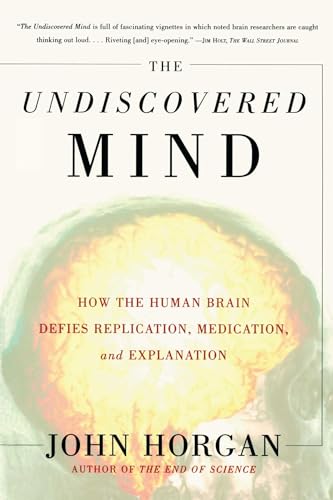
Inhaltsangabe
GRAY MATTER UNDER INVESTIGATION
In his acclaimed book The End of Science, John Horgan ignited a firestorm of controversy about the limits of knowledge in a wide range of sciences. Now in The Undiscovered Mind he focuses on the single most important scientific enterprise of all -- the effort to understand the human mind.
Horgan takes us inside laboratories, hospitals, and universities to meet neuro-scientists, Freudian analysts, electroshock therapists, behavioral geneticists, evolutionary psychologists, artificial intelligence engineers, and philosophers of consciousness. He looks into the persistent explanatory gap between mind and body that Socrates pondered and shows that it has not been bridged. He investigates what he calls the "Humpty Dumpty dilemma," the fact that neuroscientists can break the brain and mind into pieces but cannot put the pieces back together again. He presents evidence that the placebo effect is the primary ingredient of psychotherapy, Prozac, and other treatments for mental disorders. As Horgan shows, the mystery of human consciousness, of why and how we think, remains so impregnable that to expect the attempts of scientific method and technology to penetrate it anytime soon is absurd.
Die Inhaltsangabe kann sich auf eine andere Ausgabe dieses Titels beziehen.
Über die Autorin bzw. den Autor
John Horgan is the author of The End of Science, a U.S. bestseller that has been translated into ten languages. He has written for The New York Times, The Washington Post, The Times (London), The New Republic, Lingua Franca, Slate, The Sciences, and Discover, among other publications in the United States and Europe. He lives in Garrison, New York.
Auszug. © Genehmigter Nachdruck. Alle Rechte vorbehalten.
Chapter One: Neuroscience's Explanatory Gap
By 1979 Freudian psychology was treated as only an interesting historical note. The fashionable new frontier was the clinical study of the central nervous system....Today the new savants probe and probe and slice and slice and project their slides and regard Freud's mental constructs, his "libidos," "Oedipal complexes," and the rest, as quaint quackeries of yore, along the lines of Mesmer's "animal magnetism."
-- Tom Wolfe, In Our Time
In Phaedo Plato described the last hours of Socrates, who had been imprisoned and sentenced to death by Athenian authorities. Socrates told friends who had assembled in the prison why he had accepted his death sentence rather than fleeing. At one point, Socrates ridiculed the notion that his behavior could be explained in physical terms. Someone who held such a belief, Socrates speculated, would claim that
as the bones are lifted at their joints by the contraction or relaxation of the muscles, I am able to bend my limbs, and that is why I am sitting here in a curved posture...and he would have a similar explanation of my talking to you, which he would attribute to sound, and air, and hearing...forgetting to mention the true cause, which is, that the Athenians have thought fit to condemn me, and accordingly I have thought it better and more right to remain here and undergo my sentence.
This is the oldest allusion I know of to what some modern philosophers call the explanatory gap. The term was coined by Joseph Levine, a philosopher at North Carolina State University. In "Materialism and Qualia: The Explanatory Gap," published in Pacific Philosophical Quarterly in 1983, Levine addressed the puzzling inability of physiological theories to account for psychological phenomena. Levine's main focus was on consciousness, or "qualia," our subjective sensations of the world. But the explanatory gap could also refer to mental functions such as perception, memory, reasoning, and emotion -- and to human behavior.
The field that seems most likely to close the explanatory gap is neuroscience, the study of the brain. When Plato wrote Phaedo, no one even knew that the brain is the seat of mental functioning. (Aristotle's observation that chickens often continue running after being decapitated led him to rule out the brain as the body's control center.) Today neuroscientists are probing the links between the brain and the mind with an ever more potent array of tools. They can watch the entire brain in action with positron emission tomography and magnetic resonance imaging. They can monitor the minute electrical impulses passing between individual nerve cells with microelectrodes. They can trace the effects of specific genes and neurotransmitters on the brain's functioning. Investigators hope that eventually neuroscience will do for mind-science what molecular biology did for evolutionary biology, placing it on a firm empirical foundation that leads to powerful new insights and applications.
Neuroscience is certainly a growth industry. Membership in the Society for Neuroscience, based in Washington, D.C., soared from 500 in 1970, the year it was founded, to over 25,000 in 1998. Neuroscience journals have proliferated, as has coverage of the topic in premier general-interest journals such as Science and Nature. When Nature launched a new periodical, Nature Neuroscience, in 1998, it proclaimed that neuroscience "is one of the most vigorous and fast growing areas of biology. Not only is understanding the brain one of the great scientific challenges of our time, it also has profound implications for society, ranging from the basis of memory to the causes of Alzheimer's disease to the origins of emotions, personality and even consciousness itself." Neuroscience is clearly advancing; it is getting somewhere. But where?
I once asked Gerald Fischbach, the head of Harvard's Department of Neuroscience and a former president of the Society for Neuroscience, to name what he considered to be the most important accomplishment of his field. He smiled at the naiveté of the question. Neuroscience is a vast enterprise, he pointed out, which ranges from studies of molecules that facilitate neural transmission to magnetic resonance imaging of whole-brain activity. It is impossible, Fischbach added, to single out any particular finding, or even a set of findings, emerging from neuroscience. The field's most striking characteristic is its production of such an enormous and still-growing number of discoveries. Researchers keep finding new types of brain cells, or neurons; neurotransmitters, the chemicals by which neurons communicate with each other; neural receptors, the lumps of protein on the surface of neurons into which neurotransmitters fit; and neurotrophic factors, chemicals that guide the growth of the brain from the embryonic stage into adulthood.
Not long ago, Fischbach elaborated, researchers believed there was only one receptor for the neurotransmitter acetylcholine, which controls muscle functioning; now at least ten different receptors have been identified. Experiments have turned up at least fifteen receptors for the so-called GABA (gamma-amino butyric acid) neurotransmitter, which inhibits neural activity. Research into neurotrophic factors is also "exploding," Fischbach said. Researchers had learned that neurotrophic factors continue to shape the brain not only in utero and during infancy but throughout our life span. Unfortunately, neuroscientists had not determined how to fit all these findings into a coherent framework. "We're not close to having a unified view of human mental life," Fischbach said.
Fischbach was spotlighting one of his field's most paradoxical features. Although reductionist is often used as a derogatory term, science is reductionist by definition. As the philosopher Daniel Dennett once put it, "Leaving something out is not a feature of failed explanations, but of successful explanations." Science at its best isolates a common element underlying many seemingly disparate phenomena. Newton discovered that the tendency of objects to fall to the ground, the swelling and ebbing of seas, and the motion of the moon and planets through space could all be explained by a single force, gravity. Modern physicists have demonstrated that all matter consists basically of two types of particles, quarks and electrons. Darwin showed that all the diverse species on earth were created through a single process, evolution. In the last half-century, Francis Crick, James Watson, and other molecular biologists revealed that all organisms share essentially the same DNA-based method of transmitting genetic information to their offspring. Neuroscientists, in contrast, have yet to achieve their reductionist epiphany. Instead of finding a great unifying insight, they just keep uncovering more and more complexity. Neuroscience's progress is really a kind of anti-progress. As researchers learn more about the brain, it becomes increasingly difficult to imagine how all the disparate data can be organized into a cohesive, coherent whole.
The Humpty Dumpty Dilemma
In 1990, the Society for Neuroscience persuaded the U.S. Congress to designate the 1990s the Decade of the Brain. The goal of the proclamation was both to celebrate the achievements of neuroscience and to support efforts to understand mental disorders such as schizophrenia and manic depression (also known as bipolar illness). One neuroscientist who opposed the idea was Torsten Wiesel, who won a Nobel prize in 1981 and went on to become president of Rockefeller University in New York. (He stepped down to return to research at the end of 1998.) Born and raised in Sweden, Wiesel is a soft-spoken, reticent man, but when I interviewed him at Rockefeller University in...
„Über diesen Titel“ kann sich auf eine andere Ausgabe dieses Titels beziehen.
Suchergebnisse für The Undiscovered Mind: How the Human Brain Defies Replicatio...

Beispielbild für diese ISBN
The Undiscovered Mind: How the Human Brain Defies Replication, Medication, and Explanation
Anbieter: BooksRun, Philadelphia, PA, USA
Verkäuferbewertung 5 von 5 Sternen

Paperback. Zustand: Very Good. It's a well-cared-for item that has seen limited use. The item may show minor signs of wear. All the text is legible, with all pages included. It may have slight markings and/or highlighting. Artikel-Nr. 0684865785-8-1
Gebraucht kaufen
EUR 4,60
Versand gratis
Versand innerhalb von USA
Versand innerhalb von USA
Anzahl: 1 verfügbar
Beispielbild für diese ISBN
The Undiscovered Mind : How the Human Brain Defies Replication, Medication, and Explanation
Anbieter: Better World Books, Mishawaka, IN, USA
Verkäuferbewertung 5 von 5 Sternen
Zustand: Good. Pages intact with minimal writing/highlighting. The binding may be loose and creased. Dust jackets/supplements are not included. Stock photo provided. Product includes identifying sticker. Better World Books: Buy Books. Do Good. Artikel-Nr. 740393-6
Gebraucht kaufen
EUR 6,18
Versand gratis
Versand innerhalb von USA
Versand innerhalb von USA
Anzahl: 2 verfügbar
Beispielbild für diese ISBN
The Undiscovered Mind: How the Human Brain Defies Replication, Medication, and Explanation
Anbieter: Wonder Book, Frederick, MD, USA
Verkäuferbewertung 5 von 5 Sternen
Zustand: Good. Good condition. A copy that has been read but remains intact. May contain markings such as bookplates, stamps, limited notes and highlighting, or a few light stains. Artikel-Nr. B16L-00917
Gebraucht kaufen
EUR 6,42
Versand gratis
Versand innerhalb von USA
Versand innerhalb von USA
Anzahl: 2 verfügbar
Beispielbild für diese ISBN
The Undiscovered Mind: How the Human Brain Defies Replication, Medication, and Explanation
Anbieter: ThriftBooks-Atlanta, AUSTELL, GA, USA
Verkäuferbewertung 5 von 5 Sternen
Paperback. Zustand: As New. No Jacket. Pages are clean and are not marred by notes or folds of any kind. ~ ThriftBooks: Read More, Spend Less. Artikel-Nr. G0684865785I2N00
Gebraucht kaufen
EUR 6,60
Versand gratis
Versand innerhalb von USA
Versand innerhalb von USA
Anzahl: 1 verfügbar
Beispielbild für diese ISBN
The Undiscovered Mind : How the Human Brain Defies Replication, Medication, and Explanation
Anbieter: Better World Books Ltd, Dunfermline, Vereinigtes Königreich
Verkäuferbewertung 5 von 5 Sternen
Zustand: Very Good. Former library copy. Pages intact with possible writing/highlighting. Binding strong with minor wear. Dust jackets/supplements may not be included. Includes library markings. Stock photo provided. Product includes identifying sticker. Better World Books: Buy Books. Do Good. Artikel-Nr. 8458605-6
Gebraucht kaufen
EUR 6,25
EUR 5,96 Versand
Versand von Vereinigtes Königreich nach USA
Versand von Vereinigtes Königreich nach USA
Anzahl: 1 verfügbar
Beispielbild für diese ISBN
The Undiscovered Mind: How the Human Brain Defies Replication, Medication, and Explanation
Anbieter: medimops, Berlin, Deutschland
Verkäuferbewertung 5 von 5 Sternen
Zustand: good. Befriedigend/Good: Durchschnittlich erhaltenes Buch bzw. Schutzumschlag mit Gebrauchsspuren, aber vollständigen Seiten. / Describes the average WORN book or dust jacket that has all the pages present. Artikel-Nr. M00684865785-G
Gebraucht kaufen
EUR 5,93
EUR 10,00 Versand
Versand von Deutschland nach USA
Versand von Deutschland nach USA
Anzahl: 1 verfügbar
Beispielbild für diese ISBN
The Undiscovered Mind: How the Human Brain Defies Replication, Medication, and Explanation
Anbieter: Revaluation Books, Exeter, Vereinigtes Königreich
Verkäuferbewertung 5 von 5 Sternen
Paperback. Zustand: Brand New. 336 pages. 8.50x5.50x1.00 inches. In Stock. Artikel-Nr. x-0684865785
Neu kaufen
EUR 24,48
EUR 11,93 Versand
Versand von Vereinigtes Königreich nach USA
Versand von Vereinigtes Königreich nach USA
Anzahl: 2 verfügbar
Beispielbild für diese ISBN
The Undiscovered Mind: How the Human Brain Defies Replication, Medication, and Explanation
Anbieter: Majestic Books, Hounslow, Vereinigtes Königreich
Verkäuferbewertung 4 von 5 Sternen

Zustand: New. pp. 336. Artikel-Nr. 4737434
Neu kaufen
EUR 36,00
EUR 7,75 Versand
Versand von Vereinigtes Königreich nach USA
Versand von Vereinigtes Königreich nach USA
Anzahl: 1 verfügbar
Foto des Verkäufers
The Undiscovered Mind
Anbieter: AHA-BUCH GmbH, Einbeck, Deutschland
Verkäuferbewertung 5 von 5 Sternen
Taschenbuch. Zustand: Neu. Neuware - GRAY MATTER UNDER INVESTIGATION In his acclaimed book The End of Science, John Horgan ignited a firestorm of controversy about the limits of knowledge in a wide range of sciences. Now in The Undiscovered Mind he focuses on the single most important scientific enterprise of all -- the effort to understand the human mind. Horgan takes us inside laboratories, hospitals, and universities to meet neuro-scientists, Freudian analysts, electroshock therapists, behavioral geneticists, evolutionary psychologists, artificial intelligence engineers, and philosophers of consciousness. He looks into the persistent explanatory gap between mind and body that Socrates pondered and shows that it has not been bridged. He investigates what he calls the 'Humpty Dumpty dilemma,' the fact that neuroscientists can break the brain and mind into pieces but cannot put the pieces back together again. He presents evidence that the placebo effect is the primary ingredient of psychotherapy, Prozac, and other treatments for mental disorders. As Horgan shows, the mystery of human consciousness, of why and how we think, remains so impregnable that to expect the attempts of scientific method and technology to penetrate it anytime soon is absurd. Artikel-Nr. 9780684865782
Neu kaufen
EUR 36,81
EUR 35,00 Versand
Versand von Deutschland nach USA
Versand von Deutschland nach USA
Anzahl: 2 verfügbar
Foto des Verkäufers
The Undiscovered Mind: How the Human Brain Defies Replication, Medication, and Explanation
Anbieter: moluna, Greven, Deutschland
Verkäuferbewertung 5 von 5 Sternen
Zustand: New. Über den AutorrnrnJohn Horgan is the author of The End of Science, a U.S. bestseller that has been translated into ten languages. He has written for The New York Times, The Washington Post, The Times (London), The Ne. Artikel-Nr. 898448455
Neu kaufen
EUR 27,48
EUR 48,99 Versand
Versand von Deutschland nach USA
Versand von Deutschland nach USA
Anzahl: Mehr als 20 verfügbar