
Verwandte Artikel zu True At First Light: A Fictional Memoir
Inhaltsangabe
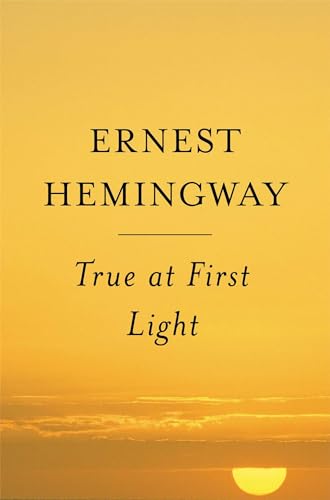
Both a revealing self-portrait and dramatic fictional chronicle of his final African safari, Ernest Hemingway's last unpublished work was written when he returned from Kenya in 1953. Edited by his son Patrick, who accompanied his father on the safari, True at First Light offers rare insights into the legendary American writer.
A blend of autobiography and fiction, the book opens on the day his close friend Pop, a celebrated hunter, leaves Ernest in charge of the safari camp and news arrives of a potential attack from a hostile tribe. Drama continues to build as his wife, Mary, pursues the great black-maned lion that has become her obsession, and Ernest becomes involved with a young African girl whom he supposedly plans to take as a second bride. Increasingly enchanted by the local African community, he struggles between the attraction of these two women and the wildly different cultures they represent.
Spicing his depictions of human longings with sharp humor, Hemingway captures the excitement of big-game hunting and the unparalleled beauty of the landscape. Rich in laughter, beauty, and profound insight. True at First Light is an extraordinary publishing event—a breathtaking final work from one of our most beloved and important writers.
Die Inhaltsangabe kann sich auf eine andere Ausgabe dieses Titels beziehen.
Über die Autorin bzw. den Autor
Ernest Hemingway did more to change the style of English prose than any other writer of his time. Publication of The Sun Also Rises and A Farewell to Arms immediately established Hemingway as one of the greatest literary lights of the twentieth century. His classic novel The Old Man and the Sea won the Pulitzer Prize in 1953. Hemingway was awarded the Nobel Prize for Literature in 1954. His life and accomplishments are explored in-depth in the PBS documentary film from Ken Burns and Lynn Novick, Hemingway. Known for his larger-than-life personality and his passions for bullfighting, fishing, and big-game hunting, he died in Ketchum, Idaho on July 2, 1961.
Auszug. © Genehmigter Nachdruck. Alle Rechte vorbehalten.
True At First Light
A Fictional MemoirBy Ernest HemingwayScribner
Copyright © 2000 Ernest HemingwayAll right reserved.
ISBN: 0684865726
From Chapter One
Things were not too simple in this safari because things had changed very much in East Africa. The white hunter had been a close friend of mine for many years. I respected him as I had never respected my father and he trusted me, which was more than I deserved. It was, however, something to try to merit. He had taught me by putting me on my own and correcting me when I made mistakes. When I made a mistake he would explain it. Then if I did not make the same mistake again he would explain a little more. But he was nomadic and he was finally leaving us because it was necessary for him to be at his farm, which is what they call a twenty-thousand-acre cattle ranch in Kenya. He was a very complicated man compounded of absolute courage, all the good human weaknesses and a strangely subtle and very critical understanding of people. He was completely dedicated to his family and his home and he loved much more to live away from them. He loved his home and his wife and his children.
"Do you have any problems?"
"I don't want to make a fool of myself with elephants."
"You'll learn."
"Anything else?"
"Know everybody knows more than you but you have to make the decisions and make them stick. Leave the camp and all that to Keiti. Be as good as you can."
There are people who love command and in their eagerness to assume it they are impatient at the formalities of taking over from someone else. I love command since it is the ideal welding of freedom and slavery. You can be happy with your freedom and when it becomes too dangerous you take refuge in your duty. For several years I had exercised no command except over myself and I was bored with this since I knew myself and my defects and strengths too well and they permitted me little freedom and much duty. Lately I had read with distaste various books written about myself by people who knew all about my inner life, aims and motives. Reading them was like reading an account of a battle where you had fought written by someone who had not only not been present but, in some cases, had not even been born when the battle had taken place. All these people who wrote of my life both inner and outer wrote with an absolute assurance that I had never felt.
On this morning I wished that my great friend and teacher Philip Percival did not have to communicate in that odd shorthand of understatement which was our legal tongue. I wished that there were things that I could ask him that it was impossible to ask. I wished more than anything that I could be instructed fully and competently as the British instruct their airmen. But I knew that the customary law which prevailed between Philip Percival and myself was as rigid as the customary law of the Kamba. My ignorance, it had been decided long ago, was to be lessened only through learning by myself. But I knew that from now on I had no one to correct my mistakes and, with all the happiness one has in assuming command, it made the morning a very lonely one.
For a long time we had called each other Pop. At first, more than twenty years before, when I had called him Pop, Mr. Percival had not minded as long as this violation of good manners was not made in public. But after I had reached the age of fifty, which made me an elder or Mzee, he had taken, happily, to calling me Pop, which was in a way a compliment, lightly bestowed and deadly if it were withdrawn. I cannot imagine a situation, or, rather, I would not wish to survive a situation in which I called him, in private, Mr. Percival or he addressed me by my proper name.
So on this morning there were many questions I wished to ask and many things I had wondered about. But we were, by custom, mute on these subjects. I felt very lonely and he knew it of course.
"If you did not have problems it would not be fun," Pop said. "You're not a mechanic and what they call white hunters now are mostly mechanics who speak the language and follow other people's tracks. Your command of the language is limited. But you and your disreputable companions made what tracks there are and you can make a few new ones. If you can't come up with the proper word in your new idiom, Kikamba, just speak Spanish. Everyone loves that. Or let the Memsahib talk. She is slightly more articulate than you."
"Oh go to hell."
"I shall go to prepare a place for thee," Pop said.
"And elephants?"
"Never give them a thought," Pop said. "Enormous silly beasts. Harmless everyone says. Just remember how deadly you are with all other beasts. After all they are not the woolly mastodon. I've never seen one with a tusk that made two curves."
"Who told you about that?"
"Keiti," Pop said. "He told me you bag thousands of them in the off-season. Those and your saber-toothed tiger and your brontosauruses."
"The son of a bitch," I said.
"No. He more than half believes it. He has a copy of the magazine and they look very convincing. I think he believes it some days and some days not. It depends on whether you bring him any guinea fowl and how you're shooting in general."
"It was a pretty well illustrated article on prehistoric animals."
"Yes. Very. Most lovely pictures. And you made a very rapid advance as a white hunter when you told him you had only come to Africa because your mastodon license was filled at home and you had shot over your limit on saber-toothed tiger. I told him it was God's truth and that you were a sort of escaped ivory poacher from Rawlins, Wyoming, which was rather like the Lado Enclave in the old days and that you had come out here to pay reverence to me who had started you in as a boy, barefoot of course, and to try to keep your hand in for when they would let you go home and take out a new mastodon license."
"Pop, please tell me one sound thing about elephants. You know I have to do away with them if they are bad behaving and if they ask me to."
"Just remember your old mastodon technique," Pop said. "Try and get your first barrel in between that second ring of the tusk. On frontals the seventh wrinkle on the nose counting down from the first wrinkle on the high forehead. Extraordinary high foreheads they have. Most abrupt. If you are nervous stick it in his ear. You will find it's simply a pastime."
"Thank you," I said.
"I've never worried ever about you taking care of the Memsahib but take care of yourself a little bit and try to be as good a boy as you can."
"You try too."
"I've tried for many years," he said. Then, in the classic formula he said, "Now it is all yours."
So it was. It was all mine on a windless morning of the last day of the month of the next to the last month of the year. I looked at the dining tent and at our own tent. Then back to the small tents and the men moving around the cooking fire and then at the trucks and the hunting car, the vehicles seeming frosted in the heavy dew. Then I looked through the trees at the Mountain showing very big and near this morning with the new snow shining in the first sunlight.
"Will you be all right in the truck?"
"Quite. It's a good road you know when it's dry."
"You take the hunting car. I won't need it."
"You're not that good," Pop said. "I want to turn this truck in and send you one that is sound. They don't trust this truck."
It was always they. They were the people, the watu. Once they had been the boys. They still were to Pop. But he had either known them all when they were boys in age or had known their fathers when their fathers were children. Twenty years ago I had called...
„Über diesen Titel“ kann sich auf eine andere Ausgabe dieses Titels beziehen.
Suchergebnisse für True At First Light: A Fictional Memoir

Beispielbild für diese ISBN
True at First Light
Verlag:
Prentice Hall (a Pearson Education company), 2000
ISBN 10: 0684865726
ISBN 13: 9780684865720
Gebraucht
Paperback
Anbieter: World of Books (was SecondSale), Montgomery, IL, USA
Verkäuferbewertung 5 von 5 Sternen

Paperback. Zustand: Very Good. Both a revealing self-portrait and dramatic fictional chronicle of his final African safari, Ernest Hemingway's last unpublished work was written when he returned from Kenya in 1953. Edited by his son Patrick, who accompanied his father on the safari, True at First Light offers rare insights into the legendary American writer. A blend of autobiography and fiction, the book opens on the day his close friend Pop, a celebrated hunter, leaves Ernest in charge of the safari camp and news arrives of a potential attack from a hostile tribe. Drama continues to build as his wife, Mary, pursues the great black-maned lion that has become her obsession, and Ernest becomes involved with a young African girl whom he supposedly plans to take as a second bride. Increasingly enchanted by the local African community, he struggles between the attraction of these two women and the wildly different cultures they represent. Spicing his depictions of human longings with sharp humor, Hemingway captures the excitement of big-game hunting and the unparalleled beauty of the landscape. Rich in laughter, beauty, and profound insight. True at First Light is an extraordinary publishing event--a breathtaking final work from one of our most beloved and important writers. Artikel-Nr. 00105609133
Gebraucht kaufen
EUR 3,95
Versand gratis
Versand innerhalb von USA
Versand innerhalb von USA
Anzahl: 1 verfügbar
Beispielbild für diese ISBN
True at First Light
Verlag:
Prentice Hall (a Pearson Education company), 2000
ISBN 10: 0684865726
ISBN 13: 9780684865720
Gebraucht
Paperback
Anbieter: World of Books (was SecondSale), Montgomery, IL, USA
Verkäuferbewertung 5 von 5 Sternen
Paperback. Zustand: Good. Both a revealing self-portrait and dramatic fictional chronicle of his final African safari, Ernest Hemingway's last unpublished work was written when he returned from Kenya in 1953. Edited by his son Patrick, who accompanied his father on the safari, True at First Light offers rare insights into the legendary American writer. A blend of autobiography and fiction, the book opens on the day his close friend Pop, a celebrated hunter, leaves Ernest in charge of the safari camp and news arrives of a potential attack from a hostile tribe. Drama continues to build as his wife, Mary, pursues the great black-maned lion that has become her obsession, and Ernest becomes involved with a young African girl whom he supposedly plans to take as a second bride. Increasingly enchanted by the local African community, he struggles between the attraction of these two women and the wildly different cultures they represent. Spicing his depictions of human longings with sharp humor, Hemingway captures the excitement of big-game hunting and the unparalleled beauty of the landscape. Rich in laughter, beauty, and profound insight. True at First Light is an extraordinary publishing event--a breathtaking final work from one of our most beloved and important writers. Artikel-Nr. 00094338639
Gebraucht kaufen
EUR 3,95
Versand gratis
Versand innerhalb von USA
Versand innerhalb von USA
Anzahl: 5 verfügbar
Beispielbild für diese ISBN
True At First Light: A Fictional Memoir
Verlag:
Scribner (edition Edition Unstated), 2000
ISBN 10: 0684865726
ISBN 13: 9780684865720
Gebraucht
Paperback
Anbieter: BooksRun, Philadelphia, PA, USA
Verkäuferbewertung 5 von 5 Sternen
Paperback. Zustand: Fair. Edition Unstated. The item might be beaten up but readable. May contain markings or highlighting, as well as stains, bent corners, or any other major defect, but the text is not obscured in any way. Artikel-Nr. 0684865726-7-1-13
Gebraucht kaufen
EUR 4,72
Versand gratis
Versand innerhalb von USA
Versand innerhalb von USA
Anzahl: 1 verfügbar
Beispielbild für diese ISBN
True At First Light: A Fictional Memoir
Verlag:
Scribner (edition Edition Unstated), 2000
ISBN 10: 0684865726
ISBN 13: 9780684865720
Gebraucht
Paperback
Anbieter: BooksRun, Philadelphia, PA, USA
Verkäuferbewertung 5 von 5 Sternen
Paperback. Zustand: Fair. Edition Unstated. The item might be beaten up but readable. May contain markings or highlighting, as well as stains, bent corners, or any other major defect, but the text is not obscured in any way. Artikel-Nr. 0684865726-7-18-13
Gebraucht kaufen
EUR 5,66
Versand gratis
Versand innerhalb von USA
Versand innerhalb von USA
Anzahl: 1 verfügbar
Beispielbild für diese ISBN
True at First Light
Anbieter: ThriftBooks-Dallas, Dallas, TX, USA
Verkäuferbewertung 5 von 5 Sternen
Paperback. Zustand: Very Good. No Jacket. Former library book; May have limited writing in cover pages. Pages are unmarked. ~ ThriftBooks: Read More, Spend Less. Artikel-Nr. G0684865726I4N10
Gebraucht kaufen
EUR 6,11
Versand gratis
Versand innerhalb von USA
Versand innerhalb von USA
Anzahl: 1 verfügbar
Beispielbild für diese ISBN
True at First Light
Anbieter: ThriftBooks-Atlanta, AUSTELL, GA, USA
Verkäuferbewertung 5 von 5 Sternen
Paperback. Zustand: Very Good. No Jacket. May have limited writing in cover pages. Pages are unmarked. ~ ThriftBooks: Read More, Spend Less. Artikel-Nr. G0684865726I4N00
Gebraucht kaufen
EUR 6,11
Versand gratis
Versand innerhalb von USA
Versand innerhalb von USA
Anzahl: 1 verfügbar
Beispielbild für diese ISBN
True at First Light
Anbieter: ThriftBooks-Dallas, Dallas, TX, USA
Verkäuferbewertung 5 von 5 Sternen
Paperback. Zustand: Fair. No Jacket. Former library book; Readable copy. Pages may have considerable notes/highlighting. ~ ThriftBooks: Read More, Spend Less. Artikel-Nr. G0684865726I5N10
Gebraucht kaufen
EUR 6,11
Versand gratis
Versand innerhalb von USA
Versand innerhalb von USA
Anzahl: 1 verfügbar
Beispielbild für diese ISBN
True at First Light : A Fictional Memoir
Anbieter: Better World Books: West, Reno, NV, USA
Verkäuferbewertung 5 von 5 Sternen
Zustand: Very Good. 1st Scribner Paperback Fiction Ed. Pages intact with possible writing/highlighting. Binding strong with minor wear. Dust jackets/supplements may not be included. Stock photo provided. Product includes identifying sticker. Better World Books: Buy Books. Do Good. Artikel-Nr. 5959858-75
Gebraucht kaufen
EUR 6,19
Versand gratis
Versand innerhalb von USA
Versand innerhalb von USA
Anzahl: 1 verfügbar
Beispielbild für diese ISBN
True at First Light : A Fictional Memoir
Anbieter: Better World Books, Mishawaka, IN, USA
Verkäuferbewertung 5 von 5 Sternen
Zustand: Very Good. 1st Scribner Paperback Fiction Ed. Pages intact with possible writing/highlighting. Binding strong with minor wear. Dust jackets/supplements may not be included. Stock photo provided. Product includes identifying sticker. Better World Books: Buy Books. Do Good. Artikel-Nr. 5959858-75
Gebraucht kaufen
EUR 6,19
Versand gratis
Versand innerhalb von USA
Versand innerhalb von USA
Anzahl: 3 verfügbar
Beispielbild für diese ISBN
True at First Light : A Fictional Memoir
Anbieter: Better World Books, Mishawaka, IN, USA
Verkäuferbewertung 5 von 5 Sternen
Zustand: Fine. 1st Scribner Paperback Fiction Ed. Used book that is in almost brand-new condition. May contain a remainder mark. Better World Books: Buy Books. Do Good. Artikel-Nr. 14446826-6
Gebraucht kaufen
EUR 6,19
Versand gratis
Versand innerhalb von USA
Versand innerhalb von USA
Anzahl: 1 verfügbar