
Verwandte Artikel zu The Magic of Dialogue: Transforming Conflict into Cooperatio...
Inhaltsangabe
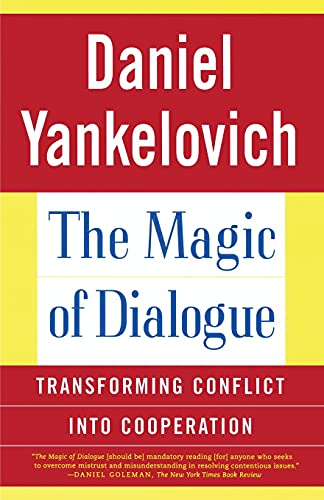
In this groundbreaking work, famed social scientist and world-famous public opinion expert Daniel Yankelovich reinvents the ancient art of dialogue.
Successful managers have always known how to make decisions and mobilize coworkers. But as our businesses continue to expand, conversations and discussions just aren't enough to bring people and their different agendas together anymore. Dialogue, when properly practiced, will align people with a shared vision, and help them realize their full potential as individuals and as a team. Drawing on decades of research and using real life examples, The Magic of Dialogue outlines specific strategies for maneuvering in a wide range of situations and teaches managers, leaders, business people, and other professionals how to succeed in the new global economy, where more players participate in decision-making than ever before.
Die Inhaltsangabe kann sich auf eine andere Ausgabe dieses Titels beziehen.
Über die Autorin bzw. den Autor
Daniel Yankelovich is a leading interpreter of trends shaping American society and the global economy. As an advisor to large corporations, government agencies, universities, and communities for over forty years, he is regularly at the forefront of public issues. His new firm, Viewpoint Learning, Inc., teaches organizations how to foster new forms of leadership through dialogue. Yankelovich has received many honorary degrees and awards, including the prestigious Helen Dinerman Award from the World Association of Public Opinion Research. He lives in La Jolla, California, and New York.
Auszug. © Genehmigter Nachdruck. Alle Rechte vorbehalten.
Chapter 1: Overcoming the Dialogue Deficit
Dialogue played a special role in reversing the nuclear arms race and ending the Cold War. Some years after the end of Ronald Reagan's presidency, George Shultz, who had been Reagan's secretary of state, asked Mikhail Gorbachev, former president of the Soviet Union, what the turning point in the Cold War had been.
"Reykjavík," Gorbachev answered unhesitatingly.
He explained that at their meeting in Reykjavík, Iceland, he and Ronald Reagan had for the first time entered into genuine dialogue with each other -- a dialogue that extended far beyond their main agenda (arms control) to cover their values, assumptions, and aspirations for their two nations. Gorbachev credited this dialogue with establishing enough trust and mutual understanding to begin to reverse the nuclear arms race.
In Oslo, Norway, in the year before Israel's prime minister, Yitzhak Rabin, was assassinated, a delegation of top-level Israelis and Palestinians, previously implacable enemies, held nonstop dialogue sessions over a period of months. Together they hammered out a blueprint for peace in the Middle East that lasted until Rabin's violent death upset the political balance.
These are history-making examples of dialogue. But dialogue is not the exclusive property of those who perform on the world stage. It works at all levels of life in ways large and small:
In San Diego County, a group of American and Mexican businesspeople and community leaders convene regularly under the auspices of San Diego Dialogue, a project of the University of California at San Diego (UCSD). These dialogues are so successful that once-intractable border and regional problems are now dealt with almost routinely.
In Silicon Valley, the CEO of a successful high-tech company recently held a weekend retreat with all the engineers in the company to conduct a dialogue on why so many of the most promising young engineers were leaving to go to competitors whose stock option plans were less generous than his own. After an initial stiffness, one after the other of the younger engineers explained that as much as they appreciated the generous stock bonuses, they felt that their ideas were unappreciated and brushed aside and that the employer reserved all of the important decisions to himself. One engineer said, "I know the stock options are supposed to make me feel like an owner, but when I come to work I don't feel like an owner. I feel like a peon, and that's not why I came to this company."
At first the employer (an engineer himself) was defensive in asserting his conviction that the CEO should be the undisputed leader who calls the shots. As the dialogue unfolded, however, he slowly began to qualify his position. Gradually, the session picked up momentum, with many of the young engineers offering ideas for improving the company's products and reducing costs.
By the end of the weekend, the employer had begun to reexamine his assumptions about leadership, and the engineers who worked for him had begun to understand him better. Subsequently, the employer made the effort to adopt a more consultative style of leadership. It never came naturally to him, but he saw the merit of it and was able to meet his coworkers halfway. Gradually, the flight of engineers from the company slowed to a trickle.
In Boston several years ago, under the auspices of the American Academy of Arts and Sciences, a number of Boston's public school teachers met over a several-day period with an equal number of professors from Harvard, MIT, and other universities in the Boston area. Together they carried out a sustained dialogue on how to improve public education in the Boston area. It was the first time these university professors (many of them distinguished scientists) and public school teachers had met as equals. Most left the meeting exhilarated and astonished at how much they had learned, how much respect they had developed for each other's point of view, and how much more hopeful they had become about future prospects for Boston's schools.
In a large midwestern food company, an older male executive formed a successful mentoring relationship with a younger woman executive. Both avoided any hint of sexual involvement and even the appearance of impropriety. A bond of real friendship as well as a business relationship united the two executives. Then one day a trivial misunderstanding triggered tension between them. The man wrongly assumed that he had offended his younger colleague's feminist sensibilities. An uncomfortable distance sprang up between them. Finally, however, they succeeded in engaging each other in dialogue. The misunderstanding evaporated as quickly as it had appeared. Now strengthened, the relationship resumed on a tranquil basis.
Every day countless dialogues -- formal and informal, brief and prolonged, between strangers and between people intimate with each other -- take place in a variety of settings and circumstances. Many, perhaps most, fail. But those that succeed transform people's relationships to one another, sometimes in ways that seem almost magical.
"The magic of dialogue."
I find the words easy to say now. Years ago they would have sounded exaggerated and unnatural to me. I would not even have known what they meant, let alone believed in them. Now they sound natural, and I fully believe in them.
The magic doesn't work if you substitute a different form of talk for dialogue. The magic of conversation? The magic of discussion? The magic of debate? None of these phrases rings true. But dialogue works its magic because it alone has unique capabilities other forms of talk do not possess.
In this book I identify what is special about dialogue, what gives it its magical properties, and, most important, what strategies individuals and organizations can use to help them conduct the kind of dialogue that best meets their objectives.
Most people have two purposes for doing dialogue: to strengthen personal relationships and to solve problems.
Today, this second purpose is growing in importance: increasingly, we find ourselves facing problems that require more shared understanding with others than in the past.
The need to reach better mutual understanding through dialogue is strong in all sectors of society, but in none more than the business community. The growth of technology, the increase in the number of knowledge workers, and the blurring of boundaries of all kinds are transforming relationships at all levels of business. The traditional top-down style of leadership in a fortress-type company semi-isolated from others is increasingly out of vogue. It is being replaced by what I have come to think of as "relational leadership," where the defining task of leaders is developing webs of relationships with others rather than handing down visions, strategies, and plans as if they were commandments from the mountaintop.
Many forces converge to intensify the need for dialogue in business settings:
- The steady erosion of authority and hierarchy in the workplace in favor of flatter organizations.
- The trend toward forming strategic alliances with organizations that bring different corporate cultures, traditions, structures, and even languages to the new partnerships. Without dialogue, misunderstandings arise almost immediately.
- The need to repair the damage to morale that results from downsizing. Employers who have recently downsized or reengineered their companies confront a mistrusting and resentful workforce precisely when, to remain competitive, they need highly motivated workers.
- The need to stimulate the maximum amount of creativity, innovation, and initiative in coworkers, rather than simply expecting them to show up and obey orders.
- The need to...
„Über diesen Titel“ kann sich auf eine andere Ausgabe dieses Titels beziehen.
Suchergebnisse für The Magic of Dialogue: Transforming Conflict into Cooperatio...

Beispielbild für diese ISBN
Magic of Dialogue
Anbieter: World of Books (was SecondSale), Montgomery, IL, USA
Verkäuferbewertung 5 von 5 Sternen

Paperback. Zustand: Good. An exploration of the benefits of effective dialogue for leadership within contemporary business structures, containing a less hierarchical structure, offers fifteen strategies for developing the disciplined communication that can tighten focus, overcome mistrust, and solve problems. Reprint. 10,00. Artikel-Nr. 00101022899
Gebraucht kaufen
EUR 4,06
Versand gratis
Versand innerhalb von USA
Versand innerhalb von USA
Anzahl: 7 verfügbar
Beispielbild für diese ISBN
Magic of Dialogue
Anbieter: World of Books (was SecondSale), Montgomery, IL, USA
Verkäuferbewertung 5 von 5 Sternen
Paperback. Zustand: Very Good. An exploration of the benefits of effective dialogue for leadership within contemporary business structures, containing a less hierarchical structure, offers fifteen strategies for developing the disciplined communication that can tighten focus, overcome mistrust, and solve problems. Reprint. 10,00. Artikel-Nr. CIN0684865661VG
Gebraucht kaufen
EUR 4,06
Versand gratis
Versand innerhalb von USA
Versand innerhalb von USA
Anzahl: 1 verfügbar
Beispielbild für diese ISBN
The Magic of Dialogue: Transforming Conflict into Cooperation
Verlag:
Touchstone (edition Reprint), 2001
ISBN 10: 0684865661
ISBN 13: 9780684865669
Gebraucht
Paperback
Anbieter: BooksRun, Philadelphia, PA, USA
Verkäuferbewertung 5 von 5 Sternen
Paperback. Zustand: Very Good. Reprint. It's a well-cared-for item that has seen limited use. The item may show minor signs of wear. All the text is legible, with all pages included. It may have slight markings and/or highlighting. Artikel-Nr. 0684865661-11-1
Gebraucht kaufen
EUR 4,29
Versand gratis
Versand innerhalb von USA
Versand innerhalb von USA
Anzahl: 1 verfügbar
Beispielbild für diese ISBN
The Magic of Dialogue: Transforming Conflict Into Cooperation
Anbieter: ThriftBooks-Dallas, Dallas, TX, USA
Verkäuferbewertung 5 von 5 Sternen
Paperback. Zustand: Very Good. No Jacket. May have limited writing in cover pages. Pages are unmarked. ~ ThriftBooks: Read More, Spend Less. Artikel-Nr. G0684865661I4N00
Gebraucht kaufen
EUR 6,26
Versand gratis
Versand innerhalb von USA
Versand innerhalb von USA
Anzahl: 1 verfügbar
Beispielbild für diese ISBN
The Magic of Dialogue: Transforming Conflict Into Cooperation
Anbieter: ThriftBooks-Atlanta, AUSTELL, GA, USA
Verkäuferbewertung 5 von 5 Sternen
Paperback. Zustand: Very Good. No Jacket. May have limited writing in cover pages. Pages are unmarked. ~ ThriftBooks: Read More, Spend Less. Artikel-Nr. G0684865661I4N00
Gebraucht kaufen
EUR 6,26
Versand gratis
Versand innerhalb von USA
Versand innerhalb von USA
Anzahl: 1 verfügbar
Beispielbild für diese ISBN
Magic of Dialogue: Transforming Conflict into Cooperation
Anbieter: Wonder Book, Frederick, MD, USA
Verkäuferbewertung 5 von 5 Sternen
Zustand: Very Good. Very Good condition. A copy that may have a few cosmetic defects. May also contain light spine creasing or a few markings such as an owner's name, short gifter's inscription or light stamp. Artikel-Nr. G13K-00792
Gebraucht kaufen
EUR 6,44
Versand gratis
Versand innerhalb von USA
Versand innerhalb von USA
Anzahl: 2 verfügbar
Beispielbild für diese ISBN
The Magic of Dialogue : Transforming Conflict into Cooperation
Anbieter: Better World Books, Mishawaka, IN, USA
Verkäuferbewertung 5 von 5 Sternen
Zustand: Good. Former library copy. Pages intact with minimal writing/highlighting. The binding may be loose and creased. Dust jackets/supplements are not included. Includes library markings. Stock photo provided. Product includes identifying sticker. Better World Books: Buy Books. Do Good. Artikel-Nr. 5464664-6
Gebraucht kaufen
EUR 6,59
Versand gratis
Versand innerhalb von USA
Versand innerhalb von USA
Anzahl: 1 verfügbar
Beispielbild für diese ISBN
The Magic of Dialogue : Transforming Conflict into Cooperation
Anbieter: Better World Books, Mishawaka, IN, USA
Verkäuferbewertung 5 von 5 Sternen
Zustand: Very Good. Pages intact with possible writing/highlighting. Binding strong with minor wear. Dust jackets/supplements may not be included. Stock photo provided. Product includes identifying sticker. Better World Books: Buy Books. Do Good. Artikel-Nr. 740392-75
Gebraucht kaufen
EUR 6,59
Versand gratis
Versand innerhalb von USA
Versand innerhalb von USA
Anzahl: 1 verfügbar
Foto des Verkäufers
The Magic of Dialogue: Transforming Conflict into Cooperation
Anbieter: WeBuyBooks, Rossendale, LANCS, Vereinigtes Königreich
Verkäuferbewertung 5 von 5 Sternen
paperback. Zustand: Very Good. Most items will be dispatched the same or the next working day. A copy that has been read, but is in excellent condition. Pages are intact and not marred by notes or highlighting. The spine remains undamaged. Artikel-Nr. rev5789934065
Gebraucht kaufen
EUR 4,23
EUR 6,13 Versand
Versand von Vereinigtes Königreich nach USA
Versand von Vereinigtes Königreich nach USA
Anzahl: 1 verfügbar
Beispielbild für diese ISBN
The Magic of Dialogue: Transforming Conflict into Cooperation
Anbieter: Robinson Street Books, IOBA, Binghamton, NY, USA
Verkäuferbewertung 4 von 5 Sternen

Paperback. Zustand: Very Good. Prompt Shipment, shipped in Boxes, Tracking PROVIDEDMinor creasing, used book, still very good. Artikel-Nr. lower5rsg619
Gebraucht kaufen
EUR 12,45
EUR 8,50 Versand
Versand innerhalb von USA
Versand innerhalb von USA
Anzahl: 1 verfügbar