
Verwandte Artikel zu Finding Hope When a Child Dies: What Other Cultures...
Inhaltsangabe
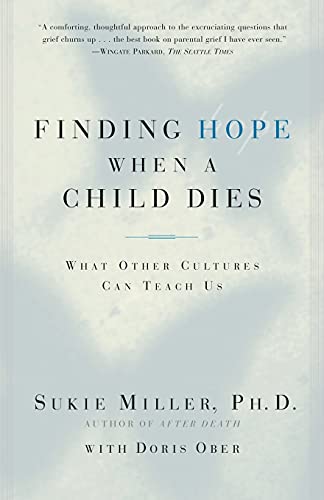
The death of a child is an overwhelming loss. "Why did my child die?" and "Is my child suffering now?" are questions that all people, of all cultures and backgrounds, ask. But characteristic of Western culture is a limited language for expressing grief, and a consuming guilt that undermines the recovery process. Dr. Sukie Miller, author of the landmark work After Death, turns to the beliefs and healing stories of other cultures to present a unique perspective that is both surprising and comforting. Sharing her research with a compassionate and grounded voice, she offers hope to those seeking meaning in what seems senseless, and heartening possibilities for returning to wholeness, even if we feel life cannot ever be the same.
Die Inhaltsangabe kann sich auf eine andere Ausgabe dieses Titels beziehen.
Über die Autorin bzw. den Autor
Sukie Miller, Ph.D., is a practicing psychotherapist and the founder and director of the Institute for the Study of the Afterdeath, as well as the pioneering Institute for the Study of Humanistic Medicine. She has served on the board of the Jung Institute of San Francisco and the Board of Medical Quality Assurance of the State of California. She lives in northern California.
Auszug. © Genehmigter Nachdruck. Alle Rechte vorbehalten.
Chapter One: We Have No Language
When your husband dies, you become a widow. When your wife dies, a widower. Children who lose their parents are called orphans. But we have no name for the parent who loses a child, nor for the brothers and sisters of a child who dies, nor for the others -- aunts, uncles, cousins, grandparents, even the friends, contemporaries, and adults -- who experience the loss of a child they love.
I hadn't realized the significance of there being no word for a child's survivors, and no word for the state of having lost a child, until I sat with those survivors over many years and began hearing the unpronounced fears that most people harbor for the children they love -- for these almost seem built in, whether we speak of them or not.
The fact that there is no name for the one who has lost a child is of enormous consequence: the nameless live in a kind of limbo. They still exist, but in a new stratosphere where their namelessness effectively isolates them from the rest of the world.
When we don't name things, they remain out of reach. I have never known a parent or anyone else who has lost a child not to describe a period of feeling completely out of touch, beyond the reach of anyone else's comfort or understanding. And it's true. You can't engage on any deep level with someone whose name you don't know. You can't effectively ask for something that you can't name: "Bring me that -- no that -- no that!" is unbearably inefficient.
More than 145,000 infants, children, teenagers, and young adults die every year in this country alone. At least as many families experience a miscarriage or stillbirth every year. So many people sharing a similar agony, and we have only the most halting language -- a few poor adjectives for what our culture considers the most tragic of personal experiences. They say we are bereaved, or that we are distraught or inconsolable. But this hardly approaches our emotional state and doesn't nearly describe who we have suddenly become when our child or brother or sister or friend dies. Because we are no longer who we were, and we never will be again.
Language Is How We Relate
Language is how we relate to one another and the world. However it is expressed -- spoken, or written, or sung; nonverbal, symbolic, even digital -- language is what allows us to express what we feel, who we are, what we know. It is that crucial link between what we're experiencing inside -- in the case of the death of a child, a unique combination of flashing turmoil that turns into grief that shifts to rage that becomes numbing despair -- and what's going on around us: other people's shock, other people's discomfort, other people's efforts to help, and the whole wide world that incredibly, astonishingly, continues to rotate on its axis and go on, business as usual, as if nothing out of the ordinary has happened at all.
Without language it is difficult to think, let alone empathize. And when we are dealing with the unthinkable to begin with and then have no words with which to approach it, no wonder that psychological wisdom says that the death of a child is the most difficult death for survivors to endure. No wonder recovery seems so impossible.
Without language those of us who want to help our grieving friends or family members or devastated clients are groping in the dark. We may have the best intentions, but what can we say? And what can they say to us? So many people want to help, need to be helped, and yet we remain isolated from each other because there is no language with which to connect.
This is the way it is when we have lost a child. Not only are we without the words to adequately express what we are feeling, but those others who love us don't know what to say to comfort us.
Those things about which we cannot speak or will not speak do not simply disappear because we don't discuss them. In fact, they gain some of their power over us because we don't have language to vent them. They remain crouching in the shadows of our lives, unpredictable, a locus of rage, of despair, of fear, looking for an opportunity to be heard.
You don't have to lose a child to know what I'm talking about. Everyone who has ever loved a child fears the death of that child. I have known mothers to hold a mirror under a sleeping child's nose to assure themselves he is still breathing, and we have all met new parents who, overwhelmed by their infant's fragility, were afraid to pick up their baby because they might hurt her or drop her or accidentally cause her death. Some parents are so frightened by the possibilities that the big world may hold for their children that they severely compromise the children's independence.
Those fears beset us when we are deciding the rules by which our daughters may stay out at night; those are the fears about the stranger in the playground. That's us, silently thinking the unthinkable.
A symptom of how unspeakable this subject is is reflected in the way we respond to the deaths of other people's children. We cannot talk about the possibility of our own children dying -- we can hardly bear to form such thoughts -- because it seems too much like tempting fate. But a child's death that is a step removed is mesmerizing. We follow the stories of children who die with a real need to understand what happened and why such a thing could happen. We're glued to our televisions when such tragedies make the news, and then we want to read about them in the next morning's paper. It is not morbid curiosity that drives us; it is a need to know, and everyone who has ever loved a child has it.
And it has always been this way. Just reciting the names of our dead children -- the Lindbergh baby, Adam Walsh, Megan Kanka, Polly Klaas, JonBenet Ramsey, Ennis Cosby -- evokes extreme emotions.
But we need words and sentences, as well as concepts, for when our children die. Without them we cannot console or be consoled. Without them healing is a forever affair.
Beginning to Speak About Death and Dying
In 1968, if we spoke about dying at all, it was in euphemisms. "She's not doing well" was about as explicit as we could be. We might bring ourselves to ask our doctor, "How much longer?" Everything was implied. And when people died, they "left us" or they "passed on." Because we were afraid or superstitious or embarrassed, we didn't speak about these things, and so we remained afraid, superstitious, and embarrassed about them.
This began to change in 1969 with the publication of an extraordinary book called On Death and Dying by Elisabeth Kubler-Ross. She became our first teacher in the language of life's last experience. And with the language we could finally begin to listen, begin to learn, begin to speak about such things.
Previously we thought about life and death as an on/off kind of thing. One was either active or inert, alive or dead. Dying meant simply that period just before death. We didn't often speak of anyone having a "good death"; we didn't distinguish ways of dying. We couldn't. We didn't have the language.
But Kubler-Ross told us that there are "stages" in the process of dying, and she named them: denial, anger, bargaining, depression, and acceptance. This sudden expansion of our language around a previously taboo subject flooded us with understanding.
By identifying and defining five specific stages in the dying process, Kubler-Ross provided us a vocabulary with which to begin to address, dissect, comfort, encourage, relate, empathize, and understand what was happening at the end of life.
Language, as I am using the word, is more than just a roster of words. It is also concepts and attendant practices. For example, at least once a year a banner is raised across the main street in the small town where I live...
„Über diesen Titel“ kann sich auf eine andere Ausgabe dieses Titels beziehen.
Suchergebnisse für Finding Hope When a Child Dies: What Other Cultures...

Beispielbild für diese ISBN
Finding Hope When a Child Dies: What Other Cultures Can Teach Us
Anbieter: World of Books (was SecondSale), Montgomery, IL, USA
Verkäuferbewertung 5 von 5 Sternen

Paperback. Zustand: Good. Synopsis coming soon. Artikel-Nr. 00103274681
Gebraucht kaufen
EUR 3,94
Versand gratis
Versand innerhalb von USA
Versand innerhalb von USA
Anzahl: 1 verfügbar
Beispielbild für diese ISBN
Finding Hope When a Child Dies: What Other Cultures Can Teach Us
Anbieter: World of Books (was SecondSale), Montgomery, IL, USA
Verkäuferbewertung 5 von 5 Sternen
Paperback. Zustand: Very Good. Synopsis coming soon. Artikel-Nr. 00109769267
Gebraucht kaufen
EUR 3,94
Versand gratis
Versand innerhalb von USA
Versand innerhalb von USA
Anzahl: 1 verfügbar
Beispielbild für diese ISBN
Finding Hope When a Child Dies: What Other Cultures Can Teach Us
Verlag:
Touchstone (edition Reprint), 2002
ISBN 10: 0684865610
ISBN 13: 9780684865614
Gebraucht
Paperback
Anbieter: BooksRun, Philadelphia, PA, USA
Verkäuferbewertung 5 von 5 Sternen
Paperback. Zustand: Fair. Reprint. The item might be beaten up but readable. May contain markings or highlighting, as well as stains, bent corners, or any other major defect, but the text is not obscured in any way. Artikel-Nr. 0684865610-7-1
Gebraucht kaufen
EUR 4,31
Versand gratis
Versand innerhalb von USA
Versand innerhalb von USA
Anzahl: 1 verfügbar
Beispielbild für diese ISBN
Finding Hope When a Child Dies: What Other Cultures Can Teach Us
Anbieter: ThriftBooks-Dallas, Dallas, TX, USA
Verkäuferbewertung 5 von 5 Sternen
Paperback. Zustand: Very Good. No Jacket. May have limited writing in cover pages. Pages are unmarked. ~ ThriftBooks: Read More, Spend Less. Artikel-Nr. G0684865610I4N00
Gebraucht kaufen
EUR 6,04
Versand gratis
Versand innerhalb von USA
Versand innerhalb von USA
Anzahl: 1 verfügbar
Beispielbild für diese ISBN
Finding Hope When a Child Dies: What Other Cultures Can Teach Us
Anbieter: Wonder Book, Frederick, MD, USA
Verkäuferbewertung 5 von 5 Sternen
Zustand: Good. Good condition. A copy that has been read but remains intact. May contain markings such as bookplates, stamps, limited notes and highlighting, or a few light stains. Artikel-Nr. G03E-02837
Gebraucht kaufen
EUR 6,41
Versand gratis
Versand innerhalb von USA
Versand innerhalb von USA
Anzahl: 1 verfügbar
Beispielbild für diese ISBN
Finding Hope When a Child Dies : What Other Cultures Can Teach Us
Anbieter: Better World Books, Mishawaka, IN, USA
Verkäuferbewertung 5 von 5 Sternen
Zustand: Good. Reprint. Pages intact with minimal writing/highlighting. The binding may be loose and creased. Dust jackets/supplements are not included. Stock photo provided. Product includes identifying sticker. Better World Books: Buy Books. Do Good. Artikel-Nr. 740072-6
Gebraucht kaufen
EUR 10,09
Versand gratis
Versand innerhalb von USA
Versand innerhalb von USA
Anzahl: 1 verfügbar
Foto des Verkäufers
Finding Hope When a Child Dies: What Other Cultures Can Teach Us
Anbieter: WeBuyBooks, Rossendale, LANCS, Vereinigtes Königreich
Verkäuferbewertung 5 von 5 Sternen
paperback. Zustand: Good. Most items will be dispatched the same or the next working day. A copy that has been read but remains in clean condition. All of the pages are intact and the cover is intact and the spine may show signs of wear. The book may have minor markings which are not specifically mentioned. A tan to the pages. Artikel-Nr. rev3931477857
Gebraucht kaufen
EUR 4,51
EUR 6,24 Versand
Versand von Vereinigtes Königreich nach USA
Versand von Vereinigtes Königreich nach USA
Anzahl: 1 verfügbar
Beispielbild für diese ISBN
Finding Hope When a Child Dies: What Other Cultures Can Teach Us
Anbieter: WorldofBooks, Goring-By-Sea, WS, Vereinigtes Königreich
Verkäuferbewertung 5 von 5 Sternen
Paperback. Zustand: Very Good. The book has been read, but is in excellent condition. Pages are intact and not marred by notes or highlighting. The spine remains undamaged. Artikel-Nr. GOR014405193
Gebraucht kaufen
EUR 4,21
EUR 6,65 Versand
Versand von Vereinigtes Königreich nach USA
Versand von Vereinigtes Königreich nach USA
Anzahl: 2 verfügbar
Beispielbild für diese ISBN
Finding Hope When a Child Dies: What Other Cultures Can Teach Us
Anbieter: AwesomeBooks, Wallingford, Vereinigtes Königreich
Verkäuferbewertung 5 von 5 Sternen
Paperback. Zustand: Very Good. Finding Hope When a Child Dies: What Other Cultures Can Teach Us This book is in very good condition and will be shipped within 24 hours of ordering. The cover may have some limited signs of wear but the pages are clean, intact and the spine remains undamaged. This book has clearly been well maintained and looked after thus far. Money back guarantee if you are not satisfied. See all our books here, order more than 1 book and get discounted shipping. Artikel-Nr. 7719-9780684865614
Gebraucht kaufen
EUR 6,15
EUR 4,89 Versand
Versand von Vereinigtes Königreich nach USA
Versand von Vereinigtes Königreich nach USA
Anzahl: 2 verfügbar
Beispielbild für diese ISBN
Finding Hope When a Child Dies: What Other Cultures Can Teach Us
Anbieter: Bahamut Media, Reading, Vereinigtes Königreich
Verkäuferbewertung 4 von 5 Sternen

Paperback. Zustand: Very Good. Shipped within 24 hours from our UK warehouse. Clean, undamaged book with no damage to pages and minimal wear to the cover. Spine still tight, in very good condition. Remember if you are not happy, you are covered by our 100% money back guarantee. Artikel-Nr. 6545-9780684865614
Gebraucht kaufen
EUR 12,21
EUR 8,29 Versand
Versand von Vereinigtes Königreich nach USA
Versand von Vereinigtes Königreich nach USA
Anzahl: 1 verfügbar