
Verwandte Artikel zu High Exposure: An Enduring Passion for Everest and...
Inhaltsangabe
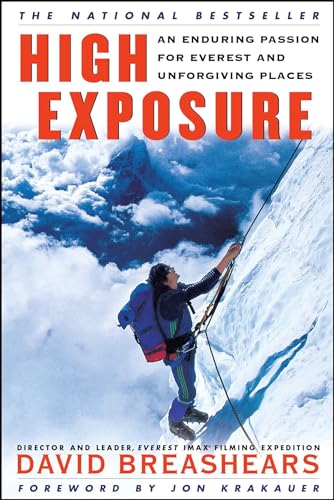
For generations of resolute adventurers, from George Mallory to Sir Edmund Hillary to Jon Krakauer, Mount Everest and the world's other greatest peaks have provided the ultimate testing ground. But the question remains: Why climb? In High Exposure, elite mountaineer and acclaimed Everest filmmaker David Breashears answers with an intimate and captivating look at his life.
For Breashears, climbing has never been a question of risk taking: Rather, it is the pursuit of excellence and a quest for self-knowledge. Danger comes, he argues, when ambition blinds reason. The stories this world-class climber and great adventurer tells will surprise you -- from discussions of competitiveness on the heights to a frank description of the 1996 Everest tragedy.
Die Inhaltsangabe kann sich auf eine andere Ausgabe dieses Titels beziehen.
Über die Autorin bzw. den Autor
David Breashears has made four trips to Everest's summit. His cinematic achievements include the IMAX® movie Everest and "Everest: The Death Zone" for the PBS series NOVA. He is the recipient of four Emmy awards for his accomplishments in cinematography. When not climbing, Breashears resides in Boston, Massachusetts.
Auszug. © Genehmigter Nachdruck. Alle Rechte vorbehalten.
Prologue: Everest 1996
As a mountain climber, I've always felt more drawn to the top than driven from the bottom. I was twelve years old when I came upon the famous picture of Tenzing Norgay standing atop Mount Everest. From that moment on, I equated climbing Everest with man's capacity for hope. Indeed, there's nothing so exhilarating, so purifying, as standing on its summit more than 29,000 feet above the sea, surveying the planet below. Before May 1996, I had climbed Everest twice, and each time I had experienced the singular sense of rebirth that the mountain has to offer.
But Everest also offers the finality of death. On the morning of May 10 my Everest IMAX® Filming Expedition resolved to go up the mountain and help bring down survivors of an icy calamity that had left eight people dead. Over the next several days our expedition climbed up Everest, struggling with bitter cold and bitter truths and a deeply felt grief for our friends who would lie frozen in death forever. There's no place to bury the dead on an ice-bound mountaintop.
In the week following Everest's cruelest disaster, other expeditions broke their siege and went home. Why did we stay on and ascend the mountain once more? On reflection, I think it was because I felt a strong kinship not only with the dead but with the mountain itself. I hated seeing it stand in disarray, under scrutiny from the world's media; I wanted redemption from the tragedy. I couldn't accept leaving, not after all my years on the mountain, not with reasonable weather and our enormous stock of equipment and human skill, not without trying one more time. Call it a specialist's pride: I felt it was up to us to finish -- safely -- this unholy episode. I wanted to prove that Everest was -- in its grandeur -- an affirmation of life, not a sentence of death.
So, with the aid of a London-based weather service, we watched and waited for a break in the weather at the top. The jet stream, which sweeps across Everest in the spring, was howling around the summit, and no man-made instrument can accurately forecast when it will blow off the mountaintop and move north over the Tibetan plateau. For days, there was little change. I was dismayed but not astonished; I've seen the jet stream pound Everest for fifty uninterrupted days. Still, I searched reports for the tiniest shard of hope, anything to signal a positive turn. Nothing.
Eventually we decided it was time to move out from our Base Camp at 17,600 feet: better to face the mountain in our boots than sit around in our tents brooding about it. On the slopes, we'd see for ourselves what the mountain held for us, and we'd let the mountain tell us when to climb -- or not to climb. So we struggled into our gear and headed up -- the entire IMAX filming team -- camp by camp.
We climbed back to the upper camps with the threat of the wind roaring ominously above at eighty to ninety miles per hour. In mountain climbing, it's not the wind around you that frightens you, but the wind that awaits you. Much of our trepidation was, to be sure, psychological. After all, skilled Everest veterans had died up there just weeks before.
At dusk on May 22, the day we reoccupied the high camp, Camp IV at 26,000 feet on the South Col, the winds died out. It was a rare and welcome moment as we pitched our tents; we could actually stand upright, and we could continue that night toward the summit minus a goodly portion of our fear.
The sun descended and the tent walls darkened. Though we were utterly exhausted, none of us could rest. Throughout the evening we readied our climbing gear and the film equipment and melted ice to drink. There's no malingering at the South Col camp. It's too high, too barren, and the air is too thin. There's no earthly reason to be there except to gain Everest's summit. We'd spent two years preparing for this summit attempt, training our bodies and minds, making checklists, customizing and winterizing and lightening the massive IMAX camera and everything else within our grasp.
Now the weather had given us the break we needed.
At 10:35 p.m. I unzipped my tent.
No matter how many times I've made this journey, it always begins in the same way. It's pitch dark outside as I unzip the door. What little heat has pooled inside spills out into the frigid night air; the sense of safety and security I feel in the tent vanishes with the warmth. On my hands and knees I crawl into one of the world's most hostile environments, into my ultimate arena -- the last 3,000 vertical feet to the summit of Everest.
The stars were out that night but there was no moon. It was dark and cold, minus 30 degrees; the night was still. Looking above, I could barely see the outline of Everest, a dark, lopsided pyramid cut out from the stars.
I sat on a small rock to put on my crampons (sharp metal spikes attached to my boots), which dug into the snow and ice. Bare-handed, I checked and rechecked to make sure the heel and toe clips were biting through the thin neoprene of my overboots, an extra layer of insulation over my climbing boots. I hadn't planned on using overboots up there. But after the catastrophe I felt inordinately vulnerable, not just to the cold, but to my own mortality. I've always relied on strength of mind to drive my body, and the body has always been good with plenty of horsepower. But the deaths in that disastrous climb reminded me that I was forty years old now. I had borrowed the overboots from a friend, Jon Krakauer, who had survived the May 10 storm.
I walked among the nylon domes of the heavy-weather tents, hoarsely shouting that it was time to go. The tents were already alive, sides huffing out with the movements inside, zippers scraping in the silent night. Sherpas and team members gathered their gear, and I mentally ran through my own checklist one more time: two full bottles of oxygen, spare mittens, ice axe, and, most important, my compass fixed with a heading so that even in a storm I could find my way home. There was no idle chatter in the air, only tension and focus on the mission.
The South Col is a broad expanse of rocks, a hard, flat, forbidding surface. I knew that the featureless terrain had been a deadly problem for the descending climbers on the night of May 10 because, without a compass to guide them, there were no directional clues in the blizzard's whiteout. Lost and desperately searching for high camp, eleven climbers had collapsed at the edge of the 8,000-foot precipice of Everest's Kangshung Face overlooking Tibet. There, a few hundred yards from safety, one woman, Yasuko Namba, had frozen to death, and a Texan named Beck Weathers had suffered mutilating frostbite.
I crossed the South Col to the first icy incline, awkwardly duckwalking on crampons scraping against fist-sized rocks and bulletproof ice. Like my team, I knew I was hypoxic (starved for oxygen), severely sleep-deprived, dehydrated, and malnourished. Yet here I was, commanding my body to work as hard as it had ever worked. That makes for tough going. But after an hour of robotically placing one foot in front of the other, I finally found my rhythm. All I could hear was the raspy sound of my labored breathing as I inhaled and exhaled through my oxygen mask, my breaths keeping pace with each step.
Yet this time there was no matching sense of purpose and exhilaration, only the grim knowledge of the littered battlefield we would find as we climbed higher. I'd been involved in body recoveries on Everest before, but there had been nothing in my training to prepare me to pass through the open graveyard waiting above: This time the graveyard held friends.
There are other bodies -- bodies of people I'd never met -- scattered from Advance Base Camp to points near the summit. Several hundred yards below Advance Base Camp, at 21,100 feet, a climber lay near the route, wrapped in a blue tarp....
„Über diesen Titel“ kann sich auf eine andere Ausgabe dieses Titels beziehen.
Suchergebnisse für High Exposure: An Enduring Passion for Everest and...

Beispielbild für diese ISBN
High Exposure an Enduring Pass
Anbieter: World of Books (was SecondSale), Montgomery, IL, USA
Verkäuferbewertung 5 von 5 Sternen

Zustand: Good. Item in good condition. Textbooks may not include supplemental items i.e. CDs, access codes etc. Artikel-Nr. 00085472995
Gebraucht kaufen
EUR 3,57
Versand gratis
Versand innerhalb von USA
Versand innerhalb von USA
Anzahl: Mehr als 20 verfügbar
Beispielbild für diese ISBN
High Exposure an Enduring Pass
Anbieter: World of Books (was SecondSale), Montgomery, IL, USA
Verkäuferbewertung 5 von 5 Sternen
Zustand: Acceptable. Item in acceptable condition! Textbooks may not include supplemental items i.e. CDs, access codes etc. Artikel-Nr. 00108947303
Gebraucht kaufen
EUR 3,57
Versand gratis
Versand innerhalb von USA
Versand innerhalb von USA
Anzahl: 1 verfügbar
Beispielbild für diese ISBN
High Exposure an Enduring Pass
Anbieter: World of Books (was SecondSale), Montgomery, IL, USA
Verkäuferbewertung 5 von 5 Sternen
Zustand: Very Good. Item in very good condition! Textbooks may not include supplemental items i.e. CDs, access codes etc. Artikel-Nr. 00103758564
Gebraucht kaufen
EUR 3,57
Versand gratis
Versand innerhalb von USA
Versand innerhalb von USA
Anzahl: 2 verfügbar
Beispielbild für diese ISBN
High Exposure: An Enduring Passion for Everest and Unforgiving Places
Verlag:
Simon & Schuster (edition Illustrated), 2000
ISBN 10: 0684865459
ISBN 13: 9780684865454
Gebraucht
Paperback
Anbieter: BooksRun, Philadelphia, PA, USA
Verkäuferbewertung 5 von 5 Sternen
Paperback. Zustand: Very Good. Illustrated. It's a well-cared-for item that has seen limited use. The item may show minor signs of wear. All the text is legible, with all pages included. It may have slight markings and/or highlighting. Artikel-Nr. 0684865459-11-6
Gebraucht kaufen
EUR 5,03
Versand gratis
Versand innerhalb von USA
Versand innerhalb von USA
Anzahl: 1 verfügbar
Beispielbild für diese ISBN
High Exposure: An Enduring Passion for Everest and Unforgiving Places
Verlag:
Simon & Schuster (edition Illustrated), 2000
ISBN 10: 0684865459
ISBN 13: 9780684865454
Gebraucht
Paperback
Anbieter: BooksRun, Philadelphia, PA, USA
Verkäuferbewertung 5 von 5 Sternen
Paperback. Zustand: Very Good. Illustrated. It's a well-cared-for item that has seen limited use. The item may show minor signs of wear. All the text is legible, with all pages included. It may have slight markings and/or highlighting. Artikel-Nr. 0684865459-11-18
Gebraucht kaufen
EUR 5,31
Versand gratis
Versand innerhalb von USA
Versand innerhalb von USA
Anzahl: 1 verfügbar
Beispielbild für diese ISBN
High Exposure: An Enduring Passion for Everest and Unforgiving Places
Verlag:
Simon & Schuster (edition Illustrated), 2000
ISBN 10: 0684865459
ISBN 13: 9780684865454
Gebraucht
Paperback
Anbieter: BooksRun, Philadelphia, PA, USA
Verkäuferbewertung 5 von 5 Sternen
Paperback. Zustand: Very Good. Illustrated. It's a well-cared-for item that has seen limited use. The item may show minor signs of wear. All the text is legible, with all pages included. It may have slight markings and/or highlighting. Artikel-Nr. 0684865459-11-1
Gebraucht kaufen
EUR 5,44
Versand gratis
Versand innerhalb von USA
Versand innerhalb von USA
Anzahl: 1 verfügbar
Beispielbild für diese ISBN
High Exposure: An Enduring Passion for Everest and Unforgiving Places
Anbieter: ThriftBooks-Atlanta, AUSTELL, GA, USA
Verkäuferbewertung 5 von 5 Sternen
Paperback. Zustand: As New. No Jacket. Pages are clean and are not marred by notes or folds of any kind. ~ ThriftBooks: Read More, Spend Less. Artikel-Nr. G0684865459I2N00
Gebraucht kaufen
EUR 5,85
Versand gratis
Versand innerhalb von USA
Versand innerhalb von USA
Anzahl: 1 verfügbar
Beispielbild für diese ISBN
High Exposure: An Enduring Passion for Everest and Unforgiving Places
Anbieter: ThriftBooks-Atlanta, AUSTELL, GA, USA
Verkäuferbewertung 5 von 5 Sternen
Paperback. Zustand: Very Good. No Jacket. May have limited writing in cover pages. Pages are unmarked. ~ ThriftBooks: Read More, Spend Less. Artikel-Nr. G0684865459I4N00
Gebraucht kaufen
EUR 5,85
Versand gratis
Versand innerhalb von USA
Versand innerhalb von USA
Anzahl: 1 verfügbar
Beispielbild für diese ISBN
High Exposure: An Enduring Passion for Everest and Unforgiving Places
Anbieter: ThriftBooks-Dallas, Dallas, TX, USA
Verkäuferbewertung 5 von 5 Sternen
Paperback. Zustand: Very Good. No Jacket. Former library book; May have limited writing in cover pages. Pages are unmarked. ~ ThriftBooks: Read More, Spend Less. Artikel-Nr. G0684865459I4N10
Gebraucht kaufen
EUR 5,85
Versand gratis
Versand innerhalb von USA
Versand innerhalb von USA
Anzahl: 1 verfügbar
Beispielbild für diese ISBN
High Exposure : An Enduring Passion for Everest and Unforgiving Places
Anbieter: Better World Books, Mishawaka, IN, USA
Verkäuferbewertung 5 von 5 Sternen
Zustand: Good. 1st Touchstone Ed. Pages intact with minimal writing/highlighting. The binding may be loose and creased. Dust jackets/supplements are not included. Stock photo provided. Product includes identifying sticker. Better World Books: Buy Books. Do Good. Artikel-Nr. 3393388-75
Gebraucht kaufen
EUR 6,04
Versand gratis
Versand innerhalb von USA
Versand innerhalb von USA
Anzahl: 3 verfügbar