
Verwandte Artikel zu Market Driven Strategy: Processes for Creating Value
Inhaltsangabe
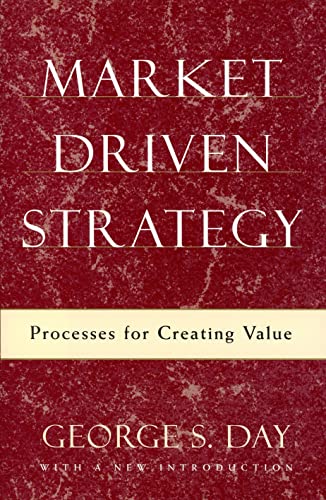
Now in its 21st printing, George S. Day's Market Driven Strategy first defined what it means to be "market- driven." Providing a foundation for Day's new companion volume The Market Driven Organization, this seminal work remains a vital resource for a generation of managers struggling to align their organizations to volatile markets. Contending that the rate of change in the market has clearly outstripped the speed at which a conventionally managed company can respond, Day makes a compelling case for first creating superior customer value, without which there can be no share-holder value. He presents a proven market-driven approach to formulating and implementing competitive strategy at the business-unit level -- "in the trenches" -- based upon materials that have been empirically tested and critiqued in more than 200 internal executive programs and strategic planning sessions at such companies as U.S. West, General Motors, Marriott, Kodak, and General Electric.
Day introduces the five critical, interdependent choices that managers must make to create a market-driven strategy. With dozens of examples from companies such as Otis Elevator, GE, H.J. Heinz, Ikea, Nestlé, Acuson, and 3M, he shows how forward-thinking companies select their markets, differentiate their products, choose their communication and distribution channels, decide on the scale and scope of their support activities, and select future areas for growth. Finally, Day persuasively documents the commitment to thinking and planning processes at these winning companies that harnesses the power of bottom-up understanding of customers and competitive realities with top-down vision and leadership.
Die Inhaltsangabe kann sich auf eine andere Ausgabe dieses Titels beziehen.
Über die Autorin bzw. den Autor
George S. Day holds the Geoffrey T. Boisi Professorship in the Department of Marketing and is Director of the Huntsman Center for Global Competition and Innovation at the Wharton School of the University of Pennsylvania. Professor Day has written more than 125 articles for leading marketing and management journals and fourteen books including The Market Driven Organization, the companion volume to this book. A consultant to leading corporations worldwide. Day is the recipient of the Charles Coolidge Parlin Award for his leadership in the field of marketing and the Paul D. Converse Award for outstanding contributions to the development of the science of marketing. He lives in Bryn Mawr, Pennsylvania.
Auszug. © Genehmigter Nachdruck. Alle Rechte vorbehalten.
Introduction
This book was written a decade ago in the belief that sound business strategies had to be based on a deep understanding of customer requirements and their anticipated behavior, and the capabilities and intentions of competitors. My approach was also guided by the premise that the process of making strategy mattered more than the plan that eventually emerged. Today, there are many more companies acting on these premises and devising new ways to gain advantage with superior customer value.
While technology and the business environment have changed, Market Driven Strategy continues to offer a comprehensive and productive framework for developing a deeper market perspective. The continued popularity of this book is an indication that it still has much to offer managers. I have been pleased to see that after a decade the senior executives I work with at Wharton and around the world still find the tools and frameworks are useful for guiding their strategy development process.
As managers seek to gain the benefits of market-driven strategies, they soon encounter limitations imposed by their organizations. They find they have to rethink the culture, capabilities, and configurations of their firms. The companion volume to this work published this year, The Market Driven Organization: Understanding Attracting, and Keeping Valuable Customers, addresses the challenges of creating organizations that support market-driven strategies and fully utilize new information technology and emerging organizational structures. This is the next important step in the process of becoming market-driven, building on the foundation established by this earlier work.
The publication of this companion volume is an opportune time to reflect on the distinctive features of this first book in strategy.
Each component of the title -- Market Driven Strategy -- and the subtitle -- Processes for Creating Value -- describes an element of the overall approach. In combination they articulate what it takes for a business to successfully steer through market turbulence and shape the competitive game to its advantage.
MARKET-DRIVEN
Being market-driven is the theme that did most to set this book apart. It had long been an article of faith that successful businesses were driven to be responsive to market requirements and anticipate changing market conditions. They were not product-driven or sales-driven -- instead their beliefs, values, and behaviors emphasized getting close to their customers and staying ahead of competitors. What was lacking was practical guidance on how to implement this theory, which was the gap this book began to fill.
Curiously, there is still some misunderstanding about what it means to be market-driven. One school of thought argues it is better to be market-driving than market-driven. Rather than giving customers what they say they want, firms should be creating markets -- even ones that were never envisaged by customers. This is a distinction without a difference. The real gains from being market-driven come from anticipating opportunities and getting to them ahead of rivals. Another point of confusion equates being market-driven with a customer focus. While a customer focus is an essential condition, it is not a sufficient guide to action. The only way a business can succeed is to deliver superior customer value, and that requires an intense emphasis on the competitors who set the performance standard. Being customer-focused sometimes metastasizes into a compulsion, where customers are given everything they want. Then firms complain that, when they tried to be responsive to their customers, their profits suffered and resources were deflected from developing the next generation of technology. But every customer is not equally valuable, nor does every need demand equal attention. Instead, market-driven firms achieve superior profits by selectively nurturing the customers with the highest profit potential.
STRATEGY
This is the foundation of the book. A sound strategy is a directional statement -- not a fixed location -- that describes the array of choices a firm makes to deliver a particular value proposition to a target group of customers. It includes the distinctive configuration of activities, processes, and investments that the firm deploys to gain a competitive advantage. Everyone in the organization contributes to the strategy, which makes it difficult to condense a strategy into a few snappy shorthand phrases.
There are a myriad of choices for any business to make. This book dealt with the four that collectively determine the market strategy. These became known as the "4A's," which is a tribute to their alliterative appeal. They are: arena, the choice of markets to serve and segments to target; advantage, which uses superior customer value as the litmus test; access via distribution and communication channels; and activities that determine the scale and scope. There was a fifth "A" that tended to get overlooked, but signaled the need to adapt the other four A's to impending threats and emerging opportunities.
Most of the attention was given to how advantage was gained. Clarity of thinking demanded distinguishing between sources (how were the advantages gained), the positions (based on superior customer value or lowest delivered cost), and performance (the rewards of superior customer satisfaction, loyalty, profit, and share). This proved to be a rich framework for understanding strategies because it captured the difference between the sources of advantage that could be influenced by managerial action -- assets, capabilities, and controls -- and the consequences in the market. It also nearly disposed of the lingering controversy over gaining market share as a strategy. It isn't! Instead, market share is something that has to be earned, and is simply one outcome of a successful strategy.
In my mind, strategy was and still is a holistic concept. Nonetheless, the last decade has seen persistent efforts within the strategy field to decompose strategy into the external factors which comprise the positional advantage and internal factors such as core competencies, distinctive capabilities, or critical resources. Those who make these distinctions do so in order to support an argument that what really defines a firm is its superior capabilities, and go on to proclaim the value of reengineering, total quality management, time-based competition, and other worthy initiatives. In practice it is hazardous to concentrate only on internal resources while ignoring the competitive position, for the resources of the firm only gain value if they distinguish a firm favorably in a served market. They have no intrinsic value in and of themselves.
PROCESSES
Here we enter the domain of the subtitle: Processes for Creating Value. Perhaps because this part of the book was subordinated in the title, it did not get the recognition I had hoped. The role of planning processes in the book is a case in point.
At the time this book was written, few companies felt they were getting much value from their planning processes. Some would argue that not much has changed even now. Too often planning was a bureaucratic exercise, following a fixed schedule and devoid of creativity. Managers had good reason to believe that their five-year plan was only a thinly disguised prelude to the annual budget.
Accepted practice implied a linear progression of activities, from mission or vision to objectives, and then to the strategy for achieving the objectives, concluding with the tactics to implement the strategy. This sequence clashed with the reality I found as a facilitator of planning sessions in several dozen companies. The actual process of strategy...
„Über diesen Titel“ kann sich auf eine andere Ausgabe dieses Titels beziehen.
Suchergebnisse für Market Driven Strategy: Processes for Creating Value

Beispielbild für diese ISBN
Market Driven Strategy: Processes for Creating Value
Anbieter: ThriftBooks-Dallas, Dallas, TX, USA
Verkäuferbewertung 5 von 5 Sternen

Hardcover. Zustand: Very Good. No Jacket. May have limited writing in cover pages. Pages are unmarked. ~ ThriftBooks: Read More, Spend Less. Artikel-Nr. G068486536XI4N00
Gebraucht kaufen
EUR 6,18
Versand gratis
Versand innerhalb von USA
Versand innerhalb von USA
Anzahl: 1 verfügbar
Beispielbild für diese ISBN
Market Driven Strategy: Processes for Creating Value
Anbieter: World of Books (was SecondSale), Montgomery, IL, USA
Verkäuferbewertung 5 von 5 Sternen
Hardback. Zustand: Very Good. In 1990, George Day coined the phrase 'market-driven' and revolutionised the way companies worldwide think about business. Day reminds us that every employee in every company needs to always consider the market, not just the marketing or sales departments. Day provides a step-by-step guide to a proven five-step system for becoming market-driven: select markets, differentiate products, choose communication and distribution channels, decide on the scale and scope of support activities, and select areas for future growth. This pioneering volume, enhanced by examples from Day's work with such world-renowned companies as General Motors, Marriott, Kodak, General Electric, H.J.Heinz, IKEA, Nestle, and 3M, is the essential guide to this proven strategic approach. Artikel-Nr. 00098726006
Gebraucht kaufen
EUR 6,26
Versand gratis
Versand innerhalb von USA
Versand innerhalb von USA
Anzahl: 2 verfügbar
Beispielbild für diese ISBN
Market Driven Strategy : Processes for Creating Value
Anbieter: Better World Books, Mishawaka, IN, USA
Verkäuferbewertung 5 von 5 Sternen
Zustand: Good. Former library copy. Pages intact with minimal writing/highlighting. The binding may be loose and creased. Dust jackets/supplements are not included. Includes library markings. Stock photo provided. Product includes identifying sticker. Better World Books: Buy Books. Do Good. Artikel-Nr. GRP82720708
Gebraucht kaufen
EUR 6,36
Versand gratis
Versand innerhalb von USA
Versand innerhalb von USA
Anzahl: 1 verfügbar
Beispielbild für diese ISBN
Market Driven Strategy : Processes for Creating Value
Anbieter: Better World Books: West, Reno, NV, USA
Verkäuferbewertung 5 von 5 Sternen
Zustand: Very Good. Pages intact with possible writing/highlighting. Binding strong with minor wear. Dust jackets/supplements may not be included. Stock photo provided. Product includes identifying sticker. Better World Books: Buy Books. Do Good. Artikel-Nr. 740682-75
Gebraucht kaufen
EUR 6,36
Versand gratis
Versand innerhalb von USA
Versand innerhalb von USA
Anzahl: 1 verfügbar
Beispielbild für diese ISBN
Market Driven Strategy : Processes for Creating Value
Anbieter: Better World Books, Mishawaka, IN, USA
Verkäuferbewertung 5 von 5 Sternen
Zustand: Very Good. Pages intact with possible writing/highlighting. Binding strong with minor wear. Dust jackets/supplements may not be included. Stock photo provided. Product includes identifying sticker. Better World Books: Buy Books. Do Good. Artikel-Nr. 740682-75
Gebraucht kaufen
EUR 6,36
Versand gratis
Versand innerhalb von USA
Versand innerhalb von USA
Anzahl: 1 verfügbar
Beispielbild für diese ISBN
Market Driven Strategy: Processes for Creating Value
Anbieter: AwesomeBooks, Wallingford, Vereinigtes Königreich
Verkäuferbewertung 5 von 5 Sternen
Hardcover. Zustand: Very Good. Market Driven Strategy: Processes for Creating Value This book is in very good condition and will be shipped within 24 hours of ordering. The cover may have some limited signs of wear but the pages are clean, intact and the spine remains undamaged. This book has clearly been well maintained and looked after thus far. Money back guarantee if you are not satisfied. See all our books here, order more than 1 book and get discounted shipping. Artikel-Nr. 7719-9780684865362
Gebraucht kaufen
EUR 4,31
EUR 4,88 Versand
Versand von Vereinigtes Königreich nach USA
Versand von Vereinigtes Königreich nach USA
Anzahl: 2 verfügbar
Beispielbild für diese ISBN
Market Driven Strategy : Processes for Creating Value
Anbieter: Better World Books Ltd, Dunfermline, Vereinigtes Königreich
Verkäuferbewertung 5 von 5 Sternen
Zustand: Very Good. Pages intact with possible writing/highlighting. Binding strong with minor wear. Dust jackets/supplements may not be included. Stock photo provided. Product includes identifying sticker. Better World Books: Buy Books. Do Good. Artikel-Nr. 740682-75
Gebraucht kaufen
EUR 5,70
EUR 5,92 Versand
Versand von Vereinigtes Königreich nach USA
Versand von Vereinigtes Königreich nach USA
Anzahl: 1 verfügbar
Beispielbild für diese ISBN
Market Driven Strategy : Processes for Creating Value
Anbieter: Better World Books Ltd, Dunfermline, Vereinigtes Königreich
Verkäuferbewertung 5 von 5 Sternen
Zustand: Good. Former library copy. Pages intact with minimal writing/highlighting. The binding may be loose and creased. Dust jackets/supplements are not included. Includes library markings. Stock photo provided. Product includes identifying sticker. Better World Books: Buy Books. Do Good. Artikel-Nr. GRP82720708
Gebraucht kaufen
EUR 5,72
EUR 5,92 Versand
Versand von Vereinigtes Königreich nach USA
Versand von Vereinigtes Königreich nach USA
Anzahl: 1 verfügbar
Beispielbild für diese ISBN
Market Driven Strategy : Processes for Creating Value
Anbieter: Better World Books Ltd, Dunfermline, Vereinigtes Königreich
Verkäuferbewertung 5 von 5 Sternen
Zustand: Very Good. Former library copy. Pages intact with possible writing/highlighting. Binding strong with minor wear. Dust jackets/supplements may not be included. Includes library markings. Stock photo provided. Product includes identifying sticker. Better World Books: Buy Books. Do Good. Artikel-Nr. GRP96991547
Gebraucht kaufen
EUR 5,72
EUR 5,92 Versand
Versand von Vereinigtes Königreich nach USA
Versand von Vereinigtes Königreich nach USA
Anzahl: 1 verfügbar
Beispielbild für diese ISBN
Market Driven Strategy: Processes for Creating Value
Anbieter: Bahamut Media, Reading, Vereinigtes Königreich
Verkäuferbewertung 4 von 5 Sternen

Hardcover. Zustand: Very Good. This book is in very good condition and will be shipped within 24 hours of ordering. The cover may have some limited signs of wear but the pages are clean, intact and the spine remains undamaged. This book has clearly been well maintained and looked after thus far. Money back guarantee if you are not satisfied. See all our books here, order more than 1 book and get discounted shipping. Artikel-Nr. 6545-9780684865362
Gebraucht kaufen
EUR 4,72
EUR 8,26 Versand
Versand von Vereinigtes Königreich nach USA
Versand von Vereinigtes Königreich nach USA
Anzahl: 2 verfügbar