
Verwandte Artikel zu America's First Families: An Inside View of 200...
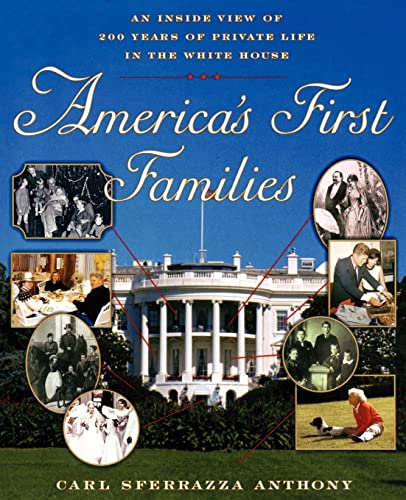
America's First Families: An Inside View of 200 Years of Private Life in the White House (Lisa Drew Books (Paperback)) - Softcover
Inhaltsangabe
Packed with more than 300 photographs from archives and private collections -- many published here for the first time -- entertaining anecdotes, political analysis, the dynamics of family relationships, and behind-the-scenes gossip, America's First Families offers the first up-close look at the families -- from John and Abigail Adams in 1800 to Bill and Hillary Clinton -- who have intrigued and entranced the American public for two centuries.
Carl Sferrazza Anthony opens the door to the world's most famous residence to reveal life as it was actually lived there. He takes readers into the heart of loyalties and estrangements, and the emotional pressures that politics brings to bear upon the forty White House families, from their arrivals to their "notices to vacate." Readers will enjoy an unprecedented tour of the previously unseen private rooms as used and decorated by each family. Revealed too are the personal proclivities of the presidents and how their families both sustained them through public crises and were used for political advantage. They'll get a firsthand look at the preparations for White House weddings and other occasions; meet the parents and children of the presidents -- as well as eccentric relatives; and discover the patterns of working, resting, and relaxing that shaped the nuts and bolts of family life.
A magnificent combination of visual delights and insider information, America's First Families is an irresistible invitation to spend some time at 1600 Pennsylvania Avenue.
Die Inhaltsangabe kann sich auf eine andere Ausgabe dieses Titels beziehen.
Über die Autorin bzw. den Autor
Carl Sferrazza Anthony is the author of a dozen books about presidents’ wives and families, including As We Remember Her: Jacqueline Kennedy Onassis in the Words of Her Family and Friends; The Kennedy White House: Family Life and Pictures, 1961–1963; and the two-volume First Ladies: The Saga of the Presidents’ Wives and Their Power, 1789–1990. He has served as guest curator for presidential library exhibits, written for numerous national publications, and served as contributing editor to the late John F. Kennedy, Jr.’s George magazine.
Auszug. © Genehmigter Nachdruck. Alle Rechte vorbehalten.
Chapter 3: A Home Within a Symbol
There is but little privacy here, the house belongs to the Government and everyone feels at home and they sometimes stalk into our bedroom and say they are looking at the house.-- Joanna Rucker, niece of First Lady Sarah Polk
I love these beautiful big rooms with their high ceilings, their wide spaces, their polished mahogany furniture, carved deep with memories of Lincoln and the Madisons....I thrill to the thought I am sitting in a chair where they once sat, eating from a plate which graced the place of McKinley or Grant.
-- First Lady Florence Harding
The four standing walls of the White House in the year 2000 are the very same that greeted the John Adams family two hundred years before, and though the suite of family rooms on the second floor has been reconfigured, rebuilt, renovated, and redecorated since then, it has consistently remained the home of First Families. The building's interior was burned in 1814, renovated in 1902, and entirely rebuilt between 1948 and 1952. From 1801 until 1902 office workers and strangers were bustling about daily on the other side of a door from the family's rooms. Despite the challenges of living there, it survives as the permanent residence of the president. The White House is among the nation's most potent symbols. But it hasn't been easy making a real life inside a symbol.
It is not certain how some of the earliest families used the rooms of the family quarters on the second floor, although there were so many relatives living with Jefferson, the Madisons, and the Monroes that some of the rooms were presumably finished and being used. One visitor noted that Jefferson used only part of the available space and left "the rest to a state of uncleanly desolation." The first description of the rooms came under Monroe, with the mention of a bed being crowned with satin and lace curtains.
Since John and Abigail Adams used it, however, the presidential suite -- a bedroom, sitting room, and later large walk-in closets and two bathrooms -- has always been in the southwest corner of the second floor. This room was often a place of peaceful isolation. Margaret "Peggy" Taylor decorated it with cherished family possessions that had been with her through years of traveling from army post to post. "I always found the most pleasant part of my visit to the White House to be passed in Mrs. Taylor's bright pretty room," recalled visitor Varina Davis, "where the invalid, full of interest in the passing show in which she had not the strength to take her part, talked most agreeably and kindly to the many friends admitted to her presence." Rarely venturing outside, or downstairs to any public events, Mrs. Taylor made the room the center of her life, where friends and family gathered for socializing, and where her young daughters often danced informally with each other under her watchful eye. Just three years later, in the same suite, Jane Pierce, in deep mourning for her recently killed eleven-year-old son, closed the doors and remained sequestered for nearly a year.
The first non-family member permitted to see and describe the presidential bedroom was Austine Stead, who wrote a newspaper column under the pen name Miss Grundy. She was guided through by President Hayes himself. For the first time this inner sanctum was depicted for the curious citizenry. The furniture was crafted from imitation bamboo, and the walls were painted a light blue with pink and gray panels. Here Lucretia Garfield nearly died of malaria in April 1881. Three months later her husband was initially put here after being shot, and the nation saw its first image of the room in newspaper illustrations of the president in bed, surrounded by doctors.
Since the 1902 renovation, the southwest suite has remained fixed as the president's bedroom. The Theodore Roosevelts slept in the Lincoln bed; the Tafts put it in storage and used twin mahogany beds. The twin beds were used by Woodrow and Ellen Wilson, who painted the room blue and white; Ellen Wilson died in this room. Wilson's second wife, Edith, brought the Lincoln bed back here for their use. The Hardings banished it and brought in Nellie Taft's twin beds. Here Florence Harding also had a special closet made for her large collection of shoes. The Coolidges returned the Lincoln bed for their use -- and the Hoovers put it in another room and didn't use it. The Franklin Roosevelts designated this room as the "First Lady's bedroom," but Mrs. Roosevelt and then Bess Truman used it as a sitting room, the former hanging hundreds of framed pictures, the latter painting the walls lavender and gray. Mamie Eisenhower used it as her bedroom, in multiple shades of pink with an enormous pink bed and pink pin-cushioned headboard. Jackie Kennedy redecorated it in powder blue and white, placing a pastel portrait of her daughter on the wall, with a favorite terra-cotta bust of a child on the mantelpiece. This bust so represented her White House tenure to her that it figures in her White House portrait. She had double beds pushed together as one, draped by a powder blue tapestry. Since the Fords the room has been shared by the spouses. The Reagans covered the walls in hand-painted Chinese paper with a design of small birds; the Clintons chose similarly patterned floral paper.
Connected to this room, in the very corner, is the narrow dressing room. It has served a multitude of purposes -- bedroom, small dining room, office, dressing room, tearoom. Nancy Reagan placed a portrait of herself with her baby daughter here, with its perfect view of the south and west from which many a First Lady has watched the lights of the Oval Office burn late.
Directly across the hall from the president's bedroom suite is the northwest suite, today used as a kitchen and dining room. Prior to 1961, the larger of the two rooms was a prime bedroom suite. For some unknown reason, President William Henry Harrison took this room; perhaps his death here led his successors to return to the original plan of using the bedroom across the hall. When the Prince of Wales came to stay with the Buchanan family, he slept in the suite, and it was christened the "Prince of Wales Room." Here in 1861 Mary Lincoln placed an ornately carved rosewood bed and matching marble-topped table from the Philadelphia firm of William Carryl. She had the bed, which would forever after be known as the Lincoln bed, crowned with a gold American shield, from which gilt lace, overlaid by rich purple satin curtains fringed in gold, flowed to the floor, covering the bed's perimeter. The bedspread was also purple and gold. Lizzie Grimsley, the First Lady's cousin, called the room "the best in the family suite." Just months after the room's completion, eleven-year-old Willie Lincoln died in the Lincoln bed. Three years later, the remains of his father would be embalmed in this room. This was the McKinleys' bedroom, decorated rather simply in crisp whites, with double brass-knobbed beds; a painting of their daughter, who had died two decades earlier, hung on the wall. Cleveland had the room painted yellow for them, but Ida McKinley demanded that it be changed to pale pink. Here she spent most of her White House life, and it was photographed for the American people for the first time in 1897.
Dining here with the Nixon family some seventy years after she lived in the White House, Alice Roosevelt Longworth looked around the room and realized this was her old bedroom -- where her appendix had been removed. In 1961, Jackie Kennedy had made the room the "President's Dining Room," hung with mid-nineteenth-century wallpaper showing battle scenes. Betty Ford found the paper unappetizing and had the room painted yellow. Rosalynn Carter returned the wallpaper, and it remained in place, although in 1997 it was covered -- but not harmed -- with a more soothing...
„Über diesen Titel“ kann sich auf eine andere Ausgabe dieses Titels beziehen.
Suchergebnisse für America's First Families: An Inside View of 200...

Beispielbild für diese ISBN
America's First Families: An Inside View of 200 Years of Private Life in the White House (Lisa Drew Books (Paperback))
Anbieter: World of Books (was SecondSale), Montgomery, IL, USA
Verkäuferbewertung 5 von 5 Sternen

Zustand: Good. Item in good condition. Textbooks may not include supplemental items i.e. CDs, access codes etc. Artikel-Nr. 00087388103
Gebraucht kaufen
EUR 5,42
Versand gratis
Versand innerhalb von USA
Versand innerhalb von USA
Anzahl: 7 verfügbar
Beispielbild für diese ISBN
America's First Families: An Inside View of 200 Years of Private Life in the White House (Lisa Drew Books (Paperback))
Anbieter: World of Books (was SecondSale), Montgomery, IL, USA
Verkäuferbewertung 5 von 5 Sternen
Zustand: Very Good. Item in very good condition! Textbooks may not include supplemental items i.e. CDs, access codes etc. Artikel-Nr. 00096159482
Gebraucht kaufen
EUR 5,42
Versand gratis
Versand innerhalb von USA
Versand innerhalb von USA
Anzahl: 1 verfügbar
Beispielbild für diese ISBN
America's First Families: An Inside View of 200 Years of Private Life in the White House (Lisa Drew Books (Paperback))
Verlag:
Touchstone (edition First Edition), 2000
ISBN 10: 0684864428
ISBN 13: 9780684864426
Gebraucht
Paperback
Erstausgabe
Anbieter: BooksRun, Philadelphia, PA, USA
Verkäuferbewertung 5 von 5 Sternen
Paperback. Zustand: Very Good. First Edition. It's a well-cared-for item that has seen limited use. The item may show minor signs of wear. All the text is legible, with all pages included. It may have slight markings and/or highlighting. Artikel-Nr. 0684864428-8-1
Gebraucht kaufen
EUR 6,11
Versand gratis
Versand innerhalb von USA
Versand innerhalb von USA
Anzahl: 1 verfügbar
Beispielbild für diese ISBN
America's First Families: An Inside View of 200 Years of Private Life in the White House
Anbieter: ThriftBooks-Atlanta, AUSTELL, GA, USA
Verkäuferbewertung 5 von 5 Sternen
Paperback. Zustand: Good. No Jacket. Pages can have notes/highlighting. Spine may show signs of wear. ~ ThriftBooks: Read More, Spend Less. Artikel-Nr. G0684864428I3N00
Gebraucht kaufen
EUR 6,16
Versand gratis
Versand innerhalb von USA
Versand innerhalb von USA
Anzahl: 1 verfügbar
Beispielbild für diese ISBN
America's First Families: An Inside View of 200 Years of Private Life in the White House
Anbieter: ThriftBooks-Dallas, Dallas, TX, USA
Verkäuferbewertung 5 von 5 Sternen
Paperback. Zustand: As New. No Jacket. Pages are clean and are not marred by notes or folds of any kind. ~ ThriftBooks: Read More, Spend Less. Artikel-Nr. G0684864428I2N00
Gebraucht kaufen
EUR 6,16
Versand gratis
Versand innerhalb von USA
Versand innerhalb von USA
Anzahl: 1 verfügbar
Beispielbild für diese ISBN
America's First Families: An Inside View of 200 Years of Private Life in the White House (Lisa Drew Books (Paperback))
Anbieter: Wonder Book, Frederick, MD, USA
Verkäuferbewertung 5 von 5 Sternen
Zustand: Very Good. Very Good condition. A copy that may have a few cosmetic defects. May also contain light spine creasing or a few markings such as an owner's name, short gifter's inscription or light stamp. Artikel-Nr. R12C-02633
Gebraucht kaufen
EUR 6,20
Versand gratis
Versand innerhalb von USA
Versand innerhalb von USA
Anzahl: 2 verfügbar
Beispielbild für diese ISBN
America's First Families: An Inside View of 200 Years of Private Life in the White House (Lisa Drew Books (Paperback))
Anbieter: Wonder Book, Frederick, MD, USA
Verkäuferbewertung 5 von 5 Sternen
Zustand: Good. Good condition. A copy that has been read but remains intact. May contain markings such as bookplates, stamps, limited notes and highlighting, or a few light stains. Artikel-Nr. Y01J-00789
Gebraucht kaufen
EUR 6,20
Versand gratis
Versand innerhalb von USA
Versand innerhalb von USA
Anzahl: 2 verfügbar
Beispielbild für diese ISBN
America's First Families : An Inside View of 200 Years of Private Life in the White House
Anbieter: Better World Books, Mishawaka, IN, USA
Verkäuferbewertung 5 von 5 Sternen
Zustand: Good. First edition. Former library copy. Pages intact with minimal writing/highlighting. The binding may be loose and creased. Dust jackets/supplements are not included. Includes library markings. Stock photo provided. Product includes identifying sticker. Better World Books: Buy Books. Do Good. Artikel-Nr. GRP73175727
Gebraucht kaufen
EUR 6,28
Versand gratis
Versand innerhalb von USA
Versand innerhalb von USA
Anzahl: 1 verfügbar
Beispielbild für diese ISBN
America's First Families : An Inside View of 200 Years of Private Life in the White House
Anbieter: Better World Books, Mishawaka, IN, USA
Verkäuferbewertung 5 von 5 Sternen
Zustand: Good. First edition. Pages intact with minimal writing/highlighting. The binding may be loose and creased. Dust jackets/supplements are not included. Stock photo provided. Product includes identifying sticker. Better World Books: Buy Books. Do Good. Artikel-Nr. 3393026-75
Gebraucht kaufen
EUR 6,28
Versand gratis
Versand innerhalb von USA
Versand innerhalb von USA
Anzahl: 1 verfügbar
Beispielbild für diese ISBN
America's First Families : An inside View of 200 Years of Private Life in the White House
Anbieter: Robinson Street Books, IOBA, Binghamton, NY, USA
Verkäuferbewertung 4 von 5 Sternen

Trade Paperbac. Zustand: VERY Good. Prompt Shipment, shipped in Boxes, Tracking PROVIDEDBiography: GeneralVERY GOOD TRADE PAPERBACK. VERY GOOD, CLEAN PAGES. Artikel-Nr. BING725MD071
Gebraucht kaufen
EUR 11,98
EUR 8,18 Versand
Versand innerhalb von USA
Versand innerhalb von USA
Anzahl: 1 verfügbar