
Verwandte Artikel zu This is My Daughter: A Novel
Inhaltsangabe
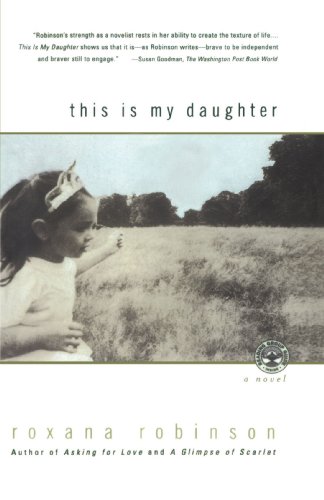
When Peter and Emma, both refugees from failed first marriages, decide to create a new life together, they do so with an optimistic commitment to creating a union -- and forging a new family from two existing ones -- bonded by love and trust. Their young daughters, however, are not partners in this new venture, but helpless participants. Like all children of divorce, the girls feel sorrow, loss, and a longing for their earlier lives. As the tensions and complexities grow steadily more powerful, This Is My Daughter moves inexorably to a stunning and emotional climax. Roxana Robinson, who has established a reputation as a perceptive chronicler of WASP family life, delivers a beautifully moving and compassionate account of a marriage in peril, proving once more that class and privilege provide no protection from the passion of opposing desires.
Die Inhaltsangabe kann sich auf eine andere Ausgabe dieses Titels beziehen.
Über die Autorin bzw. den Autor
Roxana Barry Robinson is the author of the novel Summer Light, the biography Georgia O'Keeffe: A Life, and the short-story collections A Glimpse of Scarlet and Asking for Love. Her writing has appeared in The Atlantic Monthly, Harper's, The New Yorker, and Vogue, as well as in Best American Short Stories, and has been read on National Public Radio. Three of her books have been selected as New York Times Notable Books of the Year. She is the recipient of a Creative Writing Fellowship from the National Endowment for the Arts. She lives in Westchester County and New York City.
Auszug. © Genehmigter Nachdruck. Alle Rechte vorbehalten.
Chapter 1
"You'll like my daughter," Peter told Emma, "no matter what she does to you. If she bites you."
Emma looked at him, to see if she was meant to laugh, but Peter was driving, and did not turn. Emma considered his profile, looking for clues: the long straight nose, the sober deep-set blue eye. The line of Peter's mouth was stern, and his tone had suggested not mirth but reproval. Disturbed, Emma turned away to face the road herself.
"I'm sure I'll like her," she said politely.
But it was an alarming announcement. She wondered what Peter meant: was he warning her that his daughter was difficult? Was he reminding Emma that she had no choice? In either case, Emma didn't need to be told. She knew it was important that she like Peter's daughter. She knew his daughter was difficult. But perhaps Peter meant neither of these things, perhaps this was an awkward joke, heavy with anxiety. Emma did not quite dare ask him what he meant.
Emma and Peter had been seeing each other for four months. Often Emma felt she knew him well, but still there were moments of complete confusion for her, dark silent pools set unexpectedly in an open rolling landscape. It took so long to know someone, Emma thought, to know easily, at once, what was meant by a comment, a tone of voice. Married, you took this ease for granted. Starting all over again, learning someone new by heart, seemed so slow. To Emma, it seemed at times impossible.
Emma was always afraid that Peter would discover something about her that he had never imagined, something that would turn him utterly against her, forever. She had seen him once, taking off a pair of wet gloves, peeling them off his fingers, ridding his flesh of them and flinging them in a crumpled mass onto a chair, where they hung for a moment and then fell to the floor. This was what she imagined would happen to her if she disappointed him.
Emma looked out the window. They were driving down Park Avenue, through the seventies. The big apartment buildings rose on either side, solid and immutable, with their clean stone facades and crisp canvas awnings. Uniformed doormen, brisk and authoritative in braid-trimmed hats, stood guard at each doorway. It was a neighborhood Emma knew well: Park Avenue, with its narrow, sooty, dignified strip of green, had, until now, run down the center of her adult world. When she had first come to New York, six years ago, she had lived with friends of her parents, in a tiny maid's room in a big duplex at Park and Eighty-first. When she was married to Warren, she had lived between Park and Madison, on Ninety-second. Peter's wife and daughter -- and once Peter -- lived at Park and Sixty-eighth.
Peter and Emma were on their way to pick up Peter's seven-year-old daughter, Amanda. Peter had lunch with her every Sunday, but this was the first time Emma had been included. She had been pleased and flattered when Peter asked.
"You know I've met Amanda before," Emma reminded him now.
"You have? When?" Peter asked.
"When I met you. At your cocktail party."
"I didn't know that," said Peter.
"It was very brief. She won't remember me," Emma said. "But I remember her."
They had stopped for the light at Sixty-eighth Street. The avenue sloped broadly down before them, diminishing toward the handsome Beaux Arts silhouette of Grand Central Station, which was backed by the cold blunt rectangle of the Pan Am Building. The narrow beds of earth that divided Park Avenue held neat evergreen trees, regularly spaced like musical notations, green chords struck evenly between the high stone-faced buildings. It was a clean and orderly vista, and the February sky overhead was a high pale blue.
Crossing the avenue in front of their car was a middle-aged black woman in a too-long overcoat. She held the hand of a small white girl. The girl, in a bright pink parka, green corduroy pants and scarlet boots, hung sulkily back, her body jammed into a stubborn angle of resistance. She wore no hat, and her hair blew in a wild halo around her head. The woman paid no attention to her reluctance, pulling the girl steadily along behind her. In the middle of the street the woman turned and said something, her face threatening. The girl stuck out her lower lip. When they started again the girl gave up her leaning, but each step was sluggish and resentful. Her boots slid reluctantly along the pavement, her head was down. The woman plowed ahead without looking back.
Children have no choice: they are at our mercy, Emma thought. She was glad to see, at least, that the little girl had refused a hat.
"What did Amanda do? When you met her," Peter asked, turning to Emma. One eyebrow was raised, and Emma felt the full strength of his blue gaze. He was a lawyer, and there were times when Emma felt she was being cross-examined.
"Oh, not much," Emma said. "Caroline was taking her around the party to be introduced. Amanda wasn't keen on it."
"Sounds like Caroline. Sounds like Amanda," said Peter. The light changed, and he turned the car onto his street. They pulled up in front of his old door. The doorman, short, dapper, militant, in a long buff overcoat, with heavy corded epaulets, stepped at once to the door of the car.
"Hello, Sam," Peter said
"Good morning, Mr. Chatfield," said the doorman loudly, touching his big cap. He had bright black eyes, and the stiff overcoat nearly enveloped him
"I'll be right down," Peter said to the doorman, and closed the car door. The doorman looked at Emma and nodded, brisk but neutral.
Emma, left sitting in the car, wished that Peter had spoken to her instead of to the doorman. She watched Peter walk into the building, where he still owned an apartment, Through the heavy glass of the door she could see the elevator man step forward to greet him. All the people here knew Peter; he would meet an old neighbor in the elevator. Emma watched, pressing her forehead against the window like a child, as Peter stood before the elevator door. His figure, tall and solid in his worn corduroys and old raincoat, turned vague and began to vanish. Emma blinked, focusing, but Peter turned steadily to smoke. She pressed closer to the window, staring intently, to retrieve him. But she could not, and drew back from the pane, perplexed. She saw it was her own anxiety that had made him vanish; her breath had steamed a widening circle of mist across the windowpane, a pale film of obscurity that blotted him out. When she drew back, she watched the window dry, and clarity spread across it.
The elevator doors reappeared, but now Peter had gone. The doors had glided somberly shut behind him, and he was now inside the hushed vault of the elevator, rising deliberately toward his wife, his daughter, his apartment, his past life. For nine years he had been part of Mr. and Mrs. Chatfield on the eleventh floor. What would he do up there, what would he say? How much could you trust a man who was in the middle of divorcing his wife? Taking back all the promises he had made to her?
The doorman stood like a small belligerent statue: chin raised, legs planted wide beneath his huge coat, one gloved hand on his taxi whistle. He ignored Emma. She felt like a trespasser, illicitly parked before this building. She turned away, wondering what was happening upstairs.
Emma had been in the Chatfields' apartment only once, a year earlier, when she was still married to Warren. Warren had been on a board with Caroline, Peter's Wife, and she had asked them to a cocktail party. That night, Warren and Emma had stepped off the elevator into the foyer with its black marble floors and yellow-and-white striped walls. The front door was open, and the rooms beyond were full of noise and color. The spaces were big, the ceilings high. The surfaces shimmered: the porcelain figures on the mantelpiece, the...
„Über diesen Titel“ kann sich auf eine andere Ausgabe dieses Titels beziehen.
Suchergebnisse für This is My Daughter: A Novel

Beispielbild für diese ISBN
This is My Daughter: A Novel
Anbieter: World of Books (was SecondSale), Montgomery, IL, USA
Verkäuferbewertung 5 von 5 Sternen

Zustand: Good. Item in good condition. Textbooks may not include supplemental items i.e. CDs, access codes etc. Artikel-Nr. 00099890560
Gebraucht kaufen
EUR 3,66
Versand gratis
Versand innerhalb von USA
Versand innerhalb von USA
Anzahl: 5 verfügbar
Beispielbild für diese ISBN
This is My Daughter: A Novel
Anbieter: World of Books (was SecondSale), Montgomery, IL, USA
Verkäuferbewertung 5 von 5 Sternen
Zustand: Very Good. Item in very good condition! Textbooks may not include supplemental items i.e. CDs, access codes etc. Artikel-Nr. 00097376530
Gebraucht kaufen
EUR 3,66
Versand gratis
Versand innerhalb von USA
Versand innerhalb von USA
Anzahl: 1 verfügbar
Beispielbild für diese ISBN
This Is My Daughter
Anbieter: Better World Books, Mishawaka, IN, USA
Verkäuferbewertung 5 von 5 Sternen
Zustand: Good. 1st Scribner Paperback Fiction ed. Pages intact with minimal writing/highlighting. The binding may be loose and creased. Dust jackets/supplements are not included. Stock photo provided. Product includes identifying sticker. Better World Books: Buy Books. Do Good. Artikel-Nr. 2419248-6
Gebraucht kaufen
EUR 8,43
Versand gratis
Versand innerhalb von USA
Versand innerhalb von USA
Anzahl: 2 verfügbar
Beispielbild für diese ISBN
This is My Daughter: A Novel
Anbieter: ThriftBooks-Atlanta, AUSTELL, GA, USA
Verkäuferbewertung 5 von 5 Sternen
Paperback. Zustand: Very Good. No Jacket. May have limited writing in cover pages. Pages are unmarked. ~ ThriftBooks: Read More, Spend Less. Artikel-Nr. G0684864363I4N00
Gebraucht kaufen
EUR 10,51
Versand gratis
Versand innerhalb von USA
Versand innerhalb von USA
Anzahl: 1 verfügbar
Beispielbild für diese ISBN
This is My Daughter: A Novel
Anbieter: Robinson Street Books, IOBA, Binghamton, NY, USA
Verkäuferbewertung 4 von 5 Sternen

Paperback. Zustand: Very Good. Prompt Shipment, shipped in Boxes, Tracking PROVIDEDVery good. Few creases. Artikel-Nr. lower2rsg230
Gebraucht kaufen
EUR 12,21
EUR 8,34 Versand
Versand innerhalb von USA
Versand innerhalb von USA
Anzahl: 1 verfügbar
Beispielbild für diese ISBN
This is My Daughter: A Novel
Anbieter: Robinson Street Books, IOBA, Binghamton, NY, USA
Verkäuferbewertung 4 von 5 Sternen
Paperback. Zustand: Very Good. Prompt Shipment, shipped in Boxes, Tracking PROVIDEDVery good, some creasing. *. Artikel-Nr. lower28kr1329
Gebraucht kaufen
EUR 12,21
EUR 8,34 Versand
Versand innerhalb von USA
Versand innerhalb von USA
Anzahl: 1 verfügbar
Beispielbild für diese ISBN
This is My Daughter: A Novel
Anbieter: WorldofBooks, Goring-By-Sea, WS, Vereinigtes Königreich
Verkäuferbewertung 5 von 5 Sternen
Paperback. Zustand: Very Good. The book has been read, but is in excellent condition. Pages are intact and not marred by notes or highlighting. The spine remains undamaged. Artikel-Nr. GOR005086941
Gebraucht kaufen
EUR 31,21
EUR 6,51 Versand
Versand von Vereinigtes Königreich nach USA
Versand von Vereinigtes Königreich nach USA
Anzahl: 1 verfügbar
Foto des Verkäufers
This is My Daughter
Anbieter: SoferBooks, Barcelona, B, Spanien
Verkäuferbewertung 5 von 5 Sternen
Blanda. Zustand: Buen Estado. Zustand des Schutzumschlags: Buen Estado. Artikel-Nr. 52315
Gebraucht kaufen
EUR 17,99
EUR 22,00 Versand
Versand von Spanien nach USA
Versand von Spanien nach USA
Anzahl: 1 verfügbar
Beispielbild für diese ISBN
This is My Daughter: A Novel
Anbieter: Revaluation Books, Exeter, Vereinigtes Königreich
Verkäuferbewertung 5 von 5 Sternen
Paperback. Zustand: Brand New. 416 pages. 7.75x5.25x0.75 inches. In Stock. Artikel-Nr. 0684864363
Neu kaufen
EUR 48,72
EUR 11,63 Versand
Versand von Vereinigtes Königreich nach USA
Versand von Vereinigtes Königreich nach USA
Anzahl: 1 verfügbar