
Verwandte Artikel zu The Death of Outrage: Bill Clinton and the Assault...
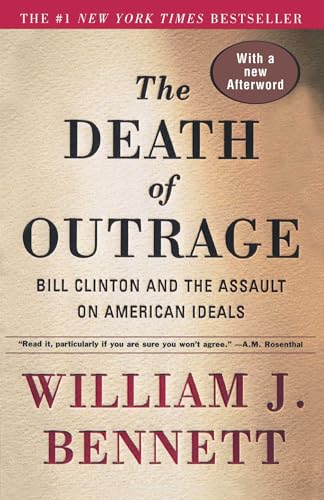
Inhaltsangabe
In this new, updated edition of a book heralded as a clarion call to the nation's conscience, William Bennett asks why we see so little public outrage in the fade of the evidence of deep corruption within Bill Clinton's administration.
The Death of Outrage examines the Monica Lewinsky scandal as it unfolded, from Clinton's denials that he had had sex with a young White House intern, to his testimony before the grand jury, to the nation's decision not to remove Clinton from office. Brick by brick, Bennett dismantles the wall of defenses offered by Clinton and his apologists, and casts the clear light of moral reason and common sense on a shameful chapter in American history.
Die Inhaltsangabe kann sich auf eine andere Ausgabe dieses Titels beziehen.
Über die Autorin bzw. den Autor
Dr. William J. Bennett is one of America’s most influential and respected voices on cultural, political, and educational issues. Host of The Bill Bennett Show podcast, he is also the Washington Fellow of the American Strategy Group. He is the author and editor of more than twenty-five books. Dr. Bennett served as the secretary of education and chairman of the National Endowment for the Humanities under President Ronald Reagan and as director of the Office of National Drug Control Policy under President George Herbert Walker Bush.
Auszug. © Genehmigter Nachdruck. Alle Rechte vorbehalten.
The Death of Outrage
Bill Clinton and the Assault on American IdealsBy William J. BennettFree Press
Copyright © 1999 William J. BennettAll right reserved.
ISBN: 0684864037
From the Introduction
Instead of keeping the nation's attention focused on scandals and squalid acts, why not move on to other issues? Why not just look away?
The answer to these questions is that on Bill Clinton's behalf, in his defense, many bad ideas are being put into widespread circulation. It is said that private character has virtually no impact on governing character; that what matters above all is a healthy economy; that moral authority is defined solely by how well a president deals with public policy matters; that America needs to become more European (read: more "sophisticated") in its attitude toward sex; that lies about sex, even under oath, don't really matter; that we shouldn't be "judgmental"....
....If these arguments take root in American soil -- if they become the coin of the public realm -- we will have validated them, and we will come to rue the day we did. These arguments define us down; they assume a lower common denominator of behavior and leadership than we Americans ought to accept. And if we do accept it, we will have committed an unthinking act of moral and intellectual disarmament. In the realm of American ideals and the great tradition of public debate, the high ground will have been lost. And when we need to rely again on this high ground -- as surely we will need to -- we will find it drained of its compelling moral power. In that sense, then, the arguments invoked by Bill Clinton and his defenders represent an assault on American ideals, even if you assume the president did nothing improper. So the arguments need to be challenged.
I believe these arguments are also a threat to our understanding of American self-government. It demands active participation in, and finally, reasoned judgments on, important civic matters. "Judgment" is a word that is out of favor these days, but it remains a cornerstone of democratic self-government. It is what enables us to hold ourselves, and our leaders, to high standards. It is how we distinguish between right and wrong, noble and base, honor and dishonor. We cannot ignore that responsibility, or foist it on others. It is the price -- sometimes the exacting price -- of citizenship in a democracy. The most popular arguments made by the president's supporters invite us to abandon that participation, those standards, and the practice of making those distinctions.
Bill Clinton's presidency is also defining public morality down. Civilized society must give public affirmation to principles and standards, categorical norms, notions of right and wrong. Even though public figures often fall short of these standards -- and we know and we expect some will -- it is nevertheless crucial that we pay tribute to them. When Senator Gary Hart withdrew from the 1988 presidential contest because of his relationship with Donna Rice, he told his staff, "Through thoughtlessness and misjudgment I've let each of you down. And I deeply regret that." By saying what he said, by withdrawing from the race, Senator Hart affirmed public standards. President Clinton, by contrast, expresses no regret, no remorse, no contrition -- even as he uses his public office to further his private ends. On every scandal, what he says or intimates always amounts to one of the following: "It doesn't matter. I wasn't involved. My political enemies are to blame. I have nothing more to say. The rules don't apply to me. There are no consequences to my actions. It's irrelevant. My only responsibility is to do the people's business." This is moral bankruptcy, and it is damaging our country, its standards, and our self-respect.
Once in a great while a single national event provides insight into where we are and who we are and what we esteem. The Clinton presidency has provided us with a window onto our times, our moral order, our understanding of citizenship. The many Clinton scandals tell us, in a way few other events can, where we are in our public philosophy. They reveal insights into how we view politics and power; virtue and vice; public trust and respect for the law; sexual morality and standards of personal conduct.
America's professional opinion classes -- journalists, columnists, and commentators -- have produced truckloads Of words, both spoken and written, about the Clinton scandals. Some of them are excellent, and I have mined them for this book. What I hope to do is to put things in a broader context, explaining their implications for our national political life and for the lessons we teach our young.
My goal is also to give public expression to people's private concerns. Many Americans have an intuitive understanding that something is deeply troubling about President Clinton's conduct and the defenses offered on his behalf. But Bill Clinton and his supporters have skillfully deflected criticism by changing the subject. They have persuaded many in the middle that the sophisticated thing is to dismiss the scandalous as irrelevant. My purpose in this book is to speak citizen to citizen to those in the middle -- not to "preach to the converted," but to speak to the troubled. I believe that public opinion has not yet hardened on these matters and that people are still open to evidence, facts, persuasion, and an appeal to reason and the rule of law. This book is presented in that spirit.
This is a short book. It is not a systematic work of moral philosophy. Its aim is much more limited: to respond to an urgent public matter now before the American people -- in a manner, I trust, that is informed by sound reasoning. In what follows I take the words of the president and his defenders seriously, examining them, and asking the reader to judge whether the conclusions that flow from them are true or false, good or harmful.
In the end this book rests on the venerable idea that moral good and moral harm are very real things, and moral good or moral harm can come to a society by what it esteems and by what it disdains.
Many people have been persuaded to take a benign view of the Clinton presidency on the basis of arguments that have attained an almost talismanic stature but that in my judgment are deeply wrong and deeply pernicious. We need to say no to those arguments as loudly as we can -- and yes to the American ideals they endanger.
Copyright © 1998 by William J. Bennett
Continues...
Excerpted from The Death of Outrageby William J. Bennett Copyright © 1999 by William J. Bennett. Excerpted by permission.
All rights reserved. No part of this excerpt may be reproduced or reprinted without permission in writing from the publisher.
Excerpts are provided by Dial-A-Book Inc. solely for the personal use of visitors to this web site.
„Über diesen Titel“ kann sich auf eine andere Ausgabe dieses Titels beziehen.
Suchergebnisse für The Death of Outrage: Bill Clinton and the Assault...

Beispielbild für diese ISBN
The Death of Outrage Bill Clin
Anbieter: World of Books (was SecondSale), Montgomery, IL, USA
Verkäuferbewertung 5 von 5 Sternen

Zustand: Good. Item in good condition. Textbooks may not include supplemental items i.e. CDs, access codes etc. Artikel-Nr. 00024467591
Gebraucht kaufen
EUR 3,13
Versand gratis
Versand innerhalb von USA
Versand innerhalb von USA
Anzahl: 4 verfügbar
Beispielbild für diese ISBN
The Death of Outrage: Bill Clinton and the Assault on American Ideals
Anbieter: World of Books (was SecondSale), Montgomery, IL, USA
Verkäuferbewertung 5 von 5 Sternen
Zustand: Good. Item in good condition. Textbooks may not include supplemental items i.e. CDs, access codes etc. Artikel-Nr. 00099726165
Gebraucht kaufen
EUR 3,47
Versand gratis
Versand innerhalb von USA
Versand innerhalb von USA
Anzahl: 8 verfügbar
Beispielbild für diese ISBN
The Death of Outrage: Bill Clinton and the Assault on American Ideals
Anbieter: World of Books (was SecondSale), Montgomery, IL, USA
Verkäuferbewertung 5 von 5 Sternen
Zustand: Acceptable. Item in acceptable condition! Textbooks may not include supplemental items i.e. CDs, access codes etc. Artikel-Nr. 00100085977
Gebraucht kaufen
EUR 3,47
Versand gratis
Versand innerhalb von USA
Versand innerhalb von USA
Anzahl: 3 verfügbar
Beispielbild für diese ISBN
The Death of Outrage: Bill Clinton and the Assault on American Ideals
Anbieter: World of Books (was SecondSale), Montgomery, IL, USA
Verkäuferbewertung 5 von 5 Sternen
Zustand: Very Good. Item in very good condition! Textbooks may not include supplemental items i.e. CDs, access codes etc. Artikel-Nr. 00109536608
Gebraucht kaufen
EUR 3,47
Versand gratis
Versand innerhalb von USA
Versand innerhalb von USA
Anzahl: 3 verfügbar
Beispielbild für diese ISBN
The Death of Outrage: Bill Clinton and the Assault on American Ideals
Verlag:
Free Press (edition Updated), 1999
ISBN 10: 0684864037
ISBN 13: 9780684864037
Gebraucht
Paperback
Anbieter: BooksRun, Philadelphia, PA, USA
Verkäuferbewertung 5 von 5 Sternen
Paperback. Zustand: Fair. Updated. The item might be beaten up but readable. May contain markings or highlighting, as well as stains, bent corners, or any other major defect, but the text is not obscured in any way. Artikel-Nr. 0684864037-7-1-13
Gebraucht kaufen
EUR 4,51
Versand gratis
Versand innerhalb von USA
Versand innerhalb von USA
Anzahl: 1 verfügbar
Beispielbild für diese ISBN
The Death of Outrage: Bill Clinton and the Assault on American Ideals
Anbieter: ThriftBooks-Dallas, Dallas, TX, USA
Verkäuferbewertung 5 von 5 Sternen
Paperback. Zustand: As New. No Jacket. Pages are clean and are not marred by notes or folds of any kind. ~ ThriftBooks: Read More, Spend Less. Artikel-Nr. G0684864037I2N00
Gebraucht kaufen
EUR 6,21
Versand gratis
Versand innerhalb von USA
Versand innerhalb von USA
Anzahl: 1 verfügbar
Beispielbild für diese ISBN
The Death of Outrage: Bill Clinton and the Assault on American Ideals
Anbieter: Wonder Book, Frederick, MD, USA
Verkäuferbewertung 5 von 5 Sternen
Zustand: Good. Good condition. A copy that has been read but remains intact. May contain markings such as bookplates, stamps, limited notes and highlighting, or a few light stains. Artikel-Nr. I21A-04805
Gebraucht kaufen
EUR 6,24
Versand gratis
Versand innerhalb von USA
Versand innerhalb von USA
Anzahl: 1 verfügbar
Beispielbild für diese ISBN
The Death of Outrage: Bill Clinton and the Assault on American Ideals
Anbieter: Wonder Book, Frederick, MD, USA
Verkäuferbewertung 5 von 5 Sternen
Zustand: Very Good. Very Good condition. A copy that may have a few cosmetic defects. May also contain light spine creasing or a few markings such as an owner's name, short gifter's inscription or light stamp. Artikel-Nr. E04A-02951
Gebraucht kaufen
EUR 6,24
Versand gratis
Versand innerhalb von USA
Versand innerhalb von USA
Anzahl: 3 verfügbar
Beispielbild für diese ISBN
The Death of Outrage : Bill Clinton and the Assault on American Ideals
Anbieter: Better World Books, Mishawaka, IN, USA
Verkäuferbewertung 5 von 5 Sternen
Zustand: Very Good. Updated. Pages intact with possible writing/highlighting. Binding strong with minor wear. Dust jackets/supplements may not be included. Stock photo provided. Product includes identifying sticker. Better World Books: Buy Books. Do Good. Artikel-Nr. 42499387-6
Gebraucht kaufen
EUR 6,81
Versand gratis
Versand innerhalb von USA
Versand innerhalb von USA
Anzahl: 1 verfügbar
Beispielbild für diese ISBN
The Death of Outrage : Bill Clinton and the Assault on American Ideals
Anbieter: Better World Books: West, Reno, NV, USA
Verkäuferbewertung 5 von 5 Sternen
Zustand: Good. Updated. Pages intact with minimal writing/highlighting. The binding may be loose and creased. Dust jackets/supplements are not included. Stock photo provided. Product includes identifying sticker. Better World Books: Buy Books. Do Good. Artikel-Nr. GRP73781222
Gebraucht kaufen
EUR 6,81
Versand gratis
Versand innerhalb von USA
Versand innerhalb von USA
Anzahl: 1 verfügbar