
Verwandte Artikel zu Competing On Internet Time: Lessons From Netscape And...
Inhaltsangabe
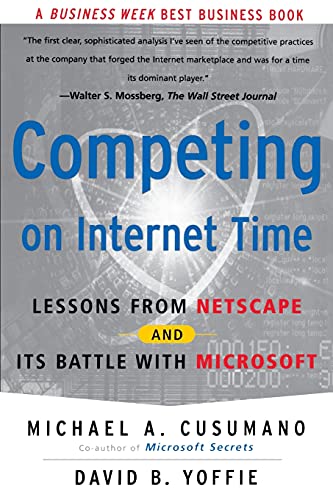
Competing on Internet time means competitive advantage can be won and lost overnight. In this penetrating analysis of strategy-making and product innovation in the dynamic markets of commercial cyberspace, bestselling Microsoft Secrets co-author Michael Cusumano and top competitive strategy expert David Yoffie draw vital lessons from Netscape, the first pure Internet company, and show how it employs the techniques of "judo strategy" in its pitched battle with Microsoft, the world's largest software producer.
With a new afterword updating the events of the year following publication of the hardcover edition, Competing on Internet Time is essential and instructive reading for all managers, engineers, and entrepreneurs who want to succeed in ultra-fast-paced markets. Managers in every high-tech industry will discover a wealth of new ideas on how to create and scale up a new company quickly; how to compete in fast-paced, unpredictable industries; and how to design products for rapidly evolving markets.
Die Inhaltsangabe kann sich auf eine andere Ausgabe dieses Titels beziehen.
Über die Autorin bzw. den Autor
Michael A. Cusumano, co-author of the newly published Thinking Beyond Lean and the international bestseller Microsoft Secrets, is the Sloan Distinguished Professor of Management at MIT's Sloan School of Management. He is also the author of The Japanese Automobile Industry and Japan's Software Factories.
Auszug. © Genehmigter Nachdruck. Alle Rechte vorbehalten.
Chapter One: Introduction Competing in the Age of the Internet
Occasionally, the world experiences a technological revolution that changes the way people live and interact. Ancient peoples experienced the emergence of agriculture, irrigation, and civil engineering. These developments led to the creation of cities and urban culture. Medieval peoples experienced the invention of the printing press. This technology gradually made books, magazines, newspapers, and the printed word -- information -- ubiquitous. Early modern Europeans championed the Industrial Revolution and new fields of science and engineering. New inventions, such as engines and factories, substituted mechanical devices and inanimate power for animal and human labor. Technology then progressed dramatically after the mid-19th century. The world has recently seen, in relatively rapid succession, the emergence of the telegraph, the telephone, radio, automobiles, airplanes, television, and the computer -- to name the better-known inventions in communications and transportation.
And now we have the Internet. The Internet is a network of computers, tens of millions of them, large and small, around the world. More accurately, it is a network of networks, based on a set of software technologies that drive computer hardware to send, receive, and locate "packets" of information traveling a worldwide electronic highway at lightning speed.1 The Internet has launched a technological revolution that is changing the way individuals, as well as organizations, live and interact. Imagine combining the power of the printing press (and most of the newspapers and magazines on earth) with the power and speed of the telegraph, telephone, radio, television, and computer. Then make this package easy to use and cheap enough for the mass market. You would then have the potential of the Internet in its most usable form, the World Wide Web (known as "the Web" for short).
We are not exaggerating when we say that the Internet and the World Wide Web, with the browser as its user interface, are revolutionizing mass communications, as well as mass networking technology. It is unlike anything we have seen before. The Internet has the potential to link easily and almost instantaneously every computing device with every database with every person who has access to a communications device (telephone, cable, satellite, etc.). As a consequence, the Internet is recasting the most traditional organizations, ranging from the U.S. Internal Revenue Service to your local grocery store. Tens of thousands of companies, both large and small, have created Web sites through which you can purchase goods and services or receive valuable (and not so valuable) information. This means that consumers can do common tasks on the Internet, such as ordering groceries or books and searching for stock prices. They can also do far more complex tasks, such as creating ideal travel itineraries, getting investment or medical advice, or holding a videoconference while sharing documents with people around the world. For anyone in the industrialized world, and for many people in developing countries, access to this great wealth of information and services is already available. The cost is usually the price of a personal computer (PC) or a cheaper device like a handheld computer, a TV set-top box, or the new network computer, as well as a local phone call and a charge of a few dollars per month.
The Age of the Internet
To understand the managerial and competitive implications of the Internet, we draw lessons from the experiences of Netscape Communications Corporation, the fastest-growing software company in history. After Netscape's explosion on the scene in 1994, it became synonymous with the Web. One year later, Netscape gained even greater -- if unwanted -- notoriety when Microsoft Corporation, the world's largest company dedicated to software production, challenged Netscape to a life-or-death battle. Together, these two companies are struggling to control key components of the Internet, including browsers, which provide a graphical user interface to the Web; servers, which are special software programs that run on powerful PCs or mainframes and deliver, or "serve," information (including pictures or sound) to the browsers; and portals, Web sites like Yahoo! and AOL.com (America Online) that aggregate information and become the jumping-off point for users surfing the Web.
It seems hard to believe that Netscape and the World Wide Web were not even on the horizon a decade ago, and the Internet was a little-known curiosity. The Internet began in the late 1960s as an arcane network connecting university and government computers. Scientists wanted to exchange data and electronic mail. Government officials wanted to be able to communicate if a nuclear war caused conventional communications technologies to collapse. The Internet remained the province of these small groups for 20 years. Then, in 1989, Tim Berners-Lee, a British researcher at the European Laboratory for Particle Physics (CERN) outside Geneva, created a system that would make it easier for scientists to use the Internet to share information. Berners-Lee defined the core elements of the Web -- a text formatting system (Hypertext Markup Language or HTML), a communications standard (Hypertext Transfer Protocol or HTTP), and an addressing scheme to locate Web sites (Uniform Resource Locators or URLs). Then he built a rudimentary browser.2 In 1993, a handful of students working for the National Center for Supercomputing Applications (NCSA) at the University of Illinois took Berners-Lee's invention, integrated graphics and multimedia features into the browser, and made it run on mass-market computing platforms, such as Windows and the Macintosh. The result was Mosaic, a wildly popular toy and information access tool. Most of the browsers available today, including Netscape's Navigator and Microsoft's Internet Explorer, have descended in some way from NCSA's Mosaic.
Mosaic launched a wave of innovation that led, in turn, to an ever-expanding technological alphabet soup. People working with the Internet have had to learn new concepts and new vocabularies almost daily. In addition to HTTP and HTML, two other early standards that defined how the Internet could send and receive information were FTP (File Transfer Protocol) and TCP/IP (Transmission Control Protocol/Internet Protocol). Many other standards quickly emerged for sending data and even video pictures and telephone conversations across the Internet. The proliferation of these technologies is testimony to the dynamism of the Web. More important evidence, however, is the explosion of Internet-based software and services in just a few short years. Utilizing the technologies of the Web, some companies have quickly grown to hundreds and even thousands of employees, hundreds of millions of dollars in revenues, and billions of dollars in market value. The "Internet future" has been unfolding so fast that managers in the industry tell us they cannot confidently predict exactly what products and features to build, what technologies to use, or what customers will buy more than six months to a year in advance. Nevertheless, many products that companies want to create, such as new operating systems, browsers, servers, or groupware applications such as electronic mail and electronic bulletin boards, take 18 months or more to design, build, and test.
Life was not like this before! In past decades, many companies extolled the virtues of long-term planning -- looking forward five to 10 years into the future. Compared to today, companies also took their time in product development. For example, Microsoft launched an operating system for IBM-compatible PCs, called MS-DOS, in 1981 and only made evolutionary changes in this technology until...
„Über diesen Titel“ kann sich auf eine andere Ausgabe dieses Titels beziehen.
Suchergebnisse für Competing On Internet Time: Lessons From Netscape And...

Beispielbild für diese ISBN
Competing on Internet Time : Lessons from Netscape and Its Battle with Microsoft
Anbieter: Better World Books, Mishawaka, IN, USA
Verkäuferbewertung 5 von 5 Sternen

Zustand: Very Good. Touchstone Ed. Pages intact with possible writing/highlighting. Binding strong with minor wear. Dust jackets/supplements may not be included. Stock photo provided. Product includes identifying sticker. Better World Books: Buy Books. Do Good. Artikel-Nr. 14761076-6
Gebraucht kaufen
EUR 6,14
Versand gratis
Versand innerhalb von USA
Versand innerhalb von USA
Anzahl: 1 verfügbar
Beispielbild für diese ISBN
Competing on Internet Time : Lessons from Netscape and Its Battle with Microsoft
Anbieter: Better World Books: West, Reno, NV, USA
Verkäuferbewertung 5 von 5 Sternen
Zustand: Good. Touchstone Ed. Pages intact with minimal writing/highlighting. The binding may be loose and creased. Dust jackets/supplements are not included. Stock photo provided. Product includes identifying sticker. Better World Books: Buy Books. Do Good. Artikel-Nr. 3393648-75
Gebraucht kaufen
EUR 6,14
Versand gratis
Versand innerhalb von USA
Versand innerhalb von USA
Anzahl: 1 verfügbar
Beispielbild für diese ISBN
Competing on Internet Time: Lessons from Netscape and It's Battle with Microsoft
Anbieter: ThriftBooks-Dallas, Dallas, TX, USA
Verkäuferbewertung 5 von 5 Sternen
Paperback. Zustand: Fair. No Jacket. Readable copy. Pages may have considerable notes/highlighting. ~ ThriftBooks: Read More, Spend Less. Artikel-Nr. G0684863456I5N00
Gebraucht kaufen
EUR 14,15
Versand gratis
Versand innerhalb von USA
Versand innerhalb von USA
Anzahl: 1 verfügbar
Beispielbild für diese ISBN
Competing on Internet Time: Lessons from Netscape and It's Battle with Microsoft
Anbieter: ThriftBooks-Dallas, Dallas, TX, USA
Verkäuferbewertung 5 von 5 Sternen
Paperback. Zustand: Very Good. No Jacket. May have limited writing in cover pages. Pages are unmarked. ~ ThriftBooks: Read More, Spend Less. Artikel-Nr. G0684863456I4N00
Gebraucht kaufen
EUR 14,15
Versand gratis
Versand innerhalb von USA
Versand innerhalb von USA
Anzahl: 1 verfügbar
Beispielbild für diese ISBN
Competing on Internet Time: Lessons from Netscape and Its Battle With Microsoft
Anbieter: Anybook.com, Lincoln, Vereinigtes Königreich
Verkäuferbewertung 5 von 5 Sternen
Zustand: Good. This is an ex-library book and may have the usual library/used-book markings inside.This book has soft covers. In good all round condition. Please note the Image in this listing is a stock photo and may not match the covers of the actual item,550grams, ISBN:9780684863450. Artikel-Nr. 9042537
Gebraucht kaufen
EUR 3,01
EUR 15,86 Versand
Versand von Vereinigtes Königreich nach USA
Versand von Vereinigtes Königreich nach USA
Anzahl: 1 verfügbar
Foto des Verkäufers
Competing on Internet Time
Anbieter: Hamelyn, Madrid, M, Spanien
Verkäuferbewertung 5 von 5 Sternen
Zustand: Fair. : Este libro ofrece un análisis profundo sobre la estrategia empresarial y la innovación de productos en los dinámicos mercados del ciberespacio comercial. A través de la historia de Netscape, los autores Michael A. Cusumano y David B. Yoffie examinan cómo esta empresa pionera empleó técnicas de "judo strategy" en su intensa batalla contra Microsoft, proporcionando lecciones valiosas para gerentes, ingenieros y emprendedores que buscan tener éxito en mercados de ritmo acelerado.La obra detalla cómo diseñar productos para mercados en rápida evolución y cómo escalar una empresa de manera eficiente en entornos impredecibles. Es una lectura esencial para quienes desean comprender la dinámica de la competencia en la era de Internet y aplicar estas estrategias en sus propias organizaciones. EAN: 9780684863450 Tipo: Libros Categoría: Negocios y Economía Título: Competing on Internet Time Autor: Michael Cusumano| David Yoffie Editorial: Free Press Idioma: en Páginas: 384 Formato: tapa blanda. Artikel-Nr. Happ-2026-06-27-1a292985
Gebraucht kaufen
EUR 5,99
EUR 12,99 Versand
Versand von Spanien nach USA
Versand von Spanien nach USA
Anzahl: 1 verfügbar
Beispielbild für diese ISBN
Competing On Internet Time: Lessons From Netscape And Its Battle With Microsoft
Anbieter: Robinson Street Books, IOBA, Binghamton, NY, USA
Verkäuferbewertung 4 von 5 Sternen

Paperback. Zustand: Very Good. Prompt Shipment, shipped in Boxes, Tracking PROVIDEDVery good copy with clean pages. Artikel-Nr. ntware65jd0020
Gebraucht kaufen
EUR 11,99
EUR 8,19 Versand
Versand innerhalb von USA
Versand innerhalb von USA
Anzahl: 1 verfügbar
Beispielbild für diese ISBN
Competing On Internet Time: Lessons From Netscape And Its Battle With Microsoft
Anbieter: Robinson Street Books, IOBA, Binghamton, NY, USA
Verkäuferbewertung 4 von 5 Sternen
Paperback. Zustand: Very Good. Prompt Shipment, shipped in Boxes, Tracking PROVIDEDVery good copy with clean pages. 8vo. 366 pages. Artikel-Nr. ware190jd002
Gebraucht kaufen
EUR 11,99
EUR 8,19 Versand
Versand innerhalb von USA
Versand innerhalb von USA
Anzahl: 1 verfügbar
Beispielbild für diese ISBN
Competing On Internet Time: Lessons From Netscape And Its Battle With Microsoft
Anbieter: Robinson Street Books, IOBA, Binghamton, NY, USA
Verkäuferbewertung 4 von 5 Sternen
Paperback. Zustand: Very Good. Prompt Shipment, shipped in Boxes, Tracking PROVIDED*. Artikel-Nr. bing206rmx5594
Gebraucht kaufen
EUR 11,99
EUR 8,19 Versand
Versand innerhalb von USA
Versand innerhalb von USA
Anzahl: 1 verfügbar
Beispielbild für diese ISBN
Competing On Internet Time: Lessons From Netscape And Its Battle With Microsoft
Anbieter: Robinson Street Books, IOBA, Binghamton, NY, USA
Verkäuferbewertung 4 von 5 Sternen
Paperback. Zustand: As New. Prompt Shipment, shipped in Boxes, Tracking PROVIDED*. Artikel-Nr. bing795xbrmx763
Gebraucht kaufen
EUR 11,99
EUR 8,19 Versand
Versand innerhalb von USA
Versand innerhalb von USA
Anzahl: 1 verfügbar