
Verwandte Artikel zu Rowing Against the Current: On Learning to Scull at...
Inhaltsangabe
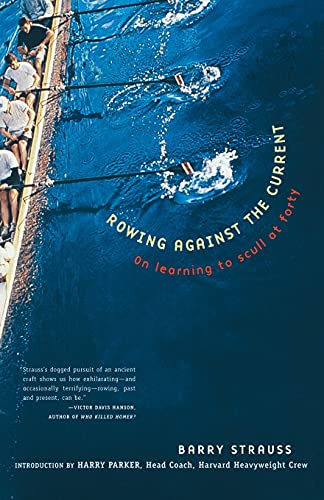
In the midst of the standard, dreary midlife crisis -- complete with wine-tasting courses, yoga classes, and a failed attempt at a first novel -- forty-year-old Barry Strauss falls unexpectedly and passionately in love with rowing, a sport in which a twenty-seven-year-old is a has-been.
Strauss, a professor of classics and history, writes about the unanticipated delights of an affair that, like so many others, begins as a casual dalliance and develops into a full-blown obsession. Drawn to the sport in part because of his affinity for Greek antiquity, he develops a love for old boathouses, a longing for rivers at dawn, a thirst to test himself, and, ultimately, a renewed sense of self-reliance -- as someone who had experienced sports humiliation as far back as Little League suddenly finds himself bursting into athleticism at an unlikely age.
From the awe-inspiring feats of the war-bound Greek triremes with their crews of 172 men rowing on three levels to the solitary pride of finishing a first race in which he gets stuck in the weeds and has to be fished out, Barry Strauss shows us why "there is nothing -- absolutely nothing -- half as much worth doing as simply messing about in boats."
Die Inhaltsangabe kann sich auf eine andere Ausgabe dieses Titels beziehen.
Über die Autorin bzw. den Autor
Barry Strauss is a senior fellow at the Hoover Institution, the Bryce and Edith M. Bowmar Professor in Humanistic Studies Emeritus at Cornell University, and a leading expert on ancient military history. He has written or edited several books, including The Battle of Salamis, The Trojan War, The Spartacus War, Masters of Command, The Death of Caesar, and Ten Caesars. Visit BarryStrauss.com.
Auszug. © Genehmigter Nachdruck. Alle Rechte vorbehalten.
Rowing Against the Current
On Learning to Scull at FortyBy Barry StraussScribner
Copyright © 2001 Barry StraussAll right reserved.
ISBN: 0684863308
Introduction
To improve the oarsman you must improve the man.-- Steve Fairbairn on Rowing
Around the time I turned forty the unfinished novel manuscript went back in the drawer. I dropped the Buddhist mantra I had been worrying over like a string of beads. What I really wanted besides career and marriage and kids and comfort was, I decided, to learn how to row boats and how to race them: four- and eight-man boats first, then two-man boats, then, finally and preeminently, a single scull. If what followed is a story worth telling, it is a tale not of a champion but of an amateur, whose heart was stirred by boats and whose imagination was lifted by history. The oars gave me power but they also taught me humility.
I began to row on a whim a few years ago. A poster in a storefront caught my fancy; it announced a summer learn-to-row course at a local boat club. I had read a lot about the history of oared ships, and I had heard a little about the sport of rowing. Graduate school friends had spoken with reverence of their undergraduate rowing experience. For years, my favorite sport had been running, but lately a string of injuries had cast doubt on my future on the road. So I decided to give the rowing course a try.
It was not a case of love at first sight. The technical complexities of the stroke confused me. If my conditioning was up to par, my innate sense of grace and my ability to concentrate left a great deal to be desired. Rowing was a tough sport and I was not a natural. After a few lessons, rowing might have gone the way of other such midlife diversions as fly-fishing, wine-tasting, yoga, and the saxophone, one-week wonders all. Yet it has lasted. Why?
Certainly not because I became a star. I am a competent rower, but my enthusiasm far outstrips my talent. I kept on rowing, rather, because I love being on the water and because the oars spoke. Listen: they spun poetry out of equations drawn from fluid mechanics. They summoned the ghosts of other rowers, from nineteenth-century collegians to Nile boatmen. Mostly, though, they asked questions, tough questions about who I am and what I am made of. Could I learn to row? Could I row a race? Could I win one? And if I couldn't win, would all the miles on the water logged in, pursuing a mirage, have brought me somewhere worth going nonetheless? After twenty years in a profession, it was sweet to hear a beginner's questions again, sweet enough to inspire the search for answers which the following pages record. Or perhaps they merely lead to other questions.
I hope this book inspires others to row. Perhaps there is a nugget or two here of practical wisdom for experienced rowers seeking to improve their form. I am not an expert on rowing technique, however, and this is not a how-to book. Several fine handbooks do exist, and they are included in the list of Suggested Readings at the end of this book. As a professional historian, I speak with more authority on oared ships of the past. Rowing has attracted over the years writers, intellectuals, and artists. A small sample of their work will be found herein, in both the text and Suggested Readings: enough to whet the appetite, if not to do them justice, and more than enough to demonstrate my good fortune in having such high standards to emulate.
A word about rowing technique. The descriptions of proper form in this book are based on my own experience, on the advice of coaches, and on my reading in the literature. Not all rowing authorities agree, however. Many points remain debated or idiosyncratic. The style may make the man, but men and women make the styles.
I have tried to keep technical terms to a minimum, but the reader will have to master a few. Rowing refers to a sport whose practitioners race in light, narrow boats propelled by oars. The practitioners are known as rowers, oarsmen, or oarswomen; the boats are known as shells. Each rower sits midway between the sides of the boat and, in what is known as sweep rowing, each rower works one long oar. In sweep rowing, a racing shell comprising two rowers, each working one oar, is called a pair; one with four rowers, each working one oar, is called a four. The most familiar racing shell, especially in high school and college competition, is the eight: that is, a shell of eight oars, four per side, one for each of the eight rowers; there is also a coxswain, who steers the boat. Seen from above, the pattern of oars in a sweep boat normally zigzags from bow (front) to stern (rear), alternating on the starboard (right) and port (left) sides of the boat, distributing power almost symmetrically. The eight is the largest shell raced today, though theoretically a rowing boat might contain far more than eight rowers. The warships of classical Greece, for instance, were rowed by one hundred seventy oarsmen, eighty five per side, arranged on three vertical decks.
Now things begin to get interesting. Give a rower a pair of two short oars, rather than one long one, and it becomes possible for one person to row a shell by himself. What is lost in camaraderie is gained in symmetry and speed. All other things being equal, a person rowing a pair of short oars will be more efficient than two persons each rowing a long oar. Such a short oar is called a scull; two such oars are called a pair of sculls. A shell worked by sculls is called a sculling boat or a scull; the rower working it, a sculler; he rows or sculls the boat. A shell worked by one sculler is called a single or a single scull; one worked by two scullers (for a total of four oars) is called a double or double scull; one worked by four scullers (a total of eight oars) is called a quad; one also finds a scull worked by eight scullers (a total of sixteen oars), called an octuple, but it is very rare indeed.
Sculling, as such rowing is called, is the main subject of this book. Sweep rowing receives some attention and indeed so do galleys (oared ships) of the ancient world, but the heart of what follows concerns sculling. Sculling is not necessarily a solitary sport. But the single sculler, alone on the river at dawn, or spotlighted in his lane during a race, is the most romantic, the most quixotic figure in all rowing. And in a sport in which every rower, whether in a rowing boat or a scull, faces backward -- did I forget to mention that? -- the Quixote is a hero.
So much for technical terminology. As for personal details, they will occupy more than enough space in what follows. Still, it will be useful for the reader to know now that I live in a college town in the northeast where I teach ancient history at a university. Facing backward, therefore, is second nature to me.
Nobody writes alone. I am extremely grateful to Harry Parker for his generosity in writing the foreword. I owe a great debt to my agents, Glen Hartley and Lynne Chu. I would especially like to thank Caroline Sutton and her colleagues at Scribner for their advice and encouragement.
I owe debts to too many friends and teammates, past and present, at the Cascadilla Boat Club (Ithaca, New York) to thank them all, but among those whom I would like to mention are Michael Bevans, Xavier Buff, Burke Carson, Stefan Cherry, Matthew Clark, Kelly Craft, Linda Godfrey, Herbert Gottfried, Bryan...
„Über diesen Titel“ kann sich auf eine andere Ausgabe dieses Titels beziehen.
Suchergebnisse für Rowing Against the Current: On Learning to Scull at...

Beispielbild für diese ISBN
Rowing Against the Current: On Learning to Scull at Forty
Anbieter: World of Books (was SecondSale), Montgomery, IL, USA
Verkäuferbewertung 5 von 5 Sternen

Paperback. Zustand: Good. Synopsis coming soon. Artikel-Nr. 00096240343
Gebraucht kaufen
EUR 6,25
Versand gratis
Versand innerhalb von USA
Versand innerhalb von USA
Anzahl: 2 verfügbar
Beispielbild für diese ISBN
Rowing Against the Current: On Learning to Scull at Forty
Anbieter: ThriftBooks-Atlanta, AUSTELL, GA, USA
Verkäuferbewertung 5 von 5 Sternen
Paperback. Zustand: Very Good. No Jacket. May have limited writing in cover pages. Pages are unmarked. ~ ThriftBooks: Read More, Spend Less. Artikel-Nr. G0684863308I4N00
Gebraucht kaufen
EUR 6,46
Versand gratis
Versand innerhalb von USA
Versand innerhalb von USA
Anzahl: 1 verfügbar
Beispielbild für diese ISBN
Rowing Against the Current: On Learning to Scull at Forty
Anbieter: ThriftBooks-Dallas, Dallas, TX, USA
Verkäuferbewertung 5 von 5 Sternen
Paperback. Zustand: Good. No Jacket. Pages can have notes/highlighting. Spine may show signs of wear. ~ ThriftBooks: Read More, Spend Less. Artikel-Nr. G0684863308I3N00
Gebraucht kaufen
EUR 6,46
Versand gratis
Versand innerhalb von USA
Versand innerhalb von USA
Anzahl: 1 verfügbar
Beispielbild für diese ISBN
Rowing Against the Current: On Learning to Scull at Forty (New York)
Verlag:
Simon & Schuster, United States, New York, 2001
ISBN 10: 0684863308
ISBN 13: 9780684863306
Gebraucht
Paperback
Anbieter: WorldofBooks, Goring-By-Sea, WS, Vereinigtes Königreich
Verkäuferbewertung 5 von 5 Sternen
Paperback. Zustand: Very Good. In the midst of the standard, dreary midlife crisis -- complete with wine-tasting courses, yoga classes, and a failed attempt at a first novel -- forty-year-old Barry Strauss falls unexpectedly and passionately in love with rowing, a sport in which a twenty-seven-year-old is a has-been. Strauss, a professor of classics and history, writes about the unanticipated delights of an affair that, like so many others, begins as a casual dalliance and develops into a full-blown obsession. Drawn to the sport in part because of his affinity for Greek antiquity, he develops a love for old boathouses, a longing for rivers at dawn, a thirst to test himself, and, ultimately, a renewed sense of self-reliance -- as someone who had experienced sports humiliation as far back as Little League suddenly finds himself bursting into athleticism at an unlikely age. From the awe-inspiring feats of the war-bound Greek triremes with their crews of 172 men rowing on three levels to the solitary pride of finishing a first race in which he gets stuck in the weeds and has to be fished out, Barry Strauss shows us why "there is nothing -- absolutely nothing -- half as much worth doing as simply messing about in boats.". The book has been read, but is in excellent condition. Pages are intact and not marred by notes or highlighting. The spine remains undamaged. Artikel-Nr. GOR005809751
Gebraucht kaufen
EUR 9,60
EUR 6,59 Versand
Versand von Vereinigtes Königreich nach USA
Versand von Vereinigtes Königreich nach USA
Anzahl: 2 verfügbar
Beispielbild für diese ISBN
Rowing Against the Current: On Learning to Scull at Forty (New York)
Anbieter: Robinson Street Books, IOBA, Binghamton, NY, USA
Verkäuferbewertung 4 von 5 Sternen

Paperback. Zustand: Very Good. Prompt Shipment, shipped in Boxes, Tracking PROVIDEDVery good clean text. Email for further information. Artikel-Nr. bingx8238424
Gebraucht kaufen
EUR 12,36
EUR 8,44 Versand
Versand innerhalb von USA
Versand innerhalb von USA
Anzahl: 1 verfügbar
Beispielbild für diese ISBN
Rowing Against the Current: On Learning to Scull at Forty
Anbieter: Ria Christie Collections, Uxbridge, Vereinigtes Königreich
Verkäuferbewertung 5 von 5 Sternen
Zustand: New. In English. Artikel-Nr. ria9780684863306_new
Neu kaufen
EUR 16,65
EUR 11,03 Versand
Versand von Vereinigtes Königreich nach USA
Versand von Vereinigtes Königreich nach USA
Anzahl: Mehr als 20 verfügbar
Beispielbild für diese ISBN
Rowing Against the Current: On Learning to Scull at Forty
Anbieter: Revaluation Books, Exeter, Vereinigtes Königreich
Verkäuferbewertung 5 von 5 Sternen
Paperback. Zustand: Brand New. 176 pages. 8.75x5.50x0.25 inches. In Stock. Artikel-Nr. x-0684863308
Neu kaufen
EUR 16,58
EUR 11,77 Versand
Versand von Vereinigtes Königreich nach USA
Versand von Vereinigtes Königreich nach USA
Anzahl: 2 verfügbar