
Verwandte Artikel zu What Remains to Be Discovered: Mapping the Secrets...
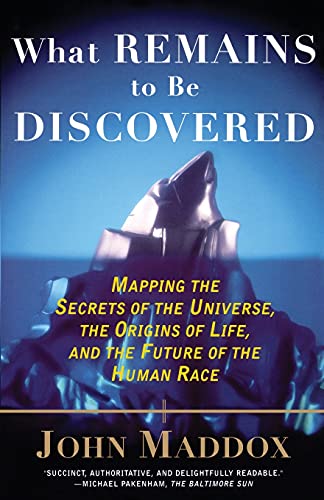
What Remains to Be Discovered: Mapping the Secrets of the Universe, the Origins of Life, and the Future of the Human Race - Softcover
Inhaltsangabe
What wonders of science will the 21st century bring? John Maddox takes up this challenge by describing precisely what remains to be discovered. Building on twenty-three years' experience at the helm of the world's preeminent science magazine, Nature, Maddox identifies new areas of discovery in physics, biology, health, intelligence, and global catastrophe. As Maddox shows, the rate of scientific discovery will continue to accelerate, hurtling us toward ever more exciting discoveries in the next century.
Die Inhaltsangabe kann sich auf eine andere Ausgabe dieses Titels beziehen.
Über die Autorin bzw. den Autor
Sir John Maddon, Editor Emeritus of Nature, was knighted for services to science in 1994 and made Fellow of the American Academy of Sciences in 1996. He was editor of Nature for twenty-three years, 1966-1973 and 1980-1995. He lives in London and Wales.
Von der hinteren Coverseite
The FUTURE Is HERE
What wonders of science will the 21st century bring? John Maddox takes up this challenge by describing precisely what remains to be discovered. Building on twenty-three years' experience at the helm of the world's preeminent science magazine, Nature, Maddox identifies new areas of discovery in physics, biology, health, intelligence, and global catastrophe. As Maddox shows, the rate of scientific discovery will continue to accelerate, hurtling us toward ever more exciting discoveries in the next century.
Auszug. © Genehmigter Nachdruck. Alle Rechte vorbehalten.
Preface
This book springs from a question first asked by my son Bruno: "If you're editor of Nature, why can't you say what will be discovered next?" In 1995, when I knew I would be leaving that thoroughly international science journal after nearly 23 years as editor-in-chief, it seemed that it would be useful to set down in simple language an account of what scientists are hoping to achieve. One of the joys of being such an editor is listening to researchers eagerly enthuse about the significance and possible outcomes of their work, while knowing at the same time that they would never be so enthusiastic about their research in print. Why not distill that unrestrained chatter into an account of where science is heading, of what remains to be discovered?
I was much helped when the Brookhaven National Laboratory invited me, in June 1996, to deliver its annual Pegram Lectures. It was an opportunity to see whether my ideas about the future of science hung together, and, having completed the lecture series, I was encouraged and emboldened. As work on the manuscript of this book proceeded, my son Bruno came to my aid. He raised serious and thoughtful objections to an early version, and I am deeply grateful for his perceptive criticism ever since.
What remains to be discovered is not, of course, the same as what will be discovered. It is possible to tell what loose ends are now dangling before us, but not how they will eventually be pulled together. People who knew that would take themselves off to a laboratory confident that a Nobel Prize would soon be on the way.
Science at present is a curious patchwork. Fundamental physics is perhaps the oddest: the research community is divided into those who believe that there will be a "theory of everything" very shortly and those who suspect (or hope) that the years ahead will throw up some kind of "new physics" instead. History is on the side of the second camp, to which I belong. By contrast, exuberant molecular genetics seems in a state in which any problem that can be accurately defined can be solved by a few weeks' work in a laboratory. There, it is more difficult to tell what problems will emerge -- as they certainly will.
I am aware that many important fields of science are not touched by this survey of outstanding problems. The most obvious is that of the solar system. The closing third of this century has seen a quite remarkable transformation of our views of how the Earth is built. The doctrine of plate tectonics (continental drift) has been firmly established. Superficially, the matter appears to have been tidied up. But a little reflection shows that to be an illusion. The mechanism that drives the tectonic plates over Earth's surface is far from clear. More to the point, it remains to be seen how the same ideas can be applied to the understanding of other solid objects in the solar system -- both planets such as Venus and satellites of Jupiter such as the strange object Io. And exactly how were the planets formed from the solar nebula, anyway? These are all absorbing questions but no new principles are involved.
......
Two close friends of mine have read the penultimate version of this text. Professor Maxime Frank-Kamanetsky, a molecular biologist whom I first met in Moscow in 1986 and who is now a member of the faculty at Boston University, and Dr. Henry Gee, Nature's resident paleontologist who has a catholic interest in all of science, have both made valuable and constructive suggestions. I owe them a great debt, although the errors and the omissions that remain are my own responsibility.
I am also grateful to my publishers, who have put up with my vacillation, and particularly to Stephen Morrow of The Free Press, who has helped enormously to shape this text by providing a stream of pointed and detailed comment on its successive versions, always with intelligence and good humor.
......
And the message? Despite assertions to the contrary, the lode of discovery is far from worked out. This book provides an agenda for several decades, even centuries, of constructive discovery that will undoubtedly change our view of our place in the world as radically as it has been changed since the time of Copernicus. Indeed, the transformation in prospect is likely to touch the imagination of all of us dramatically. How shall we feel when we know the true history of the evolution of Homo sapiens from the great apes? And when there are found to be, or even to have been, living things elsewhere in the galaxy?
But that is merely the tip of the iceberg of future discovery. The record shows that generations of scientists have been repeatedly surprised by discoveries that were not anticipated and could not have been guessed at by much earlier versions of a book like this. Who, at the end of the nineteenth century, could have smelled out the way in which physics would be turned on its head by relativity and quantum mechanics, and how the structure of DNA would have made life intelligible? And who, now, dares say that the days of surprise are over?
London, January 1998
Copyright © 1998 by John Maddox
Introduction: The River of Discovery
This century has been so rich in discovery and so packed with technical innovation that it is tempting to believe that there can never be another like it. That conceit betrays the poverty of our collective imagination. One purpose of this book is to take up some of the questions now crying out for attention, but which cannot yet be answered. The record of previous centuries suggests that the excitement in the years ahead will spring from the answers to the questions we do not yet know enough to ask.
It is an abiding difficulty in science that perspective is distorted because the structure of scientific knowledge makes its own history seem irrelevant. We forget that modern science in the European tradition is already 500 years old, dating from the time of the Polish astronomer Copernicus. The Copernican revolution was a century-long and, ultimately, successful struggle to establish that the Sun, not Earth, is at the center of the solar system.
The contributions of the ancient Chinese, the extinct civilizations of the Indus Valley, the Babylonians and Greeks, naïve though they may now seem, cannot be scorned. Copernicus and those who followed profited from them. And it remains a source of wonder that Chinese records of past astronomical events have been indispensable in the interpretation, within the past 30 years, of the exploding stars known as supernovae; that only now is a systematic search being made of the same records for plants that may be sources of still-useful therapeutic drugs; that the Athenian Greek Erastothenes made a good estimate of the circumference of Earth more than 2,000 years ago; and that the concept of zero in arithmetic, of which even Euclid was innocent, was formulated on the Indian subcontinent soon after the beginning of the modern era. Even the alchemists who distracted the Middle Ages with their search for the philosopher's stone that would turn anything it touched into gold should not be despised; they understood that chemical reactions can turn one substance into another that looks very different.
There is nevertheless a clear distinction between modern science and its precursors: the interplay between observation and explanation was formerly less important than it is now. A theory qualifies as an explanation only if it can be and has been tested by observation or experiment, employing when necessary measurements more sensitive than the human senses can yield. A further novelty of the modern idiom is that each phenomenon -- the existence of the Universe, the fact of life on Earth, and the working of the brain -- demands a physical explanation.
Copernicus...
„Über diesen Titel“ kann sich auf eine andere Ausgabe dieses Titels beziehen.
Suchergebnisse für What Remains to Be Discovered: Mapping the Secrets...

Beispielbild für diese ISBN
What Remains to Be Discovered: Mapping the Secrets of the Universe, the Origins of Life, and the Future of the Human Race
Anbieter: World of Books (was SecondSale), Montgomery, IL, USA
Verkäuferbewertung 5 von 5 Sternen

Zustand: Very Good. Item in very good condition! Textbooks may not include supplemental items i.e. CDs, access codes etc. Artikel-Nr. 00074914653
Gebraucht kaufen
EUR 4,61
Versand gratis
Versand innerhalb von USA
Versand innerhalb von USA
Anzahl: 2 verfügbar
Beispielbild für diese ISBN
What Remains to Be Discovered: Mapping the Secrets of the Universe, the Origins of Life, and the Future of the Human Race
Anbieter: World of Books (was SecondSale), Montgomery, IL, USA
Verkäuferbewertung 5 von 5 Sternen
Zustand: Acceptable. Item in acceptable condition! Textbooks may not include supplemental items i.e. CDs, access codes etc. Artikel-Nr. 00106921023
Gebraucht kaufen
EUR 4,61
Versand gratis
Versand innerhalb von USA
Versand innerhalb von USA
Anzahl: 1 verfügbar
Beispielbild für diese ISBN
What Remains to Be Discovered: Mapping the Secrets of the Universe, the Origins of Life, and the Future of the Human Race
Anbieter: Wonder Book, Frederick, MD, USA
Verkäuferbewertung 5 von 5 Sternen
Zustand: Very Good. Very Good condition. With remainder mark. A copy that may have a few cosmetic defects. May also contain light spine creasing or a few markings such as an owner's name, short gifter's inscription or light stamp. Artikel-Nr. J14O-00442
Gebraucht kaufen
EUR 6,33
Versand gratis
Versand innerhalb von USA
Versand innerhalb von USA
Anzahl: 1 verfügbar
Beispielbild für diese ISBN
What Remains to Be Discovered: Mapping the Secrets of the Universe, the Origins of Life, and the Future of the Human Race
Anbieter: Wonder Book, Frederick, MD, USA
Verkäuferbewertung 5 von 5 Sternen
Zustand: Very Good. Very Good condition. A copy that may have a few cosmetic defects. May also contain light spine creasing or a few markings such as an owner's name, short gifter's inscription or light stamp. Artikel-Nr. L11N-01040
Gebraucht kaufen
EUR 6,33
Versand gratis
Versand innerhalb von USA
Versand innerhalb von USA
Anzahl: 1 verfügbar
Beispielbild für diese ISBN
What Remains to Be Discovered: Mapping the Secrets of the Universe, the Origins of Life, and the Future of the Human Race
Anbieter: ThriftBooks-Atlanta, AUSTELL, GA, USA
Verkäuferbewertung 5 von 5 Sternen
Paperback. Zustand: As New. No Jacket. Pages are clean and are not marred by notes or folds of any kind. ~ ThriftBooks: Read More, Spend Less. Artikel-Nr. G0684863006I2N00
Gebraucht kaufen
EUR 6,63
Versand gratis
Versand innerhalb von USA
Versand innerhalb von USA
Anzahl: 1 verfügbar
Beispielbild für diese ISBN
What Remains to Be Discovered: Mapping the Secrets of the Universe, the Origins of Life, and the Future of the Human Race
Anbieter: AwesomeBooks, Wallingford, Vereinigtes Königreich
Verkäuferbewertung 5 von 5 Sternen
Paperback. Zustand: Very Good. What Remains to Be Discovered: Mapping the Secrets of the Universe, the Origins of Life, and the Future of the Human Race This book is in very good condition and will be shipped within 24 hours of ordering. The cover may have some limited signs of wear but the pages are clean, intact and the spine remains undamaged. This book has clearly been well maintained and looked after thus far. Money back guarantee if you are not satisfied. See all our books here, order more than 1 book and get discounted shipping. Artikel-Nr. 7719-9780684863009
Gebraucht kaufen
EUR 4,50
EUR 4,79 Versand
Versand von Vereinigtes Königreich nach USA
Versand von Vereinigtes Königreich nach USA
Anzahl: 2 verfügbar
Beispielbild für diese ISBN
What Remains to Be Discovered: Mapping the Secrets of the Universe, the Origins of Life, and the Future of the Human Race
Anbieter: WorldofBooks, Goring-By-Sea, WS, Vereinigtes Königreich
Verkäuferbewertung 5 von 5 Sternen
Paperback. Zustand: Very Good. The book has been read, but is in excellent condition. Pages are intact and not marred by notes or highlighting. The spine remains undamaged. Artikel-Nr. GOR003686952
Gebraucht kaufen
EUR 3,00
EUR 6,51 Versand
Versand von Vereinigtes Königreich nach USA
Versand von Vereinigtes Königreich nach USA
Anzahl: 4 verfügbar
Foto des Verkäufers
What Remains to Be Discovered: Mapping the Secrets of the Universe, the Origins of Life, and the Future of the Human Race
Anbieter: WeBuyBooks, Rossendale, LANCS, Vereinigtes Königreich
Verkäuferbewertung 5 von 5 Sternen
paperback. Zustand: Very Good. Most items will be dispatched the same or the next working day. A copy that has been read, but is in excellent condition. Pages are intact and not marred by notes or highlighting. The spine remains undamaged. Artikel-Nr. rev4177968622
Gebraucht kaufen
EUR 1,83
EUR 7,99 Versand
Versand von Vereinigtes Königreich nach USA
Versand von Vereinigtes Königreich nach USA
Anzahl: 1 verfügbar
Beispielbild für diese ISBN
What Remains to Be Discovered : Mapping the Secrets of the Universe, the Origins of Life, and the Future of the Human Race
Anbieter: Better World Books: West, Reno, NV, USA
Verkäuferbewertung 5 von 5 Sternen
Zustand: Very Good. Pages intact with possible writing/highlighting. Binding strong with minor wear. Dust jackets/supplements may not be included. Stock photo provided. Product includes identifying sticker. Better World Books: Buy Books. Do Good. Artikel-Nr. 41851520-6
Gebraucht kaufen
EUR 10,22
Versand gratis
Versand innerhalb von USA
Versand innerhalb von USA
Anzahl: 1 verfügbar
Beispielbild für diese ISBN
What Remains to Be Discovered: Mapping the Secrets of the Universe, the Origins of Life, and the Future of the Human Race
Anbieter: Bahamut Media, Reading, Vereinigtes Königreich
Verkäuferbewertung 4 von 5 Sternen

Paperback. Zustand: Very Good. This book is in very good condition and will be shipped within 24 hours of ordering. The cover may have some limited signs of wear but the pages are clean, intact and the spine remains undamaged. This book has clearly been well maintained and looked after thus far. Money back guarantee if you are not satisfied. See all our books here, order more than 1 book and get discounted shipping. Artikel-Nr. 6545-9780684863009
Gebraucht kaufen
EUR 4,84
EUR 8,12 Versand
Versand von Vereinigtes Königreich nach USA
Versand von Vereinigtes Königreich nach USA
Anzahl: 2 verfügbar