
Verwandte Artikel zu Seeing Through Places: Reflections on Geography and...
Inhaltsangabe
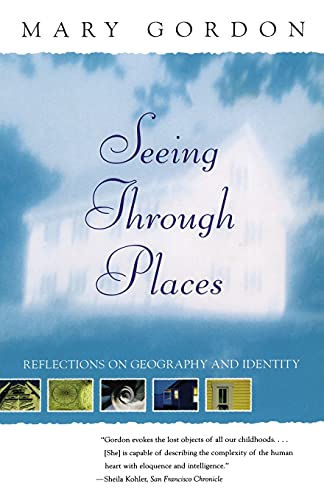
Mary Gordon, bestselling author of Spending and The Shadow Man, investigates the role that place plays in the formation of identity -- the connections between how we experience place and how we become ourselves. From her grandmother's house, which stood at the center of her childhood life, to a rented house on Cape Cod, where she began to mature as a writer, Mary Gordon navigates the reader through these spaces and worlds with subtlety and style. Wise, humorous, and intelligent, Seeing Through Places illuminates the relationship between the physical, emotional, and intellectual architectures of our lives, showing us the far-reaching power that places ultimately have in influencing a life.
Die Inhaltsangabe kann sich auf eine andere Ausgabe dieses Titels beziehen.
Über die Autorin bzw. den Autor
Mary Gordon is the author of Spending, The Company of Women, The Rest of Life, and The Shadow Man. Winner of the Lila Acheson Wallace Reader's Digest Award, a Guggenheim Fellowship, and the 1997 O. Henry Prize for best short story, she teaches at Barnard College and lives in New York City.
Auszug. © Genehmigter Nachdruck. Alle Rechte vorbehalten.
Chapter One: My Grandmother's House
Some days I would be left at my grandmother's house. I never knew why. Usually, I could ask my father anything, but I couldn't ask him that, why I was being left at my grandmother's, because I knew it was a privilege to be in that house, and no one, even my father would understand my reluctance. It was only a partial reluctance anyway, and I believed then that I had no business communicating anything I only partially understood.
Entering the house, I was plunged into an atmosphere of bafflement. The words, the manners, all the things, were foreign to me. The foreignness almost seemed literal; often I didn't understand what the people in my grandmother's house were saying, and often what I said was not understood.
What do I mean by understand? There were names for things that I found unfamiliar: "commode" for toilet, "box" for the area of the floor where the dog was made to lie, "pantry" for a series of shelves on one of the kitchen walls. My mother used these words easily, but she didn't use them to describe anything in our house. Or our apartment, what my father and I called home but what was to her something else. Something serious and untemporary. Something that generated no names proper to itself. In her mother's house, my mother knew that everything had been named long ago, once and for all.
I had trouble placing my grandmother's house. I knew it had nothing to do with America. Or postwar life. And yet it stood at the center of the lives of all her children and her children's children. It expressed an era -- historical, perhaps, wholly imaginary, that we grandchildren only vaguely understood. We knew that it had ended long before we were born; it seemed to have touched upon our parents' early childhood, but we weren't sure. There were twenty-one grandchildren who visited my grandmother's house regularly. Of her nine children, only two had settled more than ten miles away from her. We all lived on Long Island, in towns that bordered Queens and took their identity more from "the city" than "the island." My grandmother had lived in the same house since 1920, when the area was farmland; she despised the people who had moved there from Brooklyn or the Bronx after the war. She condemned new houses and the objects in them.
Each object in her house belonged to the Old World. Nothing was easy; everything required maintenance of a complicated and specialized sort. Nothing was disposable, replaceable. There were no errors of taste because there were no imaginable other choices. I was not unhappy there; each object's rightness of placement made me feel honored to be among them. Yet I was always guilty among those things, as if they knew I preferred what was in my glamorous aunt's house. She lived in the next town from my grandmother's; her husband owned a liquor store and made more money than anyone we knew. My aunt and uncle bought things easily, unlike the rest of the family, and so the house was full of new or newish objects: the plastic holders for playing cards, like shells or fans, the nut dishes in the shape of peanuts, the corn dishes in the shape of ears of corn, the hair dryer like a rocket, the makeup mirror framed by lightbulbs, the bottles of nail polish, the ice bucket, the cocktail shaker, the deep freeze. And the house was stocked with pleasurable things to eat, drink, sit on, listen to, lean against, watch, sleep in, ride, or wear. I knew these pleasures to be inferior, but I sank into them each time, stealing their luxury and fearing for my soul, as I half feared for my aunt's which I couldn't imagine to be the same, interested as she was in having a good time.
My grandmother had no interest in having a good time -- that is, in doing anything that would result only in pleasure -- and her house proclaimed this, as it proclaimed everything about her. Her house was her body, and like her body, was honorable, daunting, reassuring, defended, castigating, harsh, embellished, dark. I can't imagine how she lived, that is to say how she didn't die of the endless labor her life entailed. Nine children. It's easy either to romanticize her or utterly to push her aside.
Although I wasn't happy there, I did, somehow, like her house. Her garden had old-fashioned flowers, bright colored, a little wild; marigold, cosmos, foxglove, phlox. Older varieties of roses, whose petals seemed thinner than those of more recent types, more susceptible, as my soft flesh was more susceptible than those of the adults around me, to insect bites that made it horrible to the eye. I liked her garden even better than my aunt's, where the greens were deeper than the greens of any leaves or grass I'd seen anywhere else. I linked dark greenness to prosperity, as if my uncle had invested in that greenness so that we would all be more secure. My grandmother's house had no connection to prosperity; it had righteousness instead.
There were three ways you could enter the house: through the front porch, the side porch, or the kitchen. The kitchen was the most common way. Tacked on, it hadn't originally been part of the house. It floated on nothing, it had no foundations, it was a ship that sailed on air. And yet it was a serious place. Difficult and steady work went on there; the kitchen was productive, rigorous. And yet so light! Its lightness was a particular pleasure in summer. The screen door opened with a leisurely, indulgent creak. It bent back on a steel hasp, and even a child could hook it open easily. All the things that kitchen contained: marjoram, nutmeg, green peppercorns, sage from the garden, mason jars of preserved fruit! Some hints of the Italian from my Italian grandfather: ricotta mixed with cinnamon and sugar, almond biscotti, fresh figs purple at the top, fading to a tender green. Irish soda bread my grandmother had learned to make as a girl at home. Inexplicably, hamantaschen -- a way of using up the jars and jars of preserved figs. She would save a little dough, a little bit of fig, for me to make my own. She'd put mine in the oven along with hers, but mine were much, much smaller and they always burned. Beside her rows of golden pastry hats were my two burnt offerings, charred and solid black. I would eat them anyway, pretending they were good. I felt I had to, out of loyalty. "Don't eat those things, eat one of my nice ones here," she'd always say, and, guiltily, I would.
What was this all about? She was an expert baker. Why didn't she put my pastries in first and take them out before she put hers in? Or put mine in later, so they'd be ready at the same time as hers? What was she trying to show me? That I could try and try but would never be as good as she? That I should not have trusted her? That I should always keep an eye out, because whatever I did in life would be my own affair? It never occurred to me that the situation could be any different. My grandmother's implacable posture made the idea of alternatives impossible. What was, was. Because it had to be.
That kitchen was a monument to her refusal to accept the modern world. The sink was deep and had two narrow spigots, made of brass, that let out only thin, slow streams of water, unlike the jubilant spurts from the stainless steel faucets of ordinary fifties sinks. The table was white deal, with a seam down the middle where it could be made to fold, but it was never folded. My grandmother would run a knife blade through that seam and the ones along the sides, to dislodge crumbs of dried food. This was the sort of thing she was doing when people perceived her as being still. The linoleum was dull gray with spattered dots of red, yellow, and black. Her dishes were white with gentle floral patterns, pink and blue. I don't know where they might have come from.
There were a lot of things around the house that, like those dishes, suggested a half-glimpsed gentility. If you went into the...
„Über diesen Titel“ kann sich auf eine andere Ausgabe dieses Titels beziehen.
Suchergebnisse für Seeing Through Places: Reflections on Geography and...

Beispielbild für diese ISBN
Seeing Through Places: Reflections on Geography and Identity
Anbieter: World of Books (was SecondSale), Montgomery, IL, USA
Verkäuferbewertung 5 von 5 Sternen

Zustand: Good. Item in very good condition! Textbooks may not include supplemental items i.e. CDs, access codes etc. Artikel-Nr. 00073935883
Gebraucht kaufen
EUR 5,09
Versand gratis
Versand innerhalb von USA
Versand innerhalb von USA
Anzahl: 1 verfügbar
Beispielbild für diese ISBN
Seeing Through Places: Reflections on Geography and Identity
Verlag:
Scribner (edition 1st Touchstone Ed), 2001
ISBN 10: 0684862557
ISBN 13: 9780684862552
Gebraucht
Paperback
Anbieter: BooksRun, Philadelphia, PA, USA
Verkäuferbewertung 5 von 5 Sternen
Paperback. Zustand: Very Good. 1st Touchstone Ed. It's a well-cared-for item that has seen limited use. The item may show minor signs of wear. All the text is legible, with all pages included. It may have slight markings and/or highlighting. Artikel-Nr. 0684862557-11-1
Gebraucht kaufen
EUR 5,10
Versand gratis
Versand innerhalb von USA
Versand innerhalb von USA
Anzahl: 1 verfügbar
Beispielbild für diese ISBN
Seeing Through Places: Reflections on Geography and Identity
Anbieter: ThriftBooks-Atlanta, AUSTELL, GA, USA
Verkäuferbewertung 5 von 5 Sternen
Paperback. Zustand: Very Good. No Jacket. May have limited writing in cover pages. Pages are unmarked. ~ ThriftBooks: Read More, Spend Less. Artikel-Nr. G0684862557I4N00
Gebraucht kaufen
EUR 6,08
Versand gratis
Versand innerhalb von USA
Versand innerhalb von USA
Anzahl: 1 verfügbar
Beispielbild für diese ISBN
Seeing Through Places: Reflections on Geography and Identity
Anbieter: ThriftBooks-Atlanta, AUSTELL, GA, USA
Verkäuferbewertung 5 von 5 Sternen
Paperback. Zustand: Good. No Jacket. Former library book; Pages can have notes/highlighting. Spine may show signs of wear. ~ ThriftBooks: Read More, Spend Less. Artikel-Nr. G0684862557I3N10
Gebraucht kaufen
EUR 6,08
Versand gratis
Versand innerhalb von USA
Versand innerhalb von USA
Anzahl: 1 verfügbar
Beispielbild für diese ISBN
Seeing Through Places : Reflections on Geography and Identity
Anbieter: Better World Books, Mishawaka, IN, USA
Verkäuferbewertung 5 von 5 Sternen
Zustand: Very Good. 1 Edition. Former library copy. Pages intact with possible writing/highlighting. Binding strong with minor wear. Dust jackets/supplements may not be included. Includes library markings. Stock photo provided. Product includes identifying sticker. Better World Books: Buy Books. Do Good. Artikel-Nr. 12436023-6
Gebraucht kaufen
EUR 7,20
Versand gratis
Versand innerhalb von USA
Versand innerhalb von USA
Anzahl: 1 verfügbar
Beispielbild für diese ISBN
Seeing Through Places : Reflections on Geography and Identity
Anbieter: Better World Books, Mishawaka, IN, USA
Verkäuferbewertung 5 von 5 Sternen
Zustand: Good. 1 Edition. Pages intact with minimal writing/highlighting. The binding may be loose and creased. Dust jackets/supplements are not included. Stock photo provided. Product includes identifying sticker. Better World Books: Buy Books. Do Good. Artikel-Nr. 3393642-6
Gebraucht kaufen
EUR 7,20
Versand gratis
Versand innerhalb von USA
Versand innerhalb von USA
Anzahl: 1 verfügbar
Beispielbild für diese ISBN
Seeing Through Places : Reflections on Geography and Identity
Anbieter: Better World Books, Mishawaka, IN, USA
Verkäuferbewertung 5 von 5 Sternen
Zustand: Good. 1 Edition. Former library copy. Pages intact with minimal writing/highlighting. The binding may be loose and creased. Dust jackets/supplements are not included. Includes library markings. Stock photo provided. Product includes identifying sticker. Better World Books: Buy Books. Do Good. Artikel-Nr. GRP102595659
Gebraucht kaufen
EUR 7,20
Versand gratis
Versand innerhalb von USA
Versand innerhalb von USA
Anzahl: 1 verfügbar
Foto des Verkäufers
Seeing Through Places: Reflections on Geography and Identity
Anbieter: Southampton Books, Sag Harbor, NY, USA
Verkäuferbewertung 5 von 5 Sternen
Paperback. Zustand: Very Good. First Edition. First Edition, First Printing. Published by Scribner, 2001. Octavo. Paperback. Book is very good. Artikel-Nr. 553305
Gebraucht kaufen
EUR 9,18
EUR 4,44 Versand
Versand innerhalb von USA
Versand innerhalb von USA
Anzahl: 1 verfügbar
Beispielbild für diese ISBN
Seeing Thjrough Places
Anbieter: Robinson Street Books, IOBA, Binghamton, NY, USA
Verkäuferbewertung 4 von 5 Sternen

Trade Paperbac. Zustand: Used: Very good. Prompt Shipment, shipped in Boxes, Tracking PROVIDEDBiography: General; Very good trade paperback; tanning pages; remainder mark top edge; tips bumped; clean pages; prompt shipping with tracking. Artikel-Nr. Bing679NP045
Gebraucht kaufen
EUR 12,39
EUR 8,46 Versand
Versand innerhalb von USA
Versand innerhalb von USA
Anzahl: 1 verfügbar
Beispielbild für diese ISBN
Seeing Through Places: Reflections on Geography and Identity
Anbieter: Robinson Street Books, IOBA, Binghamton, NY, USA
Verkäuferbewertung 4 von 5 Sternen
Paperback. Zustand: As New. Prompt Shipment, shipped in Boxes, Tracking PROVIDEDFine. First edition. Artikel-Nr. bing7967032
Gebraucht kaufen
EUR 12,39
EUR 8,46 Versand
Versand innerhalb von USA
Versand innerhalb von USA
Anzahl: 1 verfügbar