
Verwandte Artikel zu How to Read and Why
Inhaltsangabe
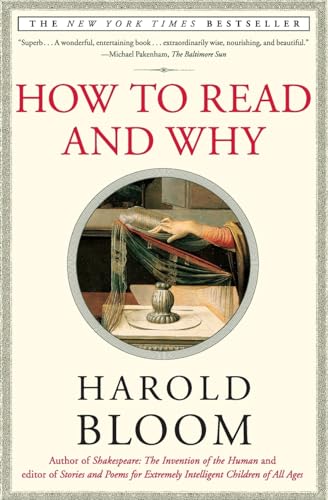
Information is endlessly available to us; where shall wisdom be found?" is the crucial question with which renowned literary critic Harold Bloom begins this impassioned book on the pleasures and benefits of reading well. For more than forty years, Bloom has transformed college students into lifelong readers with his unrivaled love for literature. Now, at a time when faster and easier electronic media threatens to eclipse the practice of reading, Bloom draws on his experience as critic, teacher, and prolific reader to plumb the great books for their sustaining wisdom.
Shedding all polemic, Bloom addresses the solitary reader, who, he urges, should read for the purest of all reasons: to discover and augment the self. His ultimate faith in the restorative power of literature resonates on every page of this infinitely rewarding and important book.
Die Inhaltsangabe kann sich auf eine andere Ausgabe dieses Titels beziehen.
Über die Autorin bzw. den Autor
Harold Bloom (1930–2019) was Sterling Professor of Humanities at Yale University. He wrote more than sixty books, including Cleopatra: I Am Fire and Air, Falstaff: Give Me Life, The Western Canon, Shakespeare: The Invention of the Human, and How to Read and Why. He was a MacArthur Prize fellow, a member of the American Academy of Arts and Letters, and the recipient of many awards, including the Academy’s Gold Medal for Criticism.
Auszug. © Genehmigter Nachdruck. Alle Rechte vorbehalten.
Prologue: Why Read?
It matters, if individuals are to retain any capacity to form their own judgments and opinions, that they continue to read for themselves. How they read, well or badly, and what they read, cannot depend wholly upon themselves, but why they read must be for and in their own interest. You can read merely to pass the time, or you can read with an overt urgency, but eventually you will read against the clock. Bible readers, those who search the Bible for themselves, perhaps exemplify the urgency more plainly than readers of Shakespeare, yet the quest is the same. One of the uses of reading is to prepare ourselves for change, and the final change alas is universal.
I turn to reading as a solitary praxis, rather than as an educational enterprise. The way we read now, when we are alone with ourselves, retains considerable continuity with the past, however it is performed in the academies. My ideal reader (and lifelong hero) is Dr. Samuel Johnson, who knew and expressed both the power and the limitation of incessant reading. Like every other activity of the mind, it must satisfy Johnson's prime concern, which is with "what comes near to ourself, what we can put to use." Sir Francis Bacon, who provided some of the ideas that Johnson put to use, famously gave the advice: "Read not to contradict and confute, nor to believe and take for granted, nor to find talk and discourse, but to weigh and consider." I add to Bacon and Johnson a third sage of reading, Emerson, fierce enemy of history and of all historicisms, who remarked that the best books "impress us with the conviction, that one nature wrote and the same reads." Let me fuse Bacon, Johnson, and Emerson into a formula of how to read: find what comes near to you that can be put to the use of weighing and considering, and that addresses you as though you share the one nature, free of time's tyranny. Pragmatically that means, first find Shakespeare, and let him find you. If King Lear is fully to find you, then weigh and consider the nature it shares with you; its closeness to yourself. I do not intend this as an idealism, but as a pragmatism. Putting the tragedy to use as a complaint against patriarchy is to forsake your own prime interests, particularly as a young woman, which sounds rather more ironical than it is. Shakespeare, more than Sophocles, is the inescapable authority upon intergenerational conflict, and more than anyone else, upon the differences between women and men. Be open to a full reading of King Lear, and you will understand better the origins of what you judge to be patriarchy.
Ultimately we read -- as Bacon, Johnson, and Emerson agree -- in order to strengthen the self, and to learn its authentic interests. We experience such augmentations as pleasure, which may be why aesthetic values have always been deprecated by social moralists, from Plato through our current campus Puritans. The pleasures of reading indeed are selfish rather than social. You cannot directly improve anyone else's life by reading better or more deeply. I remain skeptical of the traditional social hope that care for others may be stimulated by the growth of individual imagination, and I am wary of any arguments whatsoever that connect the pleasures of solitary reading to the public good.
The sorrow of professional reading is that you recapture only rarely the pleasure of reading you knew in youth, when books were a Hazlittian gusto. The way we read now partly depends upon our distance, inner or outer, from the universities, where reading is scarcely taught as a pleasure, in any of the deeper senses of the aesthetics of pleasure. Opening yourself to a direct confrontation with Shakespeare at his strongest, as in King Lear, is never an easy pleasure, whether in youth or in age, and yet not to read King Lear fully (which means without ideological expectations) is to be cognitively as well as aesthetically defrauded. A childhood largely spent watching television yields to an adolescence with a computer, and the university receives a student unlikely to welcome the suggestion that we must endure our going hence even as our going hither: ripeness is all. Reading falls apart, and much of the self scatters with it. All this is past lamenting, and will not be remedied by any vows or programs. What is to be done can only be performed by some version of elitism, and that is now unacceptable, for reasons both good and bad. There are still solitary readers, young and old, everywhere, even in the universities. If there is a function of criticism at the present time, it must be to address itself to the solitary reader, who reads for herself, and not for the interests that supposedly transcend the self.
Value, in literature as in life, has much to do with the idiosyncratic, with the excess by which meaning gets started. It is not accidental that historicists -- critics who believe all of us to be overdetermined by societal history -- should also regard literary characters as marks upon a page, and nothing more. Hamlet is not even a case history if our thoughts are not at all our own. I come then to the first principle if we are to restore the way we read now, a principle I appropriate from Dr. Johnson: Clear your mind of cant. Your dictionary will tell you that cant in this sense is speech overflowing with pious platitudes, the peculiar vocabulary of a sect or coven. Since the universities have empowered such covens as "gender and sexuality" and "multiculturalism," Johnson's admonition thus becomes "Clear your mind of academic cant." A university culture where the appreciation of Victorian women's underwear replaces the appreciation of Charles Dickens and Robert Browning sounds like the outrageousness of a new Nathanael West, but is merely the norm. A side product of such "cultural poetics" is that there can be no new Nathanael West, for how could such an academic culture sustain parody? The poems of our climate have been replaced by the body stockings of our culture. Our new Materialists tell us that they have recovered the body for historicism, and assert that they work in the name of the Reality Principle. The life of the mind must yield to the death of the body, yet that hardly requires the cheerleading of an academic sect.
Clear your mind of cant leads on to the second principle of restoring reading: Do not attempt to improve your neighbor or your neighborhood by what or how you read. Self-improvement is a large enough project for your mind and spirit: there are no ethics of reading. The mind should be kept at home until its primal ignorance has been purged; premature excursions into activism have their charm, but are time-consuming, and for reading there will never be enough time. Historicizing, whether of past or present, is a kind of idolatry, an obsessive worship of things in time. Read therefore by the inner light that John Milton celebrated and that Emerson took as a principle of reading, which can be our third: A scholar is a candle which the love and desire of all men will light. Wallace Stevens, perhaps forgetting his source, wrote marvelous variations upon that metaphor, but the original Emersonian phrasing makes for a clearer statement of the third principle of reading. You need not fear that the freedom of your development as a reader is selfish, because if you become an authentic reader, then the response to your labors will confirm you as an illumination to others. I ponder the letters that I receive from strangers these last seven or eight years, and generally I am too moved to reply. Their pathos, for me, is that all too often they testify to a yearning for canonical literary study that universities disdain to fulfill. Emerson said that society cannot do without cultivated men and women, and prophetically he added: "The people, and not the college, is the writer's...
„Über diesen Titel“ kann sich auf eine andere Ausgabe dieses Titels beziehen.
Suchergebnisse für How to Read and Why

Foto des Verkäufers
How to Read and Why
Anbieter: Dream Books Co., Denver, CO, USA
Verkäuferbewertung 5 von 5 Sternen

Zustand: acceptable. This copy has clearly been enjoyedâ"expect noticeable shelf wear and some minor creases to the cover. Binding is strong, and all pages are legible. May contain previous library markings or stamps. Artikel-Nr. DBV.0684859076.A
Gebraucht kaufen
EUR 3,89
Versand gratis
Versand innerhalb von USA
Versand innerhalb von USA
Anzahl: 2 verfügbar
Beispielbild für diese ISBN
How to Read and Why
Anbieter: World of Books (was SecondSale), Montgomery, IL, USA
Verkäuferbewertung 5 von 5 Sternen
Paperback. Zustand: Good. Information is endlessly available to us; where shall wisdom be found?" is the crucial question with which renowned literary critic Harold Bloom begins this impassioned book on the pleasures and benefits of reading well. For more than forty years, Bloom has transformed college students into lifelong readers with his unrivaled love for literature. Now, at a time when faster and easier electronic media threatens to eclipse the practice of reading, Bloom draws on his experience as critic, teacher, and prolific reader to plumb the great books for their sustaining wisdom. Shedding all polemic, Bloom addresses the solitary reader, who, he urges, should read for the purest of all reasons: to discover and augment the self. His ultimate faith in the restorative power of literature resonates on every page of this infinitely rewarding and important book. Artikel-Nr. 00104733370
Gebraucht kaufen
EUR 3,94
Versand gratis
Versand innerhalb von USA
Versand innerhalb von USA
Anzahl: 9 verfügbar
Beispielbild für diese ISBN
How to Read and Why
Anbieter: World of Books (was SecondSale), Montgomery, IL, USA
Verkäuferbewertung 5 von 5 Sternen
Paperback. Zustand: Fair. Information is endlessly available to us; where shall wisdom be found?" is the crucial question with which renowned literary critic Harold Bloom begins this impassioned book on the pleasures and benefits of reading well. For more than forty years, Bloom has transformed college students into lifelong readers with his unrivaled love for literature. Now, at a time when faster and easier electronic media threatens to eclipse the practice of reading, Bloom draws on his experience as critic, teacher, and prolific reader to plumb the great books for their sustaining wisdom. Shedding all polemic, Bloom addresses the solitary reader, who, he urges, should read for the purest of all reasons: to discover and augment the self. His ultimate faith in the restorative power of literature resonates on every page of this infinitely rewarding and important book. Artikel-Nr. 00102675080
Gebraucht kaufen
EUR 3,94
Versand gratis
Versand innerhalb von USA
Versand innerhalb von USA
Anzahl: 9 verfügbar
Foto des Verkäufers
How to Read and Why
Anbieter: Dream Books Co., Denver, CO, USA
Verkäuferbewertung 5 von 5 Sternen
Zustand: good. Gently used with minimal wear on the corners and cover. A few pages may contain light highlighting or writing, but the text remains fully legible. Dust jacket may be missing, and supplemental materials like CDs or codes may not be included. May be ex-library with library markings. Ships promptly! Artikel-Nr. DBV.0684859076.G
Gebraucht kaufen
EUR 4,54
Versand gratis
Versand innerhalb von USA
Versand innerhalb von USA
Anzahl: 2 verfügbar
Beispielbild für diese ISBN
How to Read and Why
Anbieter: Better World Books: West, Reno, NV, USA
Verkäuferbewertung 5 von 5 Sternen
Zustand: Good. Pages intact with minimal writing/highlighting. The binding may be loose and creased. Dust jackets/supplements are not included. Stock photo provided. Product includes identifying sticker. Better World Books: Buy Books. Do Good. Artikel-Nr. GRP102136525
Gebraucht kaufen
EUR 6,18
Versand gratis
Versand innerhalb von USA
Versand innerhalb von USA
Anzahl: 3 verfügbar
Beispielbild für diese ISBN
How to Read and Why
Anbieter: Better World Books, Mishawaka, IN, USA
Verkäuferbewertung 5 von 5 Sternen
Zustand: Good. Pages intact with minimal writing/highlighting. The binding may be loose and creased. Dust jackets/supplements are not included. Stock photo provided. Product includes identifying sticker. Better World Books: Buy Books. Do Good. Artikel-Nr. GRP102136525
Gebraucht kaufen
EUR 6,18
Versand gratis
Versand innerhalb von USA
Versand innerhalb von USA
Anzahl: 5 verfügbar
Beispielbild für diese ISBN
How to Read and Why
Anbieter: ThriftBooks-Atlanta, AUSTELL, GA, USA
Verkäuferbewertung 5 von 5 Sternen
Paperback. Zustand: Very Good. No Jacket. May have limited writing in cover pages. Pages are unmarked. ~ ThriftBooks: Read More, Spend Less. Artikel-Nr. G0684859076I4N00
Gebraucht kaufen
EUR 6,31
Versand gratis
Versand innerhalb von USA
Versand innerhalb von USA
Anzahl: 1 verfügbar
Beispielbild für diese ISBN
How to Read and Why
Anbieter: ThriftBooks-Reno, Reno, NV, USA
Verkäuferbewertung 5 von 5 Sternen
Paperback. Zustand: Fair. No Jacket. Readable copy. Pages may have considerable notes/highlighting. ~ ThriftBooks: Read More, Spend Less. Artikel-Nr. G0684859076I5N00
Gebraucht kaufen
EUR 6,31
Versand gratis
Versand innerhalb von USA
Versand innerhalb von USA
Anzahl: 1 verfügbar
Beispielbild für diese ISBN
How to Read and Why
Anbieter: ThriftBooks-Dallas, Dallas, TX, USA
Verkäuferbewertung 5 von 5 Sternen
Paperback. Zustand: Good. No Jacket. Pages can have notes/highlighting. Spine may show signs of wear. ~ ThriftBooks: Read More, Spend Less. Artikel-Nr. G0684859076I3N00
Gebraucht kaufen
EUR 6,31
Versand gratis
Versand innerhalb von USA
Versand innerhalb von USA
Anzahl: 2 verfügbar
Beispielbild für diese ISBN
How to Read and Why
Anbieter: ThriftBooks-Atlanta, AUSTELL, GA, USA
Verkäuferbewertung 5 von 5 Sternen
Paperback. Zustand: Fair. No Jacket. Readable copy. Pages may have considerable notes/highlighting. ~ ThriftBooks: Read More, Spend Less. Artikel-Nr. G0684859076I5N00
Gebraucht kaufen
EUR 6,31
Versand gratis
Versand innerhalb von USA
Versand innerhalb von USA
Anzahl: 1 verfügbar