
Verwandte Artikel zu The Purchasing Machine: How the Top Ten Companies Use...
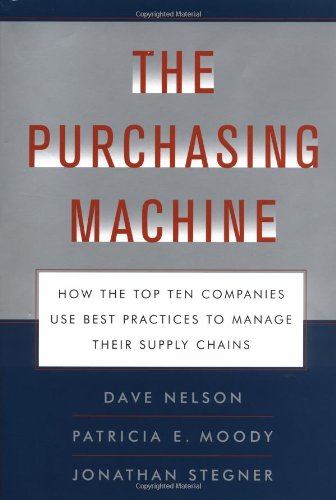
The Purchasing Machine: How the Top Ten Companies Use Best Practices to Manage Their Supply Chains - Hardcover
Inhaltsangabe
Every day companies leave billions of dollars in invisible, unrealized savings on the table because of poor supply chain management practices. Now supply management experts Dave Nelson, Patricia E. Moody, and Jonathan Stegner show not only how leading companies recoup these savings through their mastery of target costing, value engineering, and supplier development, but how supply chain management -- the discipline of acquiring and moving material -- has become a manufacturing company's hottest competitive weapon.
Based on a survey of 247 purchasing managers and more than 1,000 hours of interviews and on-site visits, the authors have selected ten top firms whose supply management pioneers excel at twenty "best practices." With cases and stories, Nelson, Moody, and Stegner show how these leading-edge purchasing departments at American Express, SmithKline Beecham, DaimlerChrysler, Harley-Davidson, Honda of America, IBM, John Deere, Whirlpool, Flextronics, and Sun Microsystems have put into place pathbreaking processes and procedures. Here, for example, described in step-by-step detail, are Chrysler's SCORE program and Honda's strategic sourcing strategy that saved the companies billions. The book also includes a crucial section on the next stage of supplier development that will involve the sourcing and allocation of ideas as well as materials.
The authors provide concrete, practical steps to improvement that any supply chain manager can take to successfully implement these best practices. The Purchasing Machine will be required reading for logistics, purchasing, and procurement managers in hundreds of thousands of companies. The authoritative nature of the authors' source material is certain to make this the single most important and practical reference on best purchasing practices for years to come.
Die Inhaltsangabe kann sich auf eine andere Ausgabe dieses Titels beziehen.
Über die Autorin bzw. den Autor
Dave Nelson is Vice President, Worldwide Supply Management, for Deere & Company. Previously he led the growth of Honda's Purchasing Division, which was the recipient of the Medal of Profes-sional Excellence from Purchasing Magazine. With Patricia Moody and Rick Mayo, he co-authored Powered by Honda.
Auszug. © Genehmigter Nachdruck. Alle Rechte vorbehalten.
Unseen Gains, Lost Profits
Every day, thousands of companies leave billions of dollars on the table, hard-earned dollars that could have appeared in lower consumer prices, exciting products or fatter shareholder returns. The losses are not leveraged cuts demanded by Lopez-type leaders, but invisible, unrealized savings that could put their organizations in the top tier of healthy, resilient supply management leaders. And every day, those same millions -- lost opportunities -- slip into someone else's pocket as the silver certificates flutter and drift farther away from their original owners. Profitable majors like Daimler/Chrysler, Honda of America, Harley-Davidson, IBM, and John Deere all recognize the power of profits realized when supply management professionals focus their attention on best practices in all areas of their operations, and these winners continue to reap the benefits of their intense cost focus. In these unique and powerful supply management leaders, the discipline of acquiring and moving material has become a key strategic advantage that enables lean manufacturing and responsive customer focus.
Unfortunately, although most industries cannot afford to let their profits blow away, many of them don't even notice the constant slipping away of cash. Sure, they have studied and struggled with MRP systems, ERP, outsourcing, and supplier development, and some of these techniques have produced temporary, noticeable gains. But their central focus is tuned to tracking everyday purchasing challenges of delivery and quality, and their peripheral vision is not engaged. Some of them may be too preoccupied with manufacturing to see the areas at other ends of the supply chain.
Opportunities for enormous savings in time and money lie at the far ends of the supply chain, most notably in procurement and design and development. In the middle, where manufacturing occupies a thin slice that converts an idea through the delivery process to consumable cash, processing operations account for an increasingly smaller slice of the continuum, because most world-class organizations have for the past fifteen years or so addressed and conquered manufacturing weak points. The problems of excess inventory, waste in the process, bad quality, inflexibility in scheduling, and a better and more professional workforce are well on their way to extinction. The expected result -- truly flexible, lean manufacturing -- will have been achieved among the winners in most manufacturing sectors within the next ten to twenty years or so.
What remains, therefore, is the challenge of bringing procurement in an extended enterprise into an equally powerful and responsive strategic position.
Manufacturing's Transformation
The past two hundred years have seen a long series of process and human innovations in the area of manufacturing, starting with Francis Cabot Lowell and Paul Moody's reintegration of the disparate textile processing functions in a single mill on the banks of the Charles River. These entrepreneurs, and a few other members of an enterprising elite called the Boston Manufacturing Company, realized 200 percent and more profits through use of simple economies of scale and expansion: bigger brick mills; longer days; faster machines; more workers; taking raw material -- cotton -- and carding, dying, weaving, rolling, and shipping finished goods from a single location. Issues around purchasing and logistics -- where and when to acquire the next raw material shipment, where to store the in-process goods, and how to ship out to a market screaming for North American goods -- were smaller questions than issues involving direct labor and the machinery that drove the looms. Innovation, therefore, centered on improving, which usually meant going faster, basic production operations. Workforce policies around productivity focused on speed rather than intelligence, perhaps even more than quality.
Limitations of Bigger, Faster Growth
This profit model preceded what we have come to call Taylorism, the perfected system of standards and incentives that further controlled and "improved" how human hands worked. Finally, as competitive threats shifted profits out of the Western world to Eastern production centers like Japan, North American manufacturing leaders adopted in quick succession a series of episodic moves toward better quality, MRP systems, workforce teams and profit sharing, reengineering, and finally lean manufacturing.
Purchasing -- Unscathed by "Improvements"
Still, although the huge improvement waves rolled through the ranks of manufacturing planners, purchasing remained relatively untouched. As late as the early 1990s, many organizations could point to no integrated systems assist that completely eliminated paperwork transactions, for example, or that linked purchasing to other production operations. Purchasing systems were an afterthought, frequently too complex to manage quickly or too awkward to change directions. Headlines about procurement tended to focus on cost-cutting drives and limited efforts to roll procurement into the picture.
The Manufacturing Continuum
To some degree, purchasing professionals have enjoyed a pleasant separation from other siloed functions; twenty years ago few buyers, for example, set foot in their shops or at their suppliers' sites. It was even possible to plan and manage entire commodities in the computer industry without ever having touched a motherboard or heard the hum of a disk drive. The typical buyer/planner's day centered on acquisition and tracking of materials at what was considered competitive prices. Strategically, few purchasing professionals participated in business planning decisions; tactically, purchasing planners, buyers, and expediters could not be overlooked because they frequently compensated for system and supplier failures -- missed performance in deliveries or quality -- a conflicted position from which no human could easily find resolution or progress.
Where manufacturing pioneers evidenced a dedication to bricks and mortar, and more and bigger machinery, purchasing studied and practiced the art of negotiation, business travel, gifting, and locating back-up supply strategies. For a few years, this approach worked, but as operations professionals redrew their landscape, procurement was challenged to get involved. Technology advances -- the CNC machine, the PLC, the personal computer, and the Toyota Production System -- took large chunks of direct and indirect labor dollars out of product processing and shifted the mix of labor to materials.
Further, as some companies examined their dedication to vertical integration, they migrated toward perfecting a few single competencies. They chose to "offload" certain processing steps, for example, "to the experts." Where companies like St. James Paper owned forests, shipped and stripped logs, and transported finished product on their own trucks, other commodity producers began to disinvest, freeing up cash to be more carefully applied among competing suppliers.
Shifting a percentage of in-house produced components and assemblies grew the second tier producers, which raised purchasing's strategic importance within large organizations. It is not unusual for final assembly producers to purchase over 50 percent of the components, making them the assembly and procurement experts and a world of specific commodity competitors. So as manufacturing trimmed down and tried to speed its own processes, procurement found itself with more of the dollar responsibilities for sourcing into final assembly plants, a task most purchasing professionals were unprepared for, and surprisingly, were somewhat blind to. The shift happened almost overnight.
Life Cycles -- From Seasons to Months, from Days to Hours...
The electronics world grew and adopted new...
„Über diesen Titel“ kann sich auf eine andere Ausgabe dieses Titels beziehen.
Suchergebnisse für The Purchasing Machine: How the Top Ten Companies Use...

Beispielbild für diese ISBN
The Purchasing Machine: How the Top Ten Companies Use Best Practices to Manage Their Supply Chains
Anbieter: World of Books (was SecondSale), Montgomery, IL, USA
Verkäuferbewertung 5 von 5 Sternen

Zustand: Very Good. Item in very good condition! Textbooks may not include supplemental items i.e. CDs, access codes etc. Artikel-Nr. 00098086564
Gebraucht kaufen
EUR 4,96
Versand gratis
Versand innerhalb von USA
Versand innerhalb von USA
Anzahl: 2 verfügbar
Beispielbild für diese ISBN
The Purchasing Machine: How the Top Ten Companies Use Best Practices to Manage Their Supply Chains
Anbieter: ThriftBooks-Atlanta, AUSTELL, GA, USA
Verkäuferbewertung 5 von 5 Sternen
Hardcover. Zustand: Good. No Jacket. Pages can have notes/highlighting. Spine may show signs of wear. ~ ThriftBooks: Read More, Spend Less. Artikel-Nr. G0684857766I3N00
Gebraucht kaufen
EUR 6,53
Versand gratis
Versand innerhalb von USA
Versand innerhalb von USA
Anzahl: 1 verfügbar
Beispielbild für diese ISBN
The Purchasing Machine: How the Top Ten Companies Use Best Practices to Manage Their Supply Chains
Anbieter: ThriftBooks-Atlanta, AUSTELL, GA, USA
Verkäuferbewertung 5 von 5 Sternen
Hardcover. Zustand: As New. No Jacket. Pages are clean and are not marred by notes or folds of any kind. ~ ThriftBooks: Read More, Spend Less. Artikel-Nr. G0684857766I2N00
Gebraucht kaufen
EUR 6,53
Versand gratis
Versand innerhalb von USA
Versand innerhalb von USA
Anzahl: 1 verfügbar
Beispielbild für diese ISBN
Purchasing Machine : How the Top Ten Companies Use Best Practices to Manage Their Supply Chains
Anbieter: Better World Books, Mishawaka, IN, USA
Verkäuferbewertung 5 von 5 Sternen
Zustand: Very Good. Pages intact with possible writing/highlighting. Binding strong with minor wear. Dust jackets/supplements may not be included. Stock photo provided. Product includes identifying sticker. Better World Books: Buy Books. Do Good. Artikel-Nr. 7827225-6
Gebraucht kaufen
EUR 8,43
Versand gratis
Versand innerhalb von USA
Versand innerhalb von USA
Anzahl: 1 verfügbar
Beispielbild für diese ISBN
The Purchasing Machine: How the Top Ten Companies Use Best Practices to Manage Their Supply Chains
Anbieter: Robinson Street Books, IOBA, Binghamton, NY, USA
Verkäuferbewertung 4 von 5 Sternen

Hardcover. Zustand: Very Good. Prompt Shipment, shipped in Boxes, Tracking PROVIDEDVery good. Clean text. Email for further information. Artikel-Nr. bingx84210781
Gebraucht kaufen
EUR 12,22
EUR 8,35 Versand
Versand innerhalb von USA
Versand innerhalb von USA
Anzahl: 1 verfügbar
Beispielbild für diese ISBN
The Purchasing Machine: How the Top Ten Companies Use Best Practices to Manage Their Supply Chains
Anbieter: Robinson Street Books, IOBA, Binghamton, NY, USA
Verkäuferbewertung 4 von 5 Sternen
Hardcover. Zustand: Very Good. Prompt Shipment, shipped in Boxes, Tracking PROVIDEDVery good in Very good dust jacket. First Edition. Artikel-Nr. ware16a4813
Gebraucht kaufen
EUR 12,22
EUR 8,35 Versand
Versand innerhalb von USA
Versand innerhalb von USA
Anzahl: 1 verfügbar
Beispielbild für diese ISBN
The Purchasing Machine: How the Top Ten Companies Use Best Practices to Manage Their Supply Chains
Anbieter: Robinson Street Books, IOBA, Binghamton, NY, USA
Verkäuferbewertung 4 von 5 Sternen
Hardcover. Zustand: As New. Prompt Shipment, shipped in Boxes, Tracking PROVIDEDFine in Fine dust jacket. First edition. Artikel-Nr. bing7748564
Gebraucht kaufen
EUR 12,22
EUR 8,35 Versand
Versand innerhalb von USA
Versand innerhalb von USA
Anzahl: 1 verfügbar
Beispielbild für diese ISBN
The Purchasing Machine: How the Top Ten Companies Use Best Practices to Manage Their Supply Chains
Anbieter: Robinson Street Books, IOBA, Binghamton, NY, USA
Verkäuferbewertung 4 von 5 Sternen
Hardcover. Zustand: As New. Prompt Shipment, shipped in Boxes, Tracking PROVIDEDFine in fine dust jacket. First edition *. Artikel-Nr. ware78kr734
Gebraucht kaufen
EUR 12,22
EUR 8,35 Versand
Versand innerhalb von USA
Versand innerhalb von USA
Anzahl: 1 verfügbar