
Verwandte Artikel zu Protect Yourself from Business Lawsuits: An Employee's...
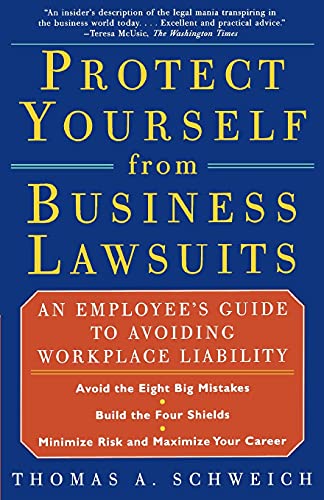
Protect Yourself from Business Lawsuits: An Employee's Guide to Avoiding Workplace Liability - Softcover
Inhaltsangabe
THE ESSENTIAL BOOK EVERY EMPLOYEE NEEDS TO AVOID WORKPLACE LIABILITY
Corporate litigation has spun out of control and can cost up to 10 percent of overall earnings. Changes in the law enabling lawyers to mount business tort claims have caused damages to soar sky-high. In this groundbreaking book, Thomas Schweich, a pioneer in the field of preventive law, turns the tables and offers managers and all employees who act as agents a manual for avoiding the mistakes that could land them in court.
In comprehensible layman's terms, Schweich shows employees from companies of all kinds and sizes how to avoid lawsuits by analyzing the Eight Big Mistakes that can lead to litigation, with examples culled from his experiences at Bryan Cave, LLP, leaders in preventive law.
This book will benefit all employees -- from the CEO of a major corporation to the average deal-making employee. An invaluable tool for avoiding workplace liability, Protect Yourself from Business Lawsuits is a must-read for every businessperson.
Die Inhaltsangabe kann sich auf eine andere Ausgabe dieses Titels beziehen.
Über die Autorin bzw. den Autor
Thomas A. Schweich is a partner in the St. Louis office of Bryan Cave, LLP. His practice focuses on the negotiation, mediation, arbitration, and litigation of commercial and government disputes. He also conducts training seminars for corporate clients and trade groups on how to avoid lawsuits. A graduate of Yale and Harvard Law School, he lives in St. Louis with his wife and two children. For more information on preventive law, visit his Web site, www.tomschweich.com.
Auszug. © Genehmigter Nachdruck. Alle Rechte vorbehalten.
PART ONE: A System Out of Control
"Litigation" is a term that encompasses the lengthy process of filing a lawsuit, developing information about the other side's case, preparing the case for trial, trying the case before a judge or jury and, if necessary, appealing the verdict or judgment to a higher court.
More than ever before, both you and everyone in your company have a strong vested interest in avoiding this arduous process. If you own a small company, protecting yourself from lawsuits may even be the key to survival. During the next several years, corporations will value much more highly than in the past those employees who keep the company out of court. Employees whose actions embroil the company in litigation on the other hand will increasingly be shown the door. This chilling policy will hold true even if an employee caught in litigation is morally, legally, or ethically right. The mere fact of litigation will hurt and could destroy your company and/or your career because of the changing nature of business lawsuits.
There is a worsening stigma associated with corporate litigation. It was not always that way. Twenty years ago, employees and executives often sailed through successful careers despite frequent involvement with legal proceedings, even when the propriety of their own job performance was directly at issue. Recently, I was preparing a crusty senior vice president of a major corporation for a "deposition" -- pretrial testimony taken under oath. I asked him whether he had had previous experience testifying in legal proceedings. He smiled, looked down at me through his bifocals, and said, "Son, I've testified before four grand juries; I've testified in three civil trials; and I've had my deposition taken nine times." He was clearly proud of his litigation experience.
There is no doubt that in the "old days," weathering litigation successfully was a badge of experience, almost a rite of passage in many corporate cultures. The reason was simple. Litigation meant the company was tough and principled and that it would get what it was entitled to have. Trial lawyers and individual executives often earned the same reputation. The halls of major law firms are filled with senior trial lawyers who tell tale after tale of corporate executives who booted unruly competitors, subcontractors, or union representatives out of their offices -- often calling security to escort them off the premises while yelling a trial lawyer's favorite cliché: "See you in court!"
THE OLD ASSUMPTIONS ABOUT THE LAW: JUSTICE, LIMITS, FUNDS, AND LAWYERS AS FRIENDS
The outdated perception of corporate litigation as both noble and normal was founded upon four basic assumptions: confidence in a just outcome; well-defined limits on the scope of the litigation process; sufficient funds to pursue or defend a lawsuit; and a close, personal relationship between the company and its trial lawyer. In many, if not most, cases, these assumptions no longer hold true.
THE DECLINE OF JUSTICE
In the past, a company's willingness to test the propriety of its conduct in court was founded upon the belief that American courts deliver justice. At one time, there was faith in the corporate world that the judicial system was always fair. That faith has eroded, and rightfully so.
A company can no longer have faith that it will be vindicated or rewarded just because its conduct was legal, ethical, or within the bounds of its contracts. Some politicians and scholars like to blame judges for the problems facing the system, but not a single practicing attorney whom I interviewed had serious complaints about the fairness and competence of American judges. Indeed, the erosion of justice in business cases has virtually nothing to do with the quality of judges, or the judicial activism for which politicians and law professors criticize the legal system.
Rather, the problem is the sheer volume of cases in the court system. The American judiciary is overwhelmed. While the American judicial system remains the most just on earth, and American judges remain as a group the most incorruptible on earth, the system is simply too overloaded to ensure justice consistently.
Take federal trial courts, for example. The federal system had over 300,000 new cases filed in 1996, up from about 250,000 in 1990. That means that the typical federal judge was assigned 471 new cases. These cases were added to his or her already crowded docket of pending cases. That same judge completed just 27 trials.
The statistics speak for themselves: the judge simply does not have time for your case. Lawyers have gotten used to appearing in court on the same case before the same judge within a month's time and finding that the judge does not even remember the names of the attorneys, much less the clients or anything at all about the case.
When a successful attorney writes a brief in support of his or her client's position, often the first argument to the judge is not why the client is right but rather why the ruling sought is the most convenient one for the judge! Trial attorneys know that, like all people faced with an overwhelming amount of work, judges will often look for the easiest solution within the bounds of the law. If there is a safe way -- one that is legally justifiable and not likely to result in a reversal by an appellate judge -- to transfer a case to another judge, dismiss a case on a technicality, or enter summary judgment (that is, decide that a party wins without a trial), the judge will feel a lot of pressure to follow that course of action. If, on the other hand, the request made by an attorney requires the judge to hold a lengthy hearing or write a complex opinion, that attorney will often lose -- even if that attorney's argument was well reasoned, well written, and extremely expensive for the client.
Many judges will also pressure parties to settle cases, even when they know little if anything about the case. They push for a compromise that is worse than you want and better than the other side wants, sometimes with little regard for the facts or the law. They just want the case to go away, and often the litigating parties bow to the pressure. Their reasoning is that if you are just going to settle the case in the middle anyway (as happens with the vast majority of business cases), then why go through the entire costly and time-consuming litigation process? Why not settle it before the lawyers take their millions?
Most judges are conscientious and honest. The problem is that they will exhibit these qualities only during the two minutes that they have to address your case. That means that trying to obtain justice these days is always a very big gamble.
LAWSUITS UNLIMITED
Some lawyers like to compare corporate litigation to boxing. Like boxing, litigation is a tactical process of punch and counterpunch, punctuated with breaks. You can adopt a strategy of wearing the other side down or you can go for a quick knockout. However, the similarities between boxing and litigation end there. In boxing, the rules are simple. The entire WBF rule book is only twenty pages long. And the rules are strictly enforced by the referees and the boxing commission. In boxing, the simplicity of the rules combined with their strict enforcement means that the event is well controlled.
In litigation, however, the rules are much more elaborate and continue to grow (the federal rules were 266 pages at last count), but they are not consistently enforced. The increasing complexity of litigation rules combined with decreasing consistency in their enforcement means that the once-clear limits on the scope of lawsuits have given way to a free-for-all. We have already seen that the referee in litigation, the trial court judge, is trying to cover several hundred matches at once. That means that a...
„Über diesen Titel“ kann sich auf eine andere Ausgabe dieses Titels beziehen.
Suchergebnisse für Protect Yourself from Business Lawsuits: An Employee's...

Beispielbild für diese ISBN
PROTECT YOURSELF FROM BUSINESS LAWSUITS: An Employee's Guide to Avoiding Workplace Liability
Verlag:
Scribner (edition Fireside ed.), 2000
ISBN 10: 0684856557
ISBN 13: 9780684856551
Gebraucht
Paperback
Anbieter: BooksRun, Philadelphia, PA, USA
Verkäuferbewertung 5 von 5 Sternen

Paperback. Zustand: Fair. Fireside ed. The item might be beaten up but readable. May contain markings or highlighting, as well as stains, bent corners, or any other major defect, but the text is not obscured in any way. Artikel-Nr. 0684856557-7-1
Gebraucht kaufen
EUR 4,79
Versand gratis
Versand innerhalb von USA
Versand innerhalb von USA
Anzahl: 1 verfügbar
Beispielbild für diese ISBN
Protect Yourself from Business Lawsuits : An Employee's Guide to Avoiding Workplace Liability
Anbieter: Better World Books: West, Reno, NV, USA
Verkäuferbewertung 5 von 5 Sternen
Zustand: Good. Fireside ed. Pages intact with minimal writing/highlighting. The binding may be loose and creased. Dust jackets/supplements are not included. Stock photo provided. Product includes identifying sticker. Better World Books: Buy Books. Do Good. Artikel-Nr. GRP102631434
Gebraucht kaufen
EUR 9,02
Versand gratis
Versand innerhalb von USA
Versand innerhalb von USA
Anzahl: 1 verfügbar
Beispielbild für diese ISBN
PROTECT YOURSELF FROM BUSINESS LAWSUITS: An Employee's Guide to Avoiding Workplace Liability
Anbieter: Robinson Street Books, IOBA, Binghamton, NY, USA
Verkäuferbewertung 4 von 5 Sternen

Paperback. Zustand: Very Good. Prompt Shipment, shipped in Boxes, Tracking PROVIDEDBusiness/Economics Very good. Minor creasing. Clean copy. Artikel-Nr. grqaytrpb25r3089
Gebraucht kaufen
EUR 12,13
EUR 8,28 Versand
Versand innerhalb von USA
Versand innerhalb von USA
Anzahl: 1 verfügbar
Beispielbild für diese ISBN
Protect Yourself from Business Lawsuits: An Employee's Guide to Avoiding Workplace Liability
Anbieter: Revaluation Books, Exeter, Vereinigtes Königreich
Verkäuferbewertung 5 von 5 Sternen
Paperback. Zustand: Brand New. 224 pages. 6.25x5.50x0.75 inches. In Stock. Artikel-Nr. x-0684856557
Neu kaufen
EUR 19,59
EUR 11,67 Versand
Versand von Vereinigtes Königreich nach USA
Versand von Vereinigtes Königreich nach USA
Anzahl: 2 verfügbar