
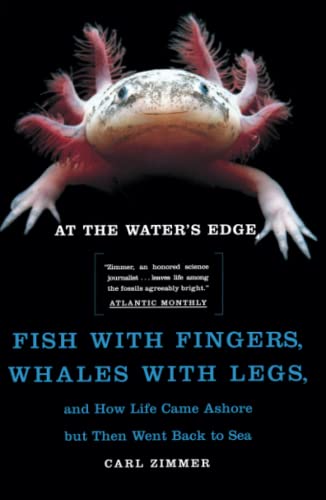
At the Water's Edge: Fish with Fingers, Whales with Legs, and How Life Came Ashore but Then Went Back to Sea - Softcover
Inhaltsangabe
Everybody Out of the Pond
At the Water's Edge will change the way you think about your place in the world. The awesome journey of life's transformation from the first microbes 4 billion years ago to Homo sapiens today is an epic that we are only now beginning to grasp. Magnificent and bizarre, it is the story of how we got here, what we left behind, and what we brought with us.
We all know about evolution, but it still seems absurd that our ancestors were fish. Darwin's idea of natural selection was the key to solving generation-to-generation evolution -- microevolution -- but it could only point us toward a complete explanation, still to come, of the engines of macroevolution, the transformation of body shapes across millions of years. Now, drawing on the latest fossil discoveries and breakthrough scientific analysis, Carl Zimmer reveals how macroevolution works. Escorting us along the trail of discovery up to the current dramatic research in paleontology, ecology, genetics, and embryology, Zimmer shows how scientists today are unveiling the secrets of life that biologists struggled with two centuries ago.
In this book, you will find a dazzling, brash literary talent and a rigorous scientific sensibility gracefully brought together. Carl Zimmer provides a comprehensive, lucid, and authoritative answer to the mystery of how nature actually made itself.
Die Inhaltsangabe kann sich auf eine andere Ausgabe dieses Titels beziehen.
Über die Autorin bzw. den Autor
Carl Zimmer, author of At the Water's Edge, is a frequent contributor to Discover, National Geographic, Natural History, Nature, and Science. He is a winner of the Everett Clark Award for science journalism and the American Institute of Biological Sciences Media Award. A John S. Guggenheim Fellow, he has also received the Pan-American Health Organization Award for Excellence in International Health Reporting and the American Institute of Biological Sciences Media Award. His previous books include Evolution: The Triumph of an Idea, Parasite Rex, and At the Water's Edge. He lives in Guilford, Connecticut.
Auszug. © Genehmigter Nachdruck. Alle Rechte vorbehalten.
Chapter One: After a Lost Balloon
In a basement laboratory in London a man contemplated a carcass. It was roughly the size and shape of a rolling pin, with a knife-edged tail, with fins like whiskers. Its eyes were the dark heads of pins, and its lips were full and sinful. The man stood tall and a little stooped, and although in 1839 he was only thirty-five, he had the kind of brown-eyed glare on which old failed prophets usually have a monopoly. He had seen the skin, guts, and bones of hundreds of animals that no Englishman had seen before, but few had irritated him more than this one.
His name was Richard Owen -- not yet Sir Richard, but on his way there. He had grown up in Lancaster, and in boyhood his prospects had not seemed so good. His father, a ruined merchant, had died in the West Indies when Richard was five. A lazy, impudent boy, he joined the navy at fourteen, working as a surgeon's apprentice, but after the end of the War of 1812 peacetime offered little hope of a career, and so he returned to Scotland. He had loved heraldry, and it may have been while drawing unicorns and griffins that he first became interested in animal form. Again employed as a surgeon's apprentice, he began collecting skulls, beginning with dogs, cats, deer, and mice. But he wanted more bones. For a time he worked for a surgeon who performed autopsies on the dead prisoners at Hadrian's Tower. On a cold day in January the two of them paid a call to the prison, and after the autopsy the surgeon left Owen to clean up. This time Owen did not pack all the instruments. He left a few blades alongside the opened corpse, and handing the guard some coins, he told him that he needed to come back later. There was some extra business to attend to before the coffin was screwed shut.
He returned in the frozen moonlight up the icy hill to the tower, bringing with him a strong brown paper bag. He nodded to the guard, who nodded back, and he climbed up the stairs to the autopsy room and shut the door as he went in. Before long he opened the door again, his paper bag full. He passed the guard again and told him that the inmate was ready. As he left the tower and began to walk back down the hill, his mind was filled with thoughts of facial angles and osseous tissues. The more he thought about the work he would enjoy at the surgery that night, the faster he walked. Suddenly his feet kicked out from under him. The bag swung away as he fell on the ice, its contents rolling free. He ran after it, down toward a cottage at the bottom of the hill, but he was too late. A woman inside heard a thump at the base of her front door. She opened it and before her was a disheveled, owl-eyed boy trying to stuff a freshly severed head into a bag. He ran with it all the way to the surgery, her screams flying after him.
Owen went to the University of Edinburgh at age twenty, but he soon outstripped their classes -- within a year he was traveling to London with letters of introduction from his private tutors and got a position as a surgeon at a hospital. To be a doctor in London in the 1820s was as much a political act as a profession. The medical establishment -- including the city's hospitals and medical journals -- was controlled by physicians who generally had Tory sympathies. Allied with the physicians were the surgeons who performed dissections and held a lower position on the social ladder. Opposed to them were the general practitioners who were educated at small private colleges and were of a more radical egalitarian bent. Set on reforming medicine, they lambasted the elitism of physicians and surgeons wherever they could, in renegade medical journals or newspapers or Parliament. They fought fiercely for access to the library and museum of the Royal College of Surgeons. A famous British surgeon named John Hunter had amassed thousands of books and a collection of thirteen thousand pickled animals, disembodied hearts, limbs, bladders, spines, and other materials that laid out the patterns of anatomy, but after his death in 1793, the collection languished for years. The government bought it and entrusted it to the Royal College of Surgeons on the understanding that they would publish catalogs, keep a lecture series, and open the museum and library to the public. But for over twenty years the college had let in only its own, and the GPs crowed loudly until Parliament took notice. The college agreed to let licensed doctors in and to draw up an official catalog.
Owen was hired to assist on the job, and when his superior died, the work became his alone. It was a labor that would keep him occupied for decades. At the same time he struggled to advance his own career as an anatomist, lecturing to medical students and winning the right to dissect the animals that died at the London zoo. It wasn't out of the ordinary to walk into Owen's house and find a freshly dead rhino parked in the hallway.
In 1830 a sixty-one-year-old French baron, ailing yet imperious, came to the Hunterian Museum. Because Owen was the only one there who spoke French, it fell to him to tour the man around. His name was Georges Cuvier -- a professor at the National Museum of Natural History in Paris, and to Owen the sun in the sky. Like Owen, Cuvier had started as a shabby-genteel outsider, a German Protestant who wandered the hills around Montbéliard as a boy, picking plants that he would take home. There he would classify them according to the scheme of the eighteenth-century naturalist Carl Linnaeus, who had constructed the hierarchy of species, genus, family, order, class, phylum, and kingdom. Cuvier was supposed to become a bureaucrat in the Prussian government after he graduated, but he emerged out of the Stuttgart Academy among a huge bolus of aspiring bureaucrats. A job came his way only when a friend returned home to Montbéliard after finishing a stint as a tutor to a family in Normandy. He arranged for Cuvier to take his place.
In Normandy Cuvier was treated more like a family servant than a tutor. He tried to console himself by thinking about the tour of Europe he was going to take his student on, and by studying whatever life he could find -- the plants in the town garden, a private store of exotic fish, another of oriental birds. But before his tour could begin, the French Revolution overran Paris and spread out into the countryside. His family fled to a village on the coast where Cuvier, now twenty-one, fell into almost complete solitude. He would walk the beach alone, collecting the animals that washed ashore, picking through the guts of skates that the fishermen would sell him. He wrote learned letters to the leading zoologists in Paris, and his reputation as a homegrown naturalist increased. After the revolution cooled, Cuvier visited Paris, where he stunned the scientists at the new National Museum with the knowledge he had taught himself. They were desperate for skilled help and hired him instantly. He was only twenty-three when he joined, but then again the man who invited him, a professor of zoology named Etienne Geoffroy Saint-Hilaire, was only twenty-one. "Come to Paris," Geoffroy wrote to him. "Come play among us the role of another legislator of natural history." It was a parliament founded by boys.
By the age of thirty Cuvier had invented modern paleontology. People had collected fossils for centuries, yet even in the 1500s Europeans thought of them not as real skeletons but as some of the many forms a rock could take: some became emeralds, other became imitations of snail shells. Gradually naturalists recognized too many similarities between these stones and the bones of living animals, mineralogists realized how bone could be transmuted to rock, and the traditional view of fossils began to buckle. By the 1700s naturalists had found bones of everything from elephants to giant spiraled shellfish in the earth. Noah's flood, many of them...
„Über diesen Titel“ kann sich auf eine andere Ausgabe dieses Titels beziehen.
Suchergebnisse für At the Water's Edge: Fish with Fingers, Whales...

Beispielbild für diese ISBN
At the Waters Edge Fish with F
Anbieter: World of Books (was SecondSale), Montgomery, IL, USA
Verkäuferbewertung 5 von 5 Sternen

Zustand: Good. Item in good condition. Textbooks may not include supplemental items i.e. CDs, access codes etc. Artikel-Nr. 00099834416
Gebraucht kaufen
EUR 4,34
Versand gratis
Versand innerhalb von USA
Versand innerhalb von USA
Anzahl: 2 verfügbar
Beispielbild für diese ISBN
At the Water's Edge : Fish with Fingers, Whales with Legs, and How Life Came Ashore but Then Went Back to Sea
Anbieter: Better World Books, Mishawaka, IN, USA
Verkäuferbewertung 5 von 5 Sternen
Zustand: Very Good. New Ed. Former library copy. Pages intact with possible writing/highlighting. Binding strong with minor wear. Dust jackets/supplements may not be included. Includes library markings. Stock photo provided. Product includes identifying sticker. Better World Books: Buy Books. Do Good. Artikel-Nr. 10782342-6
Gebraucht kaufen
EUR 6,25
Versand gratis
Versand innerhalb von USA
Versand innerhalb von USA
Anzahl: 1 verfügbar
Beispielbild für diese ISBN
At the Water's Edge : Fish with Fingers, Whales with Legs, and How Life Came Ashore but Then Went Back to Sea
Anbieter: Better World Books, Mishawaka, IN, USA
Verkäuferbewertung 5 von 5 Sternen
Zustand: Good. New Ed. Pages intact with minimal writing/highlighting. The binding may be loose and creased. Dust jackets/supplements are not included. Stock photo provided. Product includes identifying sticker. Better World Books: Buy Books. Do Good. Artikel-Nr. 3960316-6
Gebraucht kaufen
EUR 6,25
Versand gratis
Versand innerhalb von USA
Versand innerhalb von USA
Anzahl: 1 verfügbar
Beispielbild für diese ISBN
At the Water's Edge : Fish with Fingers, Whales with Legs, and How Life Came Ashore but Then Went Back to Sea
Anbieter: Better World Books: West, Reno, NV, USA
Verkäuferbewertung 5 von 5 Sternen
Zustand: Very Good. New Ed. Pages intact with possible writing/highlighting. Binding strong with minor wear. Dust jackets/supplements may not be included. Stock photo provided. Product includes identifying sticker. Better World Books: Buy Books. Do Good. Artikel-Nr. 6120600-6
Gebraucht kaufen
EUR 6,43
Versand gratis
Versand innerhalb von USA
Versand innerhalb von USA
Anzahl: 1 verfügbar
Beispielbild für diese ISBN
At the Water's Edge : Fish with Fingers, Whales with Legs, and How Life Came Ashore but Then Went Back to Sea
Anbieter: Better World Books: West, Reno, NV, USA
Verkäuferbewertung 5 von 5 Sternen
Zustand: Good. New Ed. Pages intact with minimal writing/highlighting. The binding may be loose and creased. Dust jackets/supplements are not included. Stock photo provided. Product includes identifying sticker. Better World Books: Buy Books. Do Good. Artikel-Nr. 3960316-6
Gebraucht kaufen
EUR 6,43
Versand gratis
Versand innerhalb von USA
Versand innerhalb von USA
Anzahl: 1 verfügbar
Beispielbild für diese ISBN
At the Water's Edge : Fish with Fingers, Whales with Legs, and How Life Came Ashore but Then Went Back to Sea
Anbieter: Wonder Book, Frederick, MD, USA
Verkäuferbewertung 5 von 5 Sternen
Zustand: Good. Good condition. A copy that has been read but remains intact. May contain markings such as bookplates, stamps, limited notes and highlighting, or a few light stains. Artikel-Nr. L11B-02947
Gebraucht kaufen
EUR 7,19
Versand gratis
Versand innerhalb von USA
Versand innerhalb von USA
Anzahl: 1 verfügbar
Foto des Verkäufers
At the Water's Edge: Fish with Fingers, Whales with Legs.
Anbieter: WeBuyBooks, Rossendale, LANCS, Vereinigtes Königreich
Verkäuferbewertung 5 von 5 Sternen
Zustand: Good. Most items will be dispatched the same or the next working day. A copy that has been read but remains in clean condition. All of the pages are intact and the cover is intact and the spine may show signs of wear. The book may have minor markings which are not specifically mentioned. Artikel-Nr. rev2695133584
Gebraucht kaufen
EUR 1,68
EUR 6,61 Versand
Versand von Vereinigtes Königreich nach USA
Versand von Vereinigtes Königreich nach USA
Anzahl: 2 verfügbar
Beispielbild für diese ISBN
At the Water's Edge: Fish With Fingers, Whales With Legs, and How Life Came Ashore but Then Went Back to Sea
Anbieter: Magers and Quinn Booksellers, Minneapolis, MN, USA
Verkäuferbewertung 5 von 5 Sternen
paperback. Zustand: Very Good. May have light to moderate shelf wear and/or a remainder mark. Complete. Clean pages. Artikel-Nr. 503652
Gebraucht kaufen
EUR 5,84
EUR 3,49 Versand
Versand innerhalb von USA
Versand innerhalb von USA
Anzahl: 2 verfügbar
Beispielbild für diese ISBN
At the Water's Edge: Fish with Fingers, Whales with Legs.
Verlag:
Simon & Schuster, United States, New York, 1999
ISBN 10: 0684856239
ISBN 13: 9780684856230
Gebraucht
Paperback
Anbieter: WorldofBooks, Goring-By-Sea, WS, Vereinigtes Königreich
Verkäuferbewertung 5 von 5 Sternen
Paperback. Zustand: Fair. How did we ever get ashore? How did we make legs, arms and our extremely complex intelligence? Evolution is one of the most hotly debated areas of popular science. With this book, the author presents an accessible account of one of evolution's great mysteries - how microbes turned into humans. A readable copy of the book which may include some defects such as highlighting and notes. Cover and pages may be creased and show discolouration. Artikel-Nr. GOR009129294
Gebraucht kaufen
EUR 3,59
EUR 6,58 Versand
Versand von Vereinigtes Königreich nach USA
Versand von Vereinigtes Königreich nach USA
Anzahl: 1 verfügbar
Beispielbild für diese ISBN
At the Water's Edge : Fish with Fingers, Whales with Legs, and How Life Came Ashore but Then Went Back to Sea
Verlag:
Simon & Schuster, United States, New York, 1999
ISBN 10: 0684856239
ISBN 13: 9780684856230
Gebraucht
Paperback
Anbieter: WorldofBooks, Goring-By-Sea, WS, Vereinigtes Königreich
Verkäuferbewertung 5 von 5 Sternen
Paperback. Zustand: Very Good. How did we ever get ashore? How did we make legs, arms and our extremely complex intelligence? Evolution is one of the most hotly debated areas of popular science. With this book, the author presents an accessible account of one of evolution's great mysteries - how microbes turned into humans. The book has been read, but is in excellent condition. Pages are intact and not marred by notes or highlighting. The spine remains undamaged. Artikel-Nr. GOR001561029
Gebraucht kaufen
EUR 3,59
EUR 6,58 Versand
Versand von Vereinigtes Königreich nach USA
Versand von Vereinigtes Königreich nach USA
Anzahl: 4 verfügbar