
Verwandte Artikel zu Failure to Connect: How Computers Affect Our Children's...
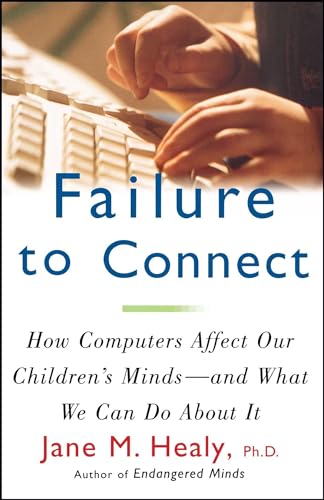
Failure to Connect: How Computers Affect Our Children's Minds -- and What We Can Do About It - Softcover
Inhaltsangabe
* When should children start using computers?
* How should schools incorporate computer use into their curriculum?
* Which types of computer software programs should be avoided?
* Are children who don't have computers in class and at home doomed to fall behind their peers?
Few parents and educators stop to consider that computers, used incorrectly, may do far more harm than good to a child's growing brain and social/emotional development. In this comprehensive and practical guide to kids and computers, Jane M. Healy, Ph.D., author of the groundbreaking bestseller Endangered Minds, examines the advantages and drawbacks of computer use for kids at home and school, exploring its effects on their health, mental development, and creativity.
In addition, this timely and ey-opening book presents:
* Concrete examples of how to develop a technology plan and use computers successfully with children of different age groups as supplements to classroom curricula, as research tools, or in family projects
* Resources for reliable reviews of child-oriented software
* Questions parents should ask when their children are using computers in school
* Advice on how to manage computer use at home
Die Inhaltsangabe kann sich auf eine andere Ausgabe dieses Titels beziehen.
Über die Autorin bzw. den Autor
Jane M. Healy, Ph.D. is a teacher and educational psychologist who has worked with young people of all ages, from pre-school to graduate school. She has been a classroom teacher, reading and learning specialist, school administrator, and clinician. She is currently a lecturer and consultant, and the author of three books about how children do (and don’t) learn, Your Child’s Growing Mind, Endangered Minds, and Failure to Connect. She and her work have been featured in national media such as CNN and NPR. She has twice been named “Educator of the Year” by Delta Kappa Gamma, the professional honor society of women educators. Jane and her husband claim they have learned most of what they know from raising three sons and enjoying six grandchildren.
Auszug. © Genehmigter Nachdruck. Alle Rechte vorbehalten.
Chapter One: Blundering Into the Future: Hype and Hope
"Computing is not about computers any more. It is about living."
Nicholas Negroponte
"Computers? The more the better. I want my kids to be prepared for the real world out there."
Suburban father, Atlanta, Georgia
"Technology! I feel as if we're being swept down this enormous river -- we don't know where we're going, or why, but we're caught in the current. I think we should stop and take a look before it's too late."
Assistant Superintendent of Schools, Long Island, New York
Technology shapes the growing mind. The younger the mind, the more malleable it is. The younger the technology, the more unproven it is. We enthusiastically expose our youngsters to new digital teachers and playmates, but we also express concern about the development of their brains, bodies, and spirits. Shouldn't we consider carefully the potential -- and irrevocable -- effects of this new electronic interface with childhood?
Today's children are the subjects of a vast and optimistic experiment. It is well financed and enthusiastically supported by major corporations, the public at large, and government officials around the world. If it is successful, our youngsters' minds and lives will be enriched, society will benefit, and education will be permanently changed for the better. But there is no proof -- or even convincing evidence -- that it will work.
The experiment, of course, involves getting kids "on computers" at school and at home in hopes that technology will improve the quality of learning and prepare our young for the future. But will it? Are the new technologies a magic bullet aimed straight at success and power? Or are we simply grasping at a technocentric "quick fix" for a multitude of problems we have failed to address?
In preparing to write this book I spent hundreds of hours in classrooms, labs, and homes, watching kids using new technologies, picking the brains of leaders in the field, and researching both off- and on-line. As a longtime enthusiast for and user of educational computing, I found this journey sometimes shocking, often disheartening, and occasionally inspiring. While some very exciting and potentially valuable things are happening between children and computers, we are currently spending far too much money with too little thought. It is past time to pause, reflect, and ask some probing questions.
This book will present a firsthand survey of the educational computing scene, raising core issues that should be addressed before we commit to computer- assisted education. We will consider technology use in light of brain development, stages and styles of learning, emotional-social development, and successful educational practice in school and at home. We will examine questions such as:
- When and how should children start using computers, and should they have them at home?
- How can parents and teachers support children's learning with technology?
- What kind of software applications and educational technology uses are best at different ages?
- Which ones may be harmful, and why?
- How do we balance education and entertainment?
- How should we deal with health concerns related to computer use?
- Will computers make human beings smarter -- or will they erode important forms of thought? How will interacting with artificial brains influence our ideas about what constitutes "intelligence"?
- What effect will technologies have on children's creativity and their emotional, personal, and social development?
- Will, or should, emerging technologies change our concept of education?
- If schools are adopting computer technology, which priorities are most important?
And...the most important question of all: How can we best help the young prepare for a changing and unpredictable future?
Belief vs. Fact
"In sum, if computers make a difference, it has yet to show up in achievement."
Samuel G. Sava, Executive Director, National Association of Elementary School Principals, in a 1997 speech
"The research is set up in a way to find benefits that aren't really there. Most knowledgeable people agree that most of the research isn't valid....Essentially, it's just worthless."
Edward Miller, Former Editor, Harvard Education Letter
Exaggerated Hopes and Unmet Promises
Why do we so desperately need to believe in computers? After surveying current attitudes for the nonprofit organization Learning in the Real World, William Ruckeyser told me, "The nearest thing I can draw a parallel to is a theological discussion. There's so much an element of faith here that demanding evidence is almost a sign of heresy." Witness the federal government's initiative to wire all schools for telecommunications by the year 2000, under the simplistic assumption that connecting kids to "information" will somehow make them more able to read and use it intelligently. Meanwhile, library and sometimes even school budgets are cut across the nation.
Eighty percent of people who plan to buy a personal computer soon will cite children's education as the main reason. Ninety percent of voters in the United States are convinced that schools with computers can do a better job of education, and 61 percent would support a federal tax increase to speed the introduction of technology into the schools. In 1995 the American Association of School Administrators published the results of a survey that asked parents, teachers, leaders from various fields, and members of the general public what skills would be important for students graduating in the twenty-first century. "Computer skills and media technology" ranked third in a list of sixteen possibilities, outvoted only by "basic skills" (reading, writing, and math) and "good work habits." Computer skills were deemed more important than "values" (e.g., honesty, tolerance) by every group but the leaders. "Good citizenship" and "curiosity and love of learning" were considerably farther down the list, and such topics as "knowledge of history and geography" and "classic works (e.g., Shakespeare, Plato)" were near the bottom (highly valued by only 29 and 21 percent of business leaders, respectively).
An atmosphere of hysteria surrounds the rush to connect even preschoolers to electronic brains. Of the ten bestselling children's CD-ROM titles sold in 1996, four are marketed for children beginning at age three. Computer programs are advertised for children as young as eighteen months. In the United States, computer users under the age of six owned an average of six software titles in 1996, a number increasing every year. Parents and educators in Europe and Japan are astonished as well as amused by this push toward electronic precocity.
It is less amusing to realize that research to be cited throughout this book demonstrates how computer "learning" for young children is far less brain-building than even such simple activities as spontaneous play or playing board games with an adult or older child. "Connecting" alone has yet to demonstrate academic value, and some of the most popular "educational" software may even be damaging to creativity, attention, and motivation. In 1995, a seminar of knowledgeable academics concluded that computers have no place at all in the lives of young children. In 1997, Samuel Sava, head of the National Association of Elementary School Principals, told school leaders that computers have done little to improve student achievement and questioned the nation's spending up to $20 billion a year to fill schools with computers.
Even for older children and teens, research has yet to confirm substantial benefits from most computer-related learning products at school or at home. Analyzing home...
„Über diesen Titel“ kann sich auf eine andere Ausgabe dieses Titels beziehen.
Suchergebnisse für Failure to Connect: How Computers Affect Our Children's...

Beispielbild für diese ISBN
FAILURE TO CONNECT: How Computers Affect Our Children's Minds -- and What We Can Do About It
Anbieter: World of Books (was SecondSale), Montgomery, IL, USA
Verkäuferbewertung 5 von 5 Sternen

Zustand: Good. Item in good condition. Textbooks may not include supplemental items i.e. CDs, access codes etc. Artikel-Nr. 00094837424
Gebraucht kaufen
EUR 3,66
Versand gratis
Versand innerhalb von USA
Versand innerhalb von USA
Anzahl: 5 verfügbar
Beispielbild für diese ISBN
FAILURE TO CONNECT: How Computers Affect Our Children's Minds -- and What We Can Do About It
Verlag:
Simon & Schuster (edition First Edition), 1999
ISBN 10: 0684855399
ISBN 13: 9780684855394
Gebraucht
Paperback
Erstausgabe
Anbieter: BooksRun, Philadelphia, PA, USA
Verkäuferbewertung 5 von 5 Sternen
Paperback. Zustand: Fair. First Edition. The item might be beaten up but readable. May contain markings or highlighting, as well as stains, bent corners, or any other major defect, but the text is not obscured in any way. Artikel-Nr. 0684855399-7-1
Gebraucht kaufen
EUR 4,52
Versand gratis
Versand innerhalb von USA
Versand innerhalb von USA
Anzahl: 1 verfügbar
Beispielbild für diese ISBN
FAILURE TO CONNECT: How Computers Affect Our Children's Minds -- and What We Can Do About It
Verlag:
Simon & Schuster (edition First Edition), 1999
ISBN 10: 0684855399
ISBN 13: 9780684855394
Gebraucht
Paperback
Erstausgabe
Anbieter: BooksRun, Philadelphia, PA, USA
Verkäuferbewertung 5 von 5 Sternen
Paperback. Zustand: Very Good. First Edition. It's a well-cared-for item that has seen limited use. The item may show minor signs of wear. All the text is legible, with all pages included. It may have slight markings and/or highlighting. Artikel-Nr. 0684855399-11-1
Gebraucht kaufen
EUR 4,80
Versand gratis
Versand innerhalb von USA
Versand innerhalb von USA
Anzahl: 1 verfügbar
Beispielbild für diese ISBN
Failure to Connect : How Computers Affect Our Children's Minds -- and What We Can Do about It
Anbieter: Better World Books, Mishawaka, IN, USA
Verkäuferbewertung 5 von 5 Sternen
Zustand: Very Good. New Ed. Pages intact with possible writing/highlighting. Binding strong with minor wear. Dust jackets/supplements may not be included. Stock photo provided. Product includes identifying sticker. Better World Books: Buy Books. Do Good. Artikel-Nr. GRP98911467
Gebraucht kaufen
EUR 6,47
Versand gratis
Versand innerhalb von USA
Versand innerhalb von USA
Anzahl: 1 verfügbar
Beispielbild für diese ISBN
Failure to Connect : How Computers Affect Our Children's Minds -- and What We Can Do about It
Anbieter: Better World Books: West, Reno, NV, USA
Verkäuferbewertung 5 von 5 Sternen
Zustand: Good. New Ed. Pages intact with minimal writing/highlighting. The binding may be loose and creased. Dust jackets/supplements are not included. Stock photo provided. Product includes identifying sticker. Better World Books: Buy Books. Do Good. Artikel-Nr. GRP97046420
Gebraucht kaufen
EUR 6,47
Versand gratis
Versand innerhalb von USA
Versand innerhalb von USA
Anzahl: 1 verfügbar
Beispielbild für diese ISBN
Failure to Connect: How Computers Affect Our Children's Minds -- And What We Can Do about It
Anbieter: ThriftBooks-Atlanta, AUSTELL, GA, USA
Verkäuferbewertung 5 von 5 Sternen
Paperback. Zustand: Very Good. No Jacket. May have limited writing in cover pages. Pages are unmarked. ~ ThriftBooks: Read More, Spend Less. Artikel-Nr. G0684855399I4N00
Gebraucht kaufen
EUR 6,49
Versand gratis
Versand innerhalb von USA
Versand innerhalb von USA
Anzahl: 1 verfügbar
Beispielbild für diese ISBN
Failure to Connect: How Computers Affect Our Children's Minds -- And What We Can Do about It
Anbieter: ThriftBooks-Reno, Reno, NV, USA
Verkäuferbewertung 5 von 5 Sternen
Paperback. Zustand: Very Good. No Jacket. May have limited writing in cover pages. Pages are unmarked. ~ ThriftBooks: Read More, Spend Less. Artikel-Nr. G0684855399I4N00
Gebraucht kaufen
EUR 6,49
Versand gratis
Versand innerhalb von USA
Versand innerhalb von USA
Anzahl: 1 verfügbar
Beispielbild für diese ISBN
FAILURE TO CONNECT: How Computers Affect Our Children's Minds (A Touchstone book)
Verlag:
Simon & Schuster 01/09/1999, 1999
ISBN 10: 0684855399
ISBN 13: 9780684855394
Gebraucht
Softcover
Anbieter: AwesomeBooks, Wallingford, Vereinigtes Königreich
Verkäuferbewertung 5 von 5 Sternen
Zustand: Very Good. This book is in very good condition and will be shipped within 24 hours of ordering. The cover may have some limited signs of wear but the pages are clean, intact and the spine remains undamaged. This book has clearly been well maintained and looked after thus far. Money back guarantee if you are not satisfied. See all our books here, order more than 1 book and get discounted shipping. . Artikel-Nr. 7719-9780684855394
Gebraucht kaufen
EUR 4,23
EUR 4,79 Versand
Versand von Vereinigtes Königreich nach USA
Versand von Vereinigtes Königreich nach USA
Anzahl: 2 verfügbar
Beispielbild für diese ISBN
FAILURE TO CONNECT: How Computers Affect Our Children's Minds -- and What We Can Do About It
Verlag:
Simon & Schuster, 1999
ISBN 10: 0684855399
ISBN 13: 9780684855394
Gebraucht
Softcover
Signiert
Anbieter: Wonder Book, Frederick, MD, USA
Verkäuferbewertung 5 von 5 Sternen
Zustand: Good. Signed Copy . Inscribed by author on front endpage. Artikel-Nr. S12A-05160
Gebraucht kaufen
EUR 9,11
Versand gratis
Versand innerhalb von USA
Versand innerhalb von USA
Anzahl: 1 verfügbar
Beispielbild für diese ISBN
Failure to Connect: How Computers Affect Our Children's Minds -- and What We Can Do About It
Anbieter: WorldofBooks, Goring-By-Sea, WS, Vereinigtes Königreich
Verkäuferbewertung 5 von 5 Sternen
Paperback. Zustand: Very Good. The book has been read, but is in excellent condition. Pages are intact and not marred by notes or highlighting. The spine remains undamaged. Artikel-Nr. GOR002705110
Gebraucht kaufen
EUR 3,45
EUR 6,51 Versand
Versand von Vereinigtes Königreich nach USA
Versand von Vereinigtes Königreich nach USA
Anzahl: 2 verfügbar