
Verwandte Artikel zu I Used to Have a Handle on Life But It Broke: Six Power...
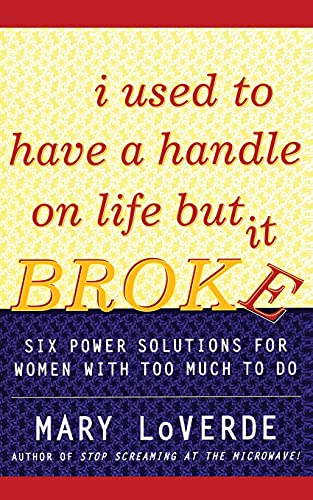
I Used to Have a Handle on Life But It Broke: Six Power Solutions for Women With Too Much To Do - Softcover
Inhaltsangabe
Working 24/7 and STILL
Can't Get It All Done?
Then don't! Most women think that the only way to manage the mounting chaos in their lives is to take control and organize, organize, organize. No wonder we have overwhelming to-do lists that leave us feeling exhausted and powerless! But in I Used to Have a Handle on Life but It Broke, Mary LoVerde has a better idea.
Showing us that the opposite of control is not chaos but contentment, LoVerde demonstrates how to counter the natural urge to assume responsibility for everything. In place of frustrating and futile controlling strategies, she gives readers straightforward techniques for maintaining their energy and keeping their balance no matter what life throws their way. Recognizing that we often confuse control with power, LoVerde delineates six solutions that will help women change from striving for control to thriving with true power:
1. Pose good questions
2. Pay attention
3. Predict your Achilles' heel
4. Partner with women
5. Pause before judging
6. Position yourself
With her trademark sense of humor and the compassionate voice that has earned her such a strong national following, Mary LoVerde shows us that the result of letting go is not a black hole of dirty laundry and unpaid bills, but a life that is light, free, and joyful.
Die Inhaltsangabe kann sich auf eine andere Ausgabe dieses Titels beziehen.
Über die Autorin bzw. den Autor
Mary LoVerde is the president of Life Balance, Inc., and was formerly on the faculty of the University of Colorado School of Medicine and director of the Hypertension Research Center in the Division of Internal Medicine. She is the author of Stop Screaming at the Microwave! and Touching Tomorrow. She lives in Aurora, Colorado.
Auszug. © Genehmigter Nachdruck. Alle Rechte vorbehalten.
Chapter One: Give It Up
Controlling Our Lives
If only i could get a handle on my life. Then I'd finally be able to have some time for myself, the kids, and my husband. I'd read the stack of books on my nightstand, put the piles of photos sitting in their envelopes in albums, and cook healthy meals. If I could just get a grip, I'd solve the problems at work, keep a cleaner house, and pay more attention to my aging parents. With just a little more leverage over my life, I could run the cat to the vet, the kids to dance and debate practice, and the tax forms to the IRS. I could volunteer more. I could lose weight, I could...well, you know, if I could just get control...
As women, we feel responsible for just about everything. And when we put "everything" on a to-do list, it makes for a very full day. As a result, we are exhausted, overwhelmed, and inundated, with no relief in sight. We tried to solve the too-much-to-do-not-enough-time-to-do-it problem by going faster, and now even at warp speed, we're getting further behind. A law of physics tells us that it takes four times as much energy to go twice as fast. No wonder we're tired.
Even those superwomen who can fly faster than a speeding minivan recognize that rushing no longer works. So we have switched gears. Our new favorite strategy is to "simply" get a handle on it all. Yes, yes, that's it! If only we could be in charge, get a grip, gain control of the situation, then we could finally live the good life.
I wondered if this new approach was working, so I began to observe women I believed were successful. I heard Linda Ellerbee, TV journalist and author, deliver an insightful, witty speech detailing her life as a divorcee, mother of two children, recovering alcoholic, and breast cancer survivor. She regaled us with tales of her firings, her career moves, and her leap of faith when she (against conventional wisdom) started her own company, Lucky Duck Productions. Then she said one line, and I didn't hear another word she said: "If I had predicted at any given moment in my life what I would be doing in the next five years, I would have been wrong 100 percent of the time."
My brain froze. Here was a tremendously respected and accomplished woman who used her power to get what she wanted in life, and yet she knew her success was not due to having a firm grip on what would happen next. She held no illusions that she was in control and seemed very comfortable with that truth.
I was intrigued and filled with hope. I reasoned that perhaps I too have enough power to get what I want in my life without forcing, pushing, and obsessing. Maybe getting a handle on my life isn't the answer.
I became very curious about the concept of control and the role it plays in our lives. Does striving for control help or hinder us? Does anyone ever really get control, and if so, what is the price? Do I need to be in control of my life to live the way I want to? What does control have to do with being a powerful woman? I read books, interviewed women from all walks of life from around the world, conducted focus groups, led seminars, and listened at dinner parties. Here's what I learned about control.
We Say We Want Control
Our language suggests that control is a big deal. I've listened to how we describe ourselves when we are out of balance. Women talk a lot about their need for control. Rarely do I get through an entire conversation without hearing something about it:
"As soon as I get things under control..." This is an odd phrase when you think about it. What things? Under where?
"I've got to get on top of things..." "I've got to get to the bottom of this..." We are very busy swarming around. How can we be on both the top and the bottom of everything?
"I need to get it nailed down." One of my friends quipped in reply: "I nailed it once; I just can't remember what I nailed it to."
"I've got a death grip on it, and it is still beyond my control!" "Death grip" is a telling phrase.
When a culture has an important concept, it creates many words to describe it. You may have heard that the Eskimos have a hundred words for snow. Well, if the number of descriptive words is any reflection, control plays a big role in our lives. Our language has everything from birth and mind control to nuclear arms and gun control. Use the word control, and nearly everyone has a strong opinion and is ready and willing to share it.
We're supposed to control our distractions, our dogs, and our dandruff. We want controlling interest. We're incensed when parents won't control their kids, and just watch what happens to some people when they can't find the remote control. Think of a life without control-top panty hose. There is no question about it: We want control!
Research Supports My Hypothesis
Our intense desire for control is not something I dreamed up. Yankelovich, Inc., one of the premiere national marketing research firms, reports that throughout most of the 1990s, the consumer's emphasis was on control. For example, eight out of ten women agreed with the statement, "It's important to me to feel in charge of each and every part of my life," and six out of ten women agreed with the statement, "Lately I find I'm looking for ways of getting more control over my life."
Yankelovich, Inc., even created a framework for understanding how we deal with control, which they called Strategic Control. Within this framework, we use three main strategies:
Jettison things that simply aren't important, or at least not worth the effort.
Delegate those things that can be delegated.
Control those things that remain.
According to their research, consumers were not, in the last decade, inclined to jettison (let go of anything), "as notions of 'sacrifice' and 'compromise' were increasingly unacceptable. Given a fundamental lack of trust, delegation was equally difficult. The results: massive 'to-do' lists and high stress levels."
But a ray of hope shines through. A new pattern is emerging -- an improved approach to managing tasks in our lives and, more important, managing our most precious resources: time and energy. I smiled when I read that the Yankelovich researchers have called the new approach "lightening up," which means, in part, not overanalyzing every decision and instead putting a continuing focus on our quality of life now and a decreased focus on accomplishments and duty. Perhaps we are ready to learn a new way.
Women Are Different
As we begin to adapt new strategies and tap into our feminine powers, we must understand that women belong to a special club. Control is often perceived as a male issue, but women have a unique perspective on it. We deal with stress and the feelings of responsibility differently from men because we react to a wider range of outside stressors. We have more on our plate and therefore more control issues. Ronald Kessler, professor of health care policy at Harvard Medical School, asked 166 married couples to keep a daily stress diary for six weeks. He found women feel stress more often because they take a more holistic view (or is it "whole-list-ic view?") of everyday life. "A man may worry if someone in his immediate family is sick; his wife takes on the burdens of the whole neighborhood. Men take care of one thing [at a time]," he says. "Women put the pieces together."
I know just what he means. I go to bed at night worrying about the starving children who need my leftovers. I lie awake mentally rehearsing the four things I did not get done (and are therefore out of my control) and ignore the 4,752 things I did do. I try to figure out how my friend can save her marriage, my kids can learn the value of money, and we can get the filmmakers to decrease violence. By 2:00 A.M. I'm...
„Über diesen Titel“ kann sich auf eine andere Ausgabe dieses Titels beziehen.
Suchergebnisse für I Used to Have a Handle on Life But It Broke: Six Power...

Beispielbild für diese ISBN
I Used to Have a Handle on Lif
Anbieter: World of Books (was SecondSale), Montgomery, IL, USA
Verkäuferbewertung 5 von 5 Sternen

Zustand: Good. Item in good condition. Textbooks may not include supplemental items i.e. CDs, access codes etc. Artikel-Nr. 00051287692
Gebraucht kaufen
EUR 3,11
Versand gratis
Versand innerhalb von USA
Versand innerhalb von USA
Anzahl: 1 verfügbar
Beispielbild für diese ISBN
I Used to Have a Handle on Life But It Broke: Six Power Solutions for Women With Too Much To Do
Verlag:
Touchstone (edition First Edition), 2002
ISBN 10: 0684854198
ISBN 13: 9780684854199
Gebraucht
Paperback
Erstausgabe
Anbieter: BooksRun, Philadelphia, PA, USA
Verkäuferbewertung 5 von 5 Sternen
Paperback. Zustand: Very Good. First Edition. It's a well-cared-for item that has seen limited use. The item may show minor signs of wear. All the text is legible, with all pages included. It may have slight markings and/or highlighting. Artikel-Nr. 0684854198-11-1
Gebraucht kaufen
EUR 4,66
Versand gratis
Versand innerhalb von USA
Versand innerhalb von USA
Anzahl: 1 verfügbar
Beispielbild für diese ISBN
I Used to Have a Handle on Life but It Broke : Six Power Solutions for Women with Too Much to Do
Anbieter: Better World Books, Mishawaka, IN, USA
Verkäuferbewertung 5 von 5 Sternen
Zustand: Good. Original. Pages intact with minimal writing/highlighting. The binding may be loose and creased. Dust jackets/supplements are not included. Stock photo provided. Product includes identifying sticker. Better World Books: Buy Books. Do Good. Artikel-Nr. GRP64813939
Gebraucht kaufen
EUR 5,97
Versand gratis
Versand innerhalb von USA
Versand innerhalb von USA
Anzahl: 1 verfügbar
Beispielbild für diese ISBN
I Used to Have a Handle on Life but It Broke : Six Power Solutions for Women with Too Much to Do
Anbieter: Better World Books: West, Reno, NV, USA
Verkäuferbewertung 5 von 5 Sternen
Zustand: Good. Original. Pages intact with minimal writing/highlighting. The binding may be loose and creased. Dust jackets/supplements are not included. Stock photo provided. Product includes identifying sticker. Better World Books: Buy Books. Do Good. Artikel-Nr. GRP64813939
Gebraucht kaufen
EUR 5,97
Versand gratis
Versand innerhalb von USA
Versand innerhalb von USA
Anzahl: 1 verfügbar
Beispielbild für diese ISBN
I Used to Have a Handle on Life But It Broke: Six Power Solutions for Women with Too Much to Do
Anbieter: ThriftBooks-Atlanta, AUSTELL, GA, USA
Verkäuferbewertung 5 von 5 Sternen
Paperback. Zustand: Fair. No Jacket. Readable copy. Pages may have considerable notes/highlighting. ~ ThriftBooks: Read More, Spend Less. Artikel-Nr. G0684854198I5N00
Gebraucht kaufen
EUR 6,57
Versand gratis
Versand innerhalb von USA
Versand innerhalb von USA
Anzahl: 1 verfügbar
Beispielbild für diese ISBN
I Used to Have a Handle on Life But It Broke: Six Power Solutions for Women With Too Much To Do
Anbieter: Wonder Book, Frederick, MD, USA
Verkäuferbewertung 5 von 5 Sternen
Zustand: Good. Signed Copy . Inscribed by author on front endpage. Highlighting inside. Artikel-Nr. SB18OS-01706
Gebraucht kaufen
EUR 10,22
Versand gratis
Versand innerhalb von USA
Versand innerhalb von USA
Anzahl: 1 verfügbar
Beispielbild für diese ISBN
I Used to Have a Handle on Life but It Broke : Six Power Solutions for Women with Too Much to Do
Anbieter: Better World Books Ltd, Dunfermline, Vereinigtes Königreich
Verkäuferbewertung 5 von 5 Sternen
Zustand: Very Good. Original. Pages intact with possible writing/highlighting. Binding strong with minor wear. Dust jackets/supplements may not be included. Stock photo provided. Product includes identifying sticker. Better World Books: Buy Books. Do Good. Artikel-Nr. 8063957-75
Gebraucht kaufen
EUR 5,62
EUR 5,83 Versand
Versand von Vereinigtes Königreich nach USA
Versand von Vereinigtes Königreich nach USA
Anzahl: 1 verfügbar
Beispielbild für diese ISBN
I Used to Have a Handle on Life But It Broke: Six Power Solutions for Women With Too Much To Do
Anbieter: Robinson Street Books, IOBA, Binghamton, NY, USA
Verkäuferbewertung 4 von 5 Sternen

Paperback. Zustand: As New. Prompt Shipment, shipped in Boxes, Tracking PROVIDEDFine. First edition. Artikel-Nr. bing45363
Gebraucht kaufen
EUR 11,99
EUR 8,19 Versand
Versand innerhalb von USA
Versand innerhalb von USA
Anzahl: 1 verfügbar
Beispielbild für diese ISBN
I Used to Have a Handle on Life But It Broke: Six Power Solutions for Women With Too Much To Do
Anbieter: Robinson Street Books, IOBA, Binghamton, NY, USA
Verkäuferbewertung 4 von 5 Sternen
Paperback. Zustand: Very Good. Prompt Shipment, shipped in Boxes, Tracking PROVIDEDVery good, few creases. Artikel-Nr. bing786rm4402
Gebraucht kaufen
EUR 11,99
EUR 8,19 Versand
Versand innerhalb von USA
Versand innerhalb von USA
Anzahl: 1 verfügbar
Beispielbild für diese ISBN
I Used to Have a Handle on Life But It Broke: Six Power Solutions for Women With Too Much To Do
Anbieter: Robinson Street Books, IOBA, Binghamton, NY, USA
Verkäuferbewertung 4 von 5 Sternen
Paperback. Zustand: Very Good. Prompt Shipment, shipped in Boxes, Tracking PROVIDEDVery good *. Artikel-Nr. bing803kr034
Gebraucht kaufen
EUR 11,99
EUR 8,19 Versand
Versand innerhalb von USA
Versand innerhalb von USA
Anzahl: 1 verfügbar