
Verwandte Artikel zu First, Break All The Rules: What The Worlds Greatest...
Inhaltsangabe
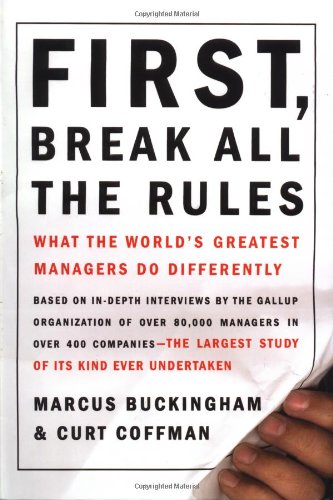
Offers intriguing and provocative insights into the attitudes and behavior of the world's greatest managers, explaining how a good manager can select, focus, motivate, and develop their employees in order to transform talent into performance. 50,000 first printing. Tour.
Die Inhaltsangabe kann sich auf eine andere Ausgabe dieses Titels beziehen.
Über die Autorin bzw. den Autor
Marcus Buckingham spent seventeen years at the Gallup Organization, where he conducted research into the world's best leaders, managers, and workplaces. The Gallup research later became the basis for the bestselling books First, Break All the Rules: What the World's Best Managers Do Differently (Simon & Schuster) and Now, Discover Your Strengths (Free Press), both coauthored by Buckingham. Buckingham has been the subject of in-depth profiles in The New York Times, Fortune, BusinessWeek and Fast Company. He now has his own company, providing strengths-based consulting, training, and e-learning. In 2007 Buckingham founded TMBC to create strengths-based management training solutions for organizations worldwide, and he spreads the strengths message in keynote addresses to over 250,000 people around the globe each year. He lives in Los Angeles with his wife Jane and children Jackson and Lilia. For more information visit: marcusbuckingham.com
Auszug. © Genehmigter Nachdruck. Alle Rechte vorbehalten.
CHAPTER 1
The Measuring Stick
* A Disaster Off the Scilly Isles
* The Measuring Stick
* Putting the Twelve to the Test
* A Case in Point
* Mountain Climbing
A Disaster Off the Scilly Isles
"What do we know to be important but are unable to measure?"
In the dense fog of a dark night in October 1707, Great Britain lost nearly an entire fleet of ships. There was no pitched battle at sea. The admiral, Clowdisley Shovell, simply miscalculated his position in the Atlantic and his flagship smashed into the rocks of the Scilly Isles, a tail of islands off the southwest coast of England. The rest of the fleet, following blindly behind, went aground and piled onto the rocks, one after another. Four warships and two thousand lives were lost.
For such a proud nation of seafarers, this tragic loss was distinctly embarrassing. But to be fair to the memory of Clowdisley Shovell, it was not altogether surprising. The concept of latitude and longitude had been around since the first century B.C. But by 1700 we still hadn't managed to devise an accurate way to measure longitude -- nobody ever knew for sure how far east or west they had traveled. Professional seamen like Clowdisley Shovell had to estimate their progress either by guessing their average speed or by dropping a log over the side of the boat and timing how long it took to float from bow to stem. Forced to rely on such crude measurements, the admiral can be forgiven his massive misjudgment.
What caused the disaster was not the admiral's ignorance, but his inability to measure something that he already knew to be critically important -- in this case longitude.
A similar drama is playing out in today's business world: many companies know that their ability to find and keep talented employees is vital to their sustained success, but they have no way of knowing whether or not they are effective at doing this.
In their book The Service Profit Chain, James Heskett, W. Earl Sasser, and Leonard Schlesinger make the case that no matter what your business, the only way to generate enduring profits is to begin by building the kind of work environment that attracts, focuses, and keeps talented employees. It is a convincing case. But the manager on the street probably didn't need convincing. Over the last twenty years most managers have come to realize their competitiveness depends upon being able to find and keep top talent in every role This is why, in tight labor markets, companies seem prepared to go to almost any lengths to prevent employees' eyes from wandering. If you work for GE, you may be one of the twenty-three thousand employees who are now granted stock options in the company. Employees of AlliedSignal and Starbucks can make use of the company concierge service when they forget that their mothers need flowers and their dachshunds need walking. And at Eddie Bauer, in-chair massages are available for all those aching backs hunched over computer terminals.
But do any of these caring carrots really work? Do they really attract and keep only the most productive employees? Or are they simply a catch-all, netting both productive employees and ROAD warriors -- the army's pithy phrase for those sleepy folk who are happy to "retire on active duty"?
The truth is, no one really knows. Why? Because even though every great manager and every great company realizes how important it is, they still haven't devised an accurate way to measure a manager's or a company's ability to find, focus, and keep talented people. The few measurements that are available -- such as employee retention figures or number of days to fill openings or lengthy employee opinion surveys -- lack precision. They are the modern-day equivalent of dropping a log over the side of the boat.
Companies and managers know they need help. What they are asking for is a simple and accurate measuring stick that can tell them how well one company or one manager is doing as compared with others, in terms of finding and keeping talented people. Without this measuring stick, many companies and many managers know they may find themselves high and dry -- sure of where they want to go but lacking the right people to get there.
And now there is a powerful new faction on the scene, demanding this simple measuring stick: institutional investors.
Institutional investors -- like the Council of Institutional Investors (CII), which manages over $1 trillion worth of stocks, and the California Public Employees Retirement System (CalPERS), which oversees a healthy $260 billion -- define the agenda for the business world. Where they lead, everyone else follows.
Institutional investors have always been the ultimate numbers guys, representing the cold voice of massed shareholders, demanding efficiency and profitability. Traditionally they focused on hard results, like return on assets and economic value added. Most of them didn't concern themselves with "soft" issues like "culture." In their minds a company's culture held the same status as public opinion polls did in Soviet Russia: superficially interesting but fundamentally irrelevant.
At least that's the way it used to be. In a recent about-face, they have started to pay much closer attention to how companies treat their people. In fact, the CII and CalPERS both met in Washington to discuss "good workplace practices...and how they can encourage the companies they invest in to value employee loyalty as an aid to productivity."
Why this newfound interest? They have started to realize that whether software designer or delivery truck driver, accountant or hotel housekeeper, the most valuable aspects of jobs are now, as Thomas Stewart describes in Intellectual Capital, "the most essentially human tasks: sensing, judging, creating, and building relationships." This means that a great deal of a company's value now lies "between the ears of its employees." And this means that when someone leaves a company, he takes his value with him -- more often than not, straight to the competition.
Today more than ever before, if a company is bleeding people, it is bleeding value. Investors are frequently stunned by this discovery. They know that their current measuring sticks do a very poor job of capturing all sources of a company's value. For example, according to Baruch Lev, professor of finance and accounting at New York University's Stern School of Business, the assets and liabilities listed on a company's balance sheet now account for only 60 percent of its real market value. And this inaccuracy is increasing. In the 1970s and 1980s, 25 percent of the changes in a company's market value could be accounted for by fluctuations in its profits. Today, according to Professor Lev, that number has shrunk to 10 percent.
The sources of a company's true value have broadened beyond rough measures of profit or fixed assets, and bean counters everywhere are scurrying to catch up. Steve Wallman, former commissioner of the Securities and Exchange Commission, describes what they are looking for:
If we start to get further afield so that the financial statements...are measuring less and less of what is truly valuable in a company, then we start to lower the relevance of that scorecard. What we need are ways to measure the intangibles, R&D, customer satisfaction, employee satisfaction. (italics ours)
Companies, managers, institutional investors, even the commissioner of the SEC -- everywhere you look, people are demanding a simple and accurate measuring stick for comparing the strength of one workplace to another. The Gallup Organization set out to build one.
The Measuring Stick
"How can you measure human capital?"
What does a strong, vibrant workplace look like?
When you walk into the building at Lankford-Sysco a few miles up the road from Ocean City, Maryland, it doesn't initially...
„Über diesen Titel“ kann sich auf eine andere Ausgabe dieses Titels beziehen.
Suchergebnisse für First, Break All The Rules: What The Worlds Greatest...

Beispielbild für diese ISBN
First, Break All the Rules: What the World's Great Managers Do Differently
Anbieter: World of Books (was SecondSale), Montgomery, IL, USA
Verkäuferbewertung 5 von 5 Sternen

Hardback. Zustand: Good. Explains how good managers can select, focus, motivate, and develop their employees in order to transform talent into performance. Artikel-Nr. 00079874061
Gebraucht kaufen
EUR 3,85
Versand gratis
Versand innerhalb von USA
Versand innerhalb von USA
Anzahl: Mehr als 20 verfügbar
Beispielbild für diese ISBN
First, Break All the Rules: What the World's Greatest Managers Do Differently
Verlag:
Gallup Press (edition First Edition), 1999
ISBN 10: 0684852861
ISBN 13: 9780684852867
Gebraucht
Hardcover
Erstausgabe
Anbieter: BooksRun, Philadelphia, PA, USA
Verkäuferbewertung 5 von 5 Sternen
Hardcover. Zustand: Fair. First Edition. With dust jacket. The item might be beaten up but readable. May contain markings or highlighting, as well as stains, bent corners, or any other major defect, but the text is not obscured in any way. Artikel-Nr. 0684852861-7-18-29
Gebraucht kaufen
EUR 5,62
Versand gratis
Versand innerhalb von USA
Versand innerhalb von USA
Anzahl: 2 verfügbar
Beispielbild für diese ISBN
First, Break All the Rules: What the World's Greatest Managers Do Differently
Verlag:
Gallup Press (edition First Edition), 1999
ISBN 10: 0684852861
ISBN 13: 9780684852867
Gebraucht
Hardcover
Erstausgabe
Anbieter: BooksRun, Philadelphia, PA, USA
Verkäuferbewertung 5 von 5 Sternen
Hardcover. Zustand: Very Good. First Edition. With dust jacket. It's a well-cared-for item that has seen limited use. The item may show minor signs of wear. All the text is legible, with all pages included. It may have slight markings and/or highlighting. Artikel-Nr. 0684852861-11-18-29
Gebraucht kaufen
EUR 5,78
Versand gratis
Versand innerhalb von USA
Versand innerhalb von USA
Anzahl: 1 verfügbar
Beispielbild für diese ISBN
First, Break All the Rules: What the World's Greatest Managers Do Differently
Anbieter: ThriftBooks-Reno, Reno, NV, USA
Verkäuferbewertung 5 von 5 Sternen
Hardcover. Zustand: Very Good. No Jacket. Missing dust jacket; May have limited writing in cover pages. Pages are unmarked. ~ ThriftBooks: Read More, Spend Less. Artikel-Nr. G0684852861I4N01
Gebraucht kaufen
EUR 5,98
Versand gratis
Versand innerhalb von USA
Versand innerhalb von USA
Anzahl: 5 verfügbar
Beispielbild für diese ISBN
First, Break All the Rules: What the World's Greatest Managers Do Differently
Anbieter: ThriftBooks-Reno, Reno, NV, USA
Verkäuferbewertung 5 von 5 Sternen
Hardcover. Zustand: Very Good. No Jacket. May have limited writing in cover pages. Pages are unmarked. ~ ThriftBooks: Read More, Spend Less. Artikel-Nr. G0684852861I4N00
Gebraucht kaufen
EUR 5,98
Versand gratis
Versand innerhalb von USA
Versand innerhalb von USA
Anzahl: 5 verfügbar
Beispielbild für diese ISBN
First, Break All the Rules: What the World's Greatest Managers Do Differently
Anbieter: ThriftBooks-Atlanta, AUSTELL, GA, USA
Verkäuferbewertung 5 von 5 Sternen
Hardcover. Zustand: Very Good. No Jacket. Missing dust jacket; May have limited writing in cover pages. Pages are unmarked. ~ ThriftBooks: Read More, Spend Less. Artikel-Nr. G0684852861I4N01
Gebraucht kaufen
EUR 5,98
Versand gratis
Versand innerhalb von USA
Versand innerhalb von USA
Anzahl: 6 verfügbar
Beispielbild für diese ISBN
First, Break All the Rules: What the World's Greatest Managers Do Differently
Anbieter: ThriftBooks-Dallas, Dallas, TX, USA
Verkäuferbewertung 5 von 5 Sternen
Hardcover. Zustand: Very Good. No Jacket. May have limited writing in cover pages. Pages are unmarked. ~ ThriftBooks: Read More, Spend Less. Artikel-Nr. G0684852861I4N00
Gebraucht kaufen
EUR 5,98
Versand gratis
Versand innerhalb von USA
Versand innerhalb von USA
Anzahl: 5 verfügbar
Beispielbild für diese ISBN
First, Break All the Rules: What the World's Greatest Managers Do Differently
Anbieter: ThriftBooks-Dallas, Dallas, TX, USA
Verkäuferbewertung 5 von 5 Sternen
Hardcover. Zustand: Very Good. No Jacket. Former library book; May have limited writing in cover pages. Pages are unmarked. ~ ThriftBooks: Read More, Spend Less. Artikel-Nr. G0684852861I4N10
Gebraucht kaufen
EUR 5,98
Versand gratis
Versand innerhalb von USA
Versand innerhalb von USA
Anzahl: 1 verfügbar
Beispielbild für diese ISBN
First, Break All the Rules: What the World's Greatest Managers Do Differently
Anbieter: ThriftBooks-Dallas, Dallas, TX, USA
Verkäuferbewertung 5 von 5 Sternen
Hardcover. Zustand: Very Good. No Jacket. Missing dust jacket; May have limited writing in cover pages. Pages are unmarked. ~ ThriftBooks: Read More, Spend Less. Artikel-Nr. G0684852861I4N01
Gebraucht kaufen
EUR 5,98
Versand gratis
Versand innerhalb von USA
Versand innerhalb von USA
Anzahl: 5 verfügbar
Beispielbild für diese ISBN
First, Break All the Rules: What the World's Greatest Managers Do Differently
Anbieter: ThriftBooks-Phoenix, Phoenix, AZ, USA
Verkäuferbewertung 5 von 5 Sternen
Hardcover. Zustand: Very Good. No Jacket. Missing dust jacket; May have limited writing in cover pages. Pages are unmarked. ~ ThriftBooks: Read More, Spend Less. Artikel-Nr. G0684852861I4N01
Gebraucht kaufen
EUR 5,98
Versand gratis
Versand innerhalb von USA
Versand innerhalb von USA
Anzahl: 5 verfügbar