
Verwandte Artikel zu If Only We Knew What We Know: The Transfer of Internal...
Inhaltsangabe
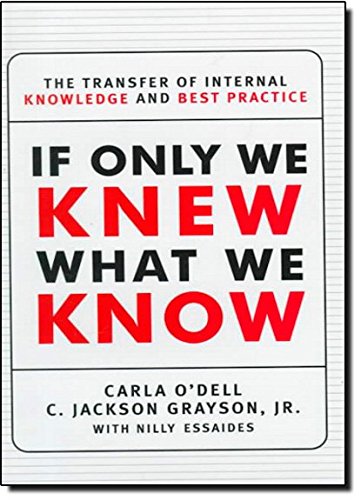
While companies search the world over to benchmark best practices, vast treasure troves of knowledge and know-how remain hidden right under their noses: in the minds of their own employees, in the often unique structure of their operations, and in the written history of their organizations. Now, acclaimed productivity and quality experts Carla O'Dell and Jack Grayson explain for the first time how applying the ideas of Knowledge Management can help employers identify their own internal best practices and share this intellectual capital throughout their organizations.
Knowledge Management (KM) is a conscious strategy of getting the right information to the right people at the right time so they can take action and create value. Basing KM on three major studies of best practices at one hundred companies, the authors demonstrate how managers can utilize a visual process model to actually transfer best practices from one business unit of the organization to another. Rich with case studies, concrete examples, and revealing anecdotes from companies including Texas Instruments, Amoco, Buckman, Chevron, Sequent Computer, the World Bank, and USAA, this valuable guide reveals how knowledge treasure chests can be unlocked to reduce product development cycle time, implement more cost-efficient operations, or create a loyal customer base. Finally, O'Dell and Grayson present three "value propositions" built around customers, products, and operations that could result in staggering payoffs as they did at the companies cited above.
No amount of knowledge or insight can keep a company ahead if it is not properly distributed where it's needed. Entirely accessible and immensely readable, If Only We Knew What We Know is a much-needed companion for business leaders everywhere.
Die Inhaltsangabe kann sich auf eine andere Ausgabe dieses Titels beziehen.
Über die Autorin bzw. den Autor
Carla O'Dell is president of the American Productivity & Quality Center and director of the Center's International Benchmarking Clearinghouse in Houston, Texas. Dr. O'Dell is co-author with C. Jackson Grayson, Jr., of American Business: A Two Minute Warning.
Auszug. © Genehmigter Nachdruck. Alle Rechte vorbehalten.
Chapter One: DEFINITIONS OF KNOWLEDGE AND KNOWLEDGE MANAGEMENT
Knowledge management is really about recognizing that regardless of what business you are in, you are competing based on the knowledge of your employees.-- Cindy Johnson, Director of Collaboration and Knowledge Sharing at Texas Instruments
WHAT DO WE MEAN BY "KNOWLEDGE"?
The recorded study of learning and knowledge dates back at least to Plato and Aristotle; however, its modern-day exploration is credited to thinkers like Daniel Bell (1973), Peter Drucker (1993), Alvin Toffler (1970, 1980), and the philosopher Michael Polanyi (1958, 1967). Polanyi's work served as the basis for the much-acclaimed knowledge management theories and books by the Japanese organizational learning guru, Ikujiro Nonaka (1991, 1995) -- as of September 1997 appointed Xerox Chair of Knowledge at his alma mater, The Haas School of Business, the University of California at Berkeley.
Polyani and Nonaka both point out that knowledge comes in two basic varieties: tacit and explicit, also known as informal/uncodified and formal/codified. Explicit knowledge comes in the form of books and documents, white papers, databases, and policy manuals. The tacit/uncodified variety, in contrast, can be found in the heads of employees, the experience of customers, the memories of past vendors. Tacit knowledge is hard to catalogue, highly experiential, difficult to document in any detail, ephemeral and transitory. Both types of knowledge are important.
Some may argue that, in a commercial context, tacit knowledge does not qualify as "knowledge" at all. just as value is defined by the " transfer price" in the context of Seller/buyer interaction, thoughts in our heads are not "knowledge" until they enter the marketplace of ideas via discussion and interaction. "It is the intersection between tacit knowledge and explicit knowledge that creates learning," Nonaka wrote in the February 1994 issue of Organizational Science.
For example, a manager who has just tried out a new sales technique has "tacit" knowledge of it. If he writes it down and posts it on his company's intranet site, some of that knowledge has become captured and " explicit." Next, another sales manager reads the description and uses the technique on her next sales trip (hence turns it into "tacit" once more). Knowledge has been captured, exchanged, and created (see Steps in the Knowledge Transfer Process, below). The learning process hence involves the continuous "intersection" of these two knowledge types and a never-ending, closed-loop transformation process.
Other organizational experts, such as Leif Edvinsson of Skandia, further divide commercial knowledge into individual, organizational, and structural knowledge. Individual knowledge is solely in the minds of employees. Organizational knowledge is the learning that occurs on a group or division level. Structural knowledge is embedded in the "bricks" of the corporation though processes, manuals, and codes of ethics. At any one of these three "states, the knowledge can be either tacit or explicit.
Knowledge is broader than intellectual capital (IC). Whereas some writers have chosen to expand IC to include practices and processes, in its purest form, IC refers to the commercial value of trademarks, licenses, brand names, formulations, and patents. In this view, knowledge-as-intellectual-capital is an asset, almost tangible. Our use of knowledge is broader: we view knowledge as dynamic -- a consequence of action and interaction of people in an organization with information and with each other.
Knowledge is bigger than information. Our organizations are awash in information, but until people use it, it isn't knowledge. While you can't have too much knowledge, you can certainly have too much information. Indeed, many organizations have already discovered that information, carried faster and in greater volumes by electronic media, leaves employees overwhelmed, not overconfident. Fumbling rather than focused. Paralyzed rather than proactive.
Hence, our simple working definition: Knowledge is information in action. In the organizational and commercial context of this book, knowledge is what people in an organization know about their customers, products, processes, mistakes, and successes, whether that knowledge is tacit or explicit.
Data (facts and figures, without context and interpretation), and information (patterns in the data), are not in themselves knowledge (actionable information). For example, when a British supermarket chain implemented a high-end customer data-mining application, it began to accumulate data on buying behavior. It then took the data and ran correlation analyses among the seemingly unrelated points to reveal buying behavior patterns. For instance, the chain quickly found a clear correlation between the purchases of diapers and beer on Friday afternoon. It took this curious piece of information, and hypothesized that men, on a Friday afternoon shopping expedition, are likely to buy beer (for themselves) and a pack of diapers (as per their wives' shopping list). Armed with this knowledge about its customers' behavior, the store took action and reconfigured the locations of diapers and beer on its shelves.
This leads us to the next fundamental question.
WHAT IS KNOWLEDGE MANAGEMENT?
Let's start with what managing and sharing knowledge is not:
- Knowledge management (KM) is not a new religion or a spiritual calling.
- It is not an attempt to rally disgruntled employees around an appealing philosophical concept.
- It is not an existentialist search for the Truth. (Actually, it's about the entirely worldly task of making money.)
- It is not a science or a "discipline" -- yet.
- It is not the latest management fad.
When explicitly managed, organizational knowledge is used to accomplish the organization's mission. Knowledge management is therefore a conscious strategy of getting the right knowledge to the right people at the right time and helping people share and put information into action in ways that strive to improve organizational performance.
Fortunately, most companies have some experience already in managing knowledge. Indeed, KM is not a radical departure or a methodology in and of itself. Rather, it is a framework, a management mind-set that includes building on past experiences (libraries, databanks, smart people) and creating new vehicles for exchanging knowledge (knowledge-enabled intranet sites, communities of practice, networks).
For most organizations, KM represents a continuation of efforts begun in other times with other names (or acronyms), all of which have likely yielded valuable learnings.
- Radical reengineering may have not delivered sustainable success, but it has "delivered" the mind-set of the process-oriented organization. Processes can be made explicit, and knowledge about how to make them work can be transferred.
- Total quality management (TQM) may have not always yielded big-time change, but it laid the foundation for a corporate-wide, systematic initiative for measurement and change and cross-functional teaming, all of which, we will argue, are critical to the successful management of knowledge
Not surprising, newly trim and lean, reengineered companies like Amoco, Chevron, and Texas Instruments have been at the forefront of the KM "[r]evolution." Companies like these have been among the first to realize that to accelerate growth -- again -- they must adopt new approaches that leverage their internal expertise.
This leads us to another building block in the foundation for the remainder of this book.
STEPS IN...
„Über diesen Titel“ kann sich auf eine andere Ausgabe dieses Titels beziehen.
Suchergebnisse für If Only We Knew What We Know: The Transfer of Internal...

Beispielbild für diese ISBN
If Only We Knew What We Know: The Transfer of Internal Knowledge and Best Practice
Anbieter: World of Books (was SecondSale), Montgomery, IL, USA
Verkäuferbewertung 5 von 5 Sternen

Zustand: Good. Item in good condition. Textbooks may not include supplemental items i.e. CDs, access codes etc. Artikel-Nr. 00096158310
Gebraucht kaufen
EUR 4,59
Versand gratis
Versand innerhalb von USA
Versand innerhalb von USA
Anzahl: 4 verfügbar
Beispielbild für diese ISBN
If Only We Knew What We Know: The Transfer of Internal Knowledge and Best Practice
Anbieter: BooksRun, Philadelphia, PA, USA
Verkäuferbewertung 5 von 5 Sternen
Hardcover. Zustand: Very Good. 1. With dust jacket. It's a well-cared-for item that has seen limited use. The item may show minor signs of wear. All the text is legible, with all pages included. It may have slight markings and/or highlighting. Artikel-Nr. 0684844745-8-1-29
Gebraucht kaufen
EUR 4,60
Versand gratis
Versand innerhalb von USA
Versand innerhalb von USA
Anzahl: 1 verfügbar
Beispielbild für diese ISBN
If Only We Knew What We Know : The Transfer of Internal Knowledge and Best Practice
Anbieter: Better World Books, Mishawaka, IN, USA
Verkäuferbewertung 5 von 5 Sternen
Zustand: Good. 1st Edition. Pages intact with minimal writing/highlighting. The binding may be loose and creased. Dust jackets/supplements are not included. Stock photo provided. Product includes identifying sticker. Better World Books: Buy Books. Do Good. Artikel-Nr. 6383430-20
Gebraucht kaufen
EUR 6,08
Versand gratis
Versand innerhalb von USA
Versand innerhalb von USA
Anzahl: 2 verfügbar
Beispielbild für diese ISBN
If Only We Knew What We Know : The Transfer of Internal Knowledge and Best Practice
Anbieter: Better World Books, Mishawaka, IN, USA
Verkäuferbewertung 5 von 5 Sternen
Zustand: Very Good. 1st Edition. Pages intact with possible writing/highlighting. Binding strong with minor wear. Dust jackets/supplements may not be included. Stock photo provided. Product includes identifying sticker. Better World Books: Buy Books. Do Good. Artikel-Nr. 12361096-75
Gebraucht kaufen
EUR 6,08
Versand gratis
Versand innerhalb von USA
Versand innerhalb von USA
Anzahl: 2 verfügbar
Beispielbild für diese ISBN
If Only We Knew What We Know: The Transfer of Internal Knowledge and Best Practice
Anbieter: ThriftBooks-Dallas, Dallas, TX, USA
Verkäuferbewertung 5 von 5 Sternen
Hardcover. Zustand: Very Good. No Jacket. May have limited writing in cover pages. Pages are unmarked. ~ ThriftBooks: Read More, Spend Less. Artikel-Nr. G0684844745I4N00
Gebraucht kaufen
EUR 6,22
Versand gratis
Versand innerhalb von USA
Versand innerhalb von USA
Anzahl: 1 verfügbar
Beispielbild für diese ISBN
If Only We Knew What We Know: The Transfer of Internal Knowledge and Best Practice
Anbieter: ThriftBooks-Atlanta, AUSTELL, GA, USA
Verkäuferbewertung 5 von 5 Sternen
Hardcover. Zustand: As New. No Jacket. Pages are clean and are not marred by notes or folds of any kind. ~ ThriftBooks: Read More, Spend Less. Artikel-Nr. G0684844745I2N00
Gebraucht kaufen
EUR 6,22
Versand gratis
Versand innerhalb von USA
Versand innerhalb von USA
Anzahl: 1 verfügbar
Beispielbild für diese ISBN
If Only We Knew What We Know: The Transfer of Internal Knowledge and Best Practice
Anbieter: Wonder Book, Frederick, MD, USA
Verkäuferbewertung 5 von 5 Sternen
Zustand: Very Good. Very Good condition. Good dust jacket. A copy that may have a few cosmetic defects. May also contain light spine creasing or a few markings such as an owner's name, short gifter's inscription or light stamp. Artikel-Nr. B01N-00673
Gebraucht kaufen
EUR 6,32
Versand gratis
Versand innerhalb von USA
Versand innerhalb von USA
Anzahl: 1 verfügbar
Beispielbild für diese ISBN
If Only We Knew What We Know: The Transfer of Internal Knowledge and Best Practice
Anbieter: Wonder Book, Frederick, MD, USA
Verkäuferbewertung 5 von 5 Sternen
Zustand: Good. Good condition. Good dust jacket. A copy that has been read but remains intact. May contain markings such as bookplates, stamps, limited notes and highlighting, or a few light stains. Artikel-Nr. R06A-03177
Gebraucht kaufen
EUR 6,32
Versand gratis
Versand innerhalb von USA
Versand innerhalb von USA
Anzahl: 1 verfügbar
Beispielbild für diese ISBN
If Only We Knew What We Know: The Transfer of Internal Knowledge and Best Practice
Anbieter: Wonder Book, Frederick, MD, USA
Verkäuferbewertung 5 von 5 Sternen
Zustand: Very Good. Signed Copy . Very Good dust jacket. Signed by O'Dell & Grayson Jr on front endpage. Artikel-Nr. D01OS-00371
Gebraucht kaufen
EUR 6,32
Versand gratis
Versand innerhalb von USA
Versand innerhalb von USA
Anzahl: 1 verfügbar
Beispielbild für diese ISBN
If Only We Knew What We Know: The Transfer of Internal Knowledge and Best Practice
Anbieter: Wonder Book, Frederick, MD, USA
Verkäuferbewertung 5 von 5 Sternen
Zustand: Good. Signed Copy . Very Good dust jacket. Signed/Inscribed by O'Dell on front endpage. Artikel-Nr. SB03A-01880
Gebraucht kaufen
EUR 6,32
Versand gratis
Versand innerhalb von USA
Versand innerhalb von USA
Anzahl: 1 verfügbar