
Verwandte Artikel zu Creating Shareholder Value: A Guide for Managers and...
Inhaltsangabe
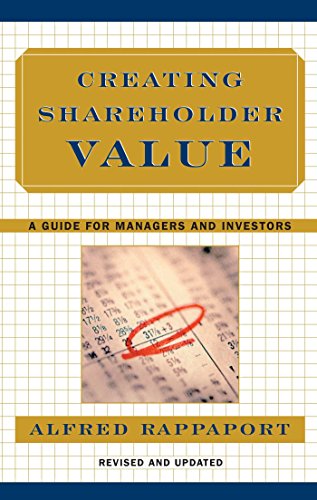
Economist, consultant, and Wall Street Journal contributor Alfred Rappaport provides managers and investors with the practical tools and tests for a corporate strategy that creates shareholder value.
The ultimate test of corporate strategy, the only reliable measure, is whether it creates economic value for shareholders.
After a decade of downsizings frequently blamed on shareholder value decision making, this book presents a new and indepth assessment of the rationale for shareholder value. Further, Rappaport presents provocative new insights on shareholder value applications to: (1) business planning, (2) performance evaluation, (3) executive compensation, (4) mergers and acquisitions, (5) interpreting stock market signals, and (6) organizational implementation. Readers will be particularly interested in Rappaport's answers to three management performance evaluation questions: (1) What is the most appropriate measure of performance? (2) What is the most appropriate target level of performance? and (3) How should rewards be linked to performance? Through the lens of high-stakes case studies, like the notable acquisition of Duracell International by Gillette, Rappaport dissects the intricate decisions and risks inherent in the merger and acquisition process.
The shareholder value approach presented here has been widely embraced by publicly traded as well as privately held companies worldwide. Brilliant and incisive, this is the one book that should be required reading for managers and investors who want to stay on the cutting edge of success in a highly competitive global economy.
Die Inhaltsangabe kann sich auf eine andere Ausgabe dieses Titels beziehen.
Über die Autorin bzw. den Autor
Dr. Alfred Happaport, the Leonard Spacek Professor Emeritus of J. L. Kellogg Graduate School of Management at Northwestern University, developed the idea for the Shareholder Scoreboard, published annually by The Wall Street Journal. He is co-founder and former Chairman of the Board of The Alcar Group Inc., whose consulting and education practices are now part of The LEK/Alcar Consulting Group, LLC, the U.S. operation of a worldwide strategy consulting firm. He has been a guest columnist for The Wall Street Journal, The New York Times, and Business Week, and lives in La Jolla, California.
Auszug. © Genehmigter Nachdruck. Alle Rechte vorbehalten.
Chapter 1
SHAREHOLDER VALUE AND CORPORATE PURPOSE
The idea that management's primary responsibility is to increase value has gained widespread acceptance in the United States since the publication of Creating Shareholder Value in 1986. With the globalization of competition and capital markets and a tidal wave of privatizations, shareholder value rapidly is capturing the attention of executives in the United Kingdom, continental Europe, Australia, and even Japan. Over the next ten years shareholder value will more than likely become the global standard for measuring business performance.
In the early 1980s there were very few companies with an unambiguous commitment to shareholder value. While many companies used piecemeal applications of the shareholder value approach, such as discounted cash-flow analysis for capital budgeting decisions and for merger-and-acquisition pricing, management thinking largely was governed by a short-term earnings orientation. The takeover movement of the latter half of the 1980s provided a powerful incentive for managers to focus on creating value. Many companies, particularly those in mature industries such as oil, allocated their very substantial excess cash flow toward uneconomic reinvestment or ill-advised diversification. Other companies failed to seek the highest valued use for their assets. For example, retailing establishments, particularly large department stores sitting on valuable downtown real estate, missed the opportunity to sell the real estate and redeploy the cash to value-creating growth or, in the absence of profitable investment opportunities, distribute the cash to shareholders. In each of these cases the stock market predictably penalized the companies' shares. This led to the infamous "value gap," i.e., the difference between the value of the company if it were operated to maximize shareholder value and its current market value. A positive "value gap" was an invitation to well-financed corporate raiders to bid for the company and replace incumbent management. The only compelling takeover defense is to close the "value gap" by delivering superior shareholder value. Whatever one thinks of raiders and their tactics, the threats of takeovers did prompt CEOs to give long-overdue focus to delivering value for shareholders.
The excesses of the late-1980s takeover movement -- payments of unwarranted acquisition premiums financed by high leverage -- led to the demise of "financial" acquisitions. Entering the 1990s CEOs of many public companies were relieved to see Wall Street raiders move backstage. But there was to be no return to business as usual. Over the past few years institutional investors have substantially increased their efforts to gain better returns for the beneficiaries of the funds they manage. Their primary approach has been to shine the spotlight on underperforming companies and promote changes in either corporate strategy or in management itself. For example, the California Public Employees' Retirement System (CalPERS) screens annually for the ten most seriously underperforming stocks in its portfolio. The Council of Institutional Investors, a trade organization for public pension funds, publishes a "bottom 20" list comprised of companies in the Standard & Poor's 500 who most underperformed their industry in total shareholder returns, i.e., dividends plus stock price change. In 1992 Robert Monks and Nell Minow founded LENS, a fund exclusively devoted to investing in "companies with strong underlying values, but whose performance lags due to lack of focus by the management or the board." After four years of constructive involvement with its portfolio companies, $1 invested in 1992 compounded to $2.28 versus $1.69 for the S&P 500. Active institutional investors have helped displace CEOs at such major companies as American Express, Eastman Kodak, General Motors, IBM, K-Mart, Sears, and Westinghouse.
Maximizing shareholder value is now embraced as the "politically correct" stance by corporate board members and top management in the United States. As is the case with other good ideas, shareholder value has moved from being ignored to being rejected to becoming self-evident. It is invariably invoked in annual reports, press releases, meetings with financial analysts, and management speeches. However, the critical role of the shareholder value approach in allocating resources in a market-based economy is far from universally accepted. Years of restructuring and employee layoffs frequently attributed to shareholder value considerations coupled with politicians who charge top management with self-interest and a shortsighted focus on the current stock price have promoted frustration and uncertainty. In other parts of the world, such as the European continent, there is increasing political tension between the shareholder value business practices required in a competitive global market and the long-standing tradition of social welfare. In light of these developments, a reassessment of the fundamental rationale for the shareholder value approach is warranted.
MANAGEMENT VERSUS SHAREHOLDER OBJECTIVES
It is important to recognize that the objectives of management may in some situations differ from those of the company's shareholders. Managers, like other people, act in their self-interest. The theory of a market economy is, after all, based on individuals promoting their self-interests via market transactions to bring about an efficient allocation of resources. In a world in which principals (e.g., stockholders) have imperfect control over their agents (e.g., managers), these agents may not always engage in transactions solely in the best interests of the principals. Agents have their own objectives and it may sometimes pay them to sacrifice the principals' interests. There are, however, a number of factors that induce management to act in the best interests of shareholders. These factors derive from the fundamental premise that the greater the expected unfavorable consequences to the manager who decreases the wealth of shareholders, the less likely it is that the manager will, in fact, act against the interests of shareholders.
Consistent with the above premise, at least four major factors will induce management to adopt a shareholder orientation: (1) a relatively large ownership position, (2) compensation tied to shareholder return performance, (3) threat of takeover by another organization, and (4) competitive labor markets for corporate executives.
Economic rationality dictates that stock ownership by management motivates executives to identify more closely with the shareholders' economic interests. Indeed, we would expect that the greater the proportion of personal wealth invested in company stock or tied to stock options, the greater would be management's shareholder orientation. While the top executives in many companies often have relatively large percentages of their wealth invested in company stock, this is much less often the case for divisional and business unit managers. And it is at the divisional and business unit levels that most resource allocation decisions are made in decentralized organizations.
Even when corporate executives own shares in their company, their viewpoint on the acceptance of risk may differ from that of shareholders. It is reasonable to expect that many corporate executives have a lower tolerance for risk. If the company invests in a risky project, stockholders can always balance this risk against other risks in their presumably diversified portfolios. The manager, however, can balance a project failure only against the other activities of the division or the company. Thus, managers are hurt by the failure more than shareholders.
The second factor likely to influence management to adopt a shareholder orientation is compensation tied to shareholder return...
„Über diesen Titel“ kann sich auf eine andere Ausgabe dieses Titels beziehen.
Suchergebnisse für Creating Shareholder Value: A Guide for Managers and...

Beispielbild für diese ISBN
Creating Shareholder Value: A Guide for Managers and Investors
Anbieter: World of Books (was SecondSale), Montgomery, IL, USA
Verkäuferbewertung 5 von 5 Sternen

Hardback. Zustand: Very Good. The revised edition of the business classic which provides definitive guidance for managers on how to select and implement the tactics that will create the most value. Managers are shown how to develop value-creating businesses that not only improve a firm's profitability, but make it more resistant to corporate raiders. Artikel-Nr. CIN0684844109VG
Gebraucht kaufen
EUR 4,79
Versand gratis
Versand innerhalb von USA
Versand innerhalb von USA
Anzahl: 1 verfügbar
Beispielbild für diese ISBN
Creating Shareholder Value: A Guide for Managers and Investors
Anbieter: World of Books (was SecondSale), Montgomery, IL, USA
Verkäuferbewertung 5 von 5 Sternen
Hardback. Zustand: Fair. The revised edition of the business classic which provides definitive guidance for managers on how to select and implement the tactics that will create the most value. Managers are shown how to develop value-creating businesses that not only improve a firm's profitability, but make it more resistant to corporate raiders. Artikel-Nr. 00098129491
Gebraucht kaufen
EUR 4,79
Versand gratis
Versand innerhalb von USA
Versand innerhalb von USA
Anzahl: 1 verfügbar
Beispielbild für diese ISBN
Creating Shareholder Value: A Guide for Managers and Investors
Anbieter: World of Books (was SecondSale), Montgomery, IL, USA
Verkäuferbewertung 5 von 5 Sternen
Hardback. Zustand: Good. The revised edition of the business classic which provides definitive guidance for managers on how to select and implement the tactics that will create the most value. Managers are shown how to develop value-creating businesses that not only improve a firm's profitability, but make it more resistant to corporate raiders. Artikel-Nr. 00098340541
Gebraucht kaufen
EUR 4,79
Versand gratis
Versand innerhalb von USA
Versand innerhalb von USA
Anzahl: 4 verfügbar
Beispielbild für diese ISBN
Creating Shareholder Value: A Guide for Managers and Investors
Verlag:
Free Press (edition Subsequent), 1997
ISBN 10: 0684844109
ISBN 13: 9780684844107
Gebraucht
Hardcover
Anbieter: BooksRun, Philadelphia, PA, USA
Verkäuferbewertung 5 von 5 Sternen
Hardcover. Zustand: Very Good. Subsequent. With dust jacket. It's a well-cared-for item that has seen limited use. The item may show minor signs of wear. All the text is legible, with all pages included. It may have slight markings and/or highlighting. Artikel-Nr. 0684844109-11-1-29
Gebraucht kaufen
EUR 6,17
Versand gratis
Versand innerhalb von USA
Versand innerhalb von USA
Anzahl: 1 verfügbar
Beispielbild für diese ISBN
Creating Shareholder Value : A Guide for Managers and Investors
Anbieter: Better World Books, Mishawaka, IN, USA
Verkäuferbewertung 5 von 5 Sternen
Zustand: Good. rev. Pages intact with minimal writing/highlighting. The binding may be loose and creased. Dust jackets/supplements are not included. Stock photo provided. Product includes identifying sticker. Better World Books: Buy Books. Do Good. Artikel-Nr. 4121578-6
Gebraucht kaufen
EUR 6,21
Versand gratis
Versand innerhalb von USA
Versand innerhalb von USA
Anzahl: 5 verfügbar
Beispielbild für diese ISBN
Creating Shareholder Value : A Guide for Managers and Investors
Anbieter: Better World Books: West, Reno, NV, USA
Verkäuferbewertung 5 von 5 Sternen
Zustand: Good. rev. Pages intact with minimal writing/highlighting. The binding may be loose and creased. Dust jackets/supplements are not included. Stock photo provided. Product includes identifying sticker. Better World Books: Buy Books. Do Good. Artikel-Nr. 4121578-6
Gebraucht kaufen
EUR 6,21
Versand gratis
Versand innerhalb von USA
Versand innerhalb von USA
Anzahl: 1 verfügbar
Beispielbild für diese ISBN
Creating Shareholder Value: A Guide for Managers and Investors
Anbieter: ThriftBooks-Dallas, Dallas, TX, USA
Verkäuferbewertung 5 von 5 Sternen
Hardcover. Zustand: Very Good. No Jacket. Missing dust jacket; May have limited writing in cover pages. Pages are unmarked. ~ ThriftBooks: Read More, Spend Less. Artikel-Nr. G0684844109I4N01
Gebraucht kaufen
EUR 6,25
Versand gratis
Versand innerhalb von USA
Versand innerhalb von USA
Anzahl: 1 verfügbar
Beispielbild für diese ISBN
Creating Shareholder Value: A Guide for Managers and Investors
Anbieter: ThriftBooks-Dallas, Dallas, TX, USA
Verkäuferbewertung 5 von 5 Sternen
Hardcover. Zustand: Good. No Jacket. Pages can have notes/highlighting. Spine may show signs of wear. ~ ThriftBooks: Read More, Spend Less. Artikel-Nr. G0684844109I3N00
Gebraucht kaufen
EUR 6,25
Versand gratis
Versand innerhalb von USA
Versand innerhalb von USA
Anzahl: 1 verfügbar
Beispielbild für diese ISBN
Creating Shareholder Value: A Guide for Managers and Investors
Anbieter: ThriftBooks-Reno, Reno, NV, USA
Verkäuferbewertung 5 von 5 Sternen
Hardcover. Zustand: Good. No Jacket. Pages can have notes/highlighting. Spine may show signs of wear. ~ ThriftBooks: Read More, Spend Less. Artikel-Nr. G0684844109I3N00
Gebraucht kaufen
EUR 6,25
Versand gratis
Versand innerhalb von USA
Versand innerhalb von USA
Anzahl: 1 verfügbar
Beispielbild für diese ISBN
Creating Shareholder Value: A Guide for Managers and Investors
Anbieter: ThriftBooks-Atlanta, AUSTELL, GA, USA
Verkäuferbewertung 5 von 5 Sternen
Hardcover. Zustand: Good. No Jacket. Pages can have notes/highlighting. Spine may show signs of wear. ~ ThriftBooks: Read More, Spend Less. Artikel-Nr. G0684844109I3N00
Gebraucht kaufen
EUR 6,25
Versand gratis
Versand innerhalb von USA
Versand innerhalb von USA
Anzahl: 1 verfügbar