
Inhaltsangabe
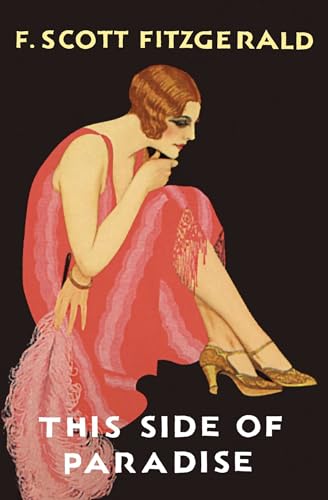
This Side of Paradise, F. Scott Fitzgerald's romantic and witty first novel, was written when the author was only twenty-three years old. This semiautobiographical story of the handsome, indulged, and idealistic Princeton student Amory Blaine received critical raves and catapulted Fitzgerald to instant fame. Now, readers can enjoy the newly edited, authorized version of this early classic of the Jazz Age, based on Fitzgerald's original manuscript. In this definitive text, This Side of Paradise captures the rhythms and romance of Fitzgerald's youth and offers a poignant portrait of the "Lost Generation."
Die Inhaltsangabe kann sich auf eine andere Ausgabe dieses Titels beziehen.
Über die Autorin bzw. den Autor
F. Scott Fitzgerald was born in St. Paul, Minnesota, in 1896. He attended Princeton University, joined the United States Army during World War I, and published his first novel, This Side of Paradise, in 1920. That same year he married Zelda Sayre and for the next decade the couple lived in New York, Paris, and on the Riviera. Fitzgerald’s novels include The Beautiful and Damned, The Great Gatsby, and Tender Is the Night. He died at the age of forty-four while working on The Last Tycoon. Fitzgerald’s fiction has secured his reputation as one of the most important American writers of the twentieth century.
Auszug. © Genehmigter Nachdruck. Alle Rechte vorbehalten.
CHAPTER I
AMORY, SON OF BEATRICE
Amory Blaine inherited from his mother every trait, except the stray inexpressible few, that made him worth while. His father, an ineffectual, inarticulate man with a taste for Byron and a habit of drowsing over the "Encyclopædia Britannica," grew wealthy at thirty through the deaths of two elder brothers, successful Chicago brokers, and in the first flush of feeling that the world was his, went to Bar Harbor and met Beatrice O'Hara. In consequence, Stephen Blaine handed down to posterity his height of just under six feet and his tendency to waver at crucial moments, these two abstractions appearing in his son Amory. For many years he hovered in the background of his family's life, an unassertive figure with a face half-obliterated by lifeless, silky hair, continually occupied in "taking care" of his wife, continually harassed by the idea that he didn't and couldn't understand her.
But Beatrice Blaine! There was a woman! Early pictures taken on her father's estate at Lake Geneva, Wisconsin, or in Rome at the Sacred Heart Convent -- an educational extravagance that in her youth was only for the daughters of the exceptionally wealthy -- showed the exquisite delicacy of her features, the consummate art and simplicity of her clothes. A brilliant education she had -- her youth passed in renaissance glory; she was versed in the latest gossip of the Older Roman Families; known by name as a fabulously wealthy American girl to Cardinal Vitori and Queen Margherita and more subtle celebrities that one must have had some culture even to have heard of. She learned in England to prefer whiskey and soda to wine, and her small talk was broadened, in two senses, during a winter in Vienna. All in all Beatrice O'Hara absorbed the sort of education that will be quite impossible ever again, a tutelage measured by the number of things and people one could be contemptuous of and charming about, a culture rich in all arts and traditions, barren of all ideas, in the last of those days when the great gardener clipped the inferior roses to produce one perfect bud.
In her less important moments she returned to America, met Stephen Blaine and married him -- this almost entirely because she was a little bit weary, a little bit sad. Her only child was carried through a tiresome season and brought into the world on a spring day in ninety-six.
When Amory was five he was already a delightful companion for her. He was an auburn-haired boy with great handsome eyes which he would grow up to in time, a facile, imaginative mind and a taste for fancy dress. From his fourth to his tenth year he did the country with his mother in her father's private car, from Coronado, where his mother became so bored that she had a nervous breakdown in a fashionable hotel, down to Mexico City, where she took a mild, almost epidemic consumption. This trouble pleased her, and later she made use of it as an intrinsic part of her atmosphere -- especially after several astounding bracers.
So while more or less fortunate little rich boys were defying governesses on the beach at Newport or being spanked or tutored or read to from "Do and Dare," or "Frank on the Lower Mississippi," Amory was biting acquiescent bell-boys in the Waldorf, outgrowing a natural repugnance to chamber music and symphonies, and deriving a highly specialized education from his mother.
"Amory."
"Yes, Beatrice." (Such a quaint name for his mother; she encouraged it.)
"Dear, don't think of getting out of bed yet. I've always suspected that early rising in early life makes one nervous. Clothilde is having your breakfast brought up."
"All right."
"I am feeling very old today, Amory," she would sigh, her face a rare cameo of pathos, her voice exquisitely modulated, her hands as facile as Bernhardt's. "My nerves are on edge -- on edge. We must leave this terrifying place tomorrow and go searching for sunshine."
Amory's penetrating green eyes would look out through tangled hair at his mother. Even at this age he had no illusions about her.
"Amory."
"Oh, yes."
"I want you to take a red-hot bath -- as hot as you can bear it, and just relax your nerves. You can read in the tub if you wish."
She fed him sections of the "Fêtes Galantes" before he was ten; at eleven he could talk glibly, if rather reminiscently, of Brahms and Mozart and Beethoven. One afternoon when left alone in the hotel at Hot Springs he sampled his mother's apricot cordial, and as the taste pleased him he became quite tipsy. This was fun for awhile, but he essayed a cigarette in his exaltation -- and succumbed to a vulgar, plebeian reaction. Though this incident horrified Beatrice, it also secretly amused her and became part of what in a later generation would have been termed her "line."
"This son of mine," he heard her tell a room full of awe-struck, admiring women one day, "is entirely sophisticated and quite charming -- but delicate -- we're all delicate; here, you know." Her hand was radiantly outlined against her beautiful bosom; then sinking her voice to a whisper, she told them of the apricot cordial. They rejoiced, for she was a brave raconteuse, but many were the keys turned in sideboard locks that night against the possible defection of little Bobby or Barbara....
These domestic pilgrimages were invariably in state: two maids, the private car, or Mr. Blaine when available, and, very often, a physician. When Amory had the whooping cough four disgusted specialists glared at each other hunched around his bed; when he took scarlet fever the number of attendants, including physicians and nurses, totalled fourteen. However, blood being thicker than broth, he was pulled through.
The Blaines were attached to no city. They were the Blaines-of-Lake-Geneva; they had quite enough relatives to serve in place of friends, and an enviable standing from Pasadena to Cape Cod. But Beatrice grew more and more prone to like only new acquaintances, as there were certain stories, such as the history of her constitution and its many amendments, and her memories of her years abroad, that it was necessary for her to repeat at regular intervals. Like Freudian dreams they must be thrown off, else they would sweep in and lay siege to her nerves.
Beatrice was critical about American women, especially the floating population of ex-Westerners.
"They have accents, my dear," she told Amory. "Not Southern accents or Boston accents, not an accent attached to any locality, just accent" -- she became dreamy. "They pick up old, moth-eaten London accents that are down on their luck and have to be used by someone. They talk as an English butler might after several years in a Chicago grand opera company." She became almost incoherent -- "Suppose -- time in every Western woman's life -- she feels her husband is prosperous enough for her to have -- accent -- they try to impress me, my dear --"
Though she thought of her body as a mass of frailties, she considered her soul quite as ill, and therefore important in her life. She had once been a Catholic, but discovering that priests were infinitely more attentive when she was in process of losing or regaining faith in Mother Church, she maintained an enchantingly wavering attitude. Often she deplored the bourgeois quality of the American Catholic clergy and was quite sure that had she lived in the shadow of the great Continental cathedrals her soul would still be a thin flame on the mighty altar of Rome. Still, next to doctors, priests were her favorite sport.
"Ah, Bishop Wiston," she would declare, "I do not want to talk of myself. I can imagine the stream of hysterical women fluttering at your doors, beseeching you to be simpatico" -- then after an interlude filled by the clergyman -- "but my mood -- is -- oddly dissimilar."
Only to bishops and above did she divulge her...
„Über diesen Titel“ kann sich auf eine andere Ausgabe dieses Titels beziehen.
Suchergebnisse für This Side Of Paradise

Beispielbild für diese ISBN
This Side of Paradise
Anbieter: World of Books (was SecondSale), Montgomery, IL, USA
Verkäuferbewertung 5 von 5 Sternen

Zustand: Good. Item in good condition. Textbooks may not include supplemental items i.e. CDs, access codes etc. Artikel-Nr. 00104672110
Gebraucht kaufen
EUR 5,20
Versand gratis
Versand innerhalb von USA
Versand innerhalb von USA
Anzahl: 1 verfügbar
Beispielbild für diese ISBN
This Side of Paradise
Anbieter: Better World Books, Mishawaka, IN, USA
Verkäuferbewertung 5 von 5 Sternen
Zustand: Good. Former library copy. Pages intact with minimal writing/highlighting. The binding may be loose and creased. Dust jackets/supplements are not included. Includes library markings. Stock photo provided. Product includes identifying sticker. Better World Books: Buy Books. Do Good. Artikel-Nr. GRP10226425
Gebraucht kaufen
EUR 5,83
Versand gratis
Versand innerhalb von USA
Versand innerhalb von USA
Anzahl: 1 verfügbar
Beispielbild für diese ISBN
This Side of Paradise
Anbieter: Better World Books, Mishawaka, IN, USA
Verkäuferbewertung 5 von 5 Sternen
Zustand: Very Good. Pages intact with possible writing/highlighting. Binding strong with minor wear. Dust jackets/supplements may not be included. Stock photo provided. Product includes identifying sticker. Better World Books: Buy Books. Do Good. Artikel-Nr. 2419689-75
Gebraucht kaufen
EUR 5,83
Versand gratis
Versand innerhalb von USA
Versand innerhalb von USA
Anzahl: 1 verfügbar
Beispielbild für diese ISBN
This Side of Paradise
Anbieter: Better World Books, Mishawaka, IN, USA
Verkäuferbewertung 5 von 5 Sternen
Zustand: Good. Pages intact with minimal writing/highlighting. The binding may be loose and creased. Dust jackets/supplements are not included. Stock photo provided. Product includes identifying sticker. Better World Books: Buy Books. Do Good. Artikel-Nr. 2419687-6
Gebraucht kaufen
EUR 5,83
Versand gratis
Versand innerhalb von USA
Versand innerhalb von USA
Anzahl: 1 verfügbar
Beispielbild für diese ISBN
This Side Of Paradise
Anbieter: Wonder Book, Frederick, MD, USA
Verkäuferbewertung 5 von 5 Sternen
Zustand: Good. Good condition. A copy that has been read but remains intact. May contain markings such as bookplates, stamps, limited notes and highlighting, or a few light stains. Artikel-Nr. G03C-02304
Gebraucht kaufen
EUR 6,83
Versand gratis
Versand innerhalb von USA
Versand innerhalb von USA
Anzahl: 2 verfügbar
Beispielbild für diese ISBN
This Side Of Paradise
Anbieter: Wonder Book, Frederick, MD, USA
Verkäuferbewertung 5 von 5 Sternen
Zustand: Very Good. Very Good condition. A copy that may have a few cosmetic defects. May also contain light spine creasing or a few markings such as an owner's name, short gifter's inscription or light stamp. Artikel-Nr. F02D-05562
Gebraucht kaufen
EUR 6,83
Versand gratis
Versand innerhalb von USA
Versand innerhalb von USA
Anzahl: 1 verfügbar
Beispielbild für diese ISBN
This Side of Paradise
Anbieter: ThriftBooks-Reno, Reno, NV, USA
Verkäuferbewertung 5 von 5 Sternen
Paperback. Zustand: Good. No Jacket. Pages can have notes/highlighting. Spine may show signs of wear. ~ ThriftBooks: Read More, Spend Less. Artikel-Nr. G0684843781I3N00
Gebraucht kaufen
EUR 7,08
Versand gratis
Versand innerhalb von USA
Versand innerhalb von USA
Anzahl: 4 verfügbar
Beispielbild für diese ISBN
This Side of Paradise
Anbieter: ThriftBooks-Reno, Reno, NV, USA
Verkäuferbewertung 5 von 5 Sternen
Paperback. Zustand: Fair. No Jacket. Missing dust jacket; Readable copy. Pages may have considerable notes/highlighting. ~ ThriftBooks: Read More, Spend Less. Artikel-Nr. G0684843781I5N01
Gebraucht kaufen
EUR 7,08
Versand gratis
Versand innerhalb von USA
Versand innerhalb von USA
Anzahl: 1 verfügbar
Beispielbild für diese ISBN
This Side of Paradise
Anbieter: ThriftBooks-Phoenix, Phoenix, AZ, USA
Verkäuferbewertung 5 von 5 Sternen
Paperback. Zustand: Good. No Jacket. Pages can have notes/highlighting. Spine may show signs of wear. ~ ThriftBooks: Read More, Spend Less. Artikel-Nr. G0684843781I3N00
Gebraucht kaufen
EUR 7,08
Versand gratis
Versand innerhalb von USA
Versand innerhalb von USA
Anzahl: 3 verfügbar
Beispielbild für diese ISBN
This Side of Paradise
Anbieter: ThriftBooks-Dallas, Dallas, TX, USA
Verkäuferbewertung 5 von 5 Sternen
Paperback. Zustand: Fair. No Jacket. Former library book; Readable copy. Pages may have considerable notes/highlighting. ~ ThriftBooks: Read More, Spend Less. Artikel-Nr. G0684843781I5N10
Gebraucht kaufen
EUR 7,08
Versand gratis
Versand innerhalb von USA
Versand innerhalb von USA
Anzahl: 1 verfügbar