
Verwandte Artikel zu Beating the Odds in Small Business
Inhaltsangabe
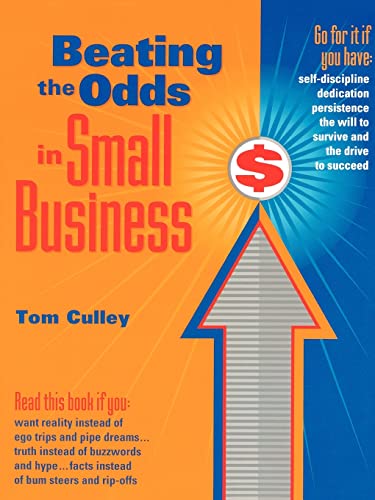
Read this book if you:
want reality instead of ego trips and pipe dreams...truth instead of buzzwords and hype...facts instead of bum steers and rip-offs
Go for it if you have:
self-discipline
dedication
persistence
the will to survive and
the drive to succeed
Die Inhaltsangabe kann sich auf eine andere Ausgabe dieses Titels beziehen.
Über die Autorin bzw. den Autor
Tom Culley is a Simon & Schuster author.
Auszug. © Genehmigter Nachdruck. Alle Rechte vorbehalten.
Chapter 1
WELCOME TO SMALL BUSINESS:
Sure, It's Tough...It's Risky...But It Still Your Best Choice
You're Not Alone
Statistics show that about 750,000 new businesses are started every year in the United States. Almost all of these are small businesses. But the actual number is much higher; that 750,000 figure is based on the actual legal process of incorporation of new business entities. It does not include one of the major trends of the '90s, the one- or two-person small business usually operated out of a home, garage, or one-room office. These businesspeople operate as "self-employed." To save costs and hassle, they file taxes as individuals. If they have a business name, it is usually a "d/b/a" (doing business as) name, not an actual corporation.
These different trends make for confusing statistics but we can safely say, without risk of overestimating, that new small businesses are being formed in the United States at a rate of at least 1 million per year. That is far higher than in previous decades. And how many small businesses, new and old, are there in all? Here again, different statistical sources give different numbers, but it's a fair guess that the total is close to 30 million small businesses in the country.
So when you consider starting up your own small business, take comfort from the fact that you're in good company; you're riding the wave of the future. There are good, solid economic and social reasons why all this is happening and there's nothing crazy about wanting to do so. It makes eminent good sense.
But the good sense has also to be applied to running your small business, not just starting it. Starting it and joining the national small business club is the easiest part. Running it day-to-day and paying the annual dues is a damn sight harder.
So What's a "Small Business"?
We can roughly group small businesses into three categories, working from the largest to the smallest:
"Big" Small Businesses
These businesses have somewhere between twenty and one hundred employees and have usually been operating for a number of years. Sometimes bad luck or mismanagement will bring one down but in general they are home safe. They've grown from nothing, made all their big mistakes and survived...they've learned their lessons well. Their management is usually professional, they're efficiently organized and they're on top of their business, whatever it may be.
Such "big" small businesses are often run by owner-managers, who still maintain the dynamism, simplicity and informality of a small company -- and prefer it that way. There's a simple rule of thumb that says that once companies get past the 100-employee level, they start thinking and operating like Big Businesses.
There are large businesses that still manage to keep their "small" personality intact, through the personal preference and style of the owners. But there is a clear point in most companies' growth (if they continue to grow) when they start to lose the flexibility, informality and dynamism of a small business and start adopting the more rigid organizational style and administrative structure that are found in large corporations.
Some owner-managers of these "big" small businesses deliberately choose to stay the same size, innovating and improving year by year to stay on top of their competition, but resisting the temptation to keep striving for further growth in sheer size. These companies, through progressive improvements over the years in efficiency and productivity, can often increase sales and profits year by year, yet still stay roughly the same size and still maintain the personality, characteristics and style of a small business.
In general, these "big" small businesses are modern and sophisticated in their management methods...they have to be, at that level.
"Mid-Sized" Small Businesses
The majority of small businesses fall into this size bracket, with about five to twenty employees. Here you're looking at the millions of retail stores, restaurants, storefront services, gas stations, repair shops, machine shops, studios, printers, bookkeepers, business services and the like. Many of these are franchise operations, operated and managed by their owners.
Here, levels of management sophistication and efficiency vary widely and wildly, from modem franchise operations with all their accounting, controls and systems supplied (and monitored) by the franchiser, to old-style businesses, comfortably secure in their niches and run pretty much as they always have been.
Among this large diversity of types, shapes and sizes, you can't say that any one is better than the other. Different strokes for different folks. But you will find a remarkable consistency among those that have survived and are making a decent profit. They all keep their eye on the basics we are talking about in this book...even if their ways of doing so range from the latest computer technology to handwritten entries on file cards and notebooks.
"Small" Small Businesses
Many of these small, one- to five-people businesses are home based. You will also find a large number working out of one-room offices, small storefronts and assorted holes-in-the-wall. Some of them will grow, get better organized, start making more money and eventually move up in the ranks. Others will stay the same small size long-term, focused only on providing their owner-managers with independence and a decent livelihood.
Nothing wrong with that. Constantly growing bigger is not necessarily what some entrepreneurs want to do, once they have achieved their primary financial goals and a secure position. They'd rather not face the extra hassle. That's one of the rewards of small business: you decide what you want from your business in personal terms. The business doesn't decide for you...unless you let it.
One painful fact is that the mortality rate is highest among these, the "babies." But that fact should not discourage you. It's pretty natural when you stop to think about it. Just like babies anywhere, they're learning how to walk and talk, they're building up immunities to disease, they're learning to take care of themselves. Some "baby" businesses just don't make it through this period of vulnerability. You can learn lessons by looking at the ones that unfortunately didn't make it and asking yourself what they did wrong.
Business Mortality: The Bad News
The bad news is that on average a majority of small businesses don't make it. They fail or fold in their first year or two.
This news should bother you, and that's all to the good. Running a little scared is the best way to run a business and the surest way to stay alive. Knowing how easily others have failed will stiffen your spine when the time comes to make hard decisions.
There's a widely quoted statistic that's been around since they invented business schools and started teaching Statistics 101. It says that over 70 percent of new business ventures fail or close down in their first two years.
Nobody knows what the exact percentage is today and it really doesn't matter. The key point is, it's damn high; it's certainly well over 50 percent. The message is clear and deadly: most new businesses-meaning small businesses -- are not prepared, in some form or other, for what they are about to face. When the first hiccup comes (and it always does), they don't have the financial resources or staying power to make the necessary adjustments, correct their mistakes and keep battling on. They get wiped out by the first salvo in the battle.
So what does that tell you? That the ones who folded were unprepared and ill informed. They went into the poker game without an adequate bankroll, without studying the rules, without knowing how to calculate the...
„Über diesen Titel“ kann sich auf eine andere Ausgabe dieses Titels beziehen.
Suchergebnisse für Beating the Odds in Small Business

Beispielbild für diese ISBN
Beating the Odds in Small Busi
Anbieter: World of Books (was SecondSale), Montgomery, IL, USA
Verkäuferbewertung 5 von 5 Sternen

Zustand: Very Good. Item in very good condition! Textbooks may not include supplemental items i.e. CDs, access codes etc. Artikel-Nr. 00101566951
Gebraucht kaufen
EUR 4,86
Versand gratis
Versand innerhalb von USA
Versand innerhalb von USA
Anzahl: 1 verfügbar
Beispielbild für diese ISBN
Beating the Odds in Small Busi
Anbieter: World of Books (was SecondSale), Montgomery, IL, USA
Verkäuferbewertung 5 von 5 Sternen
Zustand: Good. Good condition ex-library book with usual library markings and stickers. Artikel-Nr. 00103699307
Gebraucht kaufen
EUR 4,86
Versand gratis
Versand innerhalb von USA
Versand innerhalb von USA
Anzahl: 1 verfügbar
Beispielbild für diese ISBN
Beating the Odds in Small Business
Anbieter: Better World Books, Mishawaka, IN, USA
Verkäuferbewertung 5 von 5 Sternen
Zustand: Good. Pages intact with minimal writing/highlighting. The binding may be loose and creased. Dust jackets/supplements are not included. Stock photo provided. Product includes identifying sticker. Better World Books: Buy Books. Do Good. Artikel-Nr. 41084962-6
Gebraucht kaufen
EUR 6,48
Versand gratis
Versand innerhalb von USA
Versand innerhalb von USA
Anzahl: 1 verfügbar
Beispielbild für diese ISBN
Beating the Odds in Small Business
Anbieter: Better World Books: West, Reno, NV, USA
Verkäuferbewertung 5 von 5 Sternen
Zustand: Good. Pages intact with minimal writing/highlighting. The binding may be loose and creased. Dust jackets/supplements are not included. Stock photo provided. Product includes identifying sticker. Better World Books: Buy Books. Do Good. Artikel-Nr. 41084962-6
Gebraucht kaufen
EUR 6,48
Versand gratis
Versand innerhalb von USA
Versand innerhalb von USA
Anzahl: 1 verfügbar
Beispielbild für diese ISBN
Beating the Odds in Small Business
Anbieter: Better World Books, Mishawaka, IN, USA
Verkäuferbewertung 5 von 5 Sternen
Zustand: Good. Former library copy. Pages intact with minimal writing/highlighting. The binding may be loose and creased. Dust jackets/supplements are not included. Includes library markings. Stock photo provided. Product includes identifying sticker. Better World Books: Buy Books. Do Good. Artikel-Nr. 739336-6
Gebraucht kaufen
EUR 6,48
Versand gratis
Versand innerhalb von USA
Versand innerhalb von USA
Anzahl: 1 verfügbar
Beispielbild für diese ISBN
Beating the Odds in Small Business
Anbieter: Robinson Street Books, IOBA, Binghamton, NY, USA
Verkäuferbewertung 4 von 5 Sternen

Paperback. Zustand: As New. Prompt Shipment, shipped in Boxes, Tracking PROVIDEDFine. First edition. Artikel-Nr. Bing63213
Gebraucht kaufen
EUR 12,37
EUR 8,45 Versand
Versand innerhalb von USA
Versand innerhalb von USA
Anzahl: 2 verfügbar
Beispielbild für diese ISBN
Beating the Odds in Small Business
Anbieter: Robinson Street Books, IOBA, Binghamton, NY, USA
Verkäuferbewertung 4 von 5 Sternen
Paperback. Zustand: Very Good. Prompt Shipment, shipped in Boxes, Tracking PROVIDEDVery good used book, light creasing and wear. Artikel-Nr. graytrpb17r3646
Gebraucht kaufen
EUR 12,37
EUR 8,45 Versand
Versand innerhalb von USA
Versand innerhalb von USA
Anzahl: 1 verfügbar
Beispielbild für diese ISBN
Beating the Odds in Small Business
Anbieter: Revaluation Books, Exeter, Vereinigtes Königreich
Verkäuferbewertung 5 von 5 Sternen
Paperback. Zustand: Brand New. original edition. 320 pages. 11.00x8.75x0.75 inches. In Stock. Artikel-Nr. x-0684841835
Neu kaufen
EUR 39,00
EUR 14,67 Versand
Versand von Vereinigtes Königreich nach USA
Versand von Vereinigtes Königreich nach USA
Anzahl: 2 verfügbar
Beispielbild für diese ISBN
Beating the Odds in Small Business
Anbieter: Majestic Books, Hounslow, Vereinigtes Königreich
Verkäuferbewertung 4 von 5 Sternen
Zustand: New. pp. 320 6:B&W 8.25 x 11 in or 280 x 210 mm Perfect Bound on White w/Gloss Lam. Artikel-Nr. 3367606
Neu kaufen
EUR 59,66
EUR 7,63 Versand
Versand von Vereinigtes Königreich nach USA
Versand von Vereinigtes Königreich nach USA
Anzahl: 1 verfügbar