
Verwandte Artikel zu Competitive Advantage of Nations: With a New Introduction.
Inhaltsangabe
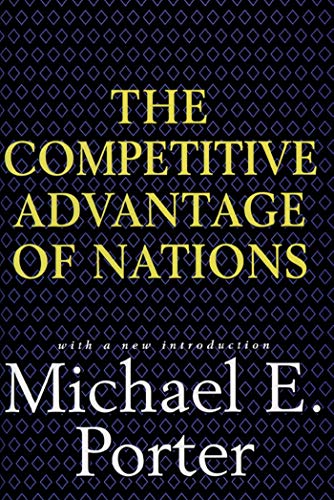
Now beyond its eleventh printing and translated into twelve languages, Michael Porter’s The Competitive Advantage of Nations has changed completely our conception of how prosperity is created and sustained in the modern global economy. Porter’s groundbreaking study of international competitiveness has shaped national policy in countries around the world. It has also transformed thinking and action in states, cities, companies, and even entire regions such as Central America.
Based on research in ten leading trading nations, The Competitive Advantage of Nations offers the first theory of competitiveness based on the causes of the productivity with which companies compete. Porter shows how traditional comparative advantages such as natural resources and pools of labor have been superseded as sources of prosperity, and how broad macroeconomic accounts of competitiveness are insufficient. The book introduces Porter’s “diamond,” a whole new way to understand the competitive position of a nation (or other locations) in global competition that is now an integral part of international business thinking. Porter's concept of “clusters,” or groups of interconnected firms, suppliers, related industries, and institutions that arise in particular locations, has become a new way for companies and governments to think about economies, assess the competitive advantage of locations, and set public policy.
Even before publication of the book, Porter’s theory had guided national reassessments in New Zealand and elsewhere. His ideas and personal involvement have shaped strategy in countries as diverse as the Netherlands, Portugal, Taiwan, Costa Rica, and India, and regions such as Massachusetts, California, and the Basque country. Hundreds of cluster initiatives have flourished throughout the world. In an era of intensifying global competition, this pathbreaking book on the new wealth of nations has become the standard by which all future work must be measured.
Die Inhaltsangabe kann sich auf eine andere Ausgabe dieses Titels beziehen.
Über die Autorin bzw. den Autor
Michael E. Porter is the C. Roland Christensen Professor of Business Administration at the Harvard Business School. The author of fourteen books and recipient of the Wells Prize in Economics, he lives in Brookline, Massachusetts.
Auszug. © Genehmigter Nachdruck. Alle Rechte vorbehalten.
Chapter 1
The Need for a New Paradigm
Why do some nations succeed and others fail in international competition? This question is perhaps the most frequently asked economic question of our times. Competitiveness has become one of the central preoccupations of government and industry in every nation. The United States is an obvious example, with its growing public debate about the apparently greater economic success of other trading nations. But intense debate about competitiveness is also taking place today in such "success story" nations as Japan and Korea. Socialist countries such as the Soviet Union and others in Eastern Europe and Asia are also asking this question as they fundamentally reappraise their economic systems.
Yet although the question is frequently asked, it is the wrong question if the aim is to best expose the underpinnings of economic prosperity for either firms or nations. We must focus instead on another, much narrower one. This is: why does a nation become the home base for successful international competitors in an industry? Or, to put it somewhat differently, why are firms based in a particular nation able to create and sustain competitive advantage against the world's best competitors in a particular field? And why is one nation often the home for so many of an industry's world leaders?
How can we explain why Germany is the home base for so many of the world's leading makers of printing presses, luxury cars, and chemicals? Why is tiny Switzerland the home base for international leaders in pharmaceuticals, chocolate, and trading? Why are leaders in heavy trucks and mining equipment based in Sweden? Why has America produced the preeminent international competitors in personal computers, software, credit cards, and movies? Why are Italian firms so strong in ceramic tiles, ski boots, packaging machinery, and factory automation equipment? What makes Japanese firms so dominant in consumer electronics, cameras, robotics, and facsimile machines?
The answers are obviously of central concern to firms that must compete in increasingly international markets. A firm must understand what it is about its home nation that is most crucial in determining its ability, or inability, to create and sustain competitive advantage in international terms. But the same question will prove to be a decisive one for national economic prosperity as well. As we will see, a nation's standard of living in the long term depends on its ability to attain a high and rising level of productivity in the industries in which its firms compete. This rests on the capacity of its firms to achieve improving quality or greater efficiency. The influence of the home nation on the pursuit of competitive advantage in particular fields is of central importance to the level and rate of productivity growth achievable.
But we lack a convincing explanation of the influence of the nation. The long-dominant paradigm for why nations succeed internationally in particular industries is showing signs of strain. There is an extensive history of theories to explain the patterns of nations' exports and imports, dating back to the work of Adam Smith and David Ricardo in the eighteenth century. It has become generally recognized, however, that these theories have grown inadequate to the task. Changes in the nature of international competition, among them the rise of the multinational corporation that not only exports but competes abroad via foreign subsidiaries, have weakened the traditional explanations for why and where a nation exports. While new rationales have been proposed, none is sufficient to explain why firms based in particular nations are able to compete successfully, through both exporting and foreign investment, in particular industries. Nor can they explain why a nation's firms are able to sustain their competitive positions over considerable periods of time.
Explaining the role played by a nation's economic environment, institutions, and policies in the competitive success of its finns in particular industries is the subject of this book. It seeks to isolate the competitive advantage of a nation, that is, the national attributes that foster competitive advantage in an industry. Drawing on my study of ten nations and the detailed histories of over one hundred industries, I will present in Part I a theory of the competitive advantage of nations in particular fields. In Part II, I will illustrate how the theory can be employed to explain the competitive success of particular nations in a number of individual industries. In Part III, I will use the theory to shed light on the overall patterns of industry success and failure in the economies of the nations we studied and how the patterns have been changing. This will serve as the basis for presenting a framework to explain how entire national economies advance in competitive terms. Finally, in Part IV, I will develop the implications of my theory for both company strategy and government policy, The book concludes with a chapter entitled "National Agendas," which illustrates how the theory can be used to identify some of the most important issues that will shape future economic progress in each of the nations I studied.
Before presenting my theory, however, I must explain why efforts to explain the competitiveness of an entire nation have been unconvincing, and why attempting to do so is tackling the wrong question. I must demonstrate that understanding the reasons for the ability of the nation's firms to create and sustain competitive advantage in particular industries is addressing the right question, not only for informing company strategy but also for achieving national economic goals. I must also describe why there is a growing consensus that the dominant paradigm used to date to explain international success in particular industries is inadequate, and why even recent efforts to modify it still do not address some of the most central questions. Finally, I will describe the study that was conducted so, that the reader will understand the factual foundations of what follows.
CONFLICTING EXPLANATIONS
There has been no shortage of explanations for why some nations are competitive and others are not. Yet these explanations are often conflicting, and there is no generally accepted theory. It is far from clear what the term "competitive" means when referring to a nation. This is a major part of the difficulty, as we will see. That there has been intense debate in many nations about whether they have a competitiveness problem in the first place is a sure sign that the subject is not completely understood.
Some see national competitiveness as a macroeconomic phenomenon, driven by such variables as exchange rates, interest rates, and government deficits. But nations have enjoyed rapidly rising living standards despite budget deficits (Japan, Italy, and Korea), appreciating currencies (Germany and Switzerland), and high interest rates (Italy and Korea).
Others argue that competitiveness is a function of cheap and abundant labor. Yet nations such as Germany, Switzerland, and Sweden have prospered despite high wages and long periods of labor shortage. Japan, with an economy supposedly built on cheap, abundant labor, has also experienced pressing labor shortages. Its firms have succeeded internationally in many industries only after automating away much of the labor content. The ability to compete despite paying high wages would seem to represent a far more desirable national target.
Another view is that competitiveness depends on possessing bountiful natural resources. Recently, however, the most successful trading nations, among them Germany, Japan, Switzerland, Italy, and Korea, have been countries with limited natural resources that must import most raw materials. It is also interesting to note that within...
„Über diesen Titel“ kann sich auf eine andere Ausgabe dieses Titels beziehen.
Suchergebnisse für Competitive Advantage of Nations: With a New Introduction.

Beispielbild für diese ISBN
Competitive Advantage of Nations
Anbieter: World of Books (was SecondSale), Montgomery, IL, USA
Verkäuferbewertung 5 von 5 Sternen

Zustand: Good. Item in good condition. Textbooks may not include supplemental items i.e. CDs, access codes etc. Artikel-Nr. 00107233096
Gebraucht kaufen
EUR 3,40
Versand gratis
Versand innerhalb von USA
Versand innerhalb von USA
Anzahl: 1 verfügbar
Beispielbild für diese ISBN
Competitive Advantage of Nations
Anbieter: ThriftBooks-Atlanta, AUSTELL, GA, USA
Verkäuferbewertung 5 von 5 Sternen
Hardcover. Zustand: Good. No Jacket. Pages can have notes/highlighting. Spine may show signs of wear. ~ ThriftBooks: Read More, Spend Less. Artikel-Nr. G0684841479I3N00
Gebraucht kaufen
EUR 5,95
Versand gratis
Versand innerhalb von USA
Versand innerhalb von USA
Anzahl: 1 verfügbar
Beispielbild für diese ISBN
Competitive Advantage of Nations
Anbieter: ThriftBooks-Dallas, Dallas, TX, USA
Verkäuferbewertung 5 von 5 Sternen
Hardcover. Zustand: Good. No Jacket. Pages can have notes/highlighting. Spine may show signs of wear. ~ ThriftBooks: Read More, Spend Less. Artikel-Nr. G0684841479I3N00
Gebraucht kaufen
EUR 5,95
Versand gratis
Versand innerhalb von USA
Versand innerhalb von USA
Anzahl: 1 verfügbar
Beispielbild für diese ISBN
Competitive Advantage of Nations
Anbieter: ThriftBooks-Dallas, Dallas, TX, USA
Verkäuferbewertung 5 von 5 Sternen
Hardcover. Zustand: Fair. No Jacket. Readable copy. Pages may have considerable notes/highlighting. ~ ThriftBooks: Read More, Spend Less. Artikel-Nr. G0684841479I5N00
Gebraucht kaufen
EUR 5,95
Versand gratis
Versand innerhalb von USA
Versand innerhalb von USA
Anzahl: 1 verfügbar
Beispielbild für diese ISBN
Competitive Advantage of Nations
Anbieter: Better World Books: West, Reno, NV, USA
Verkäuferbewertung 5 von 5 Sternen
Zustand: Good. Former library copy. Pages intact with minimal writing/highlighting. The binding may be loose and creased. Dust jackets/supplements are not included. Includes library markings. Stock photo provided. Product includes identifying sticker. Better World Books: Buy Books. Do Good. Artikel-Nr. GRP95725953
Gebraucht kaufen
EUR 6,95
Versand gratis
Versand innerhalb von USA
Versand innerhalb von USA
Anzahl: 3 verfügbar
Beispielbild für diese ISBN
Competitive Advantage of Nations
Anbieter: BooksRun, Philadelphia, PA, USA
Verkäuferbewertung 5 von 5 Sternen
Hardcover. Zustand: Very Good. With dust jacket. It's a well-cared-for item that has seen limited use. The item may show minor signs of wear. All the text is legible, with all pages included. It may have slight markings and/or highlighting. Artikel-Nr. 0684841479-11-6-29
Gebraucht kaufen
EUR 7,18
Versand gratis
Versand innerhalb von USA
Versand innerhalb von USA
Anzahl: 1 verfügbar
Beispielbild für diese ISBN
Competitive Advantage of Nations
Anbieter: Wonder Book, Frederick, MD, USA
Verkäuferbewertung 5 von 5 Sternen
Zustand: Good. Good condition. Good dust jacket. A copy that has been read but remains intact. May contain markings such as bookplates, stamps, limited notes and highlighting, or a few light stains. Artikel-Nr. D13L-01435
Gebraucht kaufen
EUR 7,62
Versand gratis
Versand innerhalb von USA
Versand innerhalb von USA
Anzahl: 1 verfügbar
Beispielbild für diese ISBN
Competitive Advantage of Nations: With a New Introduction
Anbieter: WorldofBooks, Goring-By-Sea, WS, Vereinigtes Königreich
Verkäuferbewertung 5 von 5 Sternen
Paperback. Zustand: Very Good. The book has been read, but is in excellent condition. Pages are intact and not marred by notes or highlighting. The spine remains undamaged. Artikel-Nr. GOR002432495
Gebraucht kaufen
EUR 2,62
EUR 6,53 Versand
Versand von Vereinigtes Königreich nach USA
Versand von Vereinigtes Königreich nach USA
Anzahl: 1 verfügbar
Beispielbild für diese ISBN
Competitive Advantage of Nations
Anbieter: Better World Books Ltd, Dunfermline, Vereinigtes Königreich
Verkäuferbewertung 5 von 5 Sternen
Zustand: Very Good. Former library copy. Pages intact with possible writing/highlighting. Binding strong with minor wear. Dust jackets/supplements may not be included. Includes library markings. Stock photo provided. Product includes identifying sticker. Better World Books: Buy Books. Do Good. Artikel-Nr. 5829368-6
Gebraucht kaufen
EUR 6,66
EUR 5,83 Versand
Versand von Vereinigtes Königreich nach USA
Versand von Vereinigtes Königreich nach USA
Anzahl: 2 verfügbar
Beispielbild für diese ISBN
Competitive Advantage of Nations
Anbieter: Better World Books Ltd, Dunfermline, Vereinigtes Königreich
Verkäuferbewertung 5 von 5 Sternen
Zustand: Very Good. Pages intact with possible writing/highlighting. Binding strong with minor wear. Dust jackets/supplements may not be included. Stock photo provided. Product includes identifying sticker. Better World Books: Buy Books. Do Good. Artikel-Nr. 4647968-75
Gebraucht kaufen
EUR 6,66
EUR 5,83 Versand
Versand von Vereinigtes Königreich nach USA
Versand von Vereinigtes Königreich nach USA
Anzahl: 1 verfügbar