
Verwandte Artikel zu Competitive Advantage: Creating and Sustaining Superior...
Inhaltsangabe
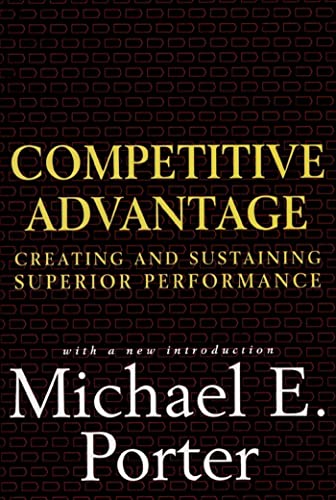
The essential complement to the pathbreaking book Competitive Strategy, Michael E. Porter's Competitive Advantage explores the underpinnings of competitive advantage in the individual firm.
Competitive Advantage introduces a whole new way of understanding what a firm does. Porter's groundbreaking concept of the value chain disaggregates a company into "activities," or the discrete functions or processes that represent the elemental building blocks of competitive advantage.
Now an essential part of international business thinking, Competitive Advantage takes strategy from broad vision to an internally consistent configuration of activities. Its powerful framework provides the tools to understand the drivers of cost and a company's relative cost position. Porter's value chain enables managers to isolate the underlying sources of buyer value that will command a premium price, and the reasons why one product or service substitutes for another. He shows how competitive advantage lies not only in activities themselves but in the way activities relate to each other, to supplier activities, and to customer activities. Competitive Advantage also provides for the first time the tools to strategically segment an industry and rigorously assess the competitive logic of diversification.
That the phrases "competitive advantage" and "sustainable competitive advantage" have become commonplace is testimony to the power of Porter's ideas. Competitive Advantage has guided countless companies, business school students, and scholars in understanding the roots of competition. Porter's work captures the extraordinary complexity of competition in a way that makes strategy both concrete and actionable.
Die Inhaltsangabe kann sich auf eine andere Ausgabe dieses Titels beziehen.
Über die Autorin bzw. den Autor
Michael E. Porter is the C. Roland Christensen Professor of Business Administration at the Harvard Business School. The author of fourteen books and recipient of the Wells Prize in Economics, he lives in Brookline, Massachusetts.
Auszug. © Genehmigter Nachdruck. Alle Rechte vorbehalten.
Chapter 1: Competitive Strategy: The Core Concepts
Competition is at the core of the success or failure of firms. Competition determines the appropriateness of a firm's activities that can contribute to its performance, such as innovations, a cohesive culture, or good implementation. Competitive strategy is the search for a favorable competitive position in an industry, the fundamental arena in which competition occurs. Competitive strategy aims to establish a profitable and sustainable position against the forces that determine industry competition.
Two central questions underlie the choice of competitive strategy. The first is the attractiveness of industries for long-term profitability and the factors that determine it. Not all industries offer equal opportunities for sustained profitability, and the inherent profitability of its industry is one essential ingredient in determining the profitability of a firm. The second central question in competitive strategy is the determinants of relative competitive position within an industry. In most industries, some firms are much more profitable than others, regardless of what the average profitability of the industry may be.
Neither question is sufficient by itself to guide the choice of competitive strategy. A firm in a very attractive industry may still not earn attractive profits if it has chosen a poor competitive position. Conversely, a firm in an excellent competitive position may be in such a poor industry that it is not very profitable, and further efforts to enhance its position will be of little benefit. Both questions are dynamic; industry attractiveness and competitive position change. Industries become more or less attractive over time, and competitive position reflects an unending battle among competitors. Even long periods of stability can be abruptly ended by competitive moves.
Both industry attractiveness and competitive position can be shaped by a firm, and this is what makes the choice of competitive strategy both challenging and exciting. While industry attractiveness is partly a reflection of factors over which a firm has little influence, competitive strategy has considerable power to make an industry more or less attractive. At the same time, a firm can clearly improve or erode its position within an industry through its choice of strategy. Competitive strategy, then, not only responds to the environment but also attempts to shape that environment in a firm's favor.
These two central questions in competitive strategy have been at the core of my research. My book Competitive Strategy: Techniques for Analyzing Industries and Competitors presents an analytical framework for understanding industries and competitors, and formulating an overall competitive strategy. It describes the five competitive forces that determine the attractiveness of an industry and their underlying causes, as well as how these forces change over time and can be influenced through strategy. It identifies three broad generic strategies for achieving competitive advantage. It also shows how to analyze competitors and to predict and influence their behavior, and how to map competitors into strategic groups and assess the most attractive positions in an industry. It then goes on to apply the framework to a range of important types of industry environments that I term structural settings, including fragmented industries, emerging industries, industries undergoing a transition to maturity, declining industries, and global industries. Finally, the book examines the important strategic decisions that occur in the context of an industry, including vertical integration, capacity expansion, and entry.
par
This book takes the framework in Competitive Strategy as a starting point. The central theme of this book is how a firm can actually create and sustain a competitive advantage in its industry -- how it can implement the broad generic strategies. My aim is to build a bridge between strategy and implementation, rather than treat these two subjects independently or consider implementation scarcely at all as has been characteristic of much previous research in the field.
Competitive advantage grows fundamentally out of value a firm is able to create for its buyers that exceeds the firm's cost of creating it. Value is what buyers are willing to pay, and superior value stems from offering lower prices than competitors for equivalent benefits or providing unique benefits that more than offset a higher price. There are two basic types of competitive advantage: cost leadership and differentiation. This book describes how a firm can gain a cost advantage or how it can differentiate itself. It describes how the choice of competitive scope, or the range of a firm's activities, can play a powerful role in determining competitive advantage. Finally, it translates these concepts, combined with those in my earlier book, into overall implications for offensive and defensive competitive strategy, including the role of uncertainty in influencing strategic choices. This book considers not only competitive strategy in an individual industry but also corporate strategy for the diversified firm. Competitive advantage in one industry can be strongly enhanced by interrelationships with business units competing in related industries, if these interrelationships can actually be achieved. Interrelationships among business units are the principal means by which a diversified firm creates value, and thus provide the underpinnings for corporate strategy. I will describe how interrelationships among business units can be identified and translated into a corporate strategy, as well as how interrelationships can be achieved in practice despite the organizational impediments to doing so that are present in many diversified firms.
Though the emphases of this book and my earlier book are different, they are strongly complementary. The emphasis of Competitive Strategy is on industry structure and competitor analysis in a variety of industry environments, though it contains many implications for competitive advantage. This book begins by assuming an understanding of industry structure and competitor behavior, and is preoccupied with how to translate that understanding into a competitive advantage. Actions to create competitive advantage often have important consequences for industry structure and competitive reaction, however, and thus I will return to these subjects frequently.
This book can be read independently of Competitive Strategy, but its power to aid practitioners in formulating strategy is diminished if the reader is not familiar with the core concepts presented in the earlier book. In this chapter, I will describe and elaborate on some of those concepts. The discussion of the core concepts will also provide a good means of introducing the concepts and techniques in this book. In the process, I will address some of the most important questions that arise in applying the core concepts in practice. Thus even readers familiar with my earlier book may find the review of interest.
The Structural Analysis of Industries
The first fundamental determinant of a firm's profitability is industry attractiveness. Competitive strategy must grow out of a sophisticated understanding of the rules of competition that determine an industry's attractiveness. The ultimate aim of competitive strategy is to cope with and, ideally, to change those rules in the firm's favor. In any industry, whether it is domestic or international or produces a product or a service, the rules of competition are embodied in five competitive forces: the entry of new competitors, the threat of substitutes, the bargaining power of buyers, the bargaining power of suppliers, and the rivalry among the existing competitors.
The collective strength of these five...
„Über diesen Titel“ kann sich auf eine andere Ausgabe dieses Titels beziehen.
Suchergebnisse für Competitive Advantage: Creating and Sustaining Superior...

Beispielbild für diese ISBN
Competitive Advantage: Creating and Sustaining Superior Performance
Anbieter: World of Books (was SecondSale), Montgomery, IL, USA
Verkäuferbewertung 5 von 5 Sternen

Hardback. Zustand: Good. COMPETITIVE ADVANTAGE introduces a whole new way of understanding what a firm does. Porter's groundbreaking concept of the value chain disaggregates a company into 'activities', or the discrete functions or processes that represent the elemental building blocks of competitive advantage. Now an essential part of international business thinking, COMPETITIVE ADVANTAGE takes strategy from broad vision to an internally consistent configuration of activities. Its powerful framework provides the tools to understand the drivers of cost and a company's relative cost position. Porter's value chain enables managers to isolate the underlying sources of buyer value that will command a premium price, and the reasons why one product or service substitutes for another. He shows how competitive advantage lies not only in activities themselves but in the way activities relate to each other, to supplier activities, and to customer activities. That the phrases 'competitive advantage' and 'sustainable competitive advantage' have become commonplace is testimony to the power of Porter's ideas. COMPETITIVE ADVANTAGE has guided countless companies, business school students, and scholars in understanding the roots of competition. Porter's work captures the extraordinary complexity of competition in a way that makes strategy both concrete and actionable. Artikel-Nr. 00100740071
Gebraucht kaufen
EUR 4,14
Versand gratis
Versand innerhalb von USA
Versand innerhalb von USA
Anzahl: 20 verfügbar
Beispielbild für diese ISBN
Competitive Advantage: Creating and Sustaining Superior Performance
Anbieter: World of Books (was SecondSale), Montgomery, IL, USA
Verkäuferbewertung 5 von 5 Sternen
Hardback. Zustand: Fair. COMPETITIVE ADVANTAGE introduces a whole new way of understanding what a firm does. Porter's groundbreaking concept of the value chain disaggregates a company into 'activities', or the discrete functions or processes that represent the elemental building blocks of competitive advantage. Now an essential part of international business thinking, COMPETITIVE ADVANTAGE takes strategy from broad vision to an internally consistent configuration of activities. Its powerful framework provides the tools to understand the drivers of cost and a company's relative cost position. Porter's value chain enables managers to isolate the underlying sources of buyer value that will command a premium price, and the reasons why one product or service substitutes for another. He shows how competitive advantage lies not only in activities themselves but in the way activities relate to each other, to supplier activities, and to customer activities. That the phrases 'competitive advantage' and 'sustainable competitive advantage' have become commonplace is testimony to the power of Porter's ideas. COMPETITIVE ADVANTAGE has guided countless companies, business school students, and scholars in understanding the roots of competition. Porter's work captures the extraordinary complexity of competition in a way that makes strategy both concrete and actionable. Artikel-Nr. 00102536945
Gebraucht kaufen
EUR 4,14
Versand gratis
Versand innerhalb von USA
Versand innerhalb von USA
Anzahl: 4 verfügbar
Foto des Verkäufers
Competitive Advantage: Creating and Sustaining Superior Performance
Anbieter: Dream Books Co., Denver, CO, USA
Verkäuferbewertung 5 von 5 Sternen
Zustand: good. Gently used with minimal wear on the corners and cover. A few pages may contain light highlighting or writing, but the text remains fully legible. Dust jacket may be missing, and supplemental materials like CDs or codes may not be included. May be ex-library with library markings. Ships promptly! Artikel-Nr. DBV.0684841460.G
Gebraucht kaufen
EUR 4,15
Versand gratis
Versand innerhalb von USA
Versand innerhalb von USA
Anzahl: 4 verfügbar
Beispielbild für diese ISBN
Competitive Advantage: Creating and Sustaining Superior Performance
Verlag:
Free Press (edition Illustrated), 1998
ISBN 10: 0684841460
ISBN 13: 9780684841465
Gebraucht
Hardcover
Anbieter: BooksRun, Philadelphia, PA, USA
Verkäuferbewertung 5 von 5 Sternen
Hardcover. Zustand: Very Good. Illustrated. With dust jacket. It's a well-cared-for item that has seen limited use. The item may show minor signs of wear. All the text is legible, with all pages included. It may have slight markings and/or highlighting. Artikel-Nr. 0684841460-11-1-29
Gebraucht kaufen
EUR 4,48
Versand gratis
Versand innerhalb von USA
Versand innerhalb von USA
Anzahl: 3 verfügbar
Beispielbild für diese ISBN
Competitive Advantage: Creating and Sustaining Superior Performance
Verlag:
Free Press (edition Illustrated), 1998
ISBN 10: 0684841460
ISBN 13: 9780684841465
Gebraucht
Hardcover
Anbieter: BooksRun, Philadelphia, PA, USA
Verkäuferbewertung 5 von 5 Sternen
Hardcover. Zustand: Very Good. Illustrated. With dust jacket. It's a well-cared-for item that has seen limited use. The item may show minor signs of wear. All the text is legible, with all pages included. It may have slight markings and/or highlighting. Artikel-Nr. 0684841460-8-1-29
Gebraucht kaufen
EUR 5,22
Versand gratis
Versand innerhalb von USA
Versand innerhalb von USA
Anzahl: 1 verfügbar
Beispielbild für diese ISBN
Competitive Advantage: Creating and Sustaining Superior Performance
Anbieter: ThriftBooks-Phoenix, Phoenix, AZ, USA
Verkäuferbewertung 5 von 5 Sternen
Hardcover. Zustand: Good. No Jacket. Missing dust jacket; Pages can have notes/highlighting. Spine may show signs of wear. ~ ThriftBooks: Read More, Spend Less. Artikel-Nr. G0684841460I3N01
Gebraucht kaufen
EUR 6,20
Versand gratis
Versand innerhalb von USA
Versand innerhalb von USA
Anzahl: 2 verfügbar
Beispielbild für diese ISBN
Competitive Advantage: Creating and Sustaining Superior Performance
Anbieter: ThriftBooks-Atlanta, AUSTELL, GA, USA
Verkäuferbewertung 5 von 5 Sternen
Hardcover. Zustand: Fair. No Jacket. Missing dust jacket; Readable copy. Pages may have considerable notes/highlighting. ~ ThriftBooks: Read More, Spend Less. Artikel-Nr. G0684841460I5N01
Gebraucht kaufen
EUR 6,20
Versand gratis
Versand innerhalb von USA
Versand innerhalb von USA
Anzahl: 2 verfügbar
Beispielbild für diese ISBN
Competitive Advantage: Creating and Sustaining Superior Performance
Anbieter: ThriftBooks-Dallas, Dallas, TX, USA
Verkäuferbewertung 5 von 5 Sternen
Hardcover. Zustand: Fair. No Jacket. Readable copy. Pages may have considerable notes/highlighting. ~ ThriftBooks: Read More, Spend Less. Artikel-Nr. G0684841460I5N00
Gebraucht kaufen
EUR 6,20
Versand gratis
Versand innerhalb von USA
Versand innerhalb von USA
Anzahl: 2 verfügbar
Beispielbild für diese ISBN
Competitive Advantage: Creating and Sustaining Superior Performance
Anbieter: ThriftBooks-Dallas, Dallas, TX, USA
Verkäuferbewertung 5 von 5 Sternen
Hardcover. Zustand: Good. No Jacket. Former library book; Pages can have notes/highlighting. Spine may show signs of wear. ~ ThriftBooks: Read More, Spend Less. Artikel-Nr. G0684841460I3N10
Gebraucht kaufen
EUR 6,20
Versand gratis
Versand innerhalb von USA
Versand innerhalb von USA
Anzahl: 2 verfügbar
Beispielbild für diese ISBN
Competitive Advantage: Creating and Sustaining Superior Performance
Anbieter: ThriftBooks-Reno, Reno, NV, USA
Verkäuferbewertung 5 von 5 Sternen
Hardcover. Zustand: Good. No Jacket. Missing dust jacket; Pages can have notes/highlighting. Spine may show signs of wear. ~ ThriftBooks: Read More, Spend Less. Artikel-Nr. G0684841460I3N01
Gebraucht kaufen
EUR 6,20
Versand gratis
Versand innerhalb von USA
Versand innerhalb von USA
Anzahl: 2 verfügbar