
Verwandte Artikel zu Home from Nowhere: Remaking Our Everyday World For...
Inhaltsangabe
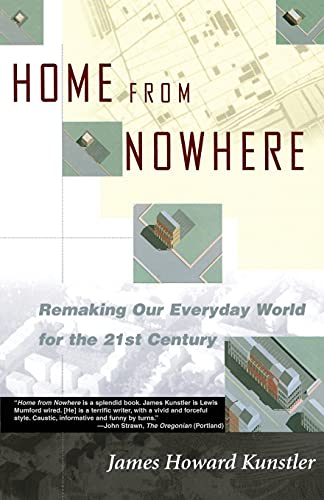
In his landmark book The Geography of Nowhere James Howard Kunstler visited the "tragic sprawlscape of cartoon architecture, junked cities, and ravaged countryside" America had become and declared that the deteriorating environment was not merely a symptom of a troubled culture, but one of the primary causes of our discontent.
In Home from Nowhere Kunstler not only shows that the original American Dream -- the desire for peaceful, pleasant places in which to work and live -- still has a strong hold on our imaginations, but also offers innovative, eminently practical ways to make that dream a reality. Citing examples from around the country, he calls for the restoration of traditional architecture, the introduction of enduring design principles in urban planning, and the development of public spaces that acknowledge our need to interact comfortable with one another.
Die Inhaltsangabe kann sich auf eine andere Ausgabe dieses Titels beziehen.
Über die Autorin bzw. den Autor
James Howard Kunstler is a frequent contributor to the New York Times Magazine and is the author of eight novels. He now lives in Saratoga Springs, New York.
Auszug. © Genehmigter Nachdruck. Alle Rechte vorbehalten.
Home from Nowhere
REMAKING OUR EVERYDAY WORLD FOR THE 21ST CENTURYBy James Howard KunstlerFree Press
Copyright ©1998 James Howard KunstlerAll right reserved.
ISBN: 0684837374
From Prologue: The Victory Disease
One dangerously sunny morning in April 1994, six guys were sitting around the attic porch of a house in the Florida panhandle swapping theories as to why the everyday world in America had become such an abysmal mess. All of them were architects except me. It was the day after the annual Seaside Prize had been awarded and some of us were still a little woozy from the festivities. The prize recipient, Christopher Alexander, author of A Pattern Language and other influential books, was there. So was Andres Duany, one of the designers of Seaside, the town we were in; Witold Rybczynski, the writer of graceful books about cities and buildings; Peter Calthorpe, the California architect and planner; and Paul Murrain, a young British landscape architect. The house was one designed by Leon Krier, the architectural theorist and, it is probably accurate to say, godfather of the movement to repair the damage done to our world by Modernism. Krier was present only in the spirit of the house, but his was a palpable presence.
Calthorpe had the floor. Lean and urbane, Calthorpe, forty-five, was in a humorously expansive mood. He proposed two theories. The first was The Stroke Theory. World War Two, he said, was so traumatic that it had caused the same kind of damage to western civilization that a cerebral hemorrhage can wreak on a human mind. It had made the advanced nations of the world lose some of their most important abilities, to forget their own history and culture, as a stroke victim loses his powers of speech, his memories, the particulars of his education. All the ghastly office buildings, banal dwellings, crappy commercial structures, and other common architectural garbage of our everyday world, Calthorpe proposed, were like the inchoate squawkings and bleatings of a stroke victim who had lost the ability to express himself. This theory met with such general approbation that Calthrope went on to propose a second.
This was The Stupor Theory. World War Two, he said, was the high tide of our fathers' generation. All these American men in the full bloom of youth had marched off to a terrible war against manifest evil and won a decisive victory for democracy and decency. In the process, many of them had the adventures of a lifetime -- moments of heroism, romances with grateful foreign girls, days and nights enjoying the spoils of liberated castles, profound friendships with army buddies, and, finally, the worshipful reception of the folks back home, with a sweet package of emoluments upon return to civilian life, including free college tuition and low-interest home mortgage loans.
These young men, Calthorpe went on, were immediately absorbed into postwar corporate life, fitting well into large hierarchical organizations. Corporate life was familiarly regimented like the army, where so many of them had lately enjoyed their heroic exploits. They knew how to give and follow orders, and patiently await promotion.
The downside was that their greatest adventures were over, that life on the commuter platform with hundreds of other guys in gray flannel suits was in some elemental way an awful comedown. What was there to look forward to? Selling ten million units a month of Oaties breakfast cereal for decades to come? How did this compare to drinking seventy-year-old cognac in an Alsatian castle with a pistol strapped to your leg and a seventeen-year-old French curie in your lap, having spent the day slaughtering Nazis? Of course, there would be the compensations of family life, a nice house in those new suburbs, a shiny new car, the fabulous panoply of washers, driers, Mixmasters, TVs, hifi's, and power mowers, autumn days teaching Skippy to throw a football, winter nights at the school auditorium watching Princess dance in her toe shoes, summer evenings presiding over the backyard barbecue, and ... wait ... was that all? Is that where it ended? Flipping hamburgers and wieners in a joke-bedizened apron and a clownish chef's hat?
Well, yes, for a lot of them. This was what life had to offer after the stupendous adventure of World War Two. A whole generation of heroes slipped into a permanent semicoma, soothing their boredom and anomie with heavy doses of hard liquor -- their beloved martinis -- and living out the rest of their days in an alcoholic fog. This, Calthrope said, explained why the world they built for us -- the suburban sprawl universe -- was so incoherent, brutal, ugly, and depressing: they didn't care about what they were building. They were drunk most of the time, in a stupor. (This also, he added with wicked parenthetical glee, explained feminism: a whole generation of daughters raised by emotionally remote, perpetually plastered fathers.)
These theories admittedly veer into burlesque, but there is still much to admire in them. The Stupor Theory especially comports with the phenomenon known among historians as The Victory Disease, the condition in which a nation's military triumph carries within it the demoralizing seeds of its own later destruction. In The Geography of Nowhere I argued that the building of suburbia as a replacement for towns and cities in the United States was just such a self-destructive act. I attempted to describe the tragic process. I argued that the living arrangement Americans now think of as normal is bankrupting us economically, socially, ecologically, and spiritually. I identified the physical setting itself -- the cartoon landscape of car-clogged highways, strip malls, tract houses, franchise fry pits, parking lots, junked cities, and ravaged countryside -- as not merely the symptom of a troubled culture but in many ways a primary cause of our troubles. I stated that all reasonable indications suggest we will not be able to continue this pattern of living, whether we like suburbia or not, and I sketched some of the remedies that were then just beginning to present themselves.
I wrote The Geography of Nowhere as a layman attempting to make sense of a national condition that seems at best complicated and at worst incomprehensible. My approach was that of a citizen-observer, not of a design professional. It seemed to me that the country was full of normal people, including plenty of intelligent ones, who were distressed by their surroundings but unable to articulate their feelings. My intention was to give shape to those feelings, to turn inchoate emotion into coherent thought. Since then I've come to understand one of the chief impediments preventing us from comprehending the tragedy of our everyday environment: American culture is very abstract. Suburbia fails us in large part because it is so abstract. It's an idea of a place rather than a place. The way you can tell is because so many places in this country seem like no place in particular, and a lack of particularity is the earmark of abstraction.
Our knowledge of cities is increasingly abstract, too. Fewer and fewer Americans have any experience living in good ones, or in any city at all -- good, bad, or mediocre. Historically, American cities at their best have left much to be desired, an issue of great significance which I will discuss further. In any case, few American cities today even function in any normal sense and many are virtually empty shells. What Americans know about city life these days often turns out to be secondhand or worse. We read in the newspapers and magazines about urban war zones...
„Über diesen Titel“ kann sich auf eine andere Ausgabe dieses Titels beziehen.
Suchergebnisse für Home from Nowhere: Remaking Our Everyday World For...

Beispielbild für diese ISBN
Home from Nowhere Remaking Our
Anbieter: World of Books (was SecondSale), Montgomery, IL, USA
Verkäuferbewertung 5 von 5 Sternen

Zustand: Good. Item in good condition. Textbooks may not include supplemental items i.e. CDs, access codes etc. Artikel-Nr. 00084558428
Gebraucht kaufen
EUR 4,27
Versand gratis
Versand innerhalb von USA
Versand innerhalb von USA
Anzahl: 7 verfügbar
Beispielbild für diese ISBN
Home from Nowhere Remaking Our
Anbieter: World of Books (was SecondSale), Montgomery, IL, USA
Verkäuferbewertung 5 von 5 Sternen
Zustand: Acceptable. Item in acceptable condition! Textbooks may not include supplemental items i.e. CDs, access codes etc. Artikel-Nr. 00099336609
Gebraucht kaufen
EUR 4,27
Versand gratis
Versand innerhalb von USA
Versand innerhalb von USA
Anzahl: 4 verfügbar
Beispielbild für diese ISBN
Home from Nowhere Remaking Our
Anbieter: World of Books (was SecondSale), Montgomery, IL, USA
Verkäuferbewertung 5 von 5 Sternen
Zustand: Very Good. Item in very good condition! Textbooks may not include supplemental items i.e. CDs, access codes etc. Artikel-Nr. 00094466628
Gebraucht kaufen
EUR 4,27
Versand gratis
Versand innerhalb von USA
Versand innerhalb von USA
Anzahl: 4 verfügbar
Beispielbild für diese ISBN
Home from Nowhere: Remaking Our Everyday World for the 21st Century
Verlag:
Touchstone Press (edition Illustrated), 1998
ISBN 10: 0684837374
ISBN 13: 9780684837376
Gebraucht
Paperback
Anbieter: BooksRun, Philadelphia, PA, USA
Verkäuferbewertung 5 von 5 Sternen
Paperback. Zustand: Very Good. Illustrated. It's a well-cared-for item that has seen limited use. The item may show minor signs of wear. All the text is legible, with all pages included. It may have slight markings and/or highlighting. Artikel-Nr. 0684837374-11-1
Gebraucht kaufen
EUR 5,21
Versand gratis
Versand innerhalb von USA
Versand innerhalb von USA
Anzahl: 1 verfügbar
Beispielbild für diese ISBN
Home from Nowhere: Remaking Our Everyday World for the 21st Century
Anbieter: ThriftBooks-Atlanta, AUSTELL, GA, USA
Verkäuferbewertung 5 von 5 Sternen
Paperback. Zustand: Good. No Jacket. Pages can have notes/highlighting. Spine may show signs of wear. ~ ThriftBooks: Read More, Spend Less. Artikel-Nr. G0684837374I3N00
Gebraucht kaufen
EUR 5,85
Versand gratis
Versand innerhalb von USA
Versand innerhalb von USA
Anzahl: 1 verfügbar
Beispielbild für diese ISBN
Home from Nowhere: Remaking Our Everyday World for the 21st Century
Anbieter: Wonder Book, Frederick, MD, USA
Verkäuferbewertung 5 von 5 Sternen
Zustand: Good. Good condition. A copy that has been read but remains intact. May contain markings such as bookplates, stamps, limited notes and highlighting, or a few light stains. Artikel-Nr. J07Q-00716
Gebraucht kaufen
EUR 6,22
Versand gratis
Versand innerhalb von USA
Versand innerhalb von USA
Anzahl: 1 verfügbar
Beispielbild für diese ISBN
Home from Nowhere: Remaking Our Everyday World for the 21st Century
Anbieter: Wonder Book, Frederick, MD, USA
Verkäuferbewertung 5 von 5 Sternen
Zustand: Very Good. Very Good condition. A copy that may have a few cosmetic defects. May also contain light spine creasing or a few markings such as an owner's name, short gifter's inscription or light stamp. Bundled media such as CDs, DVDs, floppy disks or access codes may not be included. Artikel-Nr. E15C-01697
Gebraucht kaufen
EUR 6,22
Versand gratis
Versand innerhalb von USA
Versand innerhalb von USA
Anzahl: 1 verfügbar
Beispielbild für diese ISBN
Home from Nowhere : Remaking Our Everyday World for the 21st Century
Anbieter: Better World Books, Mishawaka, IN, USA
Verkäuferbewertung 5 von 5 Sternen
Zustand: Good. First Touchstone. Pages intact with minimal writing/highlighting. The binding may be loose and creased. Dust jackets/supplements are not included. Stock photo provided. Product includes identifying sticker. Better World Books: Buy Books. Do Good. Artikel-Nr. 4525728-6
Gebraucht kaufen
EUR 6,35
Versand gratis
Versand innerhalb von USA
Versand innerhalb von USA
Anzahl: 3 verfügbar
Beispielbild für diese ISBN
Home from Nowhere : Remaking Our Everyday World for the 21st Century
Anbieter: Better World Books, Mishawaka, IN, USA
Verkäuferbewertung 5 von 5 Sternen
Zustand: Very Good. First Touchstone. Pages intact with possible writing/highlighting. Binding strong with minor wear. Dust jackets/supplements may not be included. Stock photo provided. Product includes identifying sticker. Better World Books: Buy Books. Do Good. Artikel-Nr. 11462437-75
Gebraucht kaufen
EUR 6,35
Versand gratis
Versand innerhalb von USA
Versand innerhalb von USA
Anzahl: 1 verfügbar
Beispielbild für diese ISBN
Home from Nowhere: Remaking out everyday world for
Anbieter: N. Fagin Books, Chicago, IL, USA
Verkäuferbewertung 4 von 5 Sternen

1996. Urban planning. Touchstone Book/Simon and Schuster. Good paperback though text has tanned 318p. Artikel-Nr. 21707
Gebraucht kaufen
EUR 1,78
EUR 5,18 Versand
Versand innerhalb von USA
Versand innerhalb von USA
Anzahl: 1 verfügbar