
Inhaltsangabe
The Pulitzer Prize-winning author of The Prize joins a leading expert on the global economy to present an incisive narrative of the risks and opportunities that are emerging as the balance of power shifts around the world between governments and markets -- and the battle over globalization comes front and center.
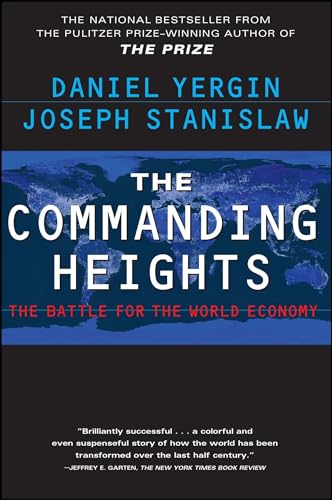
A brilliant narrative history, The Commanding Heights is about the most powerful economic forces at work in the world today, and about the people and the ideas that are shaping the future. Across the globe, it has become increasingly accepted dogma that economic activities should be dominated by market forces, not political concerns. With chapters on Europe, the US, Britain, the Third World, the Arab States, Asia, China, India, Latin America, and the former communist countries, Yergin and Stanislaw provide an incisive overview of the state of the economy, and of the battles between governments and markets in each region. Now updated throughout and with two new chapters, The Commanding Heights explains a revolution which is unfolding before our very eyes.
Die Inhaltsangabe kann sich auf eine andere Ausgabe dieses Titels beziehen.
Über die Autorin bzw. den Autor
Daniel Yergin, chairman of Cambridge Energy Research Associates and the Global Energy Expert for the CNBC business news network, is a highly respected authority on energy, international politics, and economics. Dr. Yergin received the Pulitzer Prize for the number one bestseller The Prize: The Epic Quest for Oil, Money & Power, which was also made into an eight-hour PBS/BBC series seen by 20 million people in the United States. The book has been translated into 12 languages. It also received the Eccles Prize for best book on an economic subject for a general audience.
Of Dr. Yergin’s subsequent book, Commanding Heights: The Battle for the World Economy, the Wall Street Journal said: “No one could ask for a better account of the world’s political and economic destiny since World War II.” This book has been translated into 13 languages and Dr. Yergin led the team that turned it into a six-hour PBS/BBC documentary — the major PBS television series on globalization. The series received three Emmy nominations, a CINE Golden Eagle Award and the New York Festival’s Gold World Medal for best documentary. Dr. Yergin’s other books include Shattered Peace, an award-winning history of the origins of the Cold War, Russia 2010 and What It Means for the World (with Thane Gustafson), and Energy Future: The Report of the Energy Project at the Harvard Business School, which he edited with Robert Stobaugh.
Auszug. © Genehmigter Nachdruck. Alle Rechte vorbehalten.
Introduction
AT THE FRONTIER
Books begin in unexpected places. This book began in part on a summer's day on the outskirts of Moscow. The Izmailovo outdoor market sprawls over acres on the southwest edge of the city, almost at the very end of the subway line. Its transformation -- from a park for exhibiting painting and crafts into a vast bazaar -- was one of the earliest and most visible signs of communism's collapse and the transition to an economy that was no longer state controlled but responded to the demands of the marketplace.
The past and future were simultaneously on sale. Oil paintings of snowy villages and religious icons, many of dubious origin, were commingled with South Korean electronics and cheap videocassettes. Stalls competed to sell old dishes and stained uniforms, czarist mementos, and pins decorated with Lenin's face. There were carpets from Central Asia, swords from the Caucasus, and military souvenirs from both czarist and Red armies. And everywhere were the matrioshki, wooden dolls within dolls, but of endless variation -- not only the traditional peasant women but also a host of other characters, from Soviet leaders and American presidents to the Harlem Globetrotters. The favored mode of payment for all of this was the dollar -- the same dollar whose possession only a few years earlier could have resulted in a stiff prison term.
The market drew all sorts of people, including, on this particular day Sir Brian Fall, the then British ambassador. As a career diplomat in the Foreign Office, Fall had dealt with Soviet and Russian affairs for thirty years, going back to the cold war days of George Smiley. In between, he had held a number of other positions, including senior adviser to three foreign secretaries as well as high commissioner to Canada. This day, however, he was at Izmailovo with his wife and daughter not for diplomatic purposes but, like everybody else, to shop. They were looking for a painting of a rural village scene, an evocation of traditional Mother Russia. But Sir Brian, every now and then, still had to stop to remind himself that the dramatic changes in modern Russia were really happening. Every stall at Izmailovo brought one face-to-face with that change. The market was a metaphor for a society disjointed and confused, but also reenergized, experiencing a transition more wrenching and more rapid than Russians could comprehend, having passed through a revolution they had not anticipated -- and were certainly not prepared for.
"How much easier it would have been for the Russians," he said as we wound down one of the aisles, "if the Soviet Union had collapsed in the 1960s or 1970s.
Why?
"Because that was when government intervention loomed large in the West, and national planning and state ownership were the methods of the day. That would have made it much more acceptable for Russia to hold on to its huge state-owned companies and keep pumping money into them, no matter how big the losses. And then the move to a market economy would not have been so severe and traumatic."
His observations brought into sudden and sharp focus how much has changed around the world since the 1970s in thinking about the appropriate relationship between state and marketplace. What was the conventional, indeed the dominating, wisdom of that time is now widely criticized, and in some cases discredited and abandoned. What seemed to be ideas on the fringe, or even beyond the fringe, discussed only around a few seminar tables, have now moved into the center. As a consequence, economies almost everywhere are being reordered, in some cases radically, with immense and far-reaching effects.
All around the globe, socialists are embracing capitalism, governments are selling off companies they had previously nationalized, and countries are seeking to entice back multinational corporations that they had expelled just two decades earlier. Marxism and state control are being jettisoned in favor of entrepreneurship; the number of stock markets is exploding; and mutual fund managers have become celebrities. Today, politicians on the left admit that their governments can no longer afford the expansive welfare state, and American liberals recognize that more government may not hold the solution to every problem. Many people are being forced to reexamine and reassess their root assumptions. These changes are opening up new prospects and new opportunities throughout the world. The shift is also engendering, for many, new anxieties and insecurities. They fear that government will no longer be there to protect them as they become increasingly intertwined in a global economy that seeks to ignore national borders. And they express unease about the price that the market demands of its participants. Shocks and turbulence in international capital markets, such as those that roiled Latin America in 1995 and Asia in 1997, turn that unease into fundamental questions about the danger and even legitimacy of markets.
The global financial crisis that began in Asia in 1997 and spread to the rest of the world in 1998 raised profound new issues about the powerful impact and unanticipated risks arising from integration into the global market. But all these considerations need to be set in context.
Why the Shift?
Why the move to the market? Why, and how, the shift from an era in which the "state" -- national governments -- sought to seize and exercise control over their economies to an era in which the ideas of competition, openness, privatization, and deregulation have captured world economic thinking? This question, in turn, begets others: Are these changes irreversible? Are they part of a continuing process of development and evolution? What will be the consequences and prospects -- political, social, and economic -- of this fundamental alteration in the relationship between government and marketplace? These are the basic questions that this book seeks to answer.
Where the frontier between the state and market is to be drawn has never been a matter that could be settled, once and for all, at some grand peace conference. Instead, it has been the subject, over the course of this century, of massive intellectual and political battles as well as constant skirmishes. In its entirety, the struggle constitutes one of the great defining dramas of the twentieth century. Today the clash is so far-reaching and so encompassing that it is remaking our world -- and preparing the canvas for the twenty-first century.
This frontier defines not the boundaries of nations but the division of roles within them. What are the realm and responsibility of the state in the economy, and what kind of protection is the state to afford its citizens? What is the preserve of private decision making, and what are the responsibilities of the individual? This frontier is not neat and well defined. It is constantly shifting and often ambiguous. Yet through most of the century, the state has been ascendant, extending its domain further and further into what had been the territory of the market. Its victories were propelled by revolution and two world wars, by the Great Depression, by the ambitions of politicians and governments. It was also powered by the demands of the public in the industrial democracies for greater security, by the drive for progress and improved living conditions in developing countries -- and by the quest for justice and fairness. Behind all this was the conviction that markets went to excesses, that they could readily fail, that there were too many needs and services they could not deliver, that the risks and the human and social costs were too high and the potential for abuse too great. In the aftermath of the traumatic upheavals of the first half of the twentieth century, governments expanded their existing responsibilities and obligations to their populaces and...
„Über diesen Titel“ kann sich auf eine andere Ausgabe dieses Titels beziehen.
Suchergebnisse für The Commanding Heights: The Battle for the World Economy

Beispielbild für diese ISBN
The Commanding Heights : The Battle for the World Economy
Anbieter: Wonder Book, Frederick, MD, USA
Verkäuferbewertung 5 von 5 Sternen

Zustand: Good. Good condition. Writing inside. Artikel-Nr. B01H-00628
Gebraucht kaufen
EUR 4,68
Versand gratis
Versand innerhalb von USA
Versand innerhalb von USA
Anzahl: 1 verfügbar
Beispielbild für diese ISBN
The Commanding Heights
Anbieter: ThriftBooks-Reno, Reno, NV, USA
Verkäuferbewertung 5 von 5 Sternen
Paperback. Zustand: Very Good. No Jacket. May have limited writing in cover pages. Pages are unmarked. ~ ThriftBooks: Read More, Spend Less. Artikel-Nr. G068483569XI4N00
Gebraucht kaufen
EUR 6,16
Versand gratis
Versand innerhalb von USA
Versand innerhalb von USA
Anzahl: 1 verfügbar
Beispielbild für diese ISBN
The Commanding Heights
Anbieter: ThriftBooks-Dallas, Dallas, TX, USA
Verkäuferbewertung 5 von 5 Sternen
Paperback. Zustand: Very Good. No Jacket. May have limited writing in cover pages. Pages are unmarked. ~ ThriftBooks: Read More, Spend Less. Artikel-Nr. G068483569XI4N00
Gebraucht kaufen
EUR 6,16
Versand gratis
Versand innerhalb von USA
Versand innerhalb von USA
Anzahl: 1 verfügbar
Beispielbild für diese ISBN
The Commanding Heights
Anbieter: ThriftBooks-Atlanta, AUSTELL, GA, USA
Verkäuferbewertung 5 von 5 Sternen
Paperback. Zustand: Very Good. No Jacket. May have limited writing in cover pages. Pages are unmarked. ~ ThriftBooks: Read More, Spend Less. Artikel-Nr. G068483569XI4N00
Gebraucht kaufen
EUR 6,16
Versand gratis
Versand innerhalb von USA
Versand innerhalb von USA
Anzahl: 1 verfügbar
Beispielbild für diese ISBN
The Commanding Heights Pt. 1 : The Battle for the World Economy
Anbieter: Better World Books, Mishawaka, IN, USA
Verkäuferbewertung 5 von 5 Sternen
Zustand: Good. rev Edition. Pages intact with minimal writing/highlighting. The binding may be loose and creased. Dust jackets/supplements are not included. Stock photo provided. Product includes identifying sticker. Better World Books: Buy Books. Do Good. Artikel-Nr. 739539-20
Gebraucht kaufen
EUR 6,65
Versand gratis
Versand innerhalb von USA
Versand innerhalb von USA
Anzahl: 2 verfügbar
Beispielbild für diese ISBN
The Commanding Heights Pt. 1 : The Battle for the World Economy
Anbieter: Better World Books: West, Reno, NV, USA
Verkäuferbewertung 5 von 5 Sternen
Zustand: Good. rev Edition. Pages intact with minimal writing/highlighting. The binding may be loose and creased. Dust jackets/supplements are not included. Stock photo provided. Product includes identifying sticker. Better World Books: Buy Books. Do Good. Artikel-Nr. 739539-20
Gebraucht kaufen
EUR 6,65
Versand gratis
Versand innerhalb von USA
Versand innerhalb von USA
Anzahl: 1 verfügbar
Beispielbild für diese ISBN
The Commanding Heights : The Battle for the World Economy
Anbieter: Wonder Book, Frederick, MD, USA
Verkäuferbewertung 5 von 5 Sternen
Zustand: Good. Good condition. A copy that has been read but remains intact. May contain markings such as bookplates, stamps, limited notes and highlighting, or a few light stains. Artikel-Nr. F13F-03164
Gebraucht kaufen
EUR 7,06
Versand gratis
Versand innerhalb von USA
Versand innerhalb von USA
Anzahl: 2 verfügbar
Beispielbild für diese ISBN
The Commanding Heights : The Battle for the World Economy
Anbieter: Wonder Book, Frederick, MD, USA
Verkäuferbewertung 5 von 5 Sternen
Zustand: Very Good. Very Good condition. A copy that may have a few cosmetic defects. May also contain light spine creasing or a few markings such as an owner's name, short gifter's inscription or light stamp. Artikel-Nr. H04L-00467
Gebraucht kaufen
EUR 7,06
Versand gratis
Versand innerhalb von USA
Versand innerhalb von USA
Anzahl: 1 verfügbar
Beispielbild für diese ISBN
The Commanding Heights : The Battle for the World Economy
Anbieter: Books From California, Simi Valley, CA, USA
Verkäuferbewertung 4 von 5 Sternen

paperback. Zustand: Good. Some glue is missing at the base of the backstrip. The copy shows minor external wear, but is in otherwise clean condition. Artikel-Nr. mon0004090532
Gebraucht kaufen
EUR 4,42
EUR 4,28 Versand
Versand innerhalb von USA
Versand innerhalb von USA
Anzahl: Mehr als 20 verfügbar
Beispielbild für diese ISBN
The Commanding Heights : The Battle for the World Economy
Anbieter: Books From California, Simi Valley, CA, USA
Verkäuferbewertung 4 von 5 Sternen
paperback. Zustand: Very Good. Artikel-Nr. mon0003878848
Gebraucht kaufen
EUR 4,84
EUR 4,28 Versand
Versand innerhalb von USA
Versand innerhalb von USA
Anzahl: 1 verfügbar