
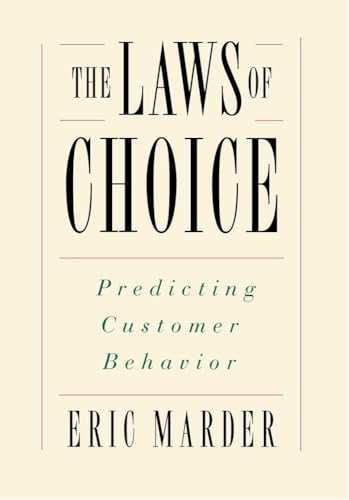
Verwandte Artikel zu The Laws of Choice: Predicting Customer Behavior
Inhaltsangabe
How do customers decide what products and brands to buy? With the rise of sophisticated advertising and marketing research methods in this century, business leaders have spent billions of dollars attempting to answer this perplexing question. Occasionally, analysts emerge with suggestive trends, but ultimately with little hard evidence to support any definitive "laws" of customer choice.
Now, in this much-anticipated major work, Eric Marder reveals how universal patterns in survey responses lead not only to general principles in marketing but to empirically verifiable laws of human nature itself. Drawing on forty years of applying his pioneering experimental design techniques to marketing research surveys, Marder presents a global theory of choice behavior, supported by original data reported here for the first time from thousands of massive real-life experiments based on millions of interviews. His dramatic findings about pricing, optimal marketing tactics, product evaluation, the relative role of product and image, and advertising effectiveness will make this book required reading for the entire marketing community. Of special interest to social scientists and survey research practitioners will be Marder's powerful research designs and techniques, including the unbounded write-in scale for measuring desirability (attitude) and his methodological analyses of the relationships among beliefs (perceptions), desires, choice, and behavior.
In the Preface, he writes: "At the core of the theory are three laws of choice behavior the Law of Congruence, the Law of Primacy, and the Law of Persistence. These laws are both general and self-evident. At first glance, they are so self-evident that you might say: 'I have known this all along.' My reply is: 'Of course you have known it all along. But there is a difference between knowing and knowing, between the passive knowing that allows us to persist in actions that are inconsistent with what we know, and the active knowing that helps us change the way we do things.' I believe that knowing the laws of choice behavior-really knowing them -- changes the way we do things. My crass but stringent criterion has been that a good theory should enable someone equipped with it to make more money than someone who isn't. I believe my theory has passed this test."
Die Inhaltsangabe kann sich auf eine andere Ausgabe dieses Titels beziehen.
Über die Autorin bzw. den Autor
Eric Marder is Chairman of Eric Marder Associates, Inc., a marketing research and consulting firm he founded in 1960. The company specializes in "Choice Research," a term Marder uses to distinguish the discipline presented in this book from traditional marketing research. His client list through the years has included American Home Products, AT&T, Campbell Soup, CBS, General Foods, General Mills, GTE, Hewlett-Packard, Johnson & Johnson, Pfizer, Scott Paper, Xerox, and others. He is married and lives in Manhattan.
Auszug. © Genehmigter Nachdruck. Alle Rechte vorbehalten.
Chapter 1
Marketing and Choice
A Personal Note
I came to marketing in a roundabout way. I was working in survey research. Superficially, surveys are a commonsense matter. One asks questions. One gets answers. One analyzes and reports the results. But my ambition went beyond that. I had an intuition that what happens in a survey, or what could be made to happen if one approached it in the right way, is of greater significance than meets the eye. If one thinks of every question as a stimulus, if one thinks of every answer as a response, if one focuses not on what is said, attributing literal meaning to it, but on the fact that it is said, then the response constitutes a special kind of behavior which should be psychologically meaningful.
My ambition was to open a path to those aspects of human nature that become most peculiarly accessible by examining what happens when questions are asked and answers are given. I was not concerned with how people felt about any particular subject, be it toilet paper or nuclear energy, an inquiry I held to be equally trivial in both cases, but with the universal pattern hidden in the responses, which would, at the appropriate level of generality, lead to principles and laws, not laws about toilet paper or nuclear energy, but laws about patterns of responses and hence about some aspects of human nature itself.
In 1951, I was contacted by the head of a prestigious graduate school and invited to join the faculty to attempt to develop a theory of marketing. I had hardly ever heard the word and thought of it more as having to do with getting my groceries home than as a serious field of study. After some soul-searching, I declined. Marketing, or what I thought it was, seemed frivolous to me. I wanted to continue to think about the embryonic science of questions and answers. Several years later, I went to work at Kenyon & Eckhardt, then one of the ten largest advertising agencies in the country. The understanding was that I would continue to think about questions and answers but, in the new environment of the advertising agency, would channel these efforts into measuring the effectiveness of advertising and helping the agency's clients sell their products.
In 1960 I left Kenyon & Eckhardt to found Eric Marder Associates, Inc. (called "EMA" throughout this book). By then I was submerged in marketing research. To be sure, the central tool was still the survey. I was still asking questions and collecting answers. I was still thinking about the structure of these questions and about the general principles that might be extracted from them. But the emphasis had shifted entirely to looking for better ways of helping clients market products. To do this effectively, it became imperative to understand the client's problem, not in the vague terms he was prone to use in articulating it, not even in the way he actually thought about it, but in the way he should have thought about it. This became dramatically clear to me when I met a high-ranking marketing executive who said expansively, "We want to do a study to find out why Mercury isn't selling this year."
"No," I replied.
He was half startled, half shocked.
"I damn well know what I want to do," he said.
"I believe you want to do a study to find out what you can do to sell more Mercurys this year."
"But that's the same thing."
"It's not quite the same thing," I replied. "If I took the assignment at face value, I would do a study among people who have just bought some other car. I might find out that they considered a Mercury but decided against it because they didn't like the look of the front end. This would give you the right answer to your question, but it wouldn't do you any good. If I want to give you a useful answer, I must study people who haven't bought a car and find out what, if anything, I could promise them or do for them to induce them to buy a Mercury in spite of the fact that they don't like the look of the front end."
It became clear to me that assignments could not be taken at face value. The important thing was not to listen to what the client said he wanted, but to what he really wanted, or to what he should have wanted, or to what he could be made to see he wanted if the issues were properly dissected for him. I also realized that much marketing research was doomed from the outset. For how could it hope to generate the right answer if it had not addressed the right question?
This led me to ponder what the right questions were, and so I began to think about marketing. Before long, a theory began to emerge, an orderly way of looking at the problems every marketer must face and solve one way or another. Given my temperament, I made every effort to think in general terms, so the theory would apply with equal force to the marketing of a paper towel, a computer, a presidential candidate, a religion, or anything else someone might attempt to induce people to choose. Ironically, I had come full circle. In the end, I was thinking about marketing after all and was thus carrying out the very assignment I had arrogantly rejected as a young man. Arrogantly indeed, though perhaps not foolishly. Because even though the theory I offer now is so elementary that I should have been able to articulate it after a little thought, I confess that it has taken many years before I was able to strip it of involutions and complications, of big words and technical jargon, and reduce it to the commonsense form in which it is presented below.
Nomenclature
What is marketing? There is, of course, no right answer. Definitions can be neither right nor wrong. But definitions do matter, for they are the tools we use in thinking about things. And some definitions can be more useful than others in helping us think clearly and arrive at answers we might have missed otherwise. In that spirit, I believe it is useful to think of marketing as a game played by N players (the marketers), each equipped with chips (their respective budgets). The players make moves on a board (the principles governing choice behavior) by adjusting eight dials (the eight tools of marketing). To understand the game, we need to understand the board on which it is played. So I begin by describing that board, using the terms marketer, brand, customer, and choice.
The initial meaning of these terms is self-evident. The marketer is the provider of goods or services, such as automobiles, soap, paging, coffee, or computers. The brand is whatever the marketer is trying to sell. The choice is the selection of one brand from a set of brands. And the customer is the person who makes the choice. The marketer may also be a campaign manager, the brand a political candidate, the choice an election, and the customer a voter. In general, these terms, as well as the principles and methods dealt with in this book, are intended to apply to any situation in which:
Someone, anyone, (the marketer) is trying to induce someone, anyone (the customer) to make some selection, any selection (the choice) in favor of something, anything (the marketer's brand), often aided and abetted by a researcher whose job it is to subject the process to scientific scrutiny and to support it with empirical evidence.
Given the intrinsic limitations of the English language, which does not have gender-free pronouns, and being unwilling to use the awkward he or she, I am arbitrarily assigning genders to the cast of characters. The marketer shall be a she; the customer shall be a she; the researcher shall be a he. With some limited partiality, I am thus reserving my own gender for the actor with whom I identify most closely. I trust no one will take offense if the brand remains an it,...
„Über diesen Titel“ kann sich auf eine andere Ausgabe dieses Titels beziehen.
Suchergebnisse für The Laws of Choice: Predicting Customer Behavior

Beispielbild für diese ISBN
The Laws of Choice: Predicting Customer Behavior
Anbieter: World of Books (was SecondSale), Montgomery, IL, USA
Verkäuferbewertung 5 von 5 Sternen

Zustand: Good. Item in good condition. Textbooks may not include supplemental items i.e. CDs, access codes etc. Artikel-Nr. 00099293553
Gebraucht kaufen
EUR 4,77
Versand gratis
Versand innerhalb von USA
Versand innerhalb von USA
Anzahl: 1 verfügbar
Beispielbild für diese ISBN
The Laws of Choice: Predicting Customer Behavior
Anbieter: World of Books (was SecondSale), Montgomery, IL, USA
Verkäuferbewertung 5 von 5 Sternen
Zustand: Very Good. Item in very good condition! Textbooks may not include supplemental items i.e. CDs, access codes etc. Artikel-Nr. 00073933472
Gebraucht kaufen
EUR 4,77
Versand gratis
Versand innerhalb von USA
Versand innerhalb von USA
Anzahl: 2 verfügbar
Beispielbild für diese ISBN
The Laws of Choice: Predicting Customer Behavior
Anbieter: ThriftBooks-Dallas, Dallas, TX, USA
Verkäuferbewertung 5 von 5 Sternen
Hardcover. Zustand: Very Good. No Jacket. May have limited writing in cover pages. Pages are unmarked. ~ ThriftBooks: Read More, Spend Less. Artikel-Nr. G0684835452I4N00
Gebraucht kaufen
EUR 6,13
Versand gratis
Versand innerhalb von USA
Versand innerhalb von USA
Anzahl: 1 verfügbar
Beispielbild für diese ISBN
The Laws of Choice: Predicting Customer Behavior
Anbieter: ThriftBooks-Atlanta, AUSTELL, GA, USA
Verkäuferbewertung 5 von 5 Sternen
Hardcover. Zustand: Very Good. No Jacket. May have limited writing in cover pages. Pages are unmarked. ~ ThriftBooks: Read More, Spend Less. Artikel-Nr. G0684835452I4N00
Gebraucht kaufen
EUR 6,13
Versand gratis
Versand innerhalb von USA
Versand innerhalb von USA
Anzahl: 1 verfügbar
Beispielbild für diese ISBN
The Laws of Choice: Predicting Customer Behavior
Verlag:
Free Press (edition First Edition), 1997
ISBN 10: 0684835452
ISBN 13: 9780684835457
Gebraucht
Hardcover
Erstausgabe
Anbieter: BooksRun, Philadelphia, PA, USA
Verkäuferbewertung 5 von 5 Sternen
Hardcover. Zustand: Very Good. First Edition. With dust jacket. It's a well-cared-for item that has seen limited use. The item may show minor signs of wear. All the text is legible, with all pages included. It may have slight markings and/or highlighting. Artikel-Nr. 0684835452-11-1-29
Gebraucht kaufen
EUR 6,50
Versand gratis
Versand innerhalb von USA
Versand innerhalb von USA
Anzahl: 1 verfügbar
Beispielbild für diese ISBN
The Laws of Choice
Anbieter: Better World Books, Mishawaka, IN, USA
Verkäuferbewertung 5 von 5 Sternen
Zustand: Very Good. 1 Edition. Pages intact with possible writing/highlighting. Binding strong with minor wear. Dust jackets/supplements may not be included. Stock photo provided. Product includes identifying sticker. Better World Books: Buy Books. Do Good. Artikel-Nr. 41162265-6
Gebraucht kaufen
EUR 7,32
Versand gratis
Versand innerhalb von USA
Versand innerhalb von USA
Anzahl: 1 verfügbar
Beispielbild für diese ISBN
The Laws of Choice
Anbieter: Better World Books, Mishawaka, IN, USA
Verkäuferbewertung 5 von 5 Sternen
Zustand: Good. 1 Edition. Former library copy. Pages intact with minimal writing/highlighting. The binding may be loose and creased. Dust jackets/supplements are not included. Includes library markings. Stock photo provided. Product includes identifying sticker. Better World Books: Buy Books. Do Good. Artikel-Nr. GRP76706481
Gebraucht kaufen
EUR 7,32
Versand gratis
Versand innerhalb von USA
Versand innerhalb von USA
Anzahl: 2 verfügbar
Beispielbild für diese ISBN
The Laws of Choice: Predicting Customer Behavior
Anbieter: Robinson Street Books, IOBA, Binghamton, NY, USA
Verkäuferbewertung 4 von 5 Sternen

Hardcover. Zustand: As New. Prompt Shipment, shipped in Boxes, Tracking PROVIDEDNear fine in near fine dust jacket. First edition. Artikel-Nr. under540ma4665
Gebraucht kaufen
EUR 11,98
EUR 8,18 Versand
Versand innerhalb von USA
Versand innerhalb von USA
Anzahl: 1 verfügbar
Beispielbild für diese ISBN
The Laws of Choice: Predicting Customer Behavior
Anbieter: WorldofBooks, Goring-By-Sea, WS, Vereinigtes Königreich
Verkäuferbewertung 5 von 5 Sternen
Hardback. Zustand: Very Good. The book has been read, but is in excellent condition. Pages are intact and not marred by notes or highlighting. The spine remains undamaged. Artikel-Nr. GOR001744679
Gebraucht kaufen
EUR 41,77
EUR 6,52 Versand
Versand von Vereinigtes Königreich nach USA
Versand von Vereinigtes Königreich nach USA
Anzahl: 1 verfügbar
Beispielbild für diese ISBN
The Laws of Choice: Predicting Customer Behavior
Anbieter: Ria Christie Collections, Uxbridge, Vereinigtes Königreich
Verkäuferbewertung 5 von 5 Sternen
Zustand: New. In. Artikel-Nr. ria9780684835457_new
Neu kaufen
EUR 56,13
EUR 13,94 Versand
Versand von Vereinigtes Königreich nach USA
Versand von Vereinigtes Königreich nach USA
Anzahl: Mehr als 20 verfügbar