
Verwandte Artikel zu Communicating in Sign: Creative Ways to Learn American...
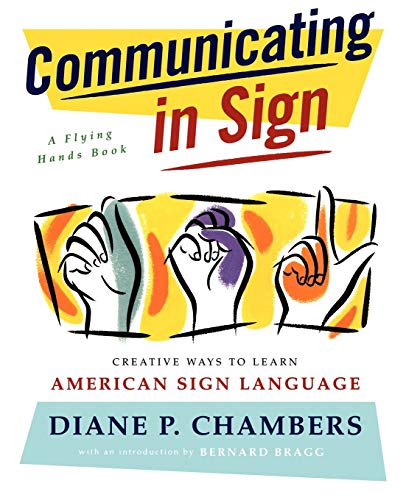
Communicating in Sign: Creative Ways to Learn American Sign Language (ASL) (A Flying Hands Book) - Softcover
Inhaltsangabe
American Sign Language (ASL) is the primary means of communication among the 22 million deaf and hard-of-hearing people in this country—and those who live and work with them.
Communicating in Sign revolutionizes the way ASL is taught by offering a beginning vocabulary based on the grammar and syntax of native signers and illustrating the eye contact, facial expressions, and body language that accompany hand and mouth movements. This breakthrough approach to mastering ASL, written for a general audience, is an invaluable resource for anyone eager to learn a language that is rapidly becoming part of our mainstream culture and also for educators, businesses,and organizations working to comply with the Americans with Disabilities Act (ADA).
Communicating in Sign places ASL within the context of Deaf culture and etiquette, delineating the components that contribute to its depth and richness.
Die Inhaltsangabe kann sich auf eine andere Ausgabe dieses Titels beziehen.
Über die Autorin bzw. den Autor
Diane P. Chambers is a nationally certified ASL interpreter and college-level instructor, and is president of Flying Hands, a firm dedicated to linking the hearing and Deaf communities. She lives in Baltimore, Maryland.
Von der hinteren Coverseite
This easy-to-use introduction to American Sign Language places the language within the context of deaf culture and etiquette, delineating the components that contribute to its depth and richness. 15 photos. 117 line drawings.
Auszug. © Genehmigter Nachdruck. Alle Rechte vorbehalten.
Chapter
Emotions
American Sign Language (ASL) is a beautiful language full of emotions. When we speak, we use our vocal chords, tongue, mouth, and ears. When we sign we use our hands, eyes, lips, jaw, and sense of touch. Our sense of touch, our feeling sense, springs to life when we sign. As we make the signs for emotions, we are really expressing how these emotions touch our body and our soul. If we are hungry, if we are happy, these basic feeling states easily transcend the spoken word. Learning to express emotions in American Sign Language is the key to understanding its power and immediacy.
The Five Basic Components of ASL
Imagine that you cannot speak or hear. You must find a way to communicate your feelings to others. Immediately, the almost unconscious physical responses to emotions that our bodies naturally make become our most basic vehicle for expression, instead of merely enhancing the words we speak. These physical responses are sometimes so second nature to us that we do not even realize our bodies communicate as strongly as our words. The band Extreme has a song that asks what someone would do to show she or he cared if the words I love you were taken away. To show love in ASL, we must speak it without words -- at least without words as we know them. The five components of American Sign Language come from the ways we can use our bodies to communicate and from our powers of observation to understand whatever emotion is communicated to us. The five components, in order of importance, are:
1. Eye contact
2. Facial expression
3. Body language
4. Mouth movements
5. Hand movements
Eye Contact. Communication is impossible unless your partner is looking at you. Looking away signals the end to a conversation and can be a great source of distress for the speaker if she or he is interrupted or distracted unexpectedly by a break in eye contact. Breaking eye contact is often a sign of anger or rudeness.
Maintaining eye contact is so important to communicating successfully in ASL that, within the Deaf culture, it is inappropriate to sign "Excuse me" when inadvertently disturbing a conversation between two other people. To draw their attention away by focusing it on your own interloping presence is considered more intrusive than simply moving along as quickly and unobtrusively as possible.
Hearing people must make a special effort to understand the importance of eye contact and a Deaf person's reliance on it. For example, a hearing student can listen to the teacher while taking notes or even while looking out the window. A Deaf student must watch a sign language interpreter to understand what the teacher is saying (or watch while the teacher signs).
Facial Expression. Facial expressions convey adjectives, adverbs, intensity, superlatives, and even denote pronouns through head movements toward or away from someone. Think about it. Is the person driving the car spaced out, sleepy, or fully attentive? Facial expressions comment on the action conveyed or present the opinion of the speaker in relation to it. For example, if you are unhappy that your little brother has a larger portion of chocolate ice cream than you do, your expression would show dismay as you nod toward him and sign the sentence, "He has more chocolate ice cream."
Body Language. Our bodies react naturally to the stimuli presented by the world around us. We move away from things we don't like or that we fear. We approach things we are curious about or are attracted to. Simple observation of another person's instinctive movement toward or away from outside stimuli can speak volumes about his or her tree feelings. In ASL, these body movements are incorporated into the performance of signs to give richness and depth to the concepts communicated.
Mouth Movements. Mouth movements in sign language don't necessarily mean English words formed by the lips. Grammatically, mouth movements can depict sizes and shapes. For example, when referring to a wide or large object, the speaker blows out his or her cheeks. When referring to a thin or small object, like a piece of wire, the speaker purses the lips or sucks air in.
Hand Movements. The formal signs or hand movements of ASL cannot be separated from the four preceding components of the language. All components are essential for fluent conversation. ASL is a language based on relationships in space and pictorial concepts, not on English words. It is important to remember that formal ASL signs are not always strict synonyms for English words, strung together to form sentences in exactly the same manner. As English is the first language for most of us, the transition to ASL can be difficult and will require some special effort. As in many other foreign languages, one sign in ASL can mean several different things, depending on facial expression, body language, or any of the other essential components.
As you learn to communicate in sign, it is important to embrace its physicality, its visual beauty and movement. Hearing people are often taught from childhood that it is not polite to express emotion graphically in public settings. The well-chosen word substitutes for the body that quakes inwardly with unspoken emotion. A blank-faced expression does nothing to promote communication with Deaf people. As we learn to become less inhibited about showing the way we feel and as we worry less and less about so-called proper or improper ways to express ourselves, the richness of communicating emotions in ASL will add depth to our very understanding of what it means to feel each precious human emotion. Exploring the ways that emotions touch us will help us empathize with others and make strong emotional connections to them.
Feeling Emotions with Your Body
Using your hands, face, and body to communicate is called nonverbal communication. In this way, you begin to think in pictures and three dimensions instead of English words.
Let's begin. Below you will find a list of ten emotional states. Think about how you feel whenever you experience each emotion.
* Fear
* Anger
* Surprise
* Shock
* Happiness
* Sadness
* Tiredness
* Frustration
* Amusement
* Excitement
Now, read the list again. Stop at each word and concentrate on the natural movements your body, face, and hands make when you feel this emotion. With a partner, or in front of a mirror, try to demonstrate each one. Let's compare your interpretations to the way most people naturally react to the emotions listed and to the way dictionaries define the experience of each. Common facial expressions are illustrated.
Fear n. A distressing emotion caused by an anticipation or awareness of danger; a feeling of dread or apprehension. v. To be afraid.
Our natural reaction is to lean away from something that makes us afraid. Sometimes we get a butterfly feeling in our stomachs and a tightening in our lungs. When we experience fear and show it, our bodies tend to lean away, shoulders back, eyes looking directly at or above the frightening thing, jaws tightening, and the head tilting back. Practice this several times in front of a mirror. Remember, however, the most important aspect here is to experience the emotion and feel the body's natural reaction. Imagine that Martians have invaded Earth, as did millions of frightened Americans during the 1938 Orson Welles radio broadcast of The War of the Worlds.
Anger n. Emotional excitement brought on by a strong feeling of displeasure.
When we are angry, our fists clench, eyes squint, lips squeeze together, and jaws tighten; and our bodies tend to stand still.
I began with the intense emotions of fear and...
„Über diesen Titel“ kann sich auf eine andere Ausgabe dieses Titels beziehen.
Suchergebnisse für Communicating in Sign: Creative Ways to Learn American...

Beispielbild für diese ISBN
Communicating in Sign: Creative Ways to Learn American Sign Language (ASL)
Anbieter: World of Books (was SecondSale), Montgomery, IL, USA
Verkäuferbewertung 5 von 5 Sternen

Paperback. Zustand: Fair. American Sign Language (ASL) is the primary means of communication among the 22 million deaf and hard-of-hearing people in this country?and those who live and work with them. Communicating in Sign revolutionizes the way ASL is taught by offering a beginning vocabulary based on the grammar and syntax of native signers and illustrating the eye contact, facial expressions, and body language that accompany hand and mouth movements. This breakthrough approach to mastering ASL, written for a general audience, is an invaluable resource for anyone eager to learn a language that is rapidly becoming part of our mainstream culture and also for educators, businesses,and organizations working to comply with the Americans with Disabilities Act (ADA). Communicating in Sign places ASL within the context of Deaf culture and etiquette, delineating the components that contribute to its depth and richness. Artikel-Nr. 00068782734
Gebraucht kaufen
EUR 3,71
Versand gratis
Versand innerhalb von USA
Versand innerhalb von USA
Anzahl: 2 verfügbar
Beispielbild für diese ISBN
Communicating in Sign: Creative Ways to Learn American Sign Language (ASL)
Anbieter: World of Books (was SecondSale), Montgomery, IL, USA
Verkäuferbewertung 5 von 5 Sternen
Paperback. Zustand: Good. American Sign Language (ASL) is the primary means of communication among the 22 million deaf and hard-of-hearing people in this country?and those who live and work with them. Communicating in Sign revolutionizes the way ASL is taught by offering a beginning vocabulary based on the grammar and syntax of native signers and illustrating the eye contact, facial expressions, and body language that accompany hand and mouth movements. This breakthrough approach to mastering ASL, written for a general audience, is an invaluable resource for anyone eager to learn a language that is rapidly becoming part of our mainstream culture and also for educators, businesses,and organizations working to comply with the Americans with Disabilities Act (ADA). Communicating in Sign places ASL within the context of Deaf culture and etiquette, delineating the components that contribute to its depth and richness. Artikel-Nr. 00109175486
Gebraucht kaufen
EUR 3,71
Versand gratis
Versand innerhalb von USA
Versand innerhalb von USA
Anzahl: 1 verfügbar
Beispielbild für diese ISBN
Communicating in Sign: Creative Ways to Learn American Sign Language (ASL) (Flying Hands Book)
Anbieter: Wonder Book, Frederick, MD, USA
Verkäuferbewertung 5 von 5 Sternen
Zustand: Good. Good condition. A copy that has been read but remains intact. May contain markings such as bookplates, stamps, limited notes and highlighting, or a few light stains. Artikel-Nr. J12U-02650
Gebraucht kaufen
EUR 6,33
Versand gratis
Versand innerhalb von USA
Versand innerhalb von USA
Anzahl: 1 verfügbar
Beispielbild für diese ISBN
Communicating in Sign: Creative Ways to Learn American Sign Language (ASL)
Anbieter: ThriftBooks-Dallas, Dallas, TX, USA
Verkäuferbewertung 5 von 5 Sternen
Paperback. Zustand: Good. No Jacket. Pages can have notes/highlighting. Spine may show signs of wear. ~ ThriftBooks: Read More, Spend Less. Artikel-Nr. G0684835207I3N00
Gebraucht kaufen
EUR 8,03
Versand gratis
Versand innerhalb von USA
Versand innerhalb von USA
Anzahl: 1 verfügbar
Beispielbild für diese ISBN
Communicating in Sign : Creative Ways to Learn American Sign Language (ASL)
Anbieter: Better World Books: West, Reno, NV, USA
Verkäuferbewertung 5 von 5 Sternen
Zustand: Fine. Used book that is in almost brand-new condition. May contain a remainder mark. Better World Books: Buy Books. Do Good. Artikel-Nr. 17360483-75
Gebraucht kaufen
EUR 9,95
Versand gratis
Versand innerhalb von USA
Versand innerhalb von USA
Anzahl: 1 verfügbar
Beispielbild für diese ISBN
Communicating in Sign: Creative Ways to Learn American Sign Language (ASL) (Flying Hands Book)
Anbieter: medimops, Berlin, Deutschland
Verkäuferbewertung 5 von 5 Sternen
Zustand: very good. Gut/Very good: Buch bzw. Schutzumschlag mit wenigen Gebrauchsspuren an Einband, Schutzumschlag oder Seiten. / Describes a book or dust jacket that does show some signs of wear on either the binding, dust jacket or pages. Artikel-Nr. M00684835207-V
Gebraucht kaufen
EUR 6,29
EUR 10,00 Versand
Versand von Deutschland nach USA
Versand von Deutschland nach USA
Anzahl: 2 verfügbar
Beispielbild für diese ISBN
Communicating in Sign: Creative Ways to Learn American Sign Language (ASL) (Flying Hands Book)
Anbieter: Ria Christie Collections, Uxbridge, Vereinigtes Königreich
Verkäuferbewertung 5 von 5 Sternen
Zustand: New. In English. Artikel-Nr. ria9780684835204_new
Neu kaufen
EUR 18,38
EUR 10,90 Versand
Versand von Vereinigtes Königreich nach USA
Versand von Vereinigtes Königreich nach USA
Anzahl: Mehr als 20 verfügbar
Beispielbild für diese ISBN
Communicating in Sign: Creative Ways to Learn American Sign Language (Asl)
Anbieter: Revaluation Books, Exeter, Vereinigtes Königreich
Verkäuferbewertung 5 von 5 Sternen
Paperback. Zustand: Brand New. 165 pages. 9.25x7.50x0.50 inches. In Stock. Artikel-Nr. x-0684835207
Neu kaufen
EUR 18,87
EUR 11,63 Versand
Versand von Vereinigtes Königreich nach USA
Versand von Vereinigtes Königreich nach USA
Anzahl: 2 verfügbar