
Verwandte Artikel zu Matsushita Leadership: Lessons from the 20th Century's...
Inhaltsangabe
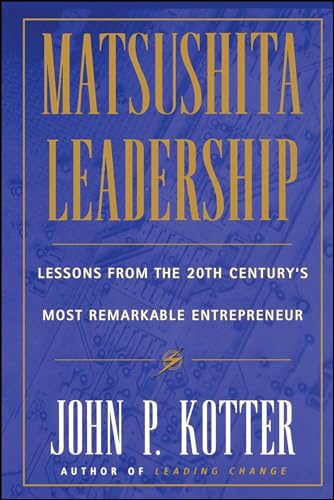
He was one of the most inspirational role models of all time. Thrown into poverty at age four, Konosuke Matsushita (Mat-SOSH-ta) struggled with the early deaths of family members, an apprenticeship which demanded sixteen-hour days at age nine, all the problems associated with starting a business with neither money nor connections, the death of his only son, the Great Depression, the horror of World War II in Japan, and more. Yet John P. Kotter shows in this fascinating and instructive book how, instead of being ground down by these hardships, Matsushita grew to be a fabulously successful entrepreneur and business leader, the founder of Japan's General Electric: the $65 billion a year Matsushita Electric Corporation. His accomplishments as a leader, author, educator, philanthropist, and management innovator are astonishing, and outshine even Soichiro Honda, J.C. Penney, Sam Walton, and Henry Ford. In this immensely readable book, Kotter relates how Matsushita created a large business, invented management practices that are increasingly being used today, helped lead his country's economic miracle after World War II wrote dozens of books in his latter years, founded a graduate school of leadership, created Japan's version of a Nobel Prize, and gave away hundreds of millions to good causes. The Matsushita story expands our notion of the possible, even for a sickly youngster who did not have the benefit of a privileged background, education, good looks, or a charismatic presence. It tells us much about leadership, entrepreneurship, a drive for lifelong learning, and their roots. It demonstrates the power of a longterm outlook, idealistic goals, and humility in the face of great success. Matsushita Leadership is both a biography and a set of lessons for careers and corporations in the 21st century. An inspirational story and a business primer, the implications are powerful, for organizations and for l
Die Inhaltsangabe kann sich auf eine andere Ausgabe dieses Titels beziehen.
Über die Autorin bzw. den Autor
John P. Kotter has been on the Harvard faculty for twenty-five years. He is the author of eight best-selling business books and a frequent speaker at management meetings around the world. He lives in Cambridge, Massachusetts and on Squam Lake in New Hampshire with his wife, Nancy Dearman, and their children, Caroline and Jonathan.
Von der hinteren Coverseite
He was one of the most inspirational role models of all time. Thrown into poverty at age four, Konosuke Matsushita (Mat-SOSH-ta) struggled with the early deaths of family members, an apprenticeship which demanded sixteen-hour days at age nine, all the problems associated with starting a business with neither money nor connections, the death of his only son, the Great Depression, the horror of World War II in Japan, and more. Yet John P. Kotter shows in this fascinating and instructive book how, instead of being ground down by these hardships, Matsushita grew to be a fabulously successful entrepreneur and business leader, the founder of Japan's General Electric: the $65 billion a year Matsushita Electric Corporation. His accomplishments as a leader, author, educator, philanthropist, and management innovator are astonishing, and outshine even Soichiro Honda, J.C. Penny, Sam Walton, and Henry Ford. In this immensely readable book, Kotter relates how Matsushita created a large business, invented management practices that are increasingly being used today, helped lead his country's economic miracle after World War II, wrote dozens of books in his latter years, founded a graduate school of leadership, created Japan's version of a Nobel Prize, and gave away hundreds of millions to good causes. Matsushita Leadership is both a biography and a set of lessons for careers and corporations in the 21st century. An inspirational story and a business primer, the implications are powerful, for organizations and for living a meaningful life.
Auszug. © Genehmigter Nachdruck. Alle Rechte vorbehalten.
Chapter 1: THE LEGACY
By many standards, he didn't look like a great leader. Early pictures of Konosuke Matsushita show an unsmiling young man whose ears stick out like airplane wings. He never grew taller than rive feet rive inches nor weighed more than 135 pounds. Unlike his rival Akio Morita at Sony, he was neither charismatically handsome nor internationally recognized. Unlike most well-known Western politicians, he didn't excel at public speaking, and in his later years his voice grew increasingly frail. He rarely displayed speed-of-light intellectual skills or warmed an audience with hilarious anecdotes. Nevertheless, he did what all great leaders do -- motivate large groups of individuals to improve the human condition.
When he died in the spring of 1989, his funeral services were swamped with a crowd of over twenty thousand. In a telegram of condolences to the family, the president of the United States called him "an inspiration to people around the world."
His legacy is daunting. After World War II, Matsushita was one of the central figures who helped lead the Japanese economic miracle. Through Panasonic and other brands, the firm he founded supplied billions of people with household appliances and consumer electronics. By the time of his death, few organizations on earth had more customers. Revenues hit a phenomenal $42 billion that year, more than the combined sales of Bethlehem Steel, Colgate-Palmolive, Gillette, Goodrich, Kellogg, Olivetti, Scott Paper, and Whirlpool.
On some dimensions, his economic achievements exceed those of much more famous entrepreneurs -- including Henry Ford, J. C. Penney, and Ray Kroc (see the exhibit on page 5). Yet because his name is not on the products, like Honda or Ford, because he was not an American in the American century, and because he never aggressively sought media attention outside of Japan, he is still largely unknown beyond his native land.
His incredible successes generated billions of dollars in wealth which were used not for villas in France but for the creation of a Nobel Prize-like organization, the founding of a school of government to reform Japan's political system, and a number of other civic projects. During his later years, he wrote dozens of books, studied human nature with a small group of research associates, and prodded his government to do more for the citizenry.
There are those who accumulated larger personal fortunes. There could be others who built even bigger enterprises or who made equally large contributions to their countries. But overall, it is difficult to find 20th-century entrepreneurs or executives with a longer list of accomplishments. And as an inspirational role model, he is without peer.
The small actions so defied stereotypes of rich and powerful industrialists that they became the subject of folklore. A typical story: in 1975, Morimasa Ogawa and rive other division general managers were invited to have lunch with their firm's founder. At this point in Matsushita's life, he had already been on the cover of Time magazine and was regularly being reported to pay more income taxes than anyone else in Japan. Because Ogawa had little contact with The Great One, he looked forward to the luncheon with both excitement and some trepidation.
The setting was a restaurant in Osaka. The six men met shortly past noon. After greetings and small talk, everyone ordered steak. Matsushita had two glasses of beer while telling stories about the business and the history of the company. When all six finished the main course, Matsushita leaned over to Ogawa and asked him to find the chef who cooked his steak. He was very clear on this point: "Not the manager, the chef." Ogawa then noticed that Matsushita had only eaten hall of his entree.
Preparing himself for what could be an extremely awkward scene, Ogawa found the chef and brought him to the table. The cook arrived looking distressed, for he knew that the customer who had summoned him was an exceptionally important person.
"Is there anything wrong?" asks a nervous chef.
"You've gone to all the trouble of broiling the steak," says Matsushita, "but I could eat only hall of it. It's not because it's not good. It's quite delicious. But, you see, I'm eighty years old and my appetite isn't what it once was."
The chef and rive other diners exchange confused expressions. It takes everyone a few seconds to realize what is happening.
"I asked to talk to you," Matsushita continues, "because I was afraid you might feel bad if you saw the half-eaten steak back in the kitchen."
Even the most rapacious businessmen occasionally show a kind side, usually as a manipulation. What is remarkable about Matsushita is the sheer volume of theses acts which, in combination with his many accomplishments, the public loved. Surveys showed that he was more admired than movie stars and professional athletes.
In an age when successful business executives throughout the world are sometimes looked upon with suspicion or even contempt, he died a national hero in Japan.
Konosuke Matsushita was born at the very end of the 19th century. During his youth, he experienced much hardship. When he began working for himself in 1917, he had 100 yen, less than four years of formal education, no connections to important people, and a history of family trauma. Yet his small and poorly financed firm flourished under the guiding hand of an increasingly clever merchant entrepreneur.
His counsel from that period was market oriented and very pragmatic. "Treat the people you do business with as if they were a part of your family. Prosperity depends on how much understanding one receives from the people with whom one conducts business....After-sales service is more important than assistance before sales. It is through such service that one gets permanent customers....Don't sell customers goods that they are attracted to, sell them goods that will benefit them....Any waste, even of a sheet of paper, will increase the price of a product by that much....To be out of stock is due to carelessness. If this happens, apologize to the customers, ask for their address, and tell them that you will deliver the goods immediately."
As both be and his firm grew, so did the scope and breadth of his ideas. By the early 1930s, pragmatic advice became increasingly intermixed with broad philosophical statements about the purpose of business enterprise, human nature, and more. "The mission of a manufacturer," he told employees in 1932, "is to overcome poverty, to relieve society as a whole from the misery of poverty and bring it wealth. Business and production are not meant to enrich only the shops or the factories of the enterprise concerned, but all the rest of society as well." He never talked narrowly about maximizing shareholder value as the proper goal of an enterprise. He did speak often about generating wealth, but for the benefit of everyone, not just owners, and even that idea was tempered by an emphasis on the psychological and the spiritual.
"Possessing material comforts in no way guarantees happiness. Only spiritual wealth can bring true happiness. If that is correct, should business be concerned only with the material aspect of life and leave the care of the human spirit to religion or ethics? I do not think so. Businessmen too should be able to share in creating a society that is spiritually rich and materially affluent."
The horror of World War II increased greatly his concerns about government. One of his last big ideas was to try to help develop a new generation of Japanese politicians by means of education. The concept was simple and extremely idealistic. Create a small, independent graduate school of government. Stress vision, integrity, the broader view, and rational policy analysis. Encourage alumni to run for elected office with...
„Über diesen Titel“ kann sich auf eine andere Ausgabe dieses Titels beziehen.
Suchergebnisse für Matsushita Leadership: Lessons from the 20th Century's...

Beispielbild für diese ISBN
Matsushita Leadership: Lessons from the 20th Century's Most Remarkable Entrepreneur
Anbieter: World of Books (was SecondSale), Montgomery, IL, USA
Verkäuferbewertung 5 von 5 Sternen

Hardback. Zustand: Very Good. He was one of the most inspirational role models of all time. Thrown into poverty at age four, Konosuke Matsushita (Mat-SOSH-ta) struggled with the early deaths of family members, an apprenticeship which demanded sixteen-hour days at age nine, all the problems associated with starting a business with neither money nor connections, the death of his only son, the Great Depression, the horror of World War II in Japan, and more. Yet John P. Kotter shows in this fascinating and instructive book how, instead of being ground down by these hardships, Matsushita grew to be a fabulously successful entrepreneur and business leader, the founder of Japan's General Electric: the $65 billion a year Matsushita Electric Corporation. His accomplishments as a leader, author, educator, philanthropist, and management innovator are astonishing, and outshine even Soichiro Honda, J.C. Penney, Sam Walton, and Henry Ford. In this immensely readable book, Kotter relates how Matsushita created a large business, invented management practices that are increasingly being used today, helped lead his country's economic miracle after World War II wrote dozens of books in his latter years, founded a graduate school of leadership, created Japan's version of a Nobel Prize, and gave away hundreds of millions to good causes. The Matsushita story expands our notion of the possible, even for a sickly youngster who did not have the benefit of a privileged background, education, good looks, or a charismatic presence. It tells us much about leadership, entrepreneurship, a drive for lifelong learning, and their roots. It demonstrates the power of a longterm outlook, idealistic goals, and humility in the face of great success. Matsushita Leadership is both a biography and a set of lessons for careers and corporations in the 21st century. An inspirational story and a business primer, the implications are powerful, for organizations and for living a meaningful life. Artikel-Nr. 00105473075
Gebraucht kaufen
EUR 3,84
Versand gratis
Versand innerhalb von USA
Versand innerhalb von USA
Anzahl: 1 verfügbar
Beispielbild für diese ISBN
Matsushita Leadership
Anbieter: World of Books (was SecondSale), Montgomery, IL, USA
Verkäuferbewertung 5 von 5 Sternen
Zustand: Acceptable. Item in acceptable condition! Textbooks may not include supplemental items i.e. CDs, access codes etc. Artikel-Nr. 00106244553
Gebraucht kaufen
EUR 3,84
Versand gratis
Versand innerhalb von USA
Versand innerhalb von USA
Anzahl: 1 verfügbar
Beispielbild für diese ISBN
Matsushita Leadership: Lessons from the 20th Century's Most Remarkable Entrepreneur
Anbieter: World of Books (was SecondSale), Montgomery, IL, USA
Verkäuferbewertung 5 von 5 Sternen
Hardback. Zustand: Good. He was one of the most inspirational role models of all time. Thrown into poverty at age four, Konosuke Matsushita (Mat-SOSH-ta) struggled with the early deaths of family members, an apprenticeship which demanded sixteen-hour days at age nine, all the problems associated with starting a business with neither money nor connections, the death of his only son, the Great Depression, the horror of World War II in Japan, and more. Yet John P. Kotter shows in this fascinating and instructive book how, instead of being ground down by these hardships, Matsushita grew to be a fabulously successful entrepreneur and business leader, the founder of Japan's General Electric: the $65 billion a year Matsushita Electric Corporation. His accomplishments as a leader, author, educator, philanthropist, and management innovator are astonishing, and outshine even Soichiro Honda, J.C. Penney, Sam Walton, and Henry Ford. In this immensely readable book, Kotter relates how Matsushita created a large business, invented management practices that are increasingly being used today, helped lead his country's economic miracle after World War II wrote dozens of books in his latter years, founded a graduate school of leadership, created Japan's version of a Nobel Prize, and gave away hundreds of millions to good causes. The Matsushita story expands our notion of the possible, even for a sickly youngster who did not have the benefit of a privileged background, education, good looks, or a charismatic presence. It tells us much about leadership, entrepreneurship, a drive for lifelong learning, and their roots. It demonstrates the power of a longterm outlook, idealistic goals, and humility in the face of great success. Matsushita Leadership is both a biography and a set of lessons for careers and corporations in the 21st century. An inspirational story and a business primer, the implications are powerful, for organizations and for living a meaningful life. Artikel-Nr. 00108846419
Gebraucht kaufen
EUR 3,84
Versand gratis
Versand innerhalb von USA
Versand innerhalb von USA
Anzahl: 1 verfügbar
Beispielbild für diese ISBN
Matsushita: Lessons from the 20th Century's Most Remarkable Entrepreneur
Anbieter: ThriftBooks-Atlanta, AUSTELL, GA, USA
Verkäuferbewertung 5 von 5 Sternen
Hardcover. Zustand: Very Good. No Jacket. May have limited writing in cover pages. Pages are unmarked. ~ ThriftBooks: Read More, Spend Less. Artikel-Nr. G068483460XI4N00
Gebraucht kaufen
EUR 6,07
Versand gratis
Versand innerhalb von USA
Versand innerhalb von USA
Anzahl: 1 verfügbar
Beispielbild für diese ISBN
Matsushita Leadership
Anbieter: Better World Books: West, Reno, NV, USA
Verkäuferbewertung 5 von 5 Sternen
Zustand: Very Good. Pages intact with possible writing/highlighting. Binding strong with minor wear. Dust jackets/supplements may not be included. Stock photo provided. Product includes identifying sticker. Better World Books: Buy Books. Do Good. Artikel-Nr. 3393058-6
Gebraucht kaufen
EUR 6,36
Versand gratis
Versand innerhalb von USA
Versand innerhalb von USA
Anzahl: 1 verfügbar
Beispielbild für diese ISBN
Matsushita Leadership
Anbieter: Better World Books, Mishawaka, IN, USA
Verkäuferbewertung 5 von 5 Sternen
Zustand: Good. Pages intact with minimal writing/highlighting. The binding may be loose and creased. Dust jackets/supplements are not included. Stock photo provided. Product includes identifying sticker. Better World Books: Buy Books. Do Good. Artikel-Nr. 5749289-6
Gebraucht kaufen
EUR 6,36
Versand gratis
Versand innerhalb von USA
Versand innerhalb von USA
Anzahl: 1 verfügbar
Beispielbild für diese ISBN
Matsushita Leadership
Anbieter: Better World Books, Mishawaka, IN, USA
Verkäuferbewertung 5 von 5 Sternen
Zustand: Good. Former library copy. Pages intact with minimal writing/highlighting. The binding may be loose and creased. Dust jackets/supplements are not included. Includes library markings. Stock photo provided. Product includes identifying sticker. Better World Books: Buy Books. Do Good. Artikel-Nr. GRP69840625
Gebraucht kaufen
EUR 6,36
Versand gratis
Versand innerhalb von USA
Versand innerhalb von USA
Anzahl: 3 verfügbar
Beispielbild für diese ISBN
Matsushita Leadership
Anbieter: WorldofBooks, Goring-By-Sea, WS, Vereinigtes Königreich
Verkäuferbewertung 5 von 5 Sternen
Hardback. Zustand: Good. The book has been read but remains in clean condition. All pages are intact and the cover is intact. Some minor wear to the spine. Artikel-Nr. GOR003685662
Gebraucht kaufen
EUR 6,58
EUR 6,61 Versand
Versand von Vereinigtes Königreich nach USA
Versand von Vereinigtes Königreich nach USA
Anzahl: 2 verfügbar
Foto des Verkäufers
Matsushita Leadership: Lessons from the 20th Century's Most Remarkable Entrepreneur
Anbieter: WeBuyBooks, Rossendale, LANCS, Vereinigtes Königreich
Verkäuferbewertung 5 von 5 Sternen
hardcover. Zustand: Good. Most items will be dispatched the same or the next working day. A copy that has been read but remains in clean condition. All of the pages are intact and the cover is intact and the spine may show signs of wear. The book may have minor markings which are not specifically mentioned. Artikel-Nr. rev7451617278
Gebraucht kaufen
EUR 7,01
EUR 9,03 Versand
Versand von Vereinigtes Königreich nach USA
Versand von Vereinigtes Königreich nach USA
Anzahl: 1 verfügbar
Beispielbild für diese ISBN
Matsushita Leadership: Lessons from the 20th Century's Most Remarkable Entrepreneur
Anbieter: Sell Books, Elland, YORKS, Vereinigtes Königreich
Verkäuferbewertung 5 von 5 Sternen
hardcover. Zustand: Good. Our good condition books are generally good for reading but not for gifting or collecting. They could have imperfections such as creasing, fanning, inscriptions, margin notes, yellowing, staining on edge or cover or pages, bumps, scuffs, etc etc (sometimes multiple of these). It's a wide category that encompasses anything that isn't almost-new down to anything that is slightly better than poor. We would NOT recommend gifting Good books - these should be considered reading copies. Our books are dispatched from a Yorkshire former cotton mill. We list via barcode/ISBN so please note that the images are stock images and may not be the exact copy you receive, furthermore the details about edition and year might not be accurate as many publishers reuse the same ISBN for multiple editions and as we simply scan a barcode or enter an ISBN we do not check the validity of the edition data when listing. If you're looking for an exact edition please don't order (at least not without checking with us first, although we don't always have time to check). We aim to dispatch prompty, the service used will depend on order value and book size. We can ship to most countries, see our shipping policies. Payment is via Abe only. Artikel-Nr. mon0000044268
Gebraucht kaufen
EUR 6,88
EUR 14,33 Versand
Versand von Vereinigtes Königreich nach USA
Versand von Vereinigtes Königreich nach USA
Anzahl: 1 verfügbar