
Verwandte Artikel zu Timeless Healing: The Power and Biology of Belief (Fireside...
Inhaltsangabe
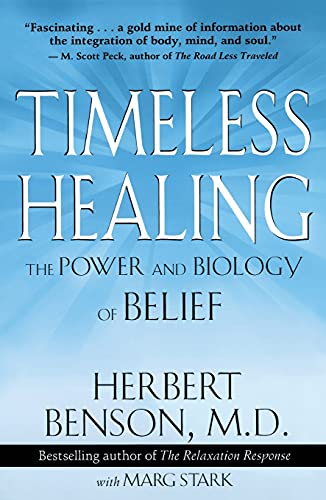
Learn how the mind shapes the body, and take charge of your health and wellness with the science and power of belief.
In this life-changing book, Dr. Herbert Benson draws on his twenty-five years as a physician and researcher to reveal how affirming beliefs, particularly belief in a higher power, make an important contribution to our physical health. We are not simply nourished by meditation and prayer, but are, in essence, "wired for God."
Combining the wisdom of modem medicine and of age-old faith. Dr. Benson shows how anyone can, with the aid of a caring physician or healer, use their beliefs and other self-care methods to heal over 60 percent of medical problems.
As practical as it is spiritual, Timeless Healing is a blueprint for healing and transforming your life.
Die Inhaltsangabe kann sich auf eine andere Ausgabe dieses Titels beziehen.
Über die Autorin bzw. den Autor
Herbert Benson, MD, is the Mind Body Medical Institute Associate Professor of Medicine, Harvard Medical School. He is the author of the mega-bestselling book, The Relaxation Response, as well as ten other trade books. His groundbreaking work established the modern field of mind body medicine. Dr. Benson is the Director Emeritus of the Benson-Henry Institute for Mind Body Medicine at Massachusetts General Hospital.
Von der hinteren Coverseite
Explores the role of faith in personal healing, discussing the mind-body link in health and the history of humankind's relationship with the deity concept.
Auszug. © Genehmigter Nachdruck. Alle Rechte vorbehalten.
Chapter 1
A SEARCH FOR SOMETHING THAT LASTS
When I was a student at Harvard Medical School, I was taught that the greater part of what I was learning about the human body would be obsolete within five years. In other words, a few years after I finished medical school, before I even completed my hospital residency and became a full-fledged member of the medical profession, medical science would have progressed so far as to create a whole new set of rules for taking care of patients.
Thus began my search for something in medicine that lasts. I wanted to identify some timeless source of healing, the merits of which could never be denied. Not only would this "treatment of choice" outlast the five-year mark but it would have proven value for generations present, for generations past, and for generations to come.
I will confess that, in part, youthful laziness launched my search. No medical student relishes the idea of having to learn a subject over and over again. But my contemplation of the enduring aspects of human life began in earnest when I was twenty-one, a premed student in college, and had to face the death of my father from rheumatic heart disease. In my mind, science never adequately explained his passing. With their diagrams, definitions, and anatomic drawings, my textbooks couldn't begin to capture the spirit and presence he embodied.
This was a man who had grown up in the jungles of South America, who came to the United States with only a fourth-grade education, who spoke five languages, and who went on to become a successful businessman in the wholesale and retail produce industry in Yonkers, New York. My father tried to impress upon me and my siblings the importance of "doing things fight." He told us about the time a shopkeeper had had to let him go from his job sweeping up. To finish the job well, my dad was especially thorough cleaning up that night, so the next day the shopkeeper called to tell my father that if he was willing to return, the shopkeeper would find the financial means to keep him on.
This was what defined my father's life, the same way that family and work, hardships and victories, principles and life lessons define the lives of all human beings. But these matters were rarely addressed in the education I received as a physician -- in the scientific literature, in grand rounds, or even in the training I received at the bedside. And as much as I began to believe that science was all-powerful, snowballing in its ability track and explain life's mysteries, I had a nagging feeling that medicine was missing a critical point.
Accumulating the Evidence
This book traces my steps over thirty years of accumulating evidence of an eternal truth about human physiology and the human experience. Luck, hunches, and happenstance often guided my journey, as with most people's careers. I went from patient to patient, from research study to research study in the same way that all physician-researchers do, unable to predict how each line of inquiry and its corresponding results would contribute to long-term improvements in medicine. But deep down, I always hoped that some immutable wisdom would emerge.
Partly because my father had died from heart disease, I started my career as a cardiologist. But soon I began to feel inhibited by my specialty, which limited its explorations to keeping chambered organs pumping in patients' chests. Increasingly, I was drawn to mind/body research, and would go on to become one of a handful of medical investigators who established the scientific field recognized today as mind/body medicine.
Except for a brief training stint in Seattle, and the time I spent in the U.S. Public Health Service in San Juan, Puerto Rico, I've spent my entire career working within Harvard Medical School's teaching hospitals. In 1988, I founded Harvard's Mind/Body Medical Institute at Boston's Deaconess Hospital. Perhaps my most significant contribution to the field was in defining a bodily calm that all of us can evoke and that has the opposite effect of the well-known fight-or-flight response. I call this bodily calm "the relaxation response," a state in which blood pressure is lowered, and heart rate, breathing rate, and metabolic rate are decreased. The relaxation response yields many long-term benefits in both health and well-being and can be brought on with very simple mental focusing or meditation techniques.
Teaching these methods to patients, health care professionals, and others, I began to realize the power of self-care, the healthy things that individuals can do for themselves. More and more, I became convinced that our bodies are wired to benefit from exercising not only our muscles but our rich inner, human core -- our beliefs, values, thoughts, and feelings. I was reluctant to explore these factors because philosophers and scientists have, through the ages, considered them intangible and unmeasurable, making any study of them "unscientific." But I wanted to try, because, again and again, my patients' progress and recoveries often seemed to hinge upon their spirit and will to live. And I could not shake the sense I had that the human mind -- and the beliefs we so often associate with the human soul -- had physical manifestations.
First Hints of Mind/Body Influence
I had witnessed this firsthand while serving as a merchant seaman the summer after my junior year of college. From the time I read Joseph Conrad as a youth, I was determined to "go to sea." And together with my best friend Howard Rotner, I fulfilled this dream by acquiring this incredible "summer job," which took me across oceans and to ports as diverse as Casablanca, Morocco; Naples, Italy; Piraeus, Greece; Southampton, England; Istanbul and Izmir, Turkey. In these ports, my fellow seamen were fond of barroom bingeing and often returned to the ship with awful hangovers. Knowing that I planned to be a doctor, my suffering shipmates would come to me for relief. But all I had to offer them were vitamins, which I promptly dispensed.
Though the vitamins should have had little or no effect, my shipmates' symptoms -- and foul moods -- improved rapidly and dramatically after taking the pills. And as word spread of the wondrous results, more and more of my fellow sailors sought me out for my magic pills. But once my indoctrination into medicine began, I found my medical mentors and peers far less interested in this phenomenon. For the first time, I realized there was a great disparity between the things laypeople felt were good for them and those that medical scientists decided were good for them.
This disparity made me uncomfortable, as did the fact that a diagnosis -- a few words from a doctor -- could dramatically change a patient's view of him- or herself. On the basis of an office visit and a simple test, a doctor could, for example, in diagnosing hypertension, ask a patient to take medication for the rest of his or her life, to endure aggravating side effects, and make major adjustments in diet and lifestyle. Overnight, patients diagnosed with chronic medical problems or illnesses began to think of themselves as "sick," and the effect that label had on their psyches and their physical health was substantial.
This is what happened to a patient of mine, Antonia Baquero. Before I met her, Ms. Baquero had had calcium deposits removed from her breast, an operation that left a large indentation. The calcium deposits were benign, but her surgeon recommended the operation because of the relatively small chance that a malignant tumor might later develop. The mere suggestion that she might develop cancer frightened Ms. Baquero. "I panicked," she explains. "I decided immediately, in one moment, to have the calcium deposits removed." Later, she regretted the decision. "My body felt cut up. It was a very difficult time in...
„Über diesen Titel“ kann sich auf eine andere Ausgabe dieses Titels beziehen.
Suchergebnisse für Timeless Healing: The Power and Biology of Belief (Fireside...

Beispielbild für diese ISBN
Timeless Healing: The Power an
Anbieter: World of Books (was SecondSale), Montgomery, IL, USA
Verkäuferbewertung 5 von 5 Sternen

Zustand: Good. Item in good condition. Textbooks may not include supplemental items i.e. CDs, access codes etc. Artikel-Nr. 00065271649
Gebraucht kaufen
EUR 3,36
Versand gratis
Versand innerhalb von USA
Versand innerhalb von USA
Anzahl: 11 verfügbar
Beispielbild für diese ISBN
Timeless Healing
Anbieter: World of Books (was SecondSale), Montgomery, IL, USA
Verkäuferbewertung 5 von 5 Sternen
Zustand: Good. Item in good condition. Textbooks may not include supplemental items i.e. CDs, access codes etc. Artikel-Nr. 00081536874
Gebraucht kaufen
EUR 3,45
Versand gratis
Versand innerhalb von USA
Versand innerhalb von USA
Anzahl: 17 verfügbar
Beispielbild für diese ISBN
Timeless Healing
Anbieter: World of Books (was SecondSale), Montgomery, IL, USA
Verkäuferbewertung 5 von 5 Sternen
Zustand: Acceptable. Item in acceptable condition! Textbooks may not include supplemental items i.e. CDs, access codes etc. Artikel-Nr. 00102597179
Gebraucht kaufen
EUR 3,45
Versand gratis
Versand innerhalb von USA
Versand innerhalb von USA
Anzahl: 4 verfügbar
Beispielbild für diese ISBN
Timeless Healing
Verlag:
Scribner (edition Illustrated), 1997
ISBN 10: 0684831465
ISBN 13: 9780684831466
Gebraucht
Paperback
Anbieter: BooksRun, Philadelphia, PA, USA
Verkäuferbewertung 5 von 5 Sternen
Paperback. Zustand: Fair. Illustrated. The item might be beaten up but readable. May contain markings or highlighting, as well as stains, bent corners, or any other major defect, but the text is not obscured in any way. Artikel-Nr. 0684831465-7-1
Gebraucht kaufen
EUR 4,58
Versand gratis
Versand innerhalb von USA
Versand innerhalb von USA
Anzahl: 1 verfügbar
Beispielbild für diese ISBN
Timeless Healing
Anbieter: ThriftBooks-Phoenix, Phoenix, AZ, USA
Verkäuferbewertung 5 von 5 Sternen
Paperback. Zustand: Very Good. No Jacket. May have limited writing in cover pages. Pages are unmarked. ~ ThriftBooks: Read More, Spend Less. Artikel-Nr. G0684831465I4N00
Gebraucht kaufen
EUR 5,89
Versand gratis
Versand innerhalb von USA
Versand innerhalb von USA
Anzahl: 1 verfügbar
Beispielbild für diese ISBN
Timeless Healing
Anbieter: ThriftBooks-Atlanta, AUSTELL, GA, USA
Verkäuferbewertung 5 von 5 Sternen
Paperback. Zustand: Very Good. No Jacket. May have limited writing in cover pages. Pages are unmarked. ~ ThriftBooks: Read More, Spend Less. Artikel-Nr. G0684831465I4N00
Gebraucht kaufen
EUR 5,89
Versand gratis
Versand innerhalb von USA
Versand innerhalb von USA
Anzahl: 1 verfügbar
Beispielbild für diese ISBN
Timeless Healing
Anbieter: Wonder Book, Frederick, MD, USA
Verkäuferbewertung 5 von 5 Sternen
Zustand: Very Good. Very Good condition. A copy that may have a few cosmetic defects. May also contain light spine creasing or a few markings such as an owner's name, short gifter's inscription or light stamp. Artikel-Nr. M02C-02363
Gebraucht kaufen
EUR 6,22
Versand gratis
Versand innerhalb von USA
Versand innerhalb von USA
Anzahl: 2 verfügbar
Beispielbild für diese ISBN
Timeless Healing
Anbieter: Wonder Book, Frederick, MD, USA
Verkäuferbewertung 5 von 5 Sternen
Zustand: Good. Good condition. A copy that has been read but remains intact. May contain markings such as bookplates, stamps, limited notes and highlighting, or a few light stains. Bundled media such as CDs, DVDs, floppy disks or access codes may not be included. Artikel-Nr. X08B-02517
Gebraucht kaufen
EUR 6,22
Versand gratis
Versand innerhalb von USA
Versand innerhalb von USA
Anzahl: 1 verfügbar
Beispielbild für diese ISBN
Timeless Healing
Anbieter: Better World Books: West, Reno, NV, USA
Verkäuferbewertung 5 von 5 Sternen
Zustand: Very Good. Reprint. Pages intact with possible writing/highlighting. Binding strong with minor wear. Dust jackets/supplements may not be included. Stock photo provided. Product includes identifying sticker. Better World Books: Buy Books. Do Good. Artikel-Nr. 10804682-6
Gebraucht kaufen
EUR 6,35
Versand gratis
Versand innerhalb von USA
Versand innerhalb von USA
Anzahl: 1 verfügbar
Beispielbild für diese ISBN
Timeless Healing
Anbieter: Better World Books, Mishawaka, IN, USA
Verkäuferbewertung 5 von 5 Sternen
Zustand: Good. Reprint. Pages intact with minimal writing/highlighting. The binding may be loose and creased. Dust jackets/supplements are not included. Stock photo provided. Product includes identifying sticker. Better World Books: Buy Books. Do Good. Artikel-Nr. GRP66091109
Gebraucht kaufen
EUR 6,35
Versand gratis
Versand innerhalb von USA
Versand innerhalb von USA
Anzahl: 1 verfügbar