
Verwandte Artikel zu The Codebreakers: The Comprehensive History of Secret...
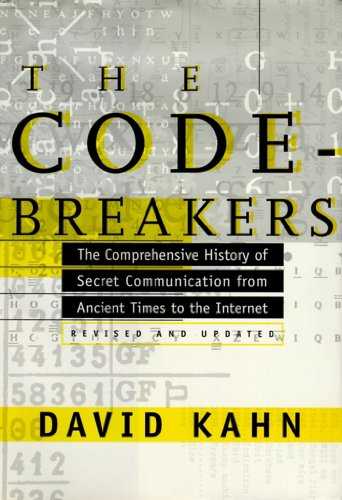
The Codebreakers: The Comprehensive History of Secret Communication from Ancient Times to the Internet - Hardcover
Inhaltsangabe
The magnificent, unrivaled history of codes and ciphers—how they're made, how they're broken, and the many and fascinating roles they've played since the dawn of civilization in war, business, diplomacy, and espionage—updated with a new chapter on computer cryptography and the Ultra secret.
Man has created codes to keep secrets and has broken codes to learn those secrets since the time of the Pharaohs. For 4,000 years, fierce battles have been waged between codemakers and codebreakers, and the story of these battles is civilization's secret history, the hidden account of how wars were won and lost, diplomatic intrigues foiled, business secrets stolen, governments ruined, computers hacked. From the XYZ Affair to the Dreyfus Affair, from the Gallic War to the Persian Gulf, from Druidic runes and the kaballah to outer space, from the Zimmermann telegram to Enigma to the Manhattan Project, codebreaking has shaped the course of human events to an extent beyond any easy reckoning. Once a government monopoly, cryptology today touches everybody. It secures the Internet, keeps e-mail private, maintains the integrity of cash machine transactions, and scrambles TV signals on unpaid-for channels. David Kahn's The Codebreakers takes the measure of what codes and codebreaking have meant in human history in a single comprehensive account, astonishing in its scope and enthralling in its execution. Hailed upon first publication as a book likely to become the definitive work of its kind, The Codebreakers has more than lived up to that prediction: it remains unsurpassed. With a brilliant new chapter that makes use of previously classified documents to bring the book thoroughly up to date, and to explore the myriad ways computer codes and their hackers are changing all of our lives, The Codebreakers is the skeleton key to a thousand thrilling true stories of intrigue, mystery, and adventure. It is a masterpiece of the historian's art.
Die Inhaltsangabe kann sich auf eine andere Ausgabe dieses Titels beziehen.
Über die Autorin bzw. den Autor
David Kahn, a recently visiting historian at the National Security Agency, is the world's leading expert on the history of cryptology, and the author of Hitler's Spies, Seizing the Enigma, and Kahn on Codes, as well as articles in numerous popular and technical journals. He holds a Ph.D. in Modern History from Oxford. An editor at Newsday, he lives in Great Neck, New York.
Von der hinteren Coverseite
Man has created codes to keep secrets and has broken codes to learn those secrets since the time of the Pharaohs. For 4,000 years, fierce battles have been waged between codemakers and codebreakers, and the story of these battles is civilization's secret history, the hidden account of how wars were won and lost, diplomatic intrigues foiled, business secrets stolen, governments ruined, computers hacked. From the XYZ Affair to the Dreyfus Affair, from the Gallic War to the Persian Gulf, from Druidic runes and the kaballah to outer space, from the Zimmermann telegram to Enigma to the Manhattan Project, codebreaking has shaped the course of human events to an extent beyond any easy reckoning. Once a government monopoly, cryptology today touches everybody. It secures the Internet, keeps e-mail private, maintains the integrity of cash machine transactions, and scrambles TV signals on unpaid-for channels. David Kahn's The Codebreakers takes the measure of what codes and codebreaking have meant in human history in a single comprehensive account, astonishing in its scope and enthralling in its execution. Hailed upon first publication as a book likely to become the definitive work of its kind, The Codebreakers has more than lived up to that prediction: it remains unsurpassed. With a brilliant new chapter that makes use of previously classified documents to bring the book thoroughly up to date, and to explore the myriad ways computer codes and their hackers are changing all of our lives, The Codebreakers is the skeleton key to a thousand thrilling true stories of intrigue, mystery, and adventure. It is a masterpiece of the historian's art.
Auszug. © Genehmigter Nachdruck. Alle Rechte vorbehalten.
Chapter 1
ONE DAY OF MAGIC
At 1:28 on the morning of December 7, 1941, the big ear of the Navy's radio station on Bainbridge Island near Seattle trembled to vibrations in the ether. A message was coming through on the Tokyo-Washington circuit. It was addressed to the Japanese embassy, and Bainbridge reached up and snared it as it flashed overhead. The message was short, and its radiotelegraph transmission took only nine minutes. Bainbridge had it all by 1:37.
The station's personnel punched the intercepted message on a teletype tape, dialed a number on the teletypewriter exchange, and, when the connection had been made, fed the tape into a mechanical transmitter that gobbled it up at 60 words per minute.
The intercept reappeared on a page-printer in Room 1649 of the Navy Department building on Constitution Avenue in Washington, D.C. What went on in this room, tucked for security's sake at the end of the first deck's sixth wing, was one of the most closely guarded secrets of the American government. For it was in here -- and in a similar War Department room in the Munitions Building next door -- that the United States peered into the most confidential thoughts and plans of its possible enemies by shredding the coded wrappings of their dispatches.
Room 1649 housed OP-20-GY, the cryptanalytic section of the Navy's cryptologic organization, OP-20-G. The page-printer stood beside the desk of the GY watch officer. It rapped out the intercept in an original and a carbon copy on yellow and pink teletype paper just like news on a city room wire-service ticker. The watch officer, Lieutenant (j.g.) Francis M. Brotherhood, U.S.N.R., a curly-haired, brown-eyed six-footer, saw immediately from indicators that the message bore for the guidance of Japanese code clerks that it was in the top Japanese cryptographic system.
This was an extremely complicated machine cipher which American cryptanalysts called PURPLE. Led by William F. Friedman, Chief Cryptanalyst of the Army Signal Corps, a team of codebreakers had solved Japan's enciphered dispatches, deduced the nature of the mechanism that would effect those letter transformations, and painstakingly built up an apparatus that cryptographically duplicated the Japanese machine. The Signal Corps had then constructed several additional PURPLE machines, using a hodgepodge of manufactured parts, and had given one to the Navy. Its three components rested now on a table in Room 1649: an electric typewriter for input; the cryptographic assembly proper, consisting of a plugboard, four electric coding rings, and associated wires and switches, set on a wooden frame; and a printing unit for output. To this precious contraption, worth quite literally more than its weight in gold, Brotherhood carried the intercept.
He flicked the switches to the key of December 7. This was a rearrangement, according to a pattern ascertained months ago, of the key of December 1, which OP-20-GY had recovered. Brotherhood typed out the coded message. Electric impulses raced through the maze of wires, reversing the intricate enciphering process. In a few minutes, he had the plaintext before him.
It was in Japanese. Brotherhood had taken some of the orientation courses in that difficult language that the Navy gave to assist its cryptanalysts. He was in no sense a translator, however, and none was on duty next door in OP-20-GZ, the translating section. He put a red priority sticker on the decode and hand-carried it to the Signal Intelligence Service, the Army counterpart of OP-20-G, where he knew that a translator was on overnight duty. Leaving it there, he returned to OP-20-G. By now it was after 5 a.m. in Washington -- the message having lost three hours as it passed through three time zones in crossing the continent.
The S.I.S. translator rendered the Japanese as: "Will the Ambassador please submit to the United States Government (if possible to the Secretary of State) our reply to the United States at 1:00 p.m. on the 7th, your time." The -- "reply" referred to had been transmitted by Tokyo in 14 parts over the past 18' hours, and Brotherhood had only recently decrypted the 14th part on the PURPLE machine. It had come out in the English in which Tokyo had framed it, and its ominous final sentence read: "The Japanese Government regrets to have to notify hereby the American Government that in view of the attitude of the American Government it cannot but consider that it is impossible to reach an agreement through further negotiations." Brotherhood had set it by for distribution early in the morning.
The translation of the message directing delivery at one o'clock had not yet come back from S.I.S. when Brotherhood was relieved at 7 a.m., and he told his relief, Lieutenant (j.g.) Alfred V. Pering, about it. Half an hour later, Lieutenant Commander Alwin D. Kramer, the Japanese-language expert who headed GZ and delivered the intercepts, arrived. He saw at once that the all-important conclusion of the long Japanese diplomatic note had come in since he had distributed the 13 previous parts the night before. He prepared a smooth copy from the rough decode and had his clerical assistant, Chief Yeoman H. L. Bryant, type up the usual 14 copies. Twelve of these were distributed by Kramer and his opposite number in S.I.S. to the President, the secretaries of State, War, and Navy, and a handful of top-ranking Army and Navy officers. The two others were file copies. This decode was part of a whole series of Japanese intercepts, which had long ago been given a collective codename, partly for security, partly for ease of reference, by a previous director of naval intelligence, Rear Admiral Walter S. Anderson. Inspired, no doubt, by the mysterious daily production of the information and by the aura of sorcery and the occult that has always enveloped cryptology, he called it MAGIC.
When Bryant had finished, Kramer sent S.I.S. its seven copies, and at 8 o'clock took a copy to his superior, Captain Arthur H. McCollum, head of the Far Eastern Section of the Office of Naval Intelligence.
He then busied himself in his office, working on intercepted traffic, until 9:30, when he left to deliver the 14th part of Tokyo's reply to Admiral Harold F. Stark, the Chief of Naval Operations, to the White House, and to Frank Knox, the Secretary of the Navy. Knox was meeting at 10 a.m. that Sunday morning in the State Department with Secretary of War Henry L. Stimson and Secretary of State Cordell Hull to discuss the critical nature of the American negotiations with Japan, which, they knew from the previous 13 parts, had virtually reached an impasse. Kramer returned to his office about 10:20, where the translation of the message referring to the one o'clock delivery had arrived from S.I.S. while he was on his rounds.
Its import crashed in upon him at once. It called for the rupture of Japan's negotiations with the United States by a certain deadline. The hour set for the Japanese ambassadors to deliver the notification -- 1 p.m. on a Sunday -- was highly unusual. And, as Kramer had quickly ascertained by drawing a navigator's time circle, 1 p.m. in Washington meant 7:30 a.m. in Hawaii and a couple of hours before dawn in the tense Far East around Malaya, which Japan had been threatening with ships and troops.
Kramer immediately directed Bryant to insert the one o'clock message into the reddish-brown looseleaf cardboard folders in which the MAGIC intercepts were bound. He included several other intercepts, adding one at the last minute, then slipped the folders into the leather briefcases, zipped these shut, and snapped their padlocks. Within ten minutes he was on his way.
He went first to Admiral Stark's office, where a conference was in session, and indicated to...
„Über diesen Titel“ kann sich auf eine andere Ausgabe dieses Titels beziehen.
Suchergebnisse für The Codebreakers: The Comprehensive History of Secret...

Foto des Verkäufers
The Codebreakers: The Comprehensive History of Secret Communication from Ancient Times to the Internet
Anbieter: Dream Books Co., Denver, CO, USA
Verkäuferbewertung 5 von 5 Sternen

Zustand: acceptable. This copy has clearly been enjoyedâ"expect noticeable shelf wear and some minor creases to the cover. Binding is strong, and all pages are legible. May contain previous library markings or stamps. Artikel-Nr. DBV.0684831309.A
Gebraucht kaufen
EUR 18,17
Versand gratis
Versand innerhalb von USA
Versand innerhalb von USA
Anzahl: 1 verfügbar
Beispielbild für diese ISBN
The Codebreakers: The Comprehensive History of Secret Communication from Ancient Times to the Internet
Anbieter: ThriftBooks-Atlanta, AUSTELL, GA, USA
Verkäuferbewertung 5 von 5 Sternen
Hardcover. Zustand: Very Good. No Jacket. Missing dust jacket; May have limited writing in cover pages. Pages are unmarked. ~ ThriftBooks: Read More, Spend Less. Artikel-Nr. G0684831309I4N01
Gebraucht kaufen
EUR 19,25
Versand gratis
Versand innerhalb von USA
Versand innerhalb von USA
Anzahl: 1 verfügbar
Beispielbild für diese ISBN
The Codebreakers: The Comprehensive History of Secret Communication from Ancient Times to the Internet
Anbieter: ThriftBooks-Reno, Reno, NV, USA
Verkäuferbewertung 5 von 5 Sternen
Hardcover. Zustand: Fair. No Jacket. Missing dust jacket; Readable copy. Pages may have considerable notes/highlighting. ~ ThriftBooks: Read More, Spend Less. Artikel-Nr. G0684831309I5N01
Gebraucht kaufen
EUR 19,25
Versand gratis
Versand innerhalb von USA
Versand innerhalb von USA
Anzahl: 1 verfügbar
Beispielbild für diese ISBN
The Codebreakers: The Comprehensive History of Secret Communication from Ancient Times to the Internet
Anbieter: ThriftBooks-Phoenix, Phoenix, AZ, USA
Verkäuferbewertung 5 von 5 Sternen
Hardcover. Zustand: Fair. No Jacket. Missing dust jacket; Readable copy. Pages may have considerable notes/highlighting. ~ ThriftBooks: Read More, Spend Less. Artikel-Nr. G0684831309I5N01
Gebraucht kaufen
EUR 19,25
Versand gratis
Versand innerhalb von USA
Versand innerhalb von USA
Anzahl: 1 verfügbar
Beispielbild für diese ISBN
The Codebreakers: The Comprehensive History of Secret Communication from Ancient Times to the Internet
Anbieter: ThriftBooks-Atlanta, AUSTELL, GA, USA
Verkäuferbewertung 5 von 5 Sternen
Hardcover. Zustand: Good. No Jacket. Pages can have notes/highlighting. Spine may show signs of wear. ~ ThriftBooks: Read More, Spend Less. Artikel-Nr. G0684831309I3N00
Gebraucht kaufen
EUR 19,25
Versand gratis
Versand innerhalb von USA
Versand innerhalb von USA
Anzahl: 1 verfügbar
Beispielbild für diese ISBN
The Codebreakers: The Comprehensive History of Secret Communication from Ancient Times to the Internet
Anbieter: ThriftBooks-Dallas, Dallas, TX, USA
Verkäuferbewertung 5 von 5 Sternen
Hardcover. Zustand: Fair. No Jacket. Readable copy. Pages may have considerable notes/highlighting. ~ ThriftBooks: Read More, Spend Less. Artikel-Nr. G0684831309I5N00
Gebraucht kaufen
EUR 19,25
Versand gratis
Versand innerhalb von USA
Versand innerhalb von USA
Anzahl: 1 verfügbar
Beispielbild für diese ISBN
The Codebreakers: The Comprehensive History of Secret Communication from Ancient Times to the Internet
Anbieter: ThriftBooks-Atlanta, AUSTELL, GA, USA
Verkäuferbewertung 5 von 5 Sternen
Hardcover. Zustand: Fair. No Jacket. Readable copy. Pages may have considerable notes/highlighting. ~ ThriftBooks: Read More, Spend Less. Artikel-Nr. G0684831309I5N00
Gebraucht kaufen
EUR 19,25
Versand gratis
Versand innerhalb von USA
Versand innerhalb von USA
Anzahl: 1 verfügbar
Beispielbild für diese ISBN
The Codebreakers: The Comprehensive History of Secret Communication from Ancient Times to the Internet
Anbieter: ThriftBooks-Dallas, Dallas, TX, USA
Verkäuferbewertung 5 von 5 Sternen
Hardcover. Zustand: Fair. No Jacket. Missing dust jacket; Readable copy. Pages may have considerable notes/highlighting. ~ ThriftBooks: Read More, Spend Less. Artikel-Nr. G0684831309I5N01
Gebraucht kaufen
EUR 19,25
Versand gratis
Versand innerhalb von USA
Versand innerhalb von USA
Anzahl: 1 verfügbar
Beispielbild für diese ISBN
The Codebreakers: The Comprehensive History of Secret Communication from Ancient Times to the Internet
Verlag:
Scribner (edition Revised ed.), 1996
ISBN 10: 0684831309
ISBN 13: 9780684831305
Gebraucht
Hardcover
Anbieter: BooksRun, Philadelphia, PA, USA
Verkäuferbewertung 5 von 5 Sternen
Hardcover. Zustand: Fair. Revised ed. With dust jacket. The item might be beaten up but readable. May contain markings or highlighting, as well as stains, bent corners, or any other major defect, but the text is not obscured in any way. Artikel-Nr. 0684831309-7-1-29
Gebraucht kaufen
EUR 22,28
Versand gratis
Versand innerhalb von USA
Versand innerhalb von USA
Anzahl: 3 verfügbar
Beispielbild für diese ISBN
The Codebreakers The Comprehen
Anbieter: World of Books (was SecondSale), Montgomery, IL, USA
Verkäuferbewertung 5 von 5 Sternen
Zustand: Good. Item in good condition. Textbooks may not include supplemental items i.e. CDs, access codes etc. Artikel-Nr. 00108647076
Gebraucht kaufen
EUR 24,18
Versand gratis
Versand innerhalb von USA
Versand innerhalb von USA
Anzahl: 3 verfügbar