
Verwandte Artikel zu Outing Yourself: How to Come Out as Lesbian or Gay...
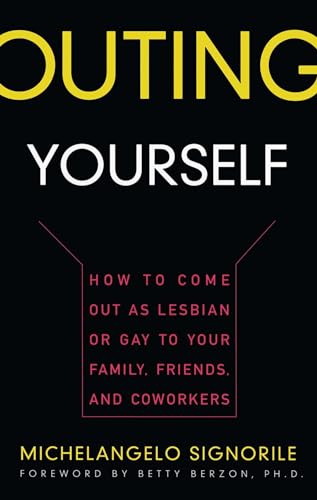
Outing Yourself: How to Come Out as Lesbian or Gay to Your Family, Friends and Coworkers - Softcover
Inhaltsangabe
Coming out isn't easy—but with Signorile's 14-step program, it's a lot easier.
No matter how much you prepare, coming out as gay or lesbian is a difficult, emotional process -- a process that will continue long after the words are spoken and the secret is out. There's no magic formula, but Outing Yourself by Michelangelo Signorile offers structure, guidance, and straightforward advice to all those who are struggling with their sexuality and unsure of what to do, who have accepted that they are gay but are still afraid of coming out, or who consider themselves out of the closet but realize they have a few more steps to go.
Signorile's 14-step program—complete with exercises, meditation notes, and anger checks, as well as the accounts of the coming-out experiences of other lesbians and gay men—shows how you can successfully handle this life-changing, life-renewing process. A guide for the coming-out journey, Outing Yourself will convince all who read it that, in the words of the author, "The stress of coming out will never be as hard on you as the stress of staying in was."
Die Inhaltsangabe kann sich auf eine andere Ausgabe dieses Titels beziehen.
Über die Autorin bzw. den Autor
Michelangelo Signorile is the author of Queer in America, Outing Yourself, Life Outside, and It's Not Over and a columnist for Out magazine. He has also written for The New York Times, The Village Voice, USA Today, The Advocate, the New York Post, the New York Daily News, People, and The Face. He is a graduate of the S. I. Newhouse School of Public Communications at Syracuse University, and he lives in New York City.
Auszug. © Genehmigter Nachdruck. Alle Rechte vorbehalten.
STEP 1
IDENTIFYING YOURSELF
Perhaps you have had one or two homosexual experiences. Perhaps you've merely thought about it. Neither scenario necessarily means that you have told yourself you are gay.
Such thoughts and actions don't actually mean a person is gay. In some cases a heterosexual person, particularly an adolescent, may simply be experimenting -- mentally or physically.
"People may be experimenting and seeing where their sexuality lies," notes Dr. Richard Isay, a clinical professor of psychiatry at Cornell Medical College and the author of Being Homosexual. "However, if someone has persistent homosexual experiences -- and not necessarily encounters but day dreams and night dreams -- and has had them for a long time, then that person is gay."
Some people are truly bisexual, equally attracted to both sexes. "I was always really turned on by men," says Sheila, a thirty-six-year-old rural Tennessee health-care worker.
Then in my early twenties I realized I was also really turned on by women. At first I thought I must be a lesbian, but my realization that I liked women did not stop or cover up my strong sexual attraction for men. I've accepted that I'm really bisexual, and I realize there aren't many people like me.
The vast majority of people who have recurring homosexual thoughts or experiences, however, are truly homosexual, although they often don't want to face the fact. Society has placed such a terrible stigma on homosexuality that even thinking about sex with someone of the same gender can be frightening. After having had several homosexual experiences, many people still deny that they are gay. They tell themselves that they are really heterosexual, they continue to live as heterosexuals, and they maintain that their homosexual incidents or thoughts don't and can't mean anything. Perhaps they tell themselves that they are bisexual as a way of holding on to some form of heterosexuality, some form of what they have been told is "normal" and "right." This is common, and has made many homosexuals -- once they have fully come out -- unfairly suspicious of the existence of true bisexuals.
Rudy, a twenty-four-year-old northern California law student, remembers how he couldn't face the truth when at age eighteen he began to realize his homosexuality.
I had what I guess you could call a crush on a guy at school -- I mean I used to dream about kissing him -- and every time I saw him in class my heart would start pounding and I'd turn red. I would then get this queasy feeling in my stomach, like I was sick, because this feeling of liking the guy made me ill, because I thought homosexuality was disgusting.
I convinced myself that I was bisexual, and that I could control the gay side and not act on it. But I soon realized that I didn't like girls in a sexual way at all. Two years later I began dating a girl who really was bisexual -- I mean, she liked girls and guys and had had relationships with both. And, well, she and I had very little sex. After a lot of long talks she eventually said to me, "You're not bisexual. You're gay."
I went home that night, and for the first time wrote in my journal, "I'm gay." Then I crossed it out. I just couldn't face it.
DECADES SPENT WITHOUT IDENTIFYING ONESELF AS GAY
For some people, this first step of identifying oneself as gay or lesbian (or even bisexual) can take many years to complete. Doris, a fifty-four-year-old Buffalo, New York, business owner, married a man and had four children before eventually coming out as a lesbian and divorcing her husband -- after thirty years of marriage. "Ever since I can remember, I wanted to be near women, to be physically close to them in a way that I really never wanted to be with men -- even though I forced myself to be with men in that way," she says.
I admitted those feelings to myself for a very long time. But still, in those days that didn't matter. If you wanted to do well, you got married. Besides, I wasn't able to deal with the feelings anyway. They were too frightening, too eerie and weird, you know?
Then, after years of just barely acknowledging to myself that I had a longing to be intimate with a woman, I finally did experience it with a very close friend who was also married. But to actually identify myself as a lesbian? Oh God. No, it was years and years before I could actually do that.
"From the moment one begins to suspect that one might be 'different' from others the seed of doubt is sown, sending out corrosive roots to obstruct and inhibit the process by which self-esteem naturally grows," declares author and journalist Mark Thompson, who has written much about the coming-out process and the dynamics of gay life. Thompson stresses the notion of "coming out inside," coming out to oneself. "There's a valuable part of ourselves that was stolen at an early part of our lives," he says, "and we need to get it back. The doubt is sown deep inside of us because society still carries the message that being gay is bad. We internalize all of that."
UGLY WORDS
Because of the social stigma attached to them, the mere words "gay" and "lesbian" -- not to mention "homosexual," "fag," "dyke," and "queer" -- are terms that most people don't want associated with themselves. It's amazing how powerful these words can be. Some people engaging in sex with people of the same sex, many even in their first same-sex relationship, still cannot bring themselves to say that they are lesbian or gay. For some, the reluctance is subtle: They get around such identification by saying that they shun "labels" of any kind and don't like "categorizing" themselves. For others, the unwillingness to identify themselves as lesbian or gay is more conscious, tinged with internalized homophobia.
"I liked being with guys and having sex with guys, but I kept telling myself that I wasn't 'gay,' or a 'fag,' or any of that," recalls Ramon, a twenty-six-year-old Miami sales clerk.
My family is Cuban, and in our culture being macho is very important. So I'd tell myself that I was every bit a man, and that the men I was sleeping with and hanging out with were real men -- we just had sex with each other, that's all. "Gay" was something else.
To me, it was all the stereotypes -- effeminate men, drag queens, you know. I wouldn't have sex with someone who identified themselves as "gay." I believed that if I didn't say I was that -- even to myself -- then I wasn't.
BEGINNING A JOURNEY
Ramon's experience resonates for many gay men and lesbians who refuse to accept their homosexuality. But many people who think they accept their newfound homosexuality have never really identified themselves as gay or lesbian. Self-identifying is a way of starting the coming-out process: You can't tell other people that you're lesbian or gay until you've told yourself. It's also important to identify yourself as gay as a way of rejecting the hatred directed at you and the lies told about you. Identifying yourself starts you on a long journey.
"I first identified myself as gay when I was about twelve or thirteen years old," says Lincoln, a nineteen-year-old West Virginia college student.
It was a scary situation but one that sticks out permanently in my mind. I was in my bathroom, brushing my teeth, looking at myself in the mirror. All of these feelings I had been having but not really understanding were flooding into my mind while I looked at myself -- all of these thoughts about men and a kind of realizing I was a homosexual. I began to cry, and then I prayed to God to change me because I thought it was evil or wrong. But then, from that point on, I underwent a tremendous inner healing. From the "mirror incident" I learned to accept for myself that I would not be changed; I was gay.
Lincoln's "mirror incident" is...
„Über diesen Titel“ kann sich auf eine andere Ausgabe dieses Titels beziehen.
Suchergebnisse für Outing Yourself: How to Come Out as Lesbian or Gay...

Beispielbild für diese ISBN
Outing Yourself: How to Come Out as Lesbian or Gay to Your Family, Friends, and Coworkers
Anbieter: World of Books (was SecondSale), Montgomery, IL, USA
Verkäuferbewertung 5 von 5 Sternen

Zustand: Good. Item in good condition. Textbooks may not include supplemental items i.e. CDs, access codes etc. Artikel-Nr. 00084687247
Gebraucht kaufen
EUR 4,53
Versand gratis
Versand innerhalb von USA
Versand innerhalb von USA
Anzahl: 5 verfügbar
Beispielbild für diese ISBN
Outing Yourself: How to Come Out as Lesbian or Gay to Your Family, Friends, and Coworkers
Anbieter: World of Books (was SecondSale), Montgomery, IL, USA
Verkäuferbewertung 5 von 5 Sternen
Zustand: Acceptable. Item in very good condition! Textbooks may not include supplemental items i.e. CDs, access codes etc. Artikel-Nr. 00073193544
Gebraucht kaufen
EUR 4,53
Versand gratis
Versand innerhalb von USA
Versand innerhalb von USA
Anzahl: 1 verfügbar
Beispielbild für diese ISBN
Outing Yourself: How to Come Out as Lesbian or Gay to Your Family, Friends, and Coworkers
Verlag:
Touchstone (edition 1st Fireside ed), 1996
ISBN 10: 0684826178
ISBN 13: 9780684826172
Gebraucht
Paperback
Anbieter: BooksRun, Philadelphia, PA, USA
Verkäuferbewertung 5 von 5 Sternen
Paperback. Zustand: Very Good. 1st Fireside ed. It's a well-cared-for item that has seen limited use. The item may show minor signs of wear. All the text is legible, with all pages included. It may have slight markings and/or highlighting. Artikel-Nr. 0684826178-11-18
Gebraucht kaufen
EUR 4,54
Versand gratis
Versand innerhalb von USA
Versand innerhalb von USA
Anzahl: 1 verfügbar
Beispielbild für diese ISBN
Outing Yourself: How to Come Out as Lesbian or Gay to Your Family, Friends, and Coworkers
Verlag:
Touchstone (edition 1st Fireside ed), 1996
ISBN 10: 0684826178
ISBN 13: 9780684826172
Gebraucht
Paperback
Anbieter: BooksRun, Philadelphia, PA, USA
Verkäuferbewertung 5 von 5 Sternen
Paperback. Zustand: Fair. 1st Fireside ed. The item might be beaten up but readable. May contain markings or highlighting, as well as stains, bent corners, or any other major defect, but the text is not obscured in any way. Artikel-Nr. 0684826178-7-1
Gebraucht kaufen
EUR 4,76
Versand gratis
Versand innerhalb von USA
Versand innerhalb von USA
Anzahl: 1 verfügbar
Beispielbild für diese ISBN
Outing Yourself
Anbieter: ThriftBooks-Atlanta, AUSTELL, GA, USA
Verkäuferbewertung 5 von 5 Sternen
Paperback. Zustand: Very Good. No Jacket. May have limited writing in cover pages. Pages are unmarked. ~ ThriftBooks: Read More, Spend Less. Artikel-Nr. G0684826178I4N00
Gebraucht kaufen
EUR 6,09
Versand gratis
Versand innerhalb von USA
Versand innerhalb von USA
Anzahl: 1 verfügbar
Beispielbild für diese ISBN
Outing Yourself: How to Come Out as Lesbian or Gay to Your Family, Friends, and Coworkers
Anbieter: Wonder Book, Frederick, MD, USA
Verkäuferbewertung 5 von 5 Sternen
Zustand: Very Good. Very Good condition. A copy that may have a few cosmetic defects. May also contain light spine creasing or a few markings such as an owner's name, short gifter's inscription or light stamp. Artikel-Nr. P06Q-01338
Gebraucht kaufen
EUR 7,22
Versand gratis
Versand innerhalb von USA
Versand innerhalb von USA
Anzahl: 1 verfügbar
Beispielbild für diese ISBN
Outing Yourself: How to Come Out as Lesbian or Gay to Your Family, Friends and Coworkers
ISBN 10: 0684826178
ISBN 13: 9780684826172
Gebraucht
Paperback
Anbieter: WorldofBooks, Goring-By-Sea, WS, Vereinigtes Königreich
Verkäuferbewertung 5 von 5 Sternen
Paperback. Zustand: Very Good. The book has been read, but is in excellent condition. Pages are intact and not marred by notes or highlighting. The spine remains undamaged. Artikel-Nr. GOR002797577
Gebraucht kaufen
EUR 3,23
EUR 6,51 Versand
Versand von Vereinigtes Königreich nach USA
Versand von Vereinigtes Königreich nach USA
Anzahl: 4 verfügbar
Beispielbild für diese ISBN
Outing Yourself : How to Come Out as Lesbian or Gay to Your Family, Friends and Coworkers
Anbieter: Better World Books, Mishawaka, IN, USA
Verkäuferbewertung 5 von 5 Sternen
Zustand: Very Good. Fireside ed. Pages intact with possible writing/highlighting. Binding strong with minor wear. Dust jackets/supplements may not be included. Stock photo provided. Product includes identifying sticker. Better World Books: Buy Books. Do Good. Artikel-Nr. 7490268-75
Gebraucht kaufen
EUR 9,95
Versand gratis
Versand innerhalb von USA
Versand innerhalb von USA
Anzahl: 1 verfügbar
Beispielbild für diese ISBN
Outing Yourself: How to Come Out as Lesbian or Gay to Your Family, Friends and Coworkers
Anbieter: medimops, Berlin, Deutschland
Verkäuferbewertung 5 von 5 Sternen
Zustand: good. Befriedigend/Good: Durchschnittlich erhaltenes Buch bzw. Schutzumschlag mit Gebrauchsspuren, aber vollständigen Seiten. / Describes the average WORN book or dust jacket that has all the pages present. Artikel-Nr. M00684826178-G
Gebraucht kaufen
EUR 9,22
EUR 10,00 Versand
Versand von Deutschland nach USA
Versand von Deutschland nach USA
Anzahl: 1 verfügbar
Beispielbild für diese ISBN
Outing Yourself: How to Come Out as Lesbian or Gay to Your Family, Friends, and Coworkers
Anbieter: Robinson Street Books, IOBA, Binghamton, NY, USA
Verkäuferbewertung 4 von 5 Sternen

Paperback. Zustand: Very Good. Prompt Shipment, shipped in Boxes, Tracking PROVIDEDVery good, minor creasing. *. Artikel-Nr. graypb32kr1191
Gebraucht kaufen
EUR 15,83
EUR 8,34 Versand
Versand innerhalb von USA
Versand innerhalb von USA
Anzahl: 1 verfügbar