
Verwandte Artikel zu Team of Rivals: The Political Genius of Abraham Lincoln
Inhaltsangabe
Winner of the Lincoln Prize
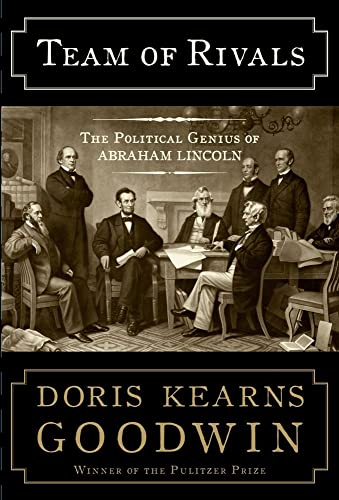
Acclaimed historian Doris Kearns Goodwin illuminates Abraham Lincoln's political genius in this highly original work, as the one-term congressman and prairie lawyer rises from obscurity to prevail over three gifted rivals of national reputation to become president.
On May 18, 1860, William H. Seward, Salmon P. Chase, Edward Bates, and Abraham Lincoln waited in their hometowns for the results from the Republican National Convention in Chicago. When Lincoln emerged as the victor, his rivals were dismayed and angry.
Throughout the turbulent 1850s, each had energetically sought the presidency as the conflict over slavery was leading inexorably to secession and civil war. That Lincoln succeeded, Goodwin demonstrates, was the result of a character that had been forged by experiences that raised him above his more privileged and accomplished rivals. He won because he possessed an extraordinary ability to put himself in the place of other men, to experience what they were feeling, to understand their motives and desires.
It was this capacity that enabled Lincoln as president to bring his disgruntled opponents together, create the most unusual cabinet in history, and marshal their talents to the task of preserving the Union and winning the war.
We view the long, horrifying struggle from the vantage of the White House as Lincoln copes with incompetent generals, hostile congressmen, and his raucous cabinet. He overcomes these obstacles by winning the respect of his former competitors, and in the case of Seward, finds a loyal and crucial friend to see him through.
This brilliant multiple biography is centered on Lincoln's mastery of men and how it shaped the most significant presidency in the nation's history.
Die Inhaltsangabe kann sich auf eine andere Ausgabe dieses Titels beziehen.
Über die Autorin bzw. den Autor
Doris Kearns Goodwin’s work for President Johnson inspired her career as a presidential historian. Her first book was Lyndon Johnson and the American Dream. She followed up with the Pulitzer Prize–winning No Ordinary Time: Franklin and Eleanor Roosevelt: The Homefront in World War II. She earned the Lincoln Prize for Team of Rivals, in part the basis for Steven Spielberg’s film Lincoln, and the Carnegie Medal for The Bully Pulpit, about the friendship between Theodore Roosevelt and William Howard Taft. Her bestselling Leadership: In Turbulent Times was the inspiration for the History Channel docuseries on Abraham Lincoln, Theodore Roosevelt, and Franklin Roosevelt, which she executive produced. Her most recent book, An Unfinished Love Story: A Personal History of the 1960s, provides a front-row seat to the pivotal people—JFK, LBJ, RFK, and MLK—and events of this momentous decade.
Auszug. © Genehmigter Nachdruck. Alle Rechte vorbehalten.
Team of Rivals
The Political Genius of Abraham LincolnBy Doris Kearns GoodwinSimon & Schuster
Copyright ©2005 Doris Kearns GoodwinAll right reserved.
ISBN: 0684824906
Chapter 1: Four Men Waiting
On May 18, 1860, the day when the Republican Party would nominate its candidate for president, Abraham Lincoln was up early. As he climbed the stairs to his plainly furnished law office on the west side of the public square in Springfield, Illinois, breakfast was being served at the 130-room Chenery House on Fourth Street. Fresh butter, flour, lard, and eggs were being put out for sale at the City Grocery Store on North Sixth Street. And in the morning newspaper, the proprietors at Smith, Wickersham & Company had announced the arrival of a large spring stock of silks, calicos, ginghams, and linens, along with a new supply of the latest styles of hosiery and gloves.
The Republicans had chosen to meet in Chicago. A new convention hall called the "Wigwam" had been constructed for the occasion. The first ballot was not due to be called until 10 a.m. and Lincoln, although patient by nature, was visibly "nervous, fidgety, and intensely excited." With an outside chance to secure the Republican nomination for the highest office of the land, he was unable to focus on his work. Even under ordinary circumstances many would have found concentration difficult in the untidy office Lincoln shared with his younger partner, William Herndon. Two worktables, piled high with papers and correspondence, formed a T in the center of the room. Additional documents and letters spilled out from the drawers and pigeonholes of an outmoded secretary in the corner. When he needed a particular piece of correspondence, Lincoln had to rifle through disorderly stacks of paper, rummaging, as a last resort, in the lining of his old plug hat, where he often put stray letters or notes.
Restlessly descending to the street, he passed the state capitol building, set back from the road, and the open lot where he played handball with his friends, and climbed a short set of stairs to the office of the Illinois State Journal, the local Republican newspaper. The editorial room on the second floor, with a central large wood-burning stove, was a gathering place for the exchange of news and gossip.
He wandered over to the telegraph office on the north side of the square to see if any new dispatches had come in. There were few outward signs that this was a day of special moment and expectation in the history of Springfield, scant record of any celebration or festivity planned should Lincoln, long their fellow townsman, actually secure the nomination. That he had garnered the support of the Illinois delegation at the state convention at Decatur earlier that month was widely understood to be a "complimentary" gesture. Yet if there were no firm plans to celebrate his dark horse bid, Lincoln knew well the ardor of his staunch circle of friends already at work on his behalf on the floor of the Wigwam.
The hands of the town clock on the steeple of the Baptist church on Adams Street must have seemed not to move. When Lincoln learned that his longtime friend James Conkling had returned unexpectedly from the convention the previous evening, he walked over to Conkling's office above Chatterton's jewelry store. Told that his friend was expected within the hour, he returned to his own quarters, intending to come back as soon as Conkling arrived.
Lincoln's shock of black hair, brown furrowed face, and deep-set eyes made him look older than his fifty-one years. He was a familiar figure to almost everyone in Springfield, as was his singular way of walking, which gave the impression that his long, gaunt frame needed oiling. He plodded forward in an awkward manner, hands hanging at his sides or folded behind his back. His step had no spring, his partner William Herndon recalled. He lifted his whole foot at once rather than lifting from the toes and then thrust the whole foot down on the ground rather than landing on his heel. "His legs," another observer noted, "seemed to drag from the knees down, like those of a laborer going home after a hard day's work."
His features, even supporters conceded, were not such "as belong to a handsome man." In repose, his face was "so overspread with sadness," the reporter Horace White noted, that it seemed as if "Shakespeare's melancholy Jacques had been translated from the forest of Arden to the capital of Illinois." Yet, when Lincoln began to speak, White observed, "this expression of sorrow dropped from him instantly. His face lighted up with a winning smile, and where I had a moment before seen only leaden sorrow I now beheld keen intelligence, genuine kindness of heart, and the promise of true friendship." If his appearance seemed somewhat odd, what captivated admirers, another contemporary observed, was "his winning manner, his ready good humor, and his unaffected kindness and gentleness." Five minutes in his presence, and "you cease to think that he is either homely or awkward."
Springfield had been Lincoln's home for nearly a quarter of a century. He had arrived in the young city to practice law at twenty-eight years old, riding into town, his great friend Joshua Speed recalled, "on a borrowed horse, with no earthly property save a pair of saddle-bags containing a few clothes." The city had grown rapidly, particularly after 1839, when it became the capital of Illinois. By 1860, Springfield boasted nearly ten thousand residents, though its business district, designed to accommodate the expanding population that arrived in town when the legislature was in session, housed thousands more. Ten hotels radiated from the public square where the capitol building stood. In addition, there were multiple saloons and restaurants, seven newspapers, three billiard halls, dozens of retail stores, three military armories, and two railroad depots.
Here in Springfield, in the Edwards mansion on the hill, Lincoln had courted and married "the belle of the town," young Mary Todd, who had come to live with her married sister, Elizabeth, wife of Ninian Edwards, the well-to-do son of the former governor of Illinois. Raised in a prominent Lexington, Kentucky, family, Mary had received an education far superior to most girls her age. For four years she had studied languages and literature in an exclusive boarding school and then spent two additional years in what was considered graduate study. The story is told of Lincoln's first meeting with Mary at a festive party. Captivated by her lively manner, intelligent face, clear blue eyes, and dimpled smile, Lincoln reportedly said, "I want to dance with you in the worst way." And, Mary laughingly told her cousin later that night, "he certainly did." In Springfield, all their children were born, and one was buried. In that spring of 1860, Mary was forty-two, Robert sixteen, William nine, and Thomas seven. Edward, the second son, had died at the age of three.
Their home, described at the time as a modest "two-story frame house, having a wide hall running through the centre, with parlors on both sides," stood close to the street and boasted few trees and no garden. "The adornments were few, but chastely appropriate," one contemporary observer noted. In the center hall stood "the customary little table with a white marble top," on which were arranged flowers, a silver-plated ice-water pitcher, and family photographs. Along the walls were positioned some chairs and a sofa. "Everything," a journalist observed, "tended to represent the home of a man who has battled hard with the fortunes of life, and whose hard...
„Über diesen Titel“ kann sich auf eine andere Ausgabe dieses Titels beziehen.
Suchergebnisse für Team of Rivals: The Political Genius of Abraham Lincoln

Beispielbild für diese ISBN
Team of Rivals: the Political Genius of Abraham Lincoln
Anbieter: World of Books (was SecondSale), Montgomery, IL, USA
Verkäuferbewertung 5 von 5 Sternen

Zustand: Very Good. Winner of the Lincoln Prize Acclaimed historian Doris Kearns Goodwin illuminates Abraham Lincoln's political genius in this highly original work, as the one-term congressman and prairie lawyer rises from obscurity to prevail over three gifted rivals of national reputation to become president. On May 18, 1860, William H. Seward, Salmon P. Chase, Edward Bates, and Abraham Lincoln waited in their hometowns for the results from the Republican National Convention in Chicago. When Lincoln emerged as the victor, his rivals were dismayed and angry. Throughout the turbulent 1850s, each had energetically sought the presidency as the conflict over slavery was leading inexorably to secession and civil war. That Lincoln succeeded, Goodwin demonstrates, was the result of a character that had been forged by experiences that raised him above his more privileged and accomplished rivals. He won because he possessed an extraordinary ability to put himself in the place of other men, to experience what they were feeling, to understand their motives and desires. It was this capacity that enabled Lincoln as president to bring his disgruntled opponents together, create the most unusual cabinet in history, and marshal their talents to the task of preserving the Union and winning the war. We view the long, horrifying struggle from the vantage of the White House as Lincoln copes with incompetent generals, hostile congressmen, and his raucous cabinet. He overcomes these obstacles by winning the respect of his former competitors, and in the case of Seward, finds a loyal and crucial friend to see him through. This brilliant multiple biography is centered on Lincoln's mastery of men and how it shaped the most significant presidency in the nation's history. Artikel-Nr. 00110560373
Gebraucht kaufen
EUR 5,36
Versand gratis
Versand innerhalb von USA
Versand innerhalb von USA
Anzahl: 1 verfügbar
Beispielbild für diese ISBN
Team of Rivals: the Political Genius of Abraham Lincoln
Anbieter: World of Books (was SecondSale), Montgomery, IL, USA
Verkäuferbewertung 5 von 5 Sternen
Zustand: Fair. Winner of the Lincoln Prize Acclaimed historian Doris Kearns Goodwin illuminates Abraham Lincoln's political genius in this highly original work, as the one-term congressman and prairie lawyer rises from obscurity to prevail over three gifted rivals of national reputation to become president. On May 18, 1860, William H. Seward, Salmon P. Chase, Edward Bates, and Abraham Lincoln waited in their hometowns for the results from the Republican National Convention in Chicago. When Lincoln emerged as the victor, his rivals were dismayed and angry. Throughout the turbulent 1850s, each had energetically sought the presidency as the conflict over slavery was leading inexorably to secession and civil war. That Lincoln succeeded, Goodwin demonstrates, was the result of a character that had been forged by experiences that raised him above his more privileged and accomplished rivals. He won because he possessed an extraordinary ability to put himself in the place of other men, to experience what they were feeling, to understand their motives and desires. It was this capacity that enabled Lincoln as president to bring his disgruntled opponents together, create the most unusual cabinet in history, and marshal their talents to the task of preserving the Union and winning the war. We view the long, horrifying struggle from the vantage of the White House as Lincoln copes with incompetent generals, hostile congressmen, and his raucous cabinet. He overcomes these obstacles by winning the respect of his former competitors, and in the case of Seward, finds a loyal and crucial friend to see him through. This brilliant multiple biography is centered on Lincoln's mastery of men and how it shaped the most significant presidency in the nation's history. Artikel-Nr. 00095545068
Gebraucht kaufen
EUR 5,36
Versand gratis
Versand innerhalb von USA
Versand innerhalb von USA
Anzahl: Mehr als 20 verfügbar
Beispielbild für diese ISBN
Team of Rivals: the Political Genius of Abraham Lincoln
Anbieter: World of Books (was SecondSale), Montgomery, IL, USA
Verkäuferbewertung 5 von 5 Sternen
Zustand: Good. Winner of the Lincoln Prize Acclaimed historian Doris Kearns Goodwin illuminates Abraham Lincoln's political genius in this highly original work, as the one-term congressman and prairie lawyer rises from obscurity to prevail over three gifted rivals of national reputation to become president. On May 18, 1860, William H. Seward, Salmon P. Chase, Edward Bates, and Abraham Lincoln waited in their hometowns for the results from the Republican National Convention in Chicago. When Lincoln emerged as the victor, his rivals were dismayed and angry. Throughout the turbulent 1850s, each had energetically sought the presidency as the conflict over slavery was leading inexorably to secession and civil war. That Lincoln succeeded, Goodwin demonstrates, was the result of a character that had been forged by experiences that raised him above his more privileged and accomplished rivals. He won because he possessed an extraordinary ability to put himself in the place of other men, to experience what they were feeling, to understand their motives and desires. It was this capacity that enabled Lincoln as president to bring his disgruntled opponents together, create the most unusual cabinet in history, and marshal their talents to the task of preserving the Union and winning the war. We view the long, horrifying struggle from the vantage of the White House as Lincoln copes with incompetent generals, hostile congressmen, and his raucous cabinet. He overcomes these obstacles by winning the respect of his former competitors, and in the case of Seward, finds a loyal and crucial friend to see him through. This brilliant multiple biography is centered on Lincoln's mastery of men and how it shaped the most significant presidency in the nation's history. Artikel-Nr. 00108999739
Gebraucht kaufen
EUR 5,36
Versand gratis
Versand innerhalb von USA
Versand innerhalb von USA
Anzahl: Mehr als 20 verfügbar
Beispielbild für diese ISBN
Team of Rivals: The Political Genius of Abraham Lincoln
Anbieter: ThriftBooks-Reno, Reno, NV, USA
Verkäuferbewertung 5 von 5 Sternen
Hardcover. Zustand: Fair. No Jacket. Former library book; Readable copy. Pages may have considerable notes/highlighting. ~ ThriftBooks: Read More, Spend Less. Artikel-Nr. G0684824906I5N10
Gebraucht kaufen
EUR 6,29
Versand gratis
Versand innerhalb von USA
Versand innerhalb von USA
Anzahl: 1 verfügbar
Beispielbild für diese ISBN
Team of Rivals: The Political Genius of Abraham Lincoln
Anbieter: ThriftBooks-Phoenix, Phoenix, AZ, USA
Verkäuferbewertung 5 von 5 Sternen
Hardcover. Zustand: Fair. No Jacket. Readable copy. Pages may have considerable notes/highlighting. ~ ThriftBooks: Read More, Spend Less. Artikel-Nr. G0684824906I5N00
Gebraucht kaufen
EUR 6,29
Versand gratis
Versand innerhalb von USA
Versand innerhalb von USA
Anzahl: Mehr als 20 verfügbar
Beispielbild für diese ISBN
Team of Rivals: The Political Genius of Abraham Lincoln
Anbieter: ThriftBooks-Dallas, Dallas, TX, USA
Verkäuferbewertung 5 von 5 Sternen
Hardcover. Zustand: Fair. No Jacket. Former library book; Readable copy. Pages may have considerable notes/highlighting. ~ ThriftBooks: Read More, Spend Less. Artikel-Nr. G0684824906I5N10
Gebraucht kaufen
EUR 6,29
Versand gratis
Versand innerhalb von USA
Versand innerhalb von USA
Anzahl: 1 verfügbar
Beispielbild für diese ISBN
Team of Rivals: The Political Genius of Abraham Lincoln
Anbieter: ThriftBooks-Dallas, Dallas, TX, USA
Verkäuferbewertung 5 von 5 Sternen
Hardcover. Zustand: Fair. No Jacket. Missing dust jacket; Readable copy. Pages may have considerable notes/highlighting. ~ ThriftBooks: Read More, Spend Less. Artikel-Nr. G0684824906I5N01
Gebraucht kaufen
EUR 6,29
Versand gratis
Versand innerhalb von USA
Versand innerhalb von USA
Anzahl: 16 verfügbar
Beispielbild für diese ISBN
Team of Rivals: The Political Genius of Abraham Lincoln
Anbieter: ThriftBooks-Dallas, Dallas, TX, USA
Verkäuferbewertung 5 von 5 Sternen
Hardcover. Zustand: Good. No Jacket. Pages can have notes/highlighting. Spine may show signs of wear. ~ ThriftBooks: Read More, Spend Less. Artikel-Nr. G0684824906I3N00
Gebraucht kaufen
EUR 6,29
Versand gratis
Versand innerhalb von USA
Versand innerhalb von USA
Anzahl: 4 verfügbar
Beispielbild für diese ISBN
Team of Rivals: The Political Genius of Abraham Lincoln
Anbieter: ThriftBooks-Atlanta, AUSTELL, GA, USA
Verkäuferbewertung 5 von 5 Sternen
Hardcover. Zustand: Fair. No Jacket. Readable copy. Pages may have considerable notes/highlighting. ~ ThriftBooks: Read More, Spend Less. Artikel-Nr. G0684824906I5N00
Gebraucht kaufen
EUR 6,29
Versand gratis
Versand innerhalb von USA
Versand innerhalb von USA
Anzahl: Mehr als 20 verfügbar
Beispielbild für diese ISBN
Team of Rivals: The Political Genius of Abraham Lincoln
Anbieter: ThriftBooks-Atlanta, AUSTELL, GA, USA
Verkäuferbewertung 5 von 5 Sternen
Hardcover. Zustand: Fair. No Jacket. Missing dust jacket; Readable copy. Pages may have considerable notes/highlighting. ~ ThriftBooks: Read More, Spend Less. Artikel-Nr. G0684824906I5N01
Gebraucht kaufen
EUR 6,29
Versand gratis
Versand innerhalb von USA
Versand innerhalb von USA
Anzahl: 16 verfügbar