
Verwandte Artikel zu Capone: The Man and the Era
Inhaltsangabe
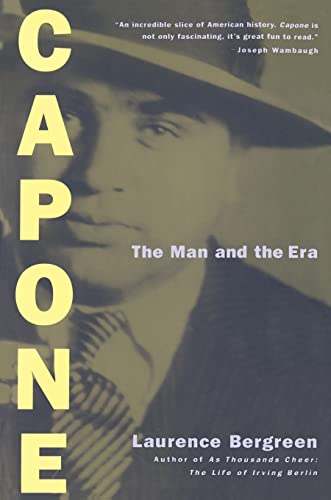
In this brilliant history of Prohibition and its most notorious gangster, acclaimed biographer Laurence Bergreen takes us to the gritty streets of Chicago where Al Capone forged his sinister empire.
Bergreen shows the seedy and glamorous sides of the age, the rise of Prohibition, the illicit liquor trade, the battlefield that was Chicago. Delving beyond the Capone mythology. Bergreen finds a paradox: a coldblooded killer, thief, pimp, and racketeer who was also a devoted son and father; a self-styled Robin Hood who rose to the top of organized crime. Capone is a masterful portrait of an extraordinary time and of the one man who reigned supreme over it all, Al Capone.
Die Inhaltsangabe kann sich auf eine andere Ausgabe dieses Titels beziehen.
Über die Autorin bzw. den Autor
Laurence Bergreen is an award-winning biographer and historian. His books have been translated into twenty-five languages worldwide. Among his books are biographies of Christopher Columbus, Giacomo Casanova, Marco Polo, Ferdinand Magellan, Louis Armstrong, Al Capone, and Irving Berlin. He lives in New York City.
Auszug. © Genehmigter Nachdruck. Alle Rechte vorbehalten.
CHAPTER 1
Campanilismo
He was atavistic, flamboyant, impossible to ignore. A big fat man with a cigar and a $50,000 pinkie ring. A jowly smiling Satan nearly six feet tall, with two scars across his left cheek. He weighed over two-fifty, yet despite his bulk and the sloppy grin, he could move with lethal speed and force. Not an articulate man, he was nonetheless charismatic: warm, charming, generous. A big tipper. He attempted elegance with an outrageous wardrobe -- custom-tailored suits of purple, electric blue, or yellow; pearl-gray fedoras accented by a black band; and diamond-encrusted stickpins. He liked people, wanted them to adore him, and people gravitated toward him, they applauded him, sought his autograph, and as he excused himself as a businessman or a rogue, he submitted to their hero worship and condemnation.
His name was Al Capone, and he was, according to the New York Times on the occasion of his death, January 25, 1947, "the symbol of a shameful era, the monstrous symptom of a disease which was eating into the conscience of America. Looking back on it now, this period of Prohibition in full, ugly flower seems fantastically incredible. Capone himself was incredible, the creation of an evil dream."
Incredible. Fantastic. Ugly. Evil. In harsh, censorious language the obituaries attempted to explain, condemn, and, perversely, revel in his life and career. They informed the public that "Alfonso Caponi" had been born in Naples in 1895, as if no American lad could ever grow up to be so evil. They evoked his apprenticeship to crime in Manhattan's Little Italy, in particular, a neighborhood known as the Mulberry Street Bend; reproduced his draft card; mentioned his service during the Great War as part of the French "Lost Battalion" and described the duel -- though some accounts referred to shrapnel -- which gave him the two famous scars across his left cheek. They confided that his nickname was "Scarface"; explained that the young Capone fled a murder rap in New York and arrived in Chicago one step ahead of the police to work for his cousin Johnny Torrio, vice lord of that city. They portrayed him as the mastermind behind the notorious St. Valentine's Day Massacre on February 14, 1929; in some accounts he even wielded a machine gun himself. They gave as the cause of his death pneumonia or a stroke, or a combination of the two; and, finally, they unanimously claimed his death marked the end of an era of gangsters and murder in Chicago and around the country. Thus his life became a paradigm of the gangster's progress in America.
However, nearly all of this endlessly repeated -- and generally accepted -- information was erroneous, beginning with the time and place of his birth. So, too, was the story of his military service in the Great War; the often-reproduced draft card actually belonged to another Al Capone, a butcher who resided in New Jersey. The manner in which he received his scar was similarly falsified and romanticized, as was his real nickname ("Scarface" was strictly for the movies and newspapers), the true cause of his death, even the correct spelling of his name. Nor did his demise mark the end of gang-land, as his moralizing obituaries predicted; powerful racketeers followed Capone as surely as they had preceded him. "You who only know him from newspaper stories will never realize the real man he is," his younger sister, Mafalda, publicly stated, but her words fell on deaf ears or met with outright derision; was she not blinded by family loyalty? And then there were the movies and later the television programs inspired by his career, which served to increase the confusion surrounding his deeds and reputation, since these dramatizations endowed characters engaged in largely fictional exploits with the names of real people. Ultimately, the Al Capone who became familiar to Americans is a myth: a poisonous but intoxicating blend of the shrill yellow journalism of the 1920s, Hollywood sensationalism, and pervasive anti-Italian prejudice. These multiple distortions transformed Capone into a larger-than-life symbol of evil.
For decades American politicians and writers had been warning the populace about Al Capone -- or someone very much like him -- as an example of the alien element contaminating clean native shores with disease, throwing the nation's economy into turmoil with cheap labor, and corrupting Anglo-American institutions with rapacious feudal codes. The Capone phenomenon, according to such voices, was the natural and inevitable outcome of the nation's permitting millions of immigrants from around the world to flow into the country during the last quarter of the nineteenth century. Among the most influential critics of unrestricted immigration was a Republican member of Congress from Massachusetts, the Honorable Henry Cabot Lodge. The scion of a wealthy family, a historian, and a former editor of the respected North American Review, Lodge personified the political, economic, and financial establishments of his day; well could he presume to decide whom to admit to the United States and whom to exclude. In 1891, three years before Capone's parents arrived in New York, this flower of New England warned that during the previous fifteen years alone, almost 6.5 million immigrants had poured into the country, a number "equal to one-tenth of the entire population of the country," a sum, he warned, that contained "enough voters to decide a presidential election." Lodge wanted them to stay away for precisely the reasons they wished to come, because they were impoverished, uneducated, without a secure place in the world. "We have the right to exclude illiterate persons from our immigration," he insisted, and he proposed screening the millions of undesirables washing up on American shores with a literacy test, a notoriously elastic gauge. "And this test," he concluded, "combined with others of a more general character, would in all probability shake out a large part of the undesirable portion of the present immigration. It would reduce in a discriminating manner the number of immigrants, and would thereby benefit the labor market." Later in the year, Lodge warned that the United States had become a haven for the "paupers and criminals" of Europe. "It is certainly madness to permit this stream to pour in without discrimination or selection, or the exclusion of dangerous and undesirable elements," by which he meant, specifically, Italians, who, he noted, simply came to this country to earn money and then returned home to spend it, enriching their countrymen at the expense of Americans. Despite Lodge's warning and an 1882 federal law excluding paupers and criminals, immigration continued almost unchecked, inhibited only by the Great War. "We are overwhelmed, submerged and almost drowned out by great flood-tide of European riff-raff, the refuse of almost every nation on the continent, paupers, criminals, beggars and the muddy residuum of foreign civilizations," complained the New York Herald. "We don't wonder that they want to come to this country, but the country is not a philanthropic institution or an asylum for the crippled and depraved of the globe....The sooner we take a decided stand and shut down the gates the better." Not until 1924 did Congress finally establish a quota system for immigrants.
Each immigrant group suffered from this intense bias in its own way, but one of the cruelest stereotypes to gain currency -- and beyond that, intellectual respectability -- was that of Southern Italians like the Capones, who were invariably portrayed as lazy, lusty, stupid, and criminal. Writing in the Century Magazine as late as 1914, Edward Alsworth Ross, a prominent sociologist, gave voice to the beliefs of America's ruling class concerning the disreputable new arrivals, especially those who came, like Al Capone's parents, from Naples....
„Über diesen Titel“ kann sich auf eine andere Ausgabe dieses Titels beziehen.
Suchergebnisse für Capone: The Man and the Era

Beispielbild für diese ISBN
Capone: The Man and the Era
Anbieter: World of Books (was SecondSale), Montgomery, IL, USA
Verkäuferbewertung 5 von 5 Sternen

Zustand: Good. Item in good condition and has highlighting/writing on text. Used texts may not contain supplemental items such as CDs, info-trac etc. Artikel-Nr. 00101272822
Gebraucht kaufen
EUR 4,37
Versand gratis
Versand innerhalb von USA
Versand innerhalb von USA
Anzahl: 2 verfügbar
Beispielbild für diese ISBN
Capone: The Man and the Era
Anbieter: ThriftBooks-Dallas, Dallas, TX, USA
Verkäuferbewertung 5 von 5 Sternen
Paperback. Zustand: Good. No Jacket. Pages can have notes/highlighting. Spine may show signs of wear. ~ ThriftBooks: Read More, Spend Less. Artikel-Nr. G0684824477I3N00
Gebraucht kaufen
EUR 6,11
Versand gratis
Versand innerhalb von USA
Versand innerhalb von USA
Anzahl: 1 verfügbar
Beispielbild für diese ISBN
Capone: The Man and the Era
Anbieter: ThriftBooks-Dallas, Dallas, TX, USA
Verkäuferbewertung 5 von 5 Sternen
Paperback. Zustand: Fair. No Jacket. Readable copy. Pages may have considerable notes/highlighting. ~ ThriftBooks: Read More, Spend Less. Artikel-Nr. G0684824477I5N00
Gebraucht kaufen
EUR 6,11
Versand gratis
Versand innerhalb von USA
Versand innerhalb von USA
Anzahl: 1 verfügbar
Beispielbild für diese ISBN
Capone: The Man and the Era
Anbieter: ThriftBooks-Dallas, Dallas, TX, USA
Verkäuferbewertung 5 von 5 Sternen
Paperback. Zustand: Very Good. No Jacket. May have limited writing in cover pages. Pages are unmarked. ~ ThriftBooks: Read More, Spend Less. Artikel-Nr. G0684824477I4N00
Gebraucht kaufen
EUR 6,11
Versand gratis
Versand innerhalb von USA
Versand innerhalb von USA
Anzahl: 1 verfügbar
Beispielbild für diese ISBN
Capone: The Man and the Era
Anbieter: Wonder Book, Frederick, MD, USA
Verkäuferbewertung 5 von 5 Sternen
Zustand: Good. Good condition. A copy that has been read but remains intact. May contain markings such as bookplates, stamps, limited notes and highlighting, or a few light stains. Artikel-Nr. E19F-00585
Gebraucht kaufen
EUR 6,19
Versand gratis
Versand innerhalb von USA
Versand innerhalb von USA
Anzahl: 2 verfügbar
Beispielbild für diese ISBN
Capone: The Man and the Era
Verlag:
Simon & Schuster (edition Reprint), 1996
ISBN 10: 0684824477
ISBN 13: 9780684824475
Gebraucht
Paperback
Anbieter: BooksRun, Philadelphia, PA, USA
Verkäuferbewertung 5 von 5 Sternen
Paperback. Zustand: Fair. Reprint. The item might be beaten up but readable. May contain markings or highlighting, as well as stains, bent corners, or any other major defect, but the text is not obscured in any way. Artikel-Nr. 0684824477-7-1
Gebraucht kaufen
EUR 6,47
Versand gratis
Versand innerhalb von USA
Versand innerhalb von USA
Anzahl: 1 verfügbar
Beispielbild für diese ISBN
Capone : The Man and the Era
Anbieter: Better World Books, Mishawaka, IN, USA
Verkäuferbewertung 5 von 5 Sternen
Zustand: Very Good. Reprint. Former library copy. Pages intact with possible writing/highlighting. Binding strong with minor wear. Dust jackets/supplements may not be included. Includes library markings. Stock photo provided. Product includes identifying sticker. Better World Books: Buy Books. Do Good. Artikel-Nr. GRP97163508
Gebraucht kaufen
EUR 6,67
Versand gratis
Versand innerhalb von USA
Versand innerhalb von USA
Anzahl: 1 verfügbar
Beispielbild für diese ISBN
Capone: The Man and the Era
Anbieter: World of Books (was SecondSale), Montgomery, IL, USA
Verkäuferbewertung 5 von 5 Sternen
Zustand: Very Good. Item in very good condition! Textbooks may not include supplemental items i.e. CDs, access codes etc. Artikel-Nr. 00109885082
Gebraucht kaufen
EUR 7,29
Versand gratis
Versand innerhalb von USA
Versand innerhalb von USA
Anzahl: 1 verfügbar
Beispielbild für diese ISBN
Capone: The Man and the Era
Anbieter: World of Books (was SecondSale), Montgomery, IL, USA
Verkäuferbewertung 5 von 5 Sternen
Zustand: Good. Item in good condition. Textbooks may not include supplemental items i.e. CDs, access codes etc. Artikel-Nr. 00107691941
Gebraucht kaufen
EUR 7,29
Versand gratis
Versand innerhalb von USA
Versand innerhalb von USA
Anzahl: 3 verfügbar
Beispielbild für diese ISBN
Capone: The Man and the Era
Anbieter: Books From California, Simi Valley, CA, USA
Verkäuferbewertung 4 von 5 Sternen

paperback. Zustand: Good. Book is bending/warping. In otherwise pristine condition with minimal/no other external wear, book has crisp & clean interiors showing unmarked text. Artikel-Nr. mon0003938079
Gebraucht kaufen
EUR 4,43
EUR 4,29 Versand
Versand innerhalb von USA
Versand innerhalb von USA
Anzahl: 1 verfügbar