
Verwandte Artikel zu Negro in the Making of America: Third Edition Revised,...
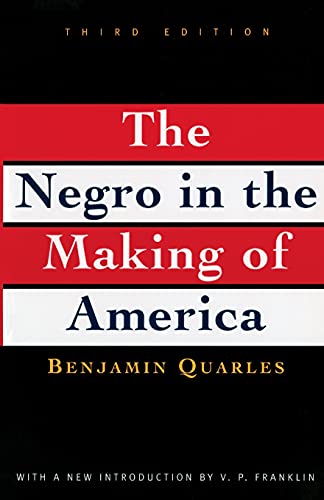
Negro in the Making of America: Third Edition Revised, Updated, and Expanded (No Series) - Softcover
Inhaltsangabe
The bestselling, definitive study of African Americans throughout American history, now with a new introduction by noted scholar V. P. Franklin.
In The Negro in the Making of America, eminent historian Benjamin Quarles provides one of the most comprehensive and readable accounts ever gathered in one volume of the role that African Americans have played in shaping the destiny of America. Starting with the arrival of the slave ships in the early 1600s and moving through the Colonial period, the Revolutionary and Civil Wars, and into the last half of the twentieth century, Quarles chronicles the sweep of events that have brought blacks and their struggle for social and economic equality to the forefront of American life.
Through compelling portraits of central political, historical, and artistic figures such as Nat Turner, Frederick Douglass, Duke Ellington, Malcolm X, and the Reverend Martin Luther King, Jr., Quarles illuminates the African American contributions that have enriched the cultural heritage of America. This classic history also covers black participation in politics, the rise of a black business class, and the forms of discrimination experienced by blacks in housing, employment, and the media.
Quarles's groundbreaking work not only surveys the role of black Americans as they engaged in the dual, simultaneous processes of assimilating into and transforming the culture of their country, but also, in a portrait of the white response to blacks, holds a mirror up to the deeper moral complexion of our nation's history. The restoration of this history holds a redemptive quality—one that can be used, in the author's words, as a "vehicle for present enlightenment, guidance, and enrichment."
Die Inhaltsangabe kann sich auf eine andere Ausgabe dieses Titels beziehen.
Über die Autorin bzw. den Autor
Benjamin Quarles was Emeritus Professor of History at Morgan State University in Baltimore and the author of many books on African American history, including Frederick Douglass, The Negro in the American Revolution, Black Abolitionists, and The Negro in the Civil War.
Von der hinteren Coverseite
Synopsis coming soon.......
Auszug. © Genehmigter Nachdruck. Alle Rechte vorbehalten.
Chapter 1
From Africa to the New World (to 1619)
"E pluribus unum," the national motto of the United States, means "one from many." Suggested by patriots at the outbreak of the American Revolution, this motto was originally used in a political sense, to demonstrate that out of thirteen separate states one new sovereign power had come into existence. But since the time of the Revolutionary War, this Latin expression has taken on a larger meaning. It has come to suggest that America is made up of many peoples from many lands, having become, in essence, a nation of nations. One of these many groups came from the continent of Africa, a group that was numbered among the very first to arrive in the New World.
Of the varied Old World stocks that entered America, none came from as wide a geographic area as the blacks. The vast majority came from the West Coast of Africa, a 3,000-mile stretch extending from the Senegal River, downward around the huge coastal bulge, to the southern limit of present-day Portuguese Angola. A small percentage came from Mozambique and the island of Madagascar in far-away East Africa, and still fewer came from the Sudanese grasslands that bordered the Sahara.
Just as the ancestor of the American Negro came from no single region, so he was of no single tribe or physical type. The "West Coast Negro," the predominant type that came to the New World, was marked by such characteristics as tall stature, woolly hair, broad features, full lips, little growth of hair on face or body, and a skin color approaching true black. But there was no such thing as one African "race." Slave ships bound for America carried a variety of genetic stocks, from the tallish, dark-skinned Ashanti of the forest lands north of the Gold Coast to the lighter and shorter Bantu from the Congo basin. Indeed, the difficulty of generalizing about the physical characteristics of the Negroid peoples is illustrated by the Nilotics and the Pygmies, one being the tallest group in the world (averaging nearly six feet in height) and the other being the shortest (averaging less than five feet).
These varied groups had no common tongue, no "lingua Africana." Indeed, there are more than 200 distinct languages in present-day Nigeria alone. There was no such thing as "the African personality," since the varied groups differed as much in their ways of life as in the physical characteristics they exhibited and the languages they spoke.
In their political institutions, there was much diversity. "One meets in Negro Africa," wrote Maurice Delafosse, "a whole series of States, ranging from the simple isolated family to confederations of kingdoms constituting empires." In pre-European Africa innumerable village kinship groups, no larger than a clan, were completely independent in their exercise of a kind of "grass-roots" democracy. These small political systems stood in contrast to an extensive empire-state like Songhay: at the height of its power, this empire extended from Lake Chad westward to the Atlantic, covering an area as large as Europe. Its most notable ruler was Askia Mohammed I (on the throne from 1493 to 1528), whose word carried as much authority in the hinterlands as at his own palace at Gao on the central Niger.
Although there were various types of states, the fundamental unit politically, as in other ways, was the family. This was not one man's family; rather, it was a kinship group numbering in the hundreds, but called a family because it was made up of the living descendants of a common ancestor. The dominant figure in this extended family community was the patriarch, who exercised a variety of functions, acting as peacemaker, judge, administrator, and keeper of the purse. The patriarch generally sought the advice of the recognized elders.
In the immediate family the practice of plural marriage was not uncommon; one man might have more than one wife if he could afford it. As a rule, marriages were formally arranged between the families, with some form of payment -- livestock generally -- going to the bride's parents. This "brideprice" was not meant to indicate that the wife had been bought; rather, it was a means of recompensing the bride's parents for their loss.
In their ways of making a living, as in other aspects of their culture, there were regional variations among the Africans. Dwellers along the shores of the great rivers turned to fishing and boat-making. In the grasslands the economy was primarily pastoral, the chief livestock being goats, sheep, and cattle. Some occupations were widespread, among them the hunting of game and the gathering of beans, nuts, and fruits. Each village had its corps of artisans, often organized into craft guilds. This skilled-labor class embraced pottery makers, weavers, wood carvers, and iron workers.
Most of the people worked in the fields that surrounded their villages, the basic economy being agricultural. Crops were grown on plots of land cleared by fire or by the felling of trees. Securing adequate foodstuffs from the earth was not always easy, but the tillers of the soil had learned such secrets as transplanting. Most of the produce was intended for local consumption, but some of it might be destined for sale outside the village. So important was agriculture as a means of livelihood that private possession of a tract of earth was not permitted. The land was the possession of the collective group; the individual had only the right to its use, owning nothing but the crops he raised.
Like so much else in African life, the land system was tied in with the gods. Among the peoples of the West Coast, religious forces found full and varied outlets. There was a supreme deity and a host of lesser ones, the latter being identified with such natural objects as rivers and the wind. Each god had priests and "diviners" who interpreted his will. The gods did not exhaust the heavenly host; sharing their powers were innumerable spirits, some of them ancestral, but most of them inhabiting the everyday objects of the hut and field.
Filling a definite place in the religious life of the Africans were their art forms, particularly the statuettes and masks of bronze, wood, or ivory that were produced as adjuncts to the performance of religious and magical rites. This wedding of art to experience gave to African sculpture its enduring vitality; the modern critic Alain Locke viewed these carved works as technically so mature and sophisticated that they could be rated as "classic in the best sense of the word." Since art was functional, the urge to express it was deeply ingrained.
Music, too, found universal expression. Among its manifestations were complex compositions for voice, an ear for the subtlest rhythm, and the use of a wide variety of instruments, including the drum, harp, xylophone, violin, guitar, zither, and flute. Like music, the dance was legion, being performed for any number of observances and purposes. Any event worthy of notice was celebrated by rhythmic movement -- births, marriages, or death. Each dance served its own specific purpose; the fertility dance, for example, was, in essence, a prayer that the seed might take good root in the soil and grow well.
The literature produced by the Africans was primarily oral rather than written and can be classified as professional and popular. In the former, knowledge about the history, customs, and traditions of the group was transmitted by men who made a profession of memorizing. The popular literature included tales, proverbs, and riddles passed down from one generation to another, occasionally by trained narrators, but most commonly by amateur storytellers.
In summary, the Negroes who came to the New World varied widely in physical type and ways of life, but there were many common patterns of culture. Whatever the type of state, the varied groups all operated under...
„Über diesen Titel“ kann sich auf eine andere Ausgabe dieses Titels beziehen.
Suchergebnisse für Negro in the Making of America: Third Edition Revised,...

Foto des Verkäufers
The Negro in the Making of America: Third Edition Revised, Updated, and Expanded
Anbieter: Dream Books Co., Denver, CO, USA
Verkäuferbewertung 5 von 5 Sternen

Zustand: acceptable. This copy has clearly been enjoyedâ"expect noticeable shelf wear and some minor creases to the cover. Binding is strong, and all pages are legible. May contain previous library markings or stamps. Artikel-Nr. DBV.0684818884.A
Gebraucht kaufen
EUR 6,04
Versand gratis
Versand innerhalb von USA
Versand innerhalb von USA
Anzahl: 1 verfügbar
Foto des Verkäufers
The Negro in the Making of America: Third Edition Revised, Updated, and Expanded
Anbieter: Dream Books Co., Denver, CO, USA
Verkäuferbewertung 5 von 5 Sternen
Zustand: very_good. Pages are clean with no markings. May show minor signs of wear or cosmetic defects marks, cuts, bends, or scuffs on the cover, spine, pages, or dust jacket. May have remainder marks on edges. Artikel-Nr. DBV.0684818884.VG
Gebraucht kaufen
EUR 6,43
Versand gratis
Versand innerhalb von USA
Versand innerhalb von USA
Anzahl: 1 verfügbar
Beispielbild für diese ISBN
Negro in the Making of America: Third Edition Revised, Updated, and Expanded
Anbieter: ThriftBooks-Dallas, Dallas, TX, USA
Verkäuferbewertung 5 von 5 Sternen
Paperback. Zustand: Fair. No Jacket. Readable copy. Pages may have considerable notes/highlighting. ~ ThriftBooks: Read More, Spend Less. Artikel-Nr. G0684818884I5N00
Gebraucht kaufen
EUR 8,08
Versand gratis
Versand innerhalb von USA
Versand innerhalb von USA
Anzahl: 1 verfügbar
Beispielbild für diese ISBN
Negro in the Making of America: Third Edition Revised, Updated, and Expanded
Anbieter: ThriftBooks-Phoenix, Phoenix, AZ, USA
Verkäuferbewertung 5 von 5 Sternen
Paperback. Zustand: Fair. No Jacket. Readable copy. Pages may have considerable notes/highlighting. ~ ThriftBooks: Read More, Spend Less. Artikel-Nr. G0684818884I5N00
Gebraucht kaufen
EUR 8,08
Versand gratis
Versand innerhalb von USA
Versand innerhalb von USA
Anzahl: 1 verfügbar
Beispielbild für diese ISBN
Negro in the Making of America: Third Edition Revised, Updated, and Expanded
Anbieter: ThriftBooks-Atlanta, AUSTELL, GA, USA
Verkäuferbewertung 5 von 5 Sternen
Paperback. Zustand: Very Good. No Jacket. May have limited writing in cover pages. Pages are unmarked. ~ ThriftBooks: Read More, Spend Less. Artikel-Nr. G0684818884I4N00
Gebraucht kaufen
EUR 8,08
Versand gratis
Versand innerhalb von USA
Versand innerhalb von USA
Anzahl: 1 verfügbar
Beispielbild für diese ISBN
Negro in the Making of America : Third Edition Revised, Updated, and Expanded
Anbieter: Better World Books: West, Reno, NV, USA
Verkäuferbewertung 5 von 5 Sternen
Zustand: Good. 3rd Edition. Former library copy. Pages intact with minimal writing/highlighting. The binding may be loose and creased. Dust jackets/supplements are not included. Includes library markings. Stock photo provided. Product includes identifying sticker. Better World Books: Buy Books. Do Good. Artikel-Nr. 4191848-6
Gebraucht kaufen
EUR 8,34
Versand gratis
Versand innerhalb von USA
Versand innerhalb von USA
Anzahl: 1 verfügbar
Beispielbild für diese ISBN
Negro in the Making of America : Third Edition Revised, Updated, and Expanded
Anbieter: Better World Books, Mishawaka, IN, USA
Verkäuferbewertung 5 von 5 Sternen
Zustand: Very Good. 3rd Edition. Former library copy. Pages intact with possible writing/highlighting. Binding strong with minor wear. Dust jackets/supplements may not be included. Includes library markings. Stock photo provided. Product includes identifying sticker. Better World Books: Buy Books. Do Good. Artikel-Nr. 9333584-75
Gebraucht kaufen
EUR 8,34
Versand gratis
Versand innerhalb von USA
Versand innerhalb von USA
Anzahl: 1 verfügbar
Beispielbild für diese ISBN
Negro in the Making of America : Third Edition Revised, Updated, and Expanded
Anbieter: Better World Books: West, Reno, NV, USA
Verkäuferbewertung 5 von 5 Sternen
Zustand: Fine. 3rd Edition. Used book that is in almost brand-new condition. May contain a remainder mark. Better World Books: Buy Books. Do Good. Artikel-Nr. 13879827-75
Gebraucht kaufen
EUR 8,34
Versand gratis
Versand innerhalb von USA
Versand innerhalb von USA
Anzahl: 1 verfügbar
Beispielbild für diese ISBN
The Negro in the Making of America: Third Edition Revised, Updated, and Expanded
Anbieter: Ria Christie Collections, Uxbridge, Vereinigtes Königreich
Verkäuferbewertung 5 von 5 Sternen
Zustand: New. In English. Artikel-Nr. ria9780684818887_new
Neu kaufen
EUR 25,84
EUR 11,05 Versand
Versand von Vereinigtes Königreich nach USA
Versand von Vereinigtes Königreich nach USA
Anzahl: Mehr als 20 verfügbar
Beispielbild für diese ISBN
Negro in the Making of America: Third Edition Revised, Updated, and Expanded
Anbieter: Revaluation Books, Exeter, Vereinigtes Königreich
Verkäuferbewertung 5 von 5 Sternen
Paperback. Zustand: Brand New. 3rd sub edition. 413 pages. 8.75x5.25x0.75 inches. In Stock. Artikel-Nr. x-0684818884
Neu kaufen
EUR 29,46
EUR 11,80 Versand
Versand von Vereinigtes Königreich nach USA
Versand von Vereinigtes Königreich nach USA
Anzahl: 2 verfügbar