
Verwandte Artikel zu The House of Mirth
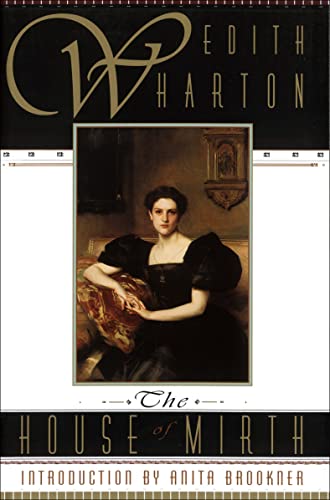
Inhaltsangabe
A literary sensation when it was published by Scribners in 1905, The House of Mirth quickly established Edith Wharton as the most important American woman of letters in the twentieth century. The first American novel to provide a devastatingly accurate portrait of New York's aristocracy, it is the story of the beautiful and beguiling Lily Bart and her ill-fated attempt to rise to the heights of a heartless society in which, ultimately, she has no part.
From the staid conventionality of Old New York to the forced conviviality of the French Riviera, from the drawing room of Gus Trenor's Bellomont to the dreary resort of a downtown boardinghouse, Wharton created her "first full-scale survey," as her biographer R.W.B. Lewis put it, "of the comédie humaine, American style." A brilliantly satiric yet sensitive exploration of manners and morality, The House of Mirth marked Wharton's transformation from an amateur into a professional writer and figures among her most important works.
Die Inhaltsangabe kann sich auf eine andere Ausgabe dieses Titels beziehen.
Über die Autorin bzw. den Autor
Edith Wharton (1862–1937) was an American novelist—the first woman to win a Pulitzer Prize for her novel The Age of Innocence in 1921—as well as a short story writer, playwright, designer, reporter, and poet. Born into one of New York's elite families, she drew upon her knowledge of upper class aristocracy to realistically portray the lives and morals of the Gilded Age.
Auszug. © Genehmigter Nachdruck. Alle Rechte vorbehalten.
Chapter 1
Selden paused in surprise. In the afternoon rush of the Grand Central Station his eyes had been refreshed by the sight of Miss Lily Bart.
It was a Monday in early September, and he was returning to his work from a hurried dip into the country; but what was Miss Bart doing in town at that season? If she had appeared to be catching a train, he might have inferred that he had come on her in the act of transition between one and another of the country-houses which disputed her presence after the close of the Newport season; but her desultory air perplexed him. She stood apart from the crowd, letting it drift by her to the platform or the street, and wearing an air of irresolution which might, as he surmised, be the mask of a very definite purpose. It struck him at once that she was waiting for some one, but he hardly knew why the idea arrested him. There was nothing new about Lily Bart, yet he could never see her without a faint movement of interest: it was characteristic of her that she always roused speculation, that her simplest acts seemed the result of far-reaching intentions.
An impulse of curiosity made him turn out of his direct line to the door, and stroll past her. He knew that if she did not wish to be seen she would contrive to elude him; and it amused him to think of putting her skill to the test.
"Mr. Selden -- what good luck!"
She came forward smiling, eager almost, in her resolve to intercept him. One or two persons, in brushing past them, lingered to look; for Miss Bart was a figure to arrest even the suburban traveller rushing to his last train.
Selden had never seen her more radiant. Her vivid head, relieved against the dull tints of the crowd, made her more conspicuous than in a ball-room, and under her dark hat and veil she regained the girlish smoothness, the purity of tint, that she was beginning to lose after eleven years of late hours and indefatigable dancing. Was it really eleven years, Selden found himself wondering, and had she indeed reached the nine-and-twentieth birthday with which her rivals credited her?
"What luck!" she repeated. "How nice of you to come to my rescue!"
He responded ioyfully that to do so was his mission in life, and asked what form the rescue was to take.
"Oh, almost any -- even to sitting on a bench and talking to me. One sits out a cotillion -- why not sit out a train? It isn't a bit hotter here than in Mrs. Van Osburgh's conservatory -- and some of the women are not a bit uglier."
She broke off, laughing, to explain that she had come up to town from Tuxedo, on her way to the Gus Trenors' at Bellomont, and had missed the three-fifteen train to Rhinebeck.
"And there isn't another till half-past five." She consulted the little jewelled watch among her laces. "Just two hours to wait. And I don't know what to do with myself. My maid came up this morning to do some shopping for me, and was to go on to Bellomont at one o'clock, and my aunt's house is closed, and I don't know a soul in town." She glanced plaintively about the station. "It is hotter than Mrs. Van Osburgh's, after all. If you can spare the time, do take me somewhere for a breath of air."
He declared himself entirely at her disposal: the adventure struck him as diverting. As a spectator, he had always enjoyed Lily Bart; and his course lay so far out of her orbit that it amused him to be drawn for a moment into the sudden intimacy which her proposal implied.
r"Shall we go over to Sherry's for a cup of tea?"
She smiled assentingly, and then made a slight grimace.
"So many people come up to town on a Monday-one is sure to meet a lot of bores. I'm as old as the hills, of course, and it ought not to make any difference; but if I'm old enough, you're not," she objected gaily. "I'm dying for tea -- but isn't there a quieter place?"
He answered her smile, which rested on him vividly. Her discretions interested him almost as much as her imprudences: he was so sure that both were part of the same carefully-elaborated plan. In judging Miss Bart, he had always made use of the "argument from design."
"The resources of New York are rather meagre," he said; "but I'll find a hansom first, and then we'll invent something."
He led her through the throng of returning holidaymakers, past sallow-faced girls in preposterous hats, and flat-chested women struggling with paper bundles and palm-leaf fans. Was it possible that she belonged to the same race? The dinginess, the crudity of this average section of womanhood made him feel how highly specialized she was.
A rapid shower had cooled the air, and clouds still hung refreshingly over the moist street.
"How delicious! Let us walk a little," she said as they emerged from the station.
They turned into Madison Avenue and began to stroll northward. As she moved beside him, with her long light step, Selden was conscious of taking a luxurious pleasure in her nearness: in the modelling of her little ear, the crisp upward wave of her hair -- was it ever so slightly brightened by art? -- and the thick planting of her straight black lashes. Everything about her was at once vigorous and exquisite, at once strong and fine. He had a confused sense that she must have cost a great deal to make, that a great many dull and ugly people must, in some mysterious way, have been sacrificed to produce her. He was aware that the qualities distinguishing her from the herd of her sex were chiefly external: as though a fine glaze of beauty and fastidiousness had been applied to vulgar clay. Yet the analogy left him unsatisfied, for a coarse texture will not take a high finish; and was it not possible that the material was fine, but that circumstance had fashioned it into a futile shape?
As he reached this point in his speculations the sun came out, and her lifted parasol cut off his enjoyment. A moment or two later she paused with a sigh.
"Oh, dear, I'm so hot and thirsty -- and what a hideous place New York is!" She looked despairingly up and down the dreary thoroughfare. "Other cities put on their best clothes in summer, but New York seems to sit in its shirtsleeves." Her eyes wandered down one of the side streets. "Some one has had the humanity to plant a few trees over there. Let us go into the shade."
"I am glad my street meets with your approval," said Selden as they turned the corner.
"Your street? Do you live here?"
She glanced with interest along the new brick and limestone house-fronts, fantastically varied in obedience to the American craving for novelty, but fresh and inviting with their awnings and flower-boxes.
"Ah, yes -- to be sure: The Benedick. What a nicelooking building! I don't think I've ever seen it before." She looked across at the flat-house with its marble porch and pseudo-Georgian facade. "Which are your windows? Those with the awnings down?"
"On the top floor -- yes."
rd"And that nice little balcony is yours? How cool it looks up there!"
He paused a moment. "Come up and see," he suggested. "I can give you a cup of tea in no time -- and you won't meet any bores."
Her colour deepened -- she still had the art of blushing at the right time -- but she took the suggestion as lightly as it was made.
"Why not? It's too tempting -- I'll take the risk," she declared.
"Oh, I'm not dangerous," he said in the same key. In truth, he had never liked her as well as at that moment. He knew she had accepted without afterthought: he could never be a factor in her calculations, and there was a surprise, a refreshment almost, in the spontaneity of her consent.
On the threshold he paused a moment, feeling for his latchkey.
"There's no one here; but I have a servant who is supposed to come in the mornings, and it's just possible he may have put out the tea-things...
„Über diesen Titel“ kann sich auf eine andere Ausgabe dieses Titels beziehen.
Suchergebnisse für The House of Mirth

Beispielbild für diese ISBN
The House of Mirth
Verlag:
Scribner (edition Reprint), 1995
ISBN 10: 068480123X
ISBN 13: 9780684801230
Gebraucht
Paperback
Anbieter: BooksRun, Philadelphia, PA, USA
Verkäuferbewertung 5 von 5 Sternen

Paperback. Zustand: Fair. Reprint. The item might be beaten up but readable. May contain markings or highlighting, as well as stains, bent corners, or any other major defect, but the text is not obscured in any way. Artikel-Nr. 068480123X-7-1-13
Gebraucht kaufen
EUR 4,67
Versand gratis
Versand innerhalb von USA
Versand innerhalb von USA
Anzahl: 1 verfügbar
Beispielbild für diese ISBN
The House of Mirth
Anbieter: Wonder Book, Frederick, MD, USA
Verkäuferbewertung 5 von 5 Sternen
Zustand: Good. Good condition. A copy that has been read but remains intact. May contain markings such as bookplates, stamps, limited notes and highlighting, or a few light stains. Artikel-Nr. K14R-00628
Gebraucht kaufen
EUR 6,42
Versand gratis
Versand innerhalb von USA
Versand innerhalb von USA
Anzahl: 1 verfügbar
Beispielbild für diese ISBN
The House of Mirth
Anbieter: Wonder Book, Frederick, MD, USA
Verkäuferbewertung 5 von 5 Sternen
Zustand: Very Good. Very Good condition. A copy that may have a few cosmetic defects. May also contain light spine creasing or a few markings such as an owner's name, short gifter's inscription or light stamp. Artikel-Nr. D12O-01553
Gebraucht kaufen
EUR 6,42
Versand gratis
Versand innerhalb von USA
Versand innerhalb von USA
Anzahl: 1 verfügbar
Beispielbild für diese ISBN
The House of Mirth
Anbieter: ThriftBooks-Phoenix, Phoenix, AZ, USA
Verkäuferbewertung 5 von 5 Sternen
Paperback. Zustand: Good. No Jacket. Pages can have notes/highlighting. Spine may show signs of wear. ~ ThriftBooks: Read More, Spend Less. Artikel-Nr. G068480123XI3N00
Gebraucht kaufen
EUR 6,67
Versand gratis
Versand innerhalb von USA
Versand innerhalb von USA
Anzahl: 4 verfügbar
Beispielbild für diese ISBN
The House of Mirth
Anbieter: ThriftBooks-Reno, Reno, NV, USA
Verkäuferbewertung 5 von 5 Sternen
Paperback. Zustand: Very Good. No Jacket. May have limited writing in cover pages. Pages are unmarked. ~ ThriftBooks: Read More, Spend Less. Artikel-Nr. G068480123XI4N00
Gebraucht kaufen
EUR 6,67
Versand gratis
Versand innerhalb von USA
Versand innerhalb von USA
Anzahl: 1 verfügbar
Beispielbild für diese ISBN
The House of Mirth
Anbieter: ThriftBooks-Dallas, Dallas, TX, USA
Verkäuferbewertung 5 von 5 Sternen
Paperback. Zustand: Good. No Jacket. Pages can have notes/highlighting. Spine may show signs of wear. ~ ThriftBooks: Read More, Spend Less. Artikel-Nr. G068480123XI3N00
Gebraucht kaufen
EUR 6,67
Versand gratis
Versand innerhalb von USA
Versand innerhalb von USA
Anzahl: 5 verfügbar
Beispielbild für diese ISBN
The House of Mirth
Anbieter: ThriftBooks-Atlanta, AUSTELL, GA, USA
Verkäuferbewertung 5 von 5 Sternen
Paperback. Zustand: Very Good. No Jacket. May have limited writing in cover pages. Pages are unmarked. ~ ThriftBooks: Read More, Spend Less. Artikel-Nr. G068480123XI4N00
Gebraucht kaufen
EUR 6,67
Versand gratis
Versand innerhalb von USA
Versand innerhalb von USA
Anzahl: 1 verfügbar
Beispielbild für diese ISBN
The House of Mirth
Anbieter: ThriftBooks-Atlanta, AUSTELL, GA, USA
Verkäuferbewertung 5 von 5 Sternen
Paperback. Zustand: Good. No Jacket. Pages can have notes/highlighting. Spine may show signs of wear. ~ ThriftBooks: Read More, Spend Less. Artikel-Nr. G068480123XI3N00
Gebraucht kaufen
EUR 6,67
Versand gratis
Versand innerhalb von USA
Versand innerhalb von USA
Anzahl: 4 verfügbar
Beispielbild für diese ISBN
The House of Mirth
Anbieter: ThriftBooks-Reno, Reno, NV, USA
Verkäuferbewertung 5 von 5 Sternen
Paperback. Zustand: Fair. No Jacket. Readable copy. Pages may have considerable notes/highlighting. ~ ThriftBooks: Read More, Spend Less. Artikel-Nr. G068480123XI5N00
Gebraucht kaufen
EUR 6,67
Versand gratis
Versand innerhalb von USA
Versand innerhalb von USA
Anzahl: 1 verfügbar
Beispielbild für diese ISBN
The House of Mirth
Anbieter: ThriftBooks-Atlanta, AUSTELL, GA, USA
Verkäuferbewertung 5 von 5 Sternen
Paperback. Zustand: Fair. No Jacket. Readable copy. Pages may have considerable notes/highlighting. ~ ThriftBooks: Read More, Spend Less. Artikel-Nr. G068480123XI5N00
Gebraucht kaufen
EUR 6,67
Versand gratis
Versand innerhalb von USA
Versand innerhalb von USA
Anzahl: 1 verfügbar