
Verwandte Artikel zu Knitting Without Tears: Basic Techniques and Easy-to-Follow...
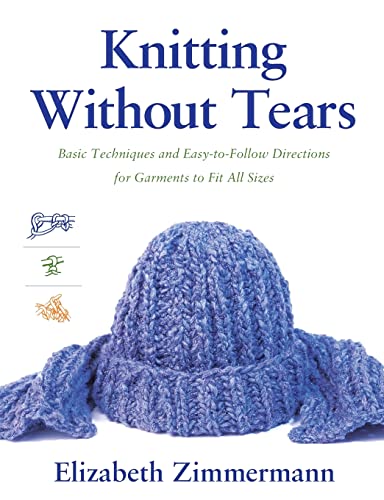
Knitting Without Tears: Basic Techniques and Easy-to-Follow Directions for Garments to Fit All Sizes (Knitting Without Tears SL 466) - Softcover
Inhaltsangabe
From Elizabeth Zimmermann, who “revolutionized the art of knitting” (New York Times), the classic knitting bible that removes the frustration and puts the fun back into knitting with easy-to-follow instructions and timeless designs.
Do you love to knit—and hate to purl? Have you ever started a sweater without enough yarn from the same dye lot to finish it? When you cast on, do you end up with a tail of yarn that’s maddeningly too long or too short? Elizabeth Zimmermann comes to the rescue with clever solutions to frustrating problems and step-by-step instructions for brilliant, timeless designs.
In Knitting Without Tears, you’ll find elegant designs for:
- Color-pattern Norwegian ski sweaters
- Seamless patterned-yoke sweaters
- Hooded garter-stitch jackets for babies
- Watch caps, socks, slippers, mittens, and more!
This classic and influential book is poised to inspire a whole new generation of knitters who have yet to discover the joys and comforts of knitting. As the lady herself once put it, “properly practiced, knitting soothes the troubled spirit, and it doesn't hurt the untroubled spirit either.”
Die Inhaltsangabe kann sich auf eine andere Ausgabe dieses Titels beziehen.
Über die Autorin bzw. den Autor
Elizabeth Zimmermann (1910-1999) was born near London, England, and attended art school in Lausanne, Switzerland, and Munich, Germany, before immigrating to the U.S. in 1937. Frustrated by magazine editors who translated her conversational knitting instructions into abbreviated code, she started her own knitting newsletter and launched Schoolhouse Press, a mail-order business that still sells knitting supplies, books, and videos under her daughter Meg Swansen's guiding hand. In the mid-1960s she hosted The Busy Knitter, a nationally syndicated public television show, and by the early 1970s had become an icon of the knitting world. This and her three lively instructional books -- Knitting Around, Knitter's Almanac, and Knitting Workshop -- are treasured by knitters around the world.
Von der hinteren Coverseite
Classic knitting bible that removes the frustration and puts the fun back into knitting with easy-to-follow instructions and timeless designs.
Auszug. © Genehmigter Nachdruck. Alle Rechte vorbehalten.
Chapter 1
The Opinionated Knitter
Most people have an obsession; mine is knitting.
Your hobby may be pie-baking, playing the piano, or potbelly-stove collecting, and you can sympathize with my enthusiasm, having an obsession of your own. Will you forgive my single-mindedness, and my tendency to see knitting in everything?
Carvings and sculpture remind me only of Aran and other textured designs; when I see a beautiful print my first thought is how it would adapt to color pattern knitting; confronted by a new fashion, I immediately start drawing in the air with my forefinger to see if it would suit itself to knitting, and if so, how -- which way the grain should run, if the shape could be knitted in, and what stitch would be most effective.
So please bear with me, and put up with my opinionated, nay, sometimes cantankerous attitude. I feel strongly about knitting.
What follows is an attempt to explain some of the ideas that come while designing knitted garments, and during the pleasant hours spent working on the plain straight pieces.
I am taking it for granted that you are already familiar with the rudiments of the craft.
Properly practiced, knitting soothes the troubled spirit, and it doesn't hurt the untroubled spirit either.
When I say properly practiced, I mean executed in a relaxed manner, without anxiety, strain, or tension, but with confidence, inventiveness, pleasure, and ultimate pride.
If you hate to knit, why, bless you, don't; follow your secret heart and take up something else. But if you start out knitting with enjoyment, you will probably continue in this pleasant path.
Consider the agreeable material and tools. (I admit to a rooted preference for wool.)
WOOL
Soft wool from the simple silly sheep can be as fine as a cobweb, tough and strong as string, or light and soft as down. There are scientific reasons why wool is the best material for knitting, and into these I will not go. I only know that it is warm, beautiful, and durable. Woolen socks never become cold and clammy, however wet. A woolen sweater is so water-resistant that when dropped overboard it floats long enough to give you ample time to rescue it. The surface on caps and mittens made of wool repels all but the most persistent of downpours. I have in mind a particularly beautiful cap made of the finest wool and angora at seven stitches to the inch in the lovely designs of Bohus in Sweden. It has been worn for two seasons by a dedicated ski-teacher in all manner of blizzards and dirty weather, and she swears that it is the warmest and driest hat she has -- snow perches on it but does not penetrate.
For people allergic to wool, one's heart can only bleed. Synthetics are a marvelous substitute, but a substitute is all they are. The allergic must be grateful that they didn't live in the Dark Ages of fifty years ago when one kept warm in winter with wool, or froze to death in linen and cotton. Of course, some avoided pleurisy by swathing themselves in sables.
It is true that a synthetic sweater can be washed and dried in machines, but to me this rather reduces it to the level of a sweatshirt. Washing a real sweater is akin to bathing a baby, and brings the same satisfaction of producing a clean, pretty, sweet-smelling creature -- very rewarding.
There is a persuasive old wives' tale about one reason why wool shrinks. It goes, "Never wind your wool into a tight hard ball, as this will make it stretched and taut. You knit it up into a sweater. Then it gets dirty and you wash it. The wool, encouraged by the dampness, goes back to its original unstretched state, with the result that the whole sweater shrinks." Think it over.
"Ply" is a frequently misunderstood concept. It has nothing to do with the thickness of yarn, except in a relative way, and everything to do with its construction.
A ply is a strand of wool. Two, three, four, or more strands are twisted together to make 2-ply, 3-ply, 4-ply, or many-plied wool. Since the strands or plies can be of any thickness, it is clear that the thickness of wool does not depend on the number of plies but on the thickness of the individual ply. I have used 9-ply wool which was no thicker than 4-ply knitting worsted, and I'm sure all are familiar with 2-ply wool so heavy and bulky that it knits up at 2 1/2 stitches to 1 inch.
So when buying wool be guided by the recommended GAUGE rather than by the number of plies, and compare this recommended GAUGE with the GAUGE specified in your knitting instructions.
When wondering how much wool to buy, ask the saleslady. She knows by experience. If she doesn't know and isn't interested, go to another store. In fact, start off by going to the best specialty yarn shop or good department store that you can find. It is not wise to shop around for cheap wool unless you are very experienced, or are willing to risk spending hours of work on an object that will shrink, fade, or run. A well-made sweater, knitted with good will and good wool, is beyond price; why try to save a dollar on the material?
Consult the nice expert in the wool shop, and if she doesn't suggest taking an extra skein as insurance against running short, take one anyway. Find out the time limit on returns and exchanges, and mark this on your sales slip. And keep the sales slip with the wool, OK? The saleslady will then love you. Even if you never get around to returning the extra skein, think what a disaster it would be to run short, and to fail to match the dye lot. Anyway, extra skeins are always useful for socks, caps, mittens, color patterns, or stripes.
If you prefer to economize and love to knit, make your sweaters with very fine wool and many stitches. A thin sweater weighs much less than a great heavy one, and, broadly speaking, wool sells by weight. Fine knitting gives you many more hours of your favorite hobby before you have to sally forth and make another capital investment.
Discrepancies will occur between dye lots; even with white, even with black. Never start a project without sufficient wool to finish it.
But on a rainy winter's night who can resist three or four skeins of wool, pleading to be made into a sweater? "I'll go to the wool shop first thing, and match the wool." Oh dear. Famous last words.
Well, there are several remedies.
If you can find an almost perfect match, the two shades may be successfully blended by working them in alternate rows for an inch or two.
Seams will also help to hide the slight color difference of a close match. You may make one or both sleeves of the new color, which will fool the eye.
If the match is Not Good At All, you can be glad you are making a Zimmermann sweater (I hope you are). Several of these start at the bottom on sleeves and body; the three pieces are united at the underarm, and the shoulders or yoke are worked last. This offers endless opportunities for using up odd wools. Few people embark on a new sweater overnight without material to get them at least to the underarm. So when the wool runs out decide that you had decided on a sweater with a contrasting yoke anyway. Eureka. If you are determined to have a one-color garment, intersperse a few purl rounds where the dye lot change occurs. This is enough to fool most eyes, even if it never fools yours -- you know too much. You can put in a small pretty color pattern at the point of change, which may please you so much that you may decide to continue with different color patterns up to the neck. This is one way of achieving a "famous masterpiece of taste and imagination." Save a few yards of the original color for one of the last patterns, and the whole thing will look as if it had been planned.
NEEDLES
Needles are made of so many materials that you can go dizzy taking your pick. Years ago you had...
„Über diesen Titel“ kann sich auf eine andere Ausgabe dieses Titels beziehen.
Suchergebnisse für Knitting Without Tears: Basic Techniques and Easy-to-Follow...

Beispielbild für diese ISBN
Knitting Without Tears: Basic Techniques and Easy-to-Follow Directions for Garments to Fit All Sizes
Anbieter: Wonder Book, Frederick, MD, USA
Verkäuferbewertung 5 von 5 Sternen

Zustand: Good. Good condition. A copy that has been read but remains intact. May contain markings such as bookplates, stamps, limited notes and highlighting, or a few light stains. Artikel-Nr. E02O-01348
Gebraucht kaufen
EUR 6,44
Versand gratis
Versand innerhalb von USA
Versand innerhalb von USA
Anzahl: 2 verfügbar
Beispielbild für diese ISBN
Knitting Without Tears: Basic Techniques and Easy-to-Follow Directions for Garments to Fit All Sizes
Anbieter: World of Books (was SecondSale), Montgomery, IL, USA
Verkäuferbewertung 5 von 5 Sternen
Paperback. Zustand: Good. Classic knitting bible that removes the frustration and puts the fun back into knitting with easy-to-follow instructions and timeless designs. Artikel-Nr. 00107892309
Gebraucht kaufen
EUR 9,77
Versand gratis
Versand innerhalb von USA
Versand innerhalb von USA
Anzahl: 12 verfügbar
Beispielbild für diese ISBN
Knitting Without Tears : Basic Techniques and Easy-to-Follow Directions for Garments to Fit All Sizes
Anbieter: Robinson Street Books, IOBA, Binghamton, NY, USA
Verkäuferbewertung 4 von 5 Sternen

Trade Paperbac. Zustand: Used: Very good. Prompt Shipment, shipped in Boxes, Tracking PROVIDEDCrafts & Hobbies: VERY Good trade paperback. Artikel-Nr. Bing917JC025
Gebraucht kaufen
EUR 12,45
EUR 8,50 Versand
Versand innerhalb von USA
Versand innerhalb von USA
Anzahl: 1 verfügbar
Beispielbild für diese ISBN
Knitting without Tears
Anbieter: Kennys Bookstore, Olney, MD, USA
Verkäuferbewertung 5 von 5 Sternen
Zustand: New. Classic knitting bible that removes the frustration and puts the fun back into knitting with easy-to-follow instructions and timeless designs. Num Pages: 128 pages, illustrations. BIC Classification: WFBS. Category: (G) General (US: Trade). Dimension: 275 x 212 x 8. Weight in Grams: 304. 1971. Paperback. . . . . Books ship from the US and Ireland. Artikel-Nr. 9780684135052
Neu kaufen
EUR 14,78
EUR 9,40 Versand
Versand innerhalb von USA
Versand innerhalb von USA
Anzahl: 1 verfügbar
Beispielbild für diese ISBN
Knitting Without Tears
Anbieter: Majestic Books, Hounslow, Vereinigtes Königreich
Verkäuferbewertung 4 von 5 Sternen
Zustand: New. pp. 128. Artikel-Nr. 8070550
Neu kaufen
EUR 17,68
EUR 7,76 Versand
Versand von Vereinigtes Königreich nach USA
Versand von Vereinigtes Königreich nach USA
Anzahl: 3 verfügbar
Beispielbild für diese ISBN
Knitting Without Tears: Basic Techniques and Easy-to-Follow Directions for Garments to Fit All Sizes
Anbieter: Ria Christie Collections, Uxbridge, Vereinigtes Königreich
Verkäuferbewertung 5 von 5 Sternen
Zustand: New. In English. Artikel-Nr. ria9780684135052_new
Neu kaufen
EUR 18,73
EUR 11,19 Versand
Versand von Vereinigtes Königreich nach USA
Versand von Vereinigtes Königreich nach USA
Anzahl: 14 verfügbar
Beispielbild für diese ISBN
Knitting Without Tears; Basic Techniques and Easy-To-Follow Directions for Garments to Fit All Sizes.
Anbieter: Revaluation Books, Exeter, Vereinigtes Königreich
Verkäuferbewertung 5 von 5 Sternen
Paperback. Zustand: Brand New. no edition stated edition. 128 pages. 10.75x8.25x0.50 inches. In Stock. Artikel-Nr. __0684135051
Neu kaufen
EUR 20,67
EUR 11,94 Versand
Versand von Vereinigtes Königreich nach USA
Versand von Vereinigtes Königreich nach USA
Anzahl: 3 verfügbar
Beispielbild für diese ISBN
Knitting Without Tears; Basic Techniques and Easy-To-Follow Directions for Garments to Fit All Sizes.
Anbieter: Revaluation Books, Exeter, Vereinigtes Königreich
Verkäuferbewertung 5 von 5 Sternen
Paperback. Zustand: Brand New. no edition stated edition. 128 pages. 10.75x8.25x0.50 inches. In Stock. Artikel-Nr. xr0684135051
Neu kaufen
EUR 22,20
EUR 11,94 Versand
Versand von Vereinigtes Königreich nach USA
Versand von Vereinigtes Königreich nach USA
Anzahl: 2 verfügbar
Foto des Verkäufers
Knitting Without Tears : Basic Techniques and Easy-To-Follow Directions for Garments to Fit All Sizes
Anbieter: AHA-BUCH GmbH, Einbeck, Deutschland
Verkäuferbewertung 5 von 5 Sternen
Taschenbuch. Zustand: Neu. Neuware - From Elizabeth Zimmermann, who 'revolutionized the art of knitting' (New York Times), the classic knitting bible that removes the frustration and puts the fun back into knitting with easy-to-follow instructions and timeless designs.Do you love to knit-and hate to purl Have you ever started a sweater without enough yarn from the same dye lot to finish it When you cast on, do you end up with a tail of yarn that's maddeningly too long or too short Elizabeth Zimmermann comes to the rescue with clever solutions to frustrating problems and step-by-step instructions for brilliant, timeless designs. In Knitting Without Tears, you'll find elegant designs for: Color-pattern Norwegian ski sweaters Seamless patterned-yoke sweaters Hooded garter-stitch jackets for babies Watch caps, socks, slippers, mittens, and more! This classic and influential book is poised to inspire a whole new generation of knitters who have yet to discover the joys and comforts of knitting. As the lady herself once put it, 'properly practiced, knitting soothes the troubled spirit, and it doesn't hurt the untroubled spirit either.'. Artikel-Nr. 9780684135052
Neu kaufen
EUR 19,48
EUR 35,00 Versand
Versand von Deutschland nach USA
Versand von Deutschland nach USA
Anzahl: 2 verfügbar
Beispielbild für diese ISBN
Knitting Without Tears
Anbieter: Infinity Books Japan, Tokyo, TKY, Japan
Verkäuferbewertung 2 von 5 Sternen

Paperback. Zustand: Very Good. Artikel-Nr. RWARE0000078375
Gebraucht kaufen
EUR 12,99
EUR 46,54 Versand
Versand von Japan nach USA
Versand von Japan nach USA
Anzahl: 1 verfügbar