
Verwandte Artikel zu Great Exploration Hoaxes (Modern Library Exploration)
Inhaltsangabe
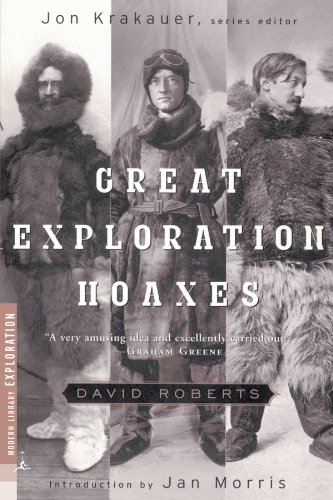
An investigation of ten famous exploration hoaxes ranges from Sebastian Cabot's disputed North American voyage of 1508-09 to Donald Crowhurst's desperate, suicidal bid to win the single-handed sailboat circumnavigation race in 1968. Reprint. 15,000 first printing.
Die Inhaltsangabe kann sich auf eine andere Ausgabe dieses Titels beziehen.
Über die Autorin bzw. den Autor
Walter Bonatti was born in Bergamo, Italy, in 1930. A well-known photographer and author, he received the Legion d’Honneur in 1961 for his heroic rescue of two fellow climbers on an expedition on which four other perished. He lives in Italy.
Aus dem Klappentext
ach the North Pole? Was Admiral Byrd the first to fly over it? Did Frederick Cook actually make the first ascent of Mt. McKinley? Spanning 450 years of history, Great Exploration Hoaxes tells the spellbinding stories of ten men who pursued glory at any cost even the truth. Acclaimed author and explorer David Roberts delves deeply into the psychology behind the stunt and asks why these individuals, all of whom were exceptionally able, would perpetrate fraud on such a grand and public scale and defend it to their deaths, even in the face of damning evidence, and why these dubious achievements are still so hotly debated, often hundreds of years afterward.
Demonstrating that the qualities that brought an individual so close to his goal were often the same ones that drove him to fake success, Great Exploration Hoaxes is history at its best: entertaining, provocative, and revealing of human nature.
David Roberts is the author of thirteen books, the most recent of which are A Newer
Auszug. © Genehmigter Nachdruck. Alle Rechte vorbehalten.
Chapter 1
Sebastian Cabot and the Northwest Passage
In 1508, Sebastian Cabot set sail from Bristol with three hundred men
in two ships. He crossed the Atlantic quickly, visited the great
fishing grounds of the Newfoundland Banks, familiar to Bristol men
for about a decade, and made a landfall. Cabot had more serious
exploratory ambitions, however, and soon pushed on toward the
northwest, coasting along the shores of Labrador. He found the
ice-clogged passage that would come to be called Hudson Strait,
drifted through it, and entered the open water of Hudson Bay, a full
century before Henry Hudson would "discover" it. Cabot wanted to push
on, but his men were on the verge of mutiny.
He turned back, sailed south past the Newfoundland Banks, and
continued along the coast of the present United States, still
searching for a westward passage through the American landmass. He
may have wintered along this coast. Having explored the Atlantic
shore all the way to the tip of Florida, he turned home, arriving in
Bristol in April 1509 to find that his monarch, Henry VII, had died
and a new Henry, who would turn out to be far less interested in
geographical discovery than his father, was on the throne. Though he
had not found a route to Cathay, Sebastian Cabot had completed the
most significant voyage yet undertaken by English ships.
Or had he?
The leading 20th-century Cabot expert, James A. Williamson, believes
that the 1508-9 expedition took place much as described above. But
there are strong grounds for concluding-and sound scholars who
argue-that Cabot's whole voyage was fictitious, that in fact he never
left England.
To a modern observer, it may seem incredible that the true facts
about a voyage of such importance remain so conjectural. Surely such
a pioneering venture would be bound to leave in its wake dozens of
authentic records, even eyewitness accounts. Surely no man, no matter
how clever, could fake a voyage that had supposedly involved three
hundred men under the patronage of the king of England.
The uncertainty about Cabot's Northwest expedition originates in two
sources. One is primarily historical. Although the Spanish, the
Portuguese, and the Italians took pains to chronicle their great
nautical voyages during the late 15th and early 16th centuries, on
the whole the English did not-until Richard Hakluyt began to collect
and publish firsthand accounts of his countrymen's discoveries in
1582. Before Hakluyt, English voyages were recorded mainly in the
memories of living seamen or in obscure Continental compendia of
knowledge. Many great deeds and adventures slipped irrevocably into
the dark hiding places of historical ignorance. Of the great mariner
John Cabot, Sebastian's father, on whose 1497 voyage England's whole
claim to North America rested, no portrait exists today, nor a single
scrap of his handwriting. By the middle of the 16th century the facts
of John Cabot's life had passed completely out of common memory.
The second cause of confusion surrounding Sebastian's Northwest
expedition lies in the very makeup of the man's character. Whether or
not the 1508 voyage was a hoax, Sebastian Cabot seems to have been a
thoroughgoing confidence artist. He managed to build successful
careers in both Spain and England as an adviser on northern
navigations mainly by fostering the illusion that he was the sole
possessor of vast funds of secret geographical lore. He seems to have
taken full credit for everything his father accomplished, letting
John Cabot's reputation dwindle to that of a mere merchant, while his
own burgeoned as the man who had discovered North America. At the
peril of his own life, he played the conflicting interests of Spain,
England, and Venice off against each other, entering into cabals and
intrigues in which he promised worlds but avoided delivering much of
real substance. He died on dry land with a comfortable pension, well
liked and reputable.
The 16th-century sources for Cabot's expedition-probably all the
evidence scholars will ever have upon which to base their
judgments-consist of some seventeen documents in Latin, Italian,
Spanish, Portuguese, French, and English. They tend to be fragments
only, some mere offhand allusions a sentence or two long. They
contain among them so many mutual contradictions that there is no
possible way of reconciling their details in a coherent account of a
single voyage. By themselves, however, such discrepancies do not
amount to evidence against Cabot. Many of the documenters were sloppy
guardians of truth, and nearly all were writing down stories they had
heard third- or fourth-hand, sometimes at a remove of seventy years
from the events they describe. The closest thing we have to an
account by Cabot himself appears in 1556 in a volume of navigations
by a Venetian named Ramusio, who claims to have received a letter
from the navigator, which he was summarizing.
Cabot's English service ended abruptly in 1512 when, on a visit to
Spain, he was invited by King Ferdinand to enter the Spanish marine
as a capitán de mar. He did not serve an English king again until
1548, when Edward VI appointed him as a maritime adviser to the
Admiralty. The long hiatus is no doubt responsible for the absence of
any English sources for the 1508 expedition until the last years of
Cabot's life, when a man named Richard Eden, who claimed to know the
aged pilot, recorded a few skimpy details of that voyage. In 1555
Eden was writing at a distance of forty-seven years from the alleged
embarkation from Bristol; and if he did receive the story from
Cabot's lips, he may have been listening-so his detractors would
insist-to an old man who had never been a reliable source aggrandize
a myth of his own deeds that he had spent a lifetime concocting.
Faced with the fragmentary nature of the Renaissance sources and the
unlikelihood that new evidence will turn up, the modern student is
reduced to choosing among scholars' portraits of Sebastian Cabot.
Surprisingly, because of the extreme variation among those portraits,
this effort amounts to a fascinating pastime. Thanks to the labors of
James A. Williamson, any student can read the original texts of the
seventeen sources translated into English. Williamson in fact invites
the reader to decide for himself about Sebastian Cabot (see
Bibliography).
The full range of judgment can be comprehended by looking at the
likenesses that three scholars, each the leading expert of his day,
have unveiled for our scrutiny. Richard Biddle, a Pittsburgh lawyer,
was the first man to try to assemble all the known documents bearing
on Cabot; his 1831 Memoir represents the pinnacle of Cabot idolatry.
In the last decade of the 19th century, the indefatigable Frenchman
Henry Harrisse issued a stream of memoirs and monographs on Cabot,
the general import of which was to debunk the explorer as a wholesale
fraud. In our own century, James A. Williamson has spent over thirty
years studying the controversy, and his works represent the effort,
to use his own metaphor, to steady the pendulum of Cabot's
reputation. Williamson acknowledges the navigator's shady and dubious
sides, but expresses faith in the reality of the bold Northwest
expedition.
Biddle's Cabot. It would not be fair to hold Richard Biddle
responsible for exaggerations that only subsequent scholarship has
corrected. The "rediscovery" of John Cabot was a triumph of
late-19th-century research, and crucial documents have been...
„Über diesen Titel“ kann sich auf eine andere Ausgabe dieses Titels beziehen.
Suchergebnisse für Great Exploration Hoaxes (Modern Library Exploration)

Beispielbild für diese ISBN
Great Exploration Hoaxes (Modern Library Exploration)
Anbieter: Wonder Book, Frederick, MD, USA
Verkäuferbewertung 5 von 5 Sternen

Zustand: Good. Good condition. A copy that has been read but remains intact. May contain markings such as bookplates, stamps, limited notes and highlighting, or a few light stains. Artikel-Nr. Z07B-02154
Gebraucht kaufen
EUR 6,33
Versand gratis
Versand innerhalb von USA
Versand innerhalb von USA
Anzahl: 2 verfügbar
Beispielbild für diese ISBN
Great Exploration Hoaxes (Modern Library Exploration)
Anbieter: ThriftBooks-Atlanta, AUSTELL, GA, USA
Verkäuferbewertung 5 von 5 Sternen
Paperback. Zustand: Good. No Jacket. Pages can have notes/highlighting. Spine may show signs of wear. ~ ThriftBooks: Read More, Spend Less. Artikel-Nr. G0679783245I3N00
Gebraucht kaufen
EUR 6,62
Versand gratis
Versand innerhalb von USA
Versand innerhalb von USA
Anzahl: 1 verfügbar
Beispielbild für diese ISBN
GREAT EXPLORATION HOAXES
Anbieter: Magers and Quinn Booksellers, Minneapolis, MN, USA
Verkäuferbewertung 5 von 5 Sternen
paperback. Zustand: Very Good. May have light to moderate shelf wear and/or a remainder mark. Complete. Clean pages. Artikel-Nr. 240967
Gebraucht kaufen
EUR 5,87
EUR 3,51 Versand
Versand innerhalb von USA
Versand innerhalb von USA
Anzahl: 1 verfügbar
Beispielbild für diese ISBN
Great Exploration Hoaxes (Modern Library Exploration)
Anbieter: Roundabout Books, Greenfield, MA, USA
Verkäuferbewertung 4 von 5 Sternen

paperback. Zustand: Near Fine. Condition Notes: Excellent, unmarked copy with little wear and tight binding. We ship in recyclable American-made mailers. 100% money-back guarantee on all orders. Artikel-Nr. 1767962
Gebraucht kaufen
EUR 9,46
Versand gratis
Versand innerhalb von USA
Versand innerhalb von USA
Anzahl: 1 verfügbar
Beispielbild für diese ISBN
Great Exploration Hoaxes (Modern Library Exploration)
Anbieter: Revaluation Books, Exeter, Vereinigtes Königreich
Verkäuferbewertung 5 von 5 Sternen
Paperback. Zustand: Brand New. modern lib edition. 225 pages. 7.75x5.00x0.50 inches. In Stock. Artikel-Nr. 0679783245
Neu kaufen
EUR 57,10
EUR 11,63 Versand
Versand von Vereinigtes Königreich nach USA
Versand von Vereinigtes Königreich nach USA
Anzahl: 1 verfügbar
Beispielbild für diese ISBN
GREAT EXPLORATION HOAXES
Anbieter: Librería Menosdiez, Madrid, MA, Spanien
Verkäuferbewertung 4 von 5 Sternen
Rústica. Zustand: Bien. Artikel-Nr. OI-5005
Gebraucht kaufen
EUR 9,00
EUR 65,00 Versand
Versand von Spanien nach USA
Versand von Spanien nach USA
Anzahl: 1 verfügbar