
Verwandte Artikel zu Sunnyvale: The Rise and Fall of a Silicon Valley Family
Inhaltsangabe
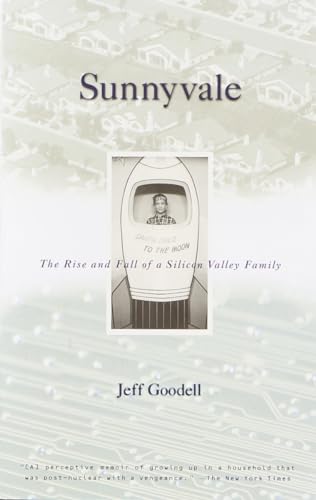
In Sunnyvale, California, in 1979, Jeff Goodell's family lived quietly on Meadowlark Lane, unaware that their town was soon to become ground zero in the digital revolution. Over the course of the next decade, as Silicon Valley boomed, the Goodell family unraveled.
Splintered by their parent's divorce, Jeff and his siblings careen toward self-destruction, while their parents end up on opposite sides of the technological divide: their mother succeeds beyond her wildest dreams at "a small company with a dopey rainbow-colored logo," called Apple, while their father refuses to keep up with the times and loses his landscaping business. Affecting and personal, Sunnyvale is a portrait of one family's fate in a brutally Darwinian world. It is also a thoughtful examination of what has happened to the American family in the face of the technological revolution.
Die Inhaltsangabe kann sich auf eine andere Ausgabe dieses Titels beziehen.
Über die Autorin bzw. den Autor
Jeff Goodell is the author of The Cyberthief and the Samurai. He is a contributing editor at Rolling Stone, and his work has appeared in The New York Times Magazine, The New Republic, Wired, and GQ. A fourth-generation Californian, he now lives in upstate New York. He can be e-mailed at jg@well.com.
Von der hinteren Coverseite
In Sunnyvale, California, in 1979, Jeff Goodell's family lived quietly on Meadowlark Lane, unaware that their town was soon to become ground zero in the digital revolution. Over the course of the next decade, as Silicon Valley boomed, the Goodell family unraveled.
Splintered by their parent's divorce, Jeff and his siblings careen toward self-destruction, while their parents end up on opposite sides of the technological divide: their mother succeeds beyond her wildest dreams at "a small company with a dopey rainbow-colored logo," called Apple, while their father refuses to keep up with the times and loses his landscaping business. Affecting and personal, Sunnyvale is a portrait of one family's fate in a brutally Darwinian world. It is also a thoughtful examination of what has happened to the American family in the face of the technological revolution.
Auszug. © Genehmigter Nachdruck. Alle Rechte vorbehalten.
Chapter 1
As a kid, I always felt lucky. I had a mother, a father, a brother, a sister, four grandparents, aunts, uncles, cousins, two dogs, a surly cat named Princess, and a brand-new house in a brand-new world. Even the name of the town I lived in made me feel lucky: Sunnyvale.
I loved the word Sunnyvale. It was different from the names of towns around us-like San Jose and Palo Alto and San Francisco, which had a dreamy, old Spanish romance about them. And it was not a name like Silicon Valley, which Sunnyvale was right in the middle of, but which always made me think of breasts and robots. The word Sunnyvale had utopian flair. It suggested to me that I lived in a special place-a world of sunshine and progress, of new gizmos and old fruit trees, where life promised to be a rocket ride across friendly skies. Streets were named after birds and flowers, and I could walk all the way to school on beautifully curving sidewalks, and my fourth-grade class took field trips to buildings where people smashed atoms and built satellites. How could I not feel lucky? I lived in a place where, as my mother often counseled me after a hard day, "Everything will work out okay."
And for a long time, I believed her. The pictures on the TV news of bloody American soldiers being lifted into helicopters, the resignation of the president, the death of Elvis-none of that rocked me. Then one morning in the spring of 1979, my mother said firmly, "I have something I need to talk to you and your brother and sister about. Let's go sit down." I knew by the disturbingly unsunny look on her face that this was a serious matter. We tromped single-file into the family room.
I was nineteen at the time, the oldest of three kids in my family. Like most other seventies teenagers with social aspirations, I wore a puffy down jacket on even the mildest days and had let my hair grow out long enough that I could chew on my bangs. I wasn't a stoner, but I smoked dope at parties, especially if the party was at my friend Rod's house, where the nights often ended with Dark Side of the Moon blasting and everyone taking off their clothes and jumping into the pool. My brother, Jerry, was twenty-two months younger than me, a senior in high school with sun-bleached blond hair and a soft, gentle face that featured none of my adolescent cockiness. My sister, Jill, had just turned eleven and was a hazel-eyed girl whose bedroom was covered with posters of the Bay City Rollers.
My mother sat on the edge of our green plaid sofa. On good days, she looked a little like Liz Taylor without the movie-star glitz: dark hair, soft round face, a hint of tragedy in every smile. On bad days, like this one, her face looked like a thundercloud that was ready to burst from pent-up emotion.
As we waited for her to speak, the word cancer flashed in my mind. I'd been obsessed with the word lately. I often checked my body for lumps and lay in bed at night imagining tumors coiling through my body, their tentacles rooting into my liver and kidneys. Now I wondered whether these nightmares had been premonitions and our mother was about to tell us she was going to die. In that split second, I was already asking myself, "Why her?" I loved my mother. Not only that, she was an extremely cool person. She had been only nineteen when I was born-she felt practically like my older sister. She listened to Creedence and the Allman Brothers just like I did, danced with my friends at my parties, and never blew a gasket when she found an empty beer can in the backyard. Lately, she had been kicking up her heels a bit. She had frizzed her hair, started wearing paisley blouses and big beaded necklaces, and decided, for the first time in her adult life, that she wanted to get a job. In a town like Sunnyvale, which was stocked with engineers and their obedient wives, this was a revolutionary act. My mother had talked to a neighbor who was an executive at a data-storage company, and before long she was working in the file room.
My father was not thrilled. He liked the idea of my mother staying at home with us kids. For her to be off, working in an office at a big company that built computer stuff, just seemed wrong to him. He worried that people would think he could not provide for his family on his own.
My father's name was Ray. When I was a kid, I thought he was a big, noble man, my own Paul Bunyan. He was six foot two, with callused hands and a worn, slender, handsome face, dazzling green-gold eyes, and light brown hair that was so fine it danced with the slightest stirring of air-a closing door, a cough. He worked in the landscape-contracting business, building city parks and beautifying highways around the Valley, and was happiest when he had dirt under his fingernails. He loved to hunt and fish and tried to pass his love of the outdoors on to me. He taught me how to shoot a rifle and split kindling wood and thread a worm onto a hook. More than anything else, he loved to build things. He turned our garage into a family room, moved the location of the front door, built a carport, a workshop, a laundry room, and benches in the backyard. I could always tell when things weren't going well at work or when he was troubled by something at home, because that was when he started a new project. Pounding nails was his form of psychotherapy.
Of all his projects, however, the fireplace in the family room was the one he was most proud of. It was a massive brick and stone structure, more appropriate for a castle in the English countryside than a flimsy tract home in Sunnyvale, where the temperature rarely dipped below forty degrees. The firebox was large enough to roast an ox and sat on a two-foot-high hearth made of old cobblestones he'd dug up on a job in San Francisco. My father had laid every brick and stone himself, buttering them with mortar, stringing them along a plumb line. It had taken him months of weekends and evenings to complete and required a devotion that was as much spiritual as physical. Over the years, the fireplace radiated that devotion back to us in heat and light. It became our family totem pole, our mosh pit, our sacred site. It was where we opened our Christmas presents and sang "Happy Birthday to You" and talked about love and the threat of nuclear war.
Now I stared at those same bricks and stones, suddenly terrified of the bomb my mother was about to drop.
"Your father and I have decided to get a divorce," she said plainly and without tears.
Divorce! I exhaled, relieved. Unlike cancer, this was a word I could handle.
To me, divorce felt more like a step into the modern world than a breaking of a sacred covenant. In the late 1970s, it seemed like everybody we knew was splitting up-it was the romantic equivalent of the Pet Rock craze. My uncle Bob, who wore leather sandals from Tijuana and told jokes about traveling salesmen who got the clap, had ended his marriage with his go-go boot-wearing wife, Sheila, and taken up with a series of flashy women. My best friend's father, a building contractor who kept tightly rolled joints in the ashtray of his van, ran off with a dental hygienist. Even my uncle Dick, a straitlaced mid-level manager at Hewlett-Packard, split with his wife and took up with a succession of free-spirited female companions.
My mother did her best to make the divorce seem like a rational and sensible decision. She told us that it was no reflection of her feelings for us, that she and my father still loved us deeply, and that they would both continue to be parts of our lives.
Jill was the only one of us who showed any emotion: Her eyes welled up, and she ran out of the room. My mother followed her.
I looked over at Jerry.
"You okay?" I asked.
"Yeah, I'm fine."
We stared at the wall for a moment.
"This is...
„Über diesen Titel“ kann sich auf eine andere Ausgabe dieses Titels beziehen.
Weitere beliebte Ausgaben desselben Titels

Suchergebnisse für Sunnyvale: The Rise and Fall of a Silicon Valley Family

Beispielbild für diese ISBN
Sunnyvale: The Rise and Fall of a Silicon Valley Family
Verlag:
Knopf Doubleday Publishing Group, 2001
ISBN 10: 0679776389
ISBN 13: 9780679776383
Gebraucht
Softcover
Anbieter: World of Books (was SecondSale), Montgomery, IL, USA
Verkäuferbewertung 5 von 5 Sternen

Zustand: Good. Item in good condition. Textbooks may not include supplemental items i.e. CDs, access codes etc. Artikel-Nr. 00095824984
Gebraucht kaufen
EUR 5,99
Versand gratis
Versand innerhalb von USA
Versand innerhalb von USA
Anzahl: 1 verfügbar
Beispielbild für diese ISBN
Sunnyvale : The Rise and Fall of a Silicon Valley Family
Verlag:
Knopf Doubleday Publishing Group, 2001
ISBN 10: 0679776389
ISBN 13: 9780679776383
Gebraucht
Softcover
Anbieter: Better World Books: West, Reno, NV, USA
Verkäuferbewertung 5 von 5 Sternen
Zustand: Good. Pages intact with minimal writing/highlighting. The binding may be loose and creased. Dust jackets/supplements are not included. Stock photo provided. Product includes identifying sticker. Better World Books: Buy Books. Do Good. Artikel-Nr. 47747704-75
Gebraucht kaufen
EUR 6,00
Versand gratis
Versand innerhalb von USA
Versand innerhalb von USA
Anzahl: 1 verfügbar
Beispielbild für diese ISBN
Sunnyvale : The Rise and Fall of a Silicon Valley Family
Verlag:
Knopf Doubleday Publishing Group, 2001
ISBN 10: 0679776389
ISBN 13: 9780679776383
Gebraucht
Softcover
Anbieter: Better World Books, Mishawaka, IN, USA
Verkäuferbewertung 5 von 5 Sternen
Zustand: Very Good. Pages intact with possible writing/highlighting. Binding strong with minor wear. Dust jackets/supplements may not be included. Stock photo provided. Product includes identifying sticker. Better World Books: Buy Books. Do Good. Artikel-Nr. 2032097-20
Gebraucht kaufen
EUR 6,00
Versand gratis
Versand innerhalb von USA
Versand innerhalb von USA
Anzahl: 1 verfügbar
Beispielbild für diese ISBN
Sunnyvale : The Rise and Fall of a Silicon Valley Family
Verlag:
Knopf Doubleday Publishing Group, 2001
ISBN 10: 0679776389
ISBN 13: 9780679776383
Gebraucht
Softcover
Anbieter: Better World Books: West, Reno, NV, USA
Verkäuferbewertung 5 von 5 Sternen
Zustand: Good. Former library copy. Pages intact with minimal writing/highlighting. The binding may be loose and creased. Dust jackets/supplements are not included. Includes library markings. Stock photo provided. Product includes identifying sticker. Better World Books: Buy Books. Do Good. Artikel-Nr. 47750992-75
Gebraucht kaufen
EUR 6,00
Versand gratis
Versand innerhalb von USA
Versand innerhalb von USA
Anzahl: 1 verfügbar
Beispielbild für diese ISBN
Sunnyvale: The Rise and Fall of a Silicon Valley Family
Anbieter: ThriftBooks-Dallas, Dallas, TX, USA
Verkäuferbewertung 5 von 5 Sternen
Paperback. Zustand: Good. No Jacket. Pages can have notes/highlighting. Spine may show signs of wear. ~ ThriftBooks: Read More, Spend Less. Artikel-Nr. G0679776389I3N00
Gebraucht kaufen
EUR 8,54
Versand gratis
Versand innerhalb von USA
Versand innerhalb von USA
Anzahl: 1 verfügbar
Beispielbild für diese ISBN
Sunnyvale: The Rise and Fall of a Silicon Valley Family
Anbieter: Revaluation Books, Exeter, Vereinigtes Königreich
Verkäuferbewertung 5 von 5 Sternen
Paperback. Zustand: Brand New. 268 pages. 8.00x5.00x0.75 inches. In Stock. Artikel-Nr. x-0679776389
Neu kaufen
EUR 17,88
EUR 11,67 Versand
Versand von Vereinigtes Königreich nach USA
Versand von Vereinigtes Königreich nach USA
Anzahl: 2 verfügbar
Foto des Verkäufers
Sunnyvale: The Rise and Fall of a Silicon Valley Family
Verlag:
Knopf Doubleday Publishing Group, 2001
ISBN 10: 0679776389
ISBN 13: 9780679776383
Gebraucht
Softcover
Anbieter: Book Broker, Berlin, Deutschland
Verkäuferbewertung 5 von 5 Sternen
Zustand: Sehr gut. 268 S. Alle Bücher & Medienartikel von Book Broker sind stets in gutem & sehr gutem gebrauchsfähigen Zustand. Unser Produktfoto entspricht dem hier angebotenen Artikel, dieser weist folgende Merkmale auf: Altersentsprechend nachgedunkelte/saubere Seiten in fester Bindung. Leichte Gebrauchsspuren. Sprache: Englisch Gewicht in Gramm: 280 Taschenbuch, Maße: 20.3 cm x 13.2 cm x 1.55 cm. Artikel-Nr. 661200118
Gebraucht kaufen
EUR 13,19
EUR 33,65 Versand
Versand von Deutschland nach USA
Versand von Deutschland nach USA
Anzahl: 1 verfügbar