
Verwandte Artikel zu Passage to Juneau: A Sea and Its Meanings (Vintage...
Inhaltsangabe
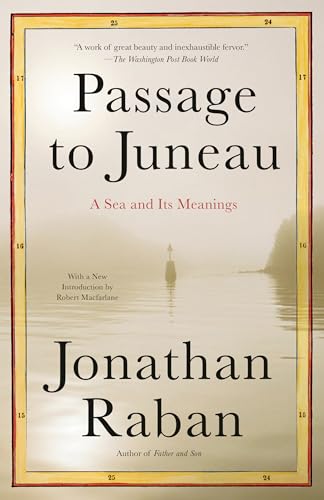
The bestselling, award-winning author of Bad Land takes us along the Inside Passage, 1,000 miles of often treacherous water, which he navigates solo in a 35-foot sailboat, offering captivating discourses on art, philosophy, and navigation and an unsparing narrative of personal loss.
"A work of great beauty and inexhaustible fervor." —The Washington Post Book World
With the same rigorous observation (natural and social), invigorating stylishness, and encyclopedic learning that he brought to his National Book Award-winning Bad Land, Jonathan Raban conducts readers along the Inside Passage from Seattle to Juneau.
But Passage to Juneau also traverses a gulf of centuries and cultures: the immeasurable divide between the Northwest's Indians and its first European explorers—between its embattled fishermen and loggers and its pampered new class.
Die Inhaltsangabe kann sich auf eine andere Ausgabe dieses Titels beziehen.
Über die Autorin bzw. den Autor
JONATHAN RABAN is the author of the novels Surveillance and Waxwings; his nonfiction works include Passage to Juneau, Bad Land, and Driving Home. His honors include the National Book Critics Circle Award, the PEN/West Creative Nonfiction Award, the Pacific Northwest Booksellers’ Award, and the Governor’s Award of the State of Washington. He died in 2023.
Von der hinteren Coverseite
With the same rigorous observation (natural and social), invigorating stylishness, and encyclopedic learning that he brought to his National Book Award-winning Bad Land, Jonathan Raban conducts readers along the Inside Passage from Seattle to Juneau. The physical distance is 1,000 miles of difficult-and often treacherous-water, which Raban navigates solo in a 35-foot sailboat.
But Passage to Juneau also traverses a gulf of centuries and cultures: the immeasurable divide between the Northwest's Indians and its first European explorers-- between its embattled fishermen and loggers and its pampered new class. Along the way, Raban offers captivating discourses on art, philosophy, and navigation and an unsparing narrative of personal loss.
Aus dem Klappentext
e rigorous observation (natural and social), invigorating stylishness, and encyclopedic learning that he brought to his National Book Award-winning Bad Land, Jonathan Raban conducts readers along the Inside Passage from Seattle to Juneau. The physical distance is 1,000 miles of difficult-and often treacherous-water, which Raban navigates solo in a 35-foot sailboat.
But Passage to Juneau also traverses a gulf of centuries and cultures: the immeasurable divide between the Northwest's Indians and its first European explorers-- between its embattled fishermen and loggers and its pampered new class. Along the way, Raban offers captivating discourses on art, philosophy, and navigation and an unsparing narrative of personal loss.
Auszug. © Genehmigter Nachdruck. Alle Rechte vorbehalten.
He was walking the dock; a big lummox, yellow hair tied back in a ponytail with a red bandanna, bedroll strapped to his shoulders. His plaid jacket looked like a fruitful research area for some unfastidious entomologist. I took him for a displaced farm boy, a Scandinavian type from Wisconsin or Minnesota, adrift in the new world of the Pacific Northwest. He held a scrap of paper, folded into a wedge the size of a postage stamp to keep its message safe inside. For what was evidently the hundredth time, he fingered it carefully apart and stared at the two words inscribed there in wonky, ballpoint capitals.
"Pacific Venturer?" he asked. The late March sun (this was Seattle's first high-pressure, blue-sky day after weeks of low overcast) glittered in the pale stubble on his cheeks. "That's the boat I'm looking for. Pacific Venturer." He spoke the name syllable by syllable, and I could see him in first grade -- a large, vacant, uncoordinated child, already far behind the rest of the class. "You seen that boat, man?"
Three, maybe four hundred boats were moored hull to hull at Fishermen's Terminal. They formed a wintry thicket, over fifty acres of water, of masts, spars, trolling poles, whip-antennae, radar scanners, deck-hoists, and davits. Looking at the names around us, I read Vigorous, Tradition, Paragon, Sea Lassie, Peregrine, Resolute, Star of Heaven, Cheryl G., Cheerful, Immigrant (a green cloverleaf blazoned on its wheelhouse), Paramount, Memories. I saw a Pacific Breeze, but no Pacific Venturer.
"What is it -- a purse-seiner?"
He took it as a trick question, staring at me as if I were an unfriendly examiner. He had Barbie-doll blue eyes. "I dunno. Salmon boat." He consulted the piece of paper in his hand. "Yup. That's a salmon boat -- I heard."
He stank of the road -- of hitchhiking on interstates, diving in Dumpsters, spending nights in cardboard boxes under highway bridges, gargling with Thunderbird.
"I been here since seven."
It was two in the afternoon. Purposeful men were pushing past us, dressed in the local uniform of hooded smocks and black peaked caps, arms full of gear, impatient with the two rubbernecks in their path.
"You better ask one of these guys."
"I asked already."
He shambled off -- "Be seeing you, man" -- up the next finger pier, and I could see his lips moving as he spelled out the words on the sterns of Oceania, Prosperity, Stella Marie, Enterprise, Quandary, lost among these resonant abstractions and women's names. The working men were giving him a wide berth. On his behalf, I kept an eye out for the Venturer; but if it had ever existed at all, it was probably now steaming for Ketchikan and points north.
The boats were fitting out, at the last minute, as usual, for their spring migration to the Alaskan fishing grounds. The resinous, linseed-oily smell of varnish and wet paint hung thickly in the still air of the terminal, and there was the continuous happy racket of electric saws and sanders, hammers, drills, and roaring blowtorches. Diesel engines were being hastily disemboweled, their black innards laid out, part by part, on afterdecks, while their bloody-knuckled owners muttered to themselves as they puzzled over camshafts and clearances. Pickup trucks, laden to the gunwales, were drawn up alongside those boats that were now most nearly ready to leave, and wholesale boxes of Dinty Moore stew and Campbell's soup and plastic-wrapped bales of toilet tissue were being swung aboard on hoists. On the broad plaza of the net-mending area, a man and a woman were "hanging web": threading white, cigar-shaped floats at two-foot intervals along the top of their quarter-mile gill net. The jade-green, gossamer nylon mesh shimmered at their feet like a river.
In Seattle, the city of virtual reality, it was always a pleasure to come to this last bastion of old-fashioned work, with its nets, crab pots, paintbrushes, and carpentering; to its outdoor faces, seamed with experience; and to its long-established family air, generation following generation into the same industry. Grandparents, now too shaky on their pins to make the trip, were still important figures at fitting-out time. They drove trucks, varnished brightwork, repaired nets, tested circuits; unlike nearly all of their contemporaries, their skills had not dated. And beyond the grandparents there stretched the ghostly presences of European fishing communities on the fjords, bays, and sounds of Norway, Sweden, Denmark, Scotland, Ireland, from where most of the families had come. These, too, were commemorated in boat names: Cape Clear, Stavanger, Solvorn, Lokken, Tyyne, Thor, Saint Patrick, Uffda, American Viking. A clever parodist, tired of the prevailing Scandinavian homesickness, had christened his gill-netter Edsel Fjord.
Centuries of seagoing converged on Fishermen's Terminal. Though its corrugated steel buildings, painted in pastel blue and beige, were new, the place felt older than the city in which it stood. Like the fishermen, it went a long way back. Its boats, built for the Pacific, were the direct descendants of the trawlers, smacks, and luggers of the North Sea and the Baltic. The high flared bow and steep sheer that had worked well in the Maelstrom waters off the Lofoten Islands were here re-created for service off the Aleutians. The trollers, with their upswept fifty-foot poles of raw fir, were old acquaintances, for I'd seen their ancient Dutch and Danish cousins. At Fishermen's Terminal the past -- and sometimes the far distant past -- was alive and usable, as it was almost nowhere else in the future-fixated United States. For someone my age, there was comfort in that. Most days, I found an excuse to drop by. I liked the boats, their redolent names, their house-proud captains, and the amiable, understated gossip of the sea.
Now, with the sun come back from exile, and the voyage north and the fishing season stretching clear ahead, everyone radiated the nervous elation -- half high hopes and half cold feet -- that marks the start of a big adventure. The weeks to come were full of flawless promise. The reality of the season would take hold soon enough: unforecast gales and groundings, engine failures, fish gone AWOL, lost sleep, lost tempers, and all the rest. In a little while the fleet would be scattered over a thousand miles and more of water, from Dixon Entrance to the Bering Sea. Then each boat would become a stranger to the others; members of the same family, aboard rival vessels, would treat one another as spies. But in the communal ceremony of fitting out, tools and expertise were passing freely from boat to boat, as the moment neared when the last line is cast off, the goodbyes are waved, the screw makes the water boil under the stern, and the passage to Alaska is under way.
I wanted as much of the mood as I could borrow for my own use. For this year I was going too -- not to fish, but to follow the fishermen's route; to go to sea in my own boat for the going's sake. I hoped to lay some ghosts to rest and come to terms, somehow, with the peculiar attraction that draws people to put themselves afloat on the deep, dark, indifferent, cold, and frightening sea. "Meditation and water are wedded for ever," wrote Melville. So, for the term of a fishing season, I meant to meditate on the sea, at sea.
In the United States, wherever young men hang out together, on college campuses as in homeless shelters, this story went the rounds: if you could get to Seattle and talk your way aboard a fishing boat bound for Alaska, you could make $1,000 a day. Or more. Someone...
„Über diesen Titel“ kann sich auf eine andere Ausgabe dieses Titels beziehen.
Suchergebnisse für Passage to Juneau: A Sea and Its Meanings (Vintage...

Beispielbild für diese ISBN
Passage to Juneau A Sea and It
Anbieter: World of Books (was SecondSale), Montgomery, IL, USA
Verkäuferbewertung 5 von 5 Sternen

Zustand: Very Good. Item in very good condition! Textbooks may not include supplemental items i.e. CDs, access codes etc. Artikel-Nr. 00105170812
Gebraucht kaufen
EUR 4,05
Versand gratis
Versand innerhalb von USA
Versand innerhalb von USA
Anzahl: 3 verfügbar
Beispielbild für diese ISBN
Passage to Juneau A Sea and It
Anbieter: World of Books (was SecondSale), Montgomery, IL, USA
Verkäuferbewertung 5 von 5 Sternen
Zustand: Acceptable. Item in acceptable condition! Textbooks may not include supplemental items i.e. CDs, access codes etc. Artikel-Nr. 00082810281
Gebraucht kaufen
EUR 4,05
Versand gratis
Versand innerhalb von USA
Versand innerhalb von USA
Anzahl: 10 verfügbar
Beispielbild für diese ISBN
Passage to Juneau A Sea and It
Anbieter: World of Books (was SecondSale), Montgomery, IL, USA
Verkäuferbewertung 5 von 5 Sternen
Zustand: Good. Item in good condition. Textbooks may not include supplemental items i.e. CDs, access codes etc. Artikel-Nr. 00087547439
Gebraucht kaufen
EUR 4,05
Versand gratis
Versand innerhalb von USA
Versand innerhalb von USA
Anzahl: 16 verfügbar
Beispielbild für diese ISBN
Passage to Juneau: A Sea and Its Meanings (Vintage Departures)
Verlag:
Vintage (edition Large type / Large print), 2000
ISBN 10: 0679776141
ISBN 13: 9780679776147
Gebraucht
Paperback
Anbieter: BooksRun, Philadelphia, PA, USA
Verkäuferbewertung 5 von 5 Sternen
Paperback. Zustand: Very Good. Large type / Large print. It's a well-cared-for item that has seen limited use. The item may show minor signs of wear. All the text is legible, with all pages included. It may have slight markings and/or highlighting. Artikel-Nr. 0679776141-11-1
Gebraucht kaufen
EUR 5,24
Versand gratis
Versand innerhalb von USA
Versand innerhalb von USA
Anzahl: 1 verfügbar
Beispielbild für diese ISBN
Passage to Juneau: A Sea and Its Meanings
Anbieter: ThriftBooks-Dallas, Dallas, TX, USA
Verkäuferbewertung 5 von 5 Sternen
Paperback. Zustand: Good. No Jacket. Pages can have notes/highlighting. Spine may show signs of wear. ~ ThriftBooks: Read More, Spend Less. Artikel-Nr. G0679776141I3N00
Gebraucht kaufen
EUR 5,99
Versand gratis
Versand innerhalb von USA
Versand innerhalb von USA
Anzahl: 1 verfügbar
Beispielbild für diese ISBN
Passage to Juneau: A Sea and Its Meanings
Anbieter: ThriftBooks-Atlanta, AUSTELL, GA, USA
Verkäuferbewertung 5 von 5 Sternen
Paperback. Zustand: Good. No Jacket. Pages can have notes/highlighting. Spine may show signs of wear. ~ ThriftBooks: Read More, Spend Less. Artikel-Nr. G0679776141I3N00
Gebraucht kaufen
EUR 5,99
Versand gratis
Versand innerhalb von USA
Versand innerhalb von USA
Anzahl: 1 verfügbar
Beispielbild für diese ISBN
Passage to Juneau: A Sea and Its Meanings
Anbieter: ThriftBooks-Dallas, Dallas, TX, USA
Verkäuferbewertung 5 von 5 Sternen
Paperback. Zustand: Very Good. No Jacket. May have limited writing in cover pages. Pages are unmarked. ~ ThriftBooks: Read More, Spend Less. Artikel-Nr. G0679776141I4N00
Gebraucht kaufen
EUR 5,99
Versand gratis
Versand innerhalb von USA
Versand innerhalb von USA
Anzahl: 1 verfügbar
Beispielbild für diese ISBN
Passage to Juneau: A Sea and Its Meanings
Anbieter: ThriftBooks-Phoenix, Phoenix, AZ, USA
Verkäuferbewertung 5 von 5 Sternen
Paperback. Zustand: Good. No Jacket. Pages can have notes/highlighting. Spine may show signs of wear. ~ ThriftBooks: Read More, Spend Less. Artikel-Nr. G0679776141I3N00
Gebraucht kaufen
EUR 5,99
Versand gratis
Versand innerhalb von USA
Versand innerhalb von USA
Anzahl: 1 verfügbar
Beispielbild für diese ISBN
Passage to Juneau: A Sea and Its Meanings
Anbieter: ThriftBooks-Dallas, Dallas, TX, USA
Verkäuferbewertung 5 von 5 Sternen
Paperback. Zustand: Fair. No Jacket. Readable copy. Pages may have considerable notes/highlighting. ~ ThriftBooks: Read More, Spend Less. Artikel-Nr. G0679776141I5N00
Gebraucht kaufen
EUR 5,99
Versand gratis
Versand innerhalb von USA
Versand innerhalb von USA
Anzahl: 1 verfügbar
Beispielbild für diese ISBN
Passage to Juneau: A Sea and Its Meanings
Anbieter: ThriftBooks-Reno, Reno, NV, USA
Verkäuferbewertung 5 von 5 Sternen
Paperback. Zustand: Good. No Jacket. Pages can have notes/highlighting. Spine may show signs of wear. ~ ThriftBooks: Read More, Spend Less. Artikel-Nr. G0679776141I3N00
Gebraucht kaufen
EUR 5,99
Versand gratis
Versand innerhalb von USA
Versand innerhalb von USA
Anzahl: 1 verfügbar