
Verwandte Artikel zu Masquerade: The Life and Times of Deborah Sampson,...
Inhaltsangabe
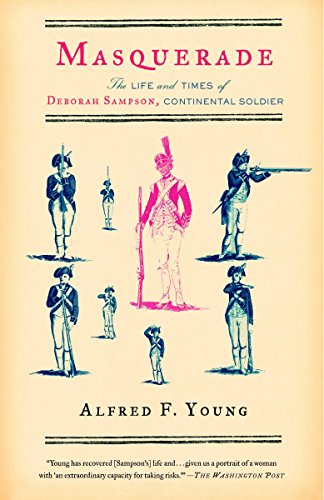
In Masquerade, Alfred F. Young scrapes through layers of fiction and myth to uncover the story of Deborah Sampson, a Massachusetts woman who passed as a man and fought as a soldier for seventeen months toward the end of the American Revolution.
Deborah Sampson was not the only woman to pose as a male and fight in the war, but she was certainly one of the most successful and celebrated. She managed to fight in combat and earn the respect of her officers and peers, and in later years she toured the country lecturing about her experiences and was partially successful in obtaining veterans’ benefits. Her full story, however, was buried underneath exaggeration and myth (some of which she may have created herself), becoming another sort of masquerade. Young takes the reader with him through his painstaking efforts to reveal the real Deborah Sampson in a work of history that is as spellbinding as the best detective fiction.
Die Inhaltsangabe kann sich auf eine andere Ausgabe dieses Titels beziehen.
Über die Autorin bzw. den Autor
In Masquerade, Alfred F. Young scrapes through layers of fiction and myth to uncover the story of Deborah Sampson, a Massachusetts woman who passed as a man and fought as a soldier for seventeen months toward the end of the American Revolution.
Deborah Sampson was not the only woman to pose as a male and fight in the war, but she was certainly one of the most successful and celebrated. She managed to fight in combat and earn the respect of her officers and peers, and in later years she toured the country lecturing about her experiences and was partially successful in obtaining veterans’ benefits. Her full story, however, was buried underneath exaggeration and myth (some of which she may have created herself), becoming another sort of masquerade. Young takes the reader with him through his painstaking efforts to reveal the real Deborah Sampson in a work of history that is as spellbinding as the best detective fiction.
Von der hinteren Coverseite
The remarkable story of the woman who fought in the American Revolution as Robert Shurtliff–and got away with it.
Serving for seventeen months during the period between the British surrender at Yorktown and the signing of the final treaty, a time when peace was far from secure, Deborah Sampson accomplished her deception by becoming an outstanding soldier. Alfred Young shows us why she did it and exactly how she carried it off. He meticulously reconstructs her early life as an indentured servant; her young adulthood as a weaver, teacher, and religious rebel; and her military career in the light infantry–consisting of dangerous patrols and small-party encounters, duty that demanded constant vigilance–followed by service as an orderly to a general at West Point.
Young also examines her postwar life as a wife–Mrs. Benjamin Gannett–and mother on a hardscrabble farm in southeastern Massachusetts, her collaboration with Herman Mann on the book that made her a celebrity and sent her on a pathbreaking yearlong lecture tour through New England and New York in 1802—03, and her relentless and partially successful quest for veterans’ benefits. He looks, too, at how Americans have dealt with Sampson in public memory and have appropriated her for a number of causes over the past two hundred years.
Throughout we are aware of the historian as detective, as Young carefully sifts through layers of fact and fiction to reveal a fascinating, complex, and unusual woman who lived in an era that both opened opportunities to and imposed limitations on women.
From the Hardcover edition.
Aus dem Klappentext
The remarkable story of the woman who fought in the American Revolution as Robert Shurtliff and got away with it.
Serving for seventeen months during the period between the British surrender at Yorktown and the signing of the final treaty, a time when peace was far from secure, Deborah Sampson accomplished her deception by becoming an outstanding soldier. Alfred Young shows us why she did it and exactly how she carried it off. He meticulously reconstructs her early life as an indentured servant; her young adulthood as a weaver, teacher, and religious rebel; and her military career in the light infantry consisting of dangerous patrols and small-party encounters, duty that demanded constant vigilance followed by service as an orderly to a general at West Point.
Young also examines her postwar life as a wife Mrs. Benjamin Gannett and mother on a hardscrabble farm in southeastern Massachusetts, her collaboration with Herman Mann on the book that made her a celebrity and sent her on a pathbreaking yearlong lecture tour through New England and New York in 1802 03, and her relentless and partially successful quest for veterans benefits. He looks, too, at how Americans have dealt with Sampson in public memory and have appropriated her for a number of causes over the past two hundred years.
Throughout we are aware of the historian as detective, as Young carefully sifts through layers of fact and fiction to reveal a fascinating, complex, and unusual woman who lived in an era that both opened opportunities to and imposed limitations on women.
From the Hardcover edition.
Auszug. © Genehmigter Nachdruck. Alle Rechte vorbehalten.
Chapter One
Deborah
When either of the sexes reverses its common sphere of action," her memoirist Herman Mann wrote in 1797, "our curiosity is excited to know the cause and event." Mann was not of an analytical mind, but, in five rambling chapters about Deborah Samson as a child, youth, and young adult, using the clues she provided, Mann offered answers to the question he posed. Judging by the number of times he attributes her as his source ("she informs," "she has often said," "she has assured me," "she has said"), for her youth she was his major source of information. She even revealed something of her inner life in a riveting dream. A child in effect without parents after she was five, Deborah was placed as an indentured servant in a farm household, and after she was a free person became a weaver and for a time a teacher. Setting the scraps of her biography in what we can piece together about the different worlds she entered gives us a story of a remarkable transformation. To use Mann's words, she was a "young female of low birth and station" who rebelled against "a contracted female sphere."
1. The Child
"As I was born to be unfortunate, my sun soon clouded"
At an early age, Deborah Samson was a near orphan. She was born into a family of unusually prominent ancestry that had already slid to a point near the bottom of colonial society, a slope of downward mobility Americans have pushed out of their national myths. She was a Bradford. Her mother, Deborah Bradford, was the great-granddaughter of William Bradford (1590-
1657), the first governor of the Plymouth colony. Living in Plymouth County, in what had once been a separate Pilgrim colony until it was absorbed by Massachusetts in the 1690s, she grew up with a heritage that was being celebrated anew in the Revolutionary era.
On the side of her father, Jonathan Samson, Jr., she was also descended from a settler who had come over on the Mayflower, Henry Samson. The Samsons knew their ancestry-in 1785, she (or someone else with the same name) bought and inscribed a copy of a sermon by Reverend Robert Cushman, the first preached in the Pilgrim colony, reprinted in 1785. How much the Bradford name meant to her is left to our imagination; in her dark days as a child and servant, it could have been a source of shame that she had sunk so far below the expectations the community had for someone with so illustrious an ancestry, but it might also have been a source of pride and inspiration. In 1785, she would name her firstborn child Earl Bradford Gannett.1
She was born in Plympton, a small inland farming village adjoining the seaport, Plymouth, according to family tradition, in the house of her grandfather, Jonathan Samson, Sr., a prosperous respected farmer. The house still stands, enveloped by subsequent additions and layers of renovation. The core of the original house, as far as one can tell, was a one-story cottage organized around a multipurpose room with a huge hearth, and small bedrooms at either end. Jan Lewis Nelson, who was caretaker of the house in 1974, thought it was not much changed from the original: wide pine planks in the floor, pine on the walls, a fireplace with wrought-iron fixtures for cooking over an open hearth, built-in beehive ovens. As farmhouses went in colonial New England, it was a comfortable dwelling, but it is not where Deborah lived for long.2
Deborah was born December 17, 1760-at least that is the date she gave Mann; no birth record has been found. It is possible she was born a year or so before. Exactly where Jonathan and Deborah Bradford Samson lived after they were married in 1751 is cloudy. In 1758, Jonathan was identified as a "labourer" in a legal document, which meant he very likely moved around for work, as agricultural laborers often had to do. Many decades later, the Plympton town clerk explained to the descendants of Ephraim, Deborah's brother, that he thought the Samsons led "a rather transient and unsettled life," which accounts for the birth dates of their children not always being registered. Deborah seems to have been the fifth of seven children: Jonathan (1753), Elisha (1755), Hannah (1756), Ephraim (1759[?]), Nehemiah (1764), and Sylvia (1766).3
One suspects her mother was responsible for the children's biblical names, all save Sylvia taken from the Old Testament. Such names were still in vogue in conservative areas of New England like Plymouth County, even as they were passing out of fashion elsewhere. In naming a daughter Deborah, she was passing on a name common in her family-no less than a dozen Deborahs came before her in the Bradford line. Our Deborah could hardly have escaped the story of her namesake in Judges, the prophet in Israel who inspired men to battle, or of Jael who in the same chapter killed the enemy general Sisera. "A good name," as an English Puritan minister put it, "is a thread tyed about the finger, to make us mindful of the errand we came into the world to do for our Master."4
The family spelled their name "Samson" without a "p." Her grandfather and father and mother are Samson in legal documents. John Adams Vinton, who in the 1850s worked on a genealogy of the family, wrote that "the name is Samson in nearly all the records, down to a late period. . . . But as the name now almost universally appears with a p he would follow the modern usage."5 Deborah never signed her maiden name on any document that has survived, but at two landmark events where her name was taken down orally, she was Samson: at her admission to the Third Baptist Church in Middleborough; and at her marriage. After she became a Gannett, it did not seem to matter very much to her. On her lecture tour in 1802-03, when she arranged her own publicity, she was "the celebrated Mrs. Gannett, the late Deborah Sampson." Her family name is Samson, and I have spelled it so in this part of the book about her youth, but I have left it Sampson thereafter, the common spelling.6
In 1758, her grandfather on her father's side died, and according to the story the children were told which Deborah passed on, a brother-in-law by his "ill designs, conniving and insinuations" cheated her father out of his inheritance, after which her father went off to sea to seek his fortune, "from whence he was not heard for some years." Eventually, "her mother was informed he had perished in a shipwreck." This is the kind of story a proud mother might tell her children because she was unable to face the fact that her husband had deserted her.7
Deborah's father never reappeared in her life. "She informs she had little knowledge of her father during her juvenile years," Mann wrote. Or if he did, she was too ashamed of his scandalous life to talk about him. Her parents seem to have had a tempestuous marriage. In the mid-nineteenth century the Plympton town clerk wrote, "I am told by older people who well recollected [Jonathan Samson, Jr.] that he and his wife quarreled, which led to their separation."8
The story that her father was cheated by a wicked brother-in-law smacks of a fairy tale. His father died intestate and the estate was divided by administrators among Jonathan Junior's mother, his five sisters, and himself. As the only son, he may possibly have received a double share, but he may have expected more had his father made a will. In February 1758, within three weeks of his father's death, Jonathan Samson, Jr., sold his share of the estate to a brother-in-law, a "cordwainer," according to the deed.9 The fact that her brother Ephraim did not know either the place or date of his birth, and that Nehemiah was born in Stoughton in 1764 and Deborah in Plympton in 1760,...
„Über diesen Titel“ kann sich auf eine andere Ausgabe dieses Titels beziehen.
Suchergebnisse für Masquerade: The Life and Times of Deborah Sampson,...

Beispielbild für diese ISBN
Masquerade: The Life and Times of Deborah Sampson, Continental Soldier
Anbieter: World of Books (was SecondSale), Montgomery, IL, USA
Verkäuferbewertung 5 von 5 Sternen

Paperback. Zustand: Very Good. In Masquerade, Alfred F. Young scrapes through layers of fiction and myth to uncover the story of Deborah Sampson, a Massachusetts woman who passed as a man and fought as a soldier for seventeen months toward the end of the American Revolution. Deborah Sampson was not the only woman to pose as a male and fight in the war, but she was certainly one of the most successful and celebrated. She managed to fight in combat and earn the respect of her officers and peers, and in later years she toured the country lecturing about her experiences and was partially successful in obtaining veterans' benefits. Her full story, however, was buried underneath exaggeration and myth (some of which she may have created herself), becoming another sort of masquerade. Young takes the reader with him through his painstaking efforts to reveal the real Deborah Sampson in a work of history that is as spellbinding as the best detective fiction. Artikel-Nr. 00105054633
Gebraucht kaufen
EUR 4,50
Versand gratis
Versand innerhalb von USA
Versand innerhalb von USA
Anzahl: 4 verfügbar
Beispielbild für diese ISBN
Masquerade The Life and Times
Anbieter: World of Books (was SecondSale), Montgomery, IL, USA
Verkäuferbewertung 5 von 5 Sternen
Zustand: Good. Item in good condition. Textbooks may not include supplemental items i.e. CDs, access codes etc. Artikel-Nr. 00106578856
Gebraucht kaufen
EUR 4,50
Versand gratis
Versand innerhalb von USA
Versand innerhalb von USA
Anzahl: 2 verfügbar
Beispielbild für diese ISBN
Masquerade: The Life and Times of Deborah Sampson, Continental Soldier
Verlag:
Knopf Doubleday Publishing Group, 2005
ISBN 10: 0679761853
ISBN 13: 9780679761853
Gebraucht
Paperback
Anbieter: ThriftBooks-Dallas, Dallas, TX, USA
Verkäuferbewertung 5 von 5 Sternen
Paperback. Zustand: Fair. No Jacket. Readable copy. Pages may have considerable notes/highlighting. ~ ThriftBooks: Read More, Spend Less. Artikel-Nr. G0679761853I5N00
Gebraucht kaufen
EUR 6,47
Versand gratis
Versand innerhalb von USA
Versand innerhalb von USA
Anzahl: 1 verfügbar
Beispielbild für diese ISBN
Masquerade: The Life and Times of Deborah Sampson, Continental Soldier
Verlag:
Knopf Doubleday Publishing Group, 2005
ISBN 10: 0679761853
ISBN 13: 9780679761853
Gebraucht
Paperback
Anbieter: ThriftBooks-Dallas, Dallas, TX, USA
Verkäuferbewertung 5 von 5 Sternen
Paperback. Zustand: Good. No Jacket. Pages can have notes/highlighting. Spine may show signs of wear. ~ ThriftBooks: Read More, Spend Less. Artikel-Nr. G0679761853I3N00
Gebraucht kaufen
EUR 6,47
Versand gratis
Versand innerhalb von USA
Versand innerhalb von USA
Anzahl: 1 verfügbar
Beispielbild für diese ISBN
Masquerade : The Life and Times of Deborah Sampson, Continental Soldier
Verlag:
Knopf Doubleday Publishing Group, 2005
ISBN 10: 0679761853
ISBN 13: 9780679761853
Gebraucht
Softcover
Anbieter: Better World Books: West, Reno, NV, USA
Verkäuferbewertung 5 von 5 Sternen
Zustand: Very Good. Former library copy. Pages intact with possible writing/highlighting. Binding strong with minor wear. Dust jackets/supplements may not be included. Includes library markings. Stock photo provided. Product includes identifying sticker. Better World Books: Buy Books. Do Good. Artikel-Nr. 19024011-75
Gebraucht kaufen
EUR 7,21
Versand gratis
Versand innerhalb von USA
Versand innerhalb von USA
Anzahl: 1 verfügbar
Beispielbild für diese ISBN
Masquerade : The Life and Times of Deborah Sampson, Continental Soldier
Verlag:
Knopf Doubleday Publishing Group, 2005
ISBN 10: 0679761853
ISBN 13: 9780679761853
Gebraucht
Softcover
Anbieter: Better World Books: West, Reno, NV, USA
Verkäuferbewertung 5 von 5 Sternen
Zustand: Good. Pages intact with minimal writing/highlighting. The binding may be loose and creased. Dust jackets/supplements are not included. Stock photo provided. Product includes identifying sticker. Better World Books: Buy Books. Do Good. Artikel-Nr. 4839206-6
Gebraucht kaufen
EUR 7,21
Versand gratis
Versand innerhalb von USA
Versand innerhalb von USA
Anzahl: 1 verfügbar
Beispielbild für diese ISBN
Masquerade : The Life and Times of Deborah Sampson, Continental Soldier
Verlag:
Knopf Doubleday Publishing Group, 2005
ISBN 10: 0679761853
ISBN 13: 9780679761853
Gebraucht
Softcover
Anbieter: Better World Books, Mishawaka, IN, USA
Verkäuferbewertung 5 von 5 Sternen
Zustand: Very Good. Former library copy. Pages intact with possible writing/highlighting. Binding strong with minor wear. Dust jackets/supplements may not be included. Includes library markings. Stock photo provided. Product includes identifying sticker. Better World Books: Buy Books. Do Good. Artikel-Nr. 19024011-75
Gebraucht kaufen
EUR 7,21
Versand gratis
Versand innerhalb von USA
Versand innerhalb von USA
Anzahl: 1 verfügbar
Beispielbild für diese ISBN
Masquerade : The Life and Times of Deborah Sampson, Continental Soldier
Verlag:
Knopf Doubleday Publishing Group, 2005
ISBN 10: 0679761853
ISBN 13: 9780679761853
Gebraucht
Softcover
Anbieter: Better World Books, Mishawaka, IN, USA
Verkäuferbewertung 5 von 5 Sternen
Zustand: Good. Former library copy. Pages intact with minimal writing/highlighting. The binding may be loose and creased. Dust jackets/supplements are not included. Includes library markings. Stock photo provided. Product includes identifying sticker. Better World Books: Buy Books. Do Good. Artikel-Nr. 4577816-6
Gebraucht kaufen
EUR 7,21
Versand gratis
Versand innerhalb von USA
Versand innerhalb von USA
Anzahl: 1 verfügbar
Beispielbild für diese ISBN
Masquerade The Life and Times of Deborah Sampson, Continental Soldier
Anbieter: Powell's Bookstores Chicago, ABAA, Chicago, IL, USA
Verkäuferbewertung 5 von 5 Sternen
Paperback. Zustand: Very Good. Minimal shelf wear, clean internals. Remainder mark. Artikel-Nr. 2046899
Gebraucht kaufen
EUR 9,65
EUR 4,46 Versand
Versand innerhalb von USA
Versand innerhalb von USA
Anzahl: 6 verfügbar
Beispielbild für diese ISBN
Masquerade: The Life and Times of Deborah Sampson, Continental Soldier
Anbieter: Powell's Bookstores Chicago, ABAA, Chicago, IL, USA
Verkäuferbewertung 5 von 5 Sternen
Paperback. Zustand: Used-Very Good. Pap. Minor shelf-wear. Artikel-Nr. 1811879
Gebraucht kaufen
EUR 9,65
EUR 4,46 Versand
Versand innerhalb von USA
Versand innerhalb von USA
Anzahl: 1 verfügbar