
Verwandte Artikel zu Titan: the Life of John D. Rockefeller, Sr
Inhaltsangabe
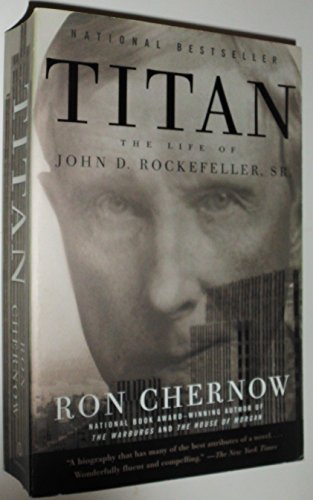
National Book Critics Circle Award Finalist
"A biography that has many of the best attributes of a novel. . . . Wonderfully fluent and compelling." --The New York Times
"A triumph of the art of biography. Unflaggingly interesting, it brings John D. Rockefeller Sr. to life through sustained narrative portraiture of the large-scale, nineteenth-century kind."--The New York Times Book Review
In this endlessly engrossing book, National Book Award-winning biographer Ron Chernow devotes his penetrating powers of scholarship and insight to the Jekyll and Hyde of American capitalism. In the course of his nearly 98 years, John D. Rockefeller, Sr., was known as both a rapacious robber baron, whose Standard Oil Company rode roughshod over an industry, and a philanthropist who donated money lavishly to universities and medical centers. He was the terror of his competitors, the bogeyman of reformers, the delight of caricaturists--and an utter enigma.
Drawing on unprecedented access to Rockefeller's private papers, Chernow reconstructs his subject's troubled origins (his father was a swindler and a bigamist) and his single-minded pursuit of wealth. But he also uncovers the profound religiosity that drove him "to give all I could"; his devotion to his family; and the wry sense of humor that made him the country's most colorful codger. Titan is a magnificent biography --balanced, revelatory, and elegantly written.
"Important and impressive. . . . Reveals the man behind both the mask and the myth."--The Wall Street Journal
"One of the great American biographies. . . . [Chernow] writes with rich impartiality. He turns the machinations of Standard Oil . . . into fascinating social history."--Time
Die Inhaltsangabe kann sich auf eine andere Ausgabe dieses Titels beziehen.
Über die Autorin bzw. den Autor
Ron Chernow lives in Brooklyn Heights, New York.
Auszug. © Genehmigter Nachdruck. Alle Rechte vorbehalten.
The Flimflam Man
In the early 1900s, as Rockefeller vied with Andrew Carnegie for the title of the world's richest man, a spirited rivalry arose between France and Germany, with each claiming to be Rockefeller's ancestral land. Assorted genealogists stood ready, for a sizable fee, to manufacture a splendid royal lineage for the oilman. "I have no desire to trace myself back to the nobility," he said honestly. "I am satisfied with my good old American stock."
1
The most ambitious search for Rockefeller's roots traced them back to a ninth-century French family, the Roquefeuilles, who supposedly inhabited a Languedoc chbteau. The clan's departure from France is much better documented than its origins. After Louis XIV revoked the Edict of Nantes in 1685, the Huguenot family fled from religious persecution and emigrated to Sagendorf, near the Rhenish town of Koblenz, and Germanized their surname to Rockefeller.
Around 1723, Johann Peter Rockefeller, a miller, gathered up his wife and five children, set sail for Philadelphia, and settled on a farm in Somerville and then Amwell, New Jersey, where he evidently flourished and acquired large landholdings. More than a decade later, his cousin Diell Rockefeller left southwest Germany and moved to Germantown, New York.
Diell's granddaughter Christina married her distant relative William, one of Johann's grandsons. (Never particularly sentimental about his European forebears, John D. Rockefeller did erect a monument to the patriarch, Johann Peter, at his burial site in Flemington, New Jersey.) The marriage of William and Christina produced a son named Godfrey Rockefeller, who was
the grandfather of the oil titan and a most unlikely progenitor of the clan. In 1806, Godfrey married Lucy Avery in Great Barrington, Massachusetts, despite the grave qualms of her family.
Establishing a pattern that would be replicated by Rockefeller's own mother, Lucy had, in her family's disparaging view, married down. Her ancestors had emigrated from Devon, England, to Salem, Massachusetts, around 1630, forming part of the Puritan tide. As they became settled and gentrified, the versatile Averys spawned ministers, soldiers, civic leaders, explorers, and traders, not to mention a bold clutch of Indian fighters. During the American Revolution, eleven Averys perished gloriously in the battle of Groton.
While the Rockefellers' "noble" roots required some poetic license and liberal embellishment, Lucy could justly claim
descent from Edmund Ironside, the English king, who was crowned in 1016. Godfrey Rockefeller was sadly mismatched with his enterprising wife. He had a stunted, impoverished look and a hangdog air of perpetual defeat. Taller than her husband, a fiery Baptist of commanding presence, Lucy was rawboned and confident, with a vigorous step and alert blue eyes. A former schoolteacher, she was better educated than Godfrey. Even John D., never given to invidious comments about relatives, tactfully conceded, "My
grandmother was a brave woman. Her husband was not so brave as she."
2
If Godfrey contributed the Rockefeller coloring-bluish gray eyes, light brown hair-Lucy introduced the rangy frame later notable among the men. Enjoying robust energy and buoyant health, Lucy had ten children, with the third, William Avery Rockefeller, born in Granger, New York, in 1810. While it is easy enough to date the birth of Rockefeller's father, teams of frazzled reporters would one day exhaust themselves trying to establish the date of his death.
As a farmer and businessman, Godfrey enjoyed checkered success, and his aborted business ventures exposed his family to an insecure, peripatetic life. They were forced to move to Granger and Ancram, New York, then to Great Barrington, before doubling back to Livingston, New York. John D. Rockefeller's upbringing would be fertile with cautionary figures of weak
men gone astray. Godfrey must have been invoked frequently as a model to be avoided. By all accounts, Grandpa was a jovial, good-natured man but feckless and addicted to drink, producing in Lucy an everlasting hatred of liquor that she must have drummed into her grandson. Grandpa Godfrey was the first to establish in John D.'s mind an enduring equation between bonhomie and lax character, making the latter prefer the society of sober, tight-lipped men in full command of their emotions.
The Rockefeller records offer various scenarios of why Godfrey and Lucy packed their belongings into an overloaded Conestoga wagon and headed west between 1832 and 1834. By one account, the Rockefellers, along with several neighbors, were dispossessed of their land in a heated title dispute with some English investors. Another account has an unscrupulous businessman gulling Godfrey into swapping his farm for allegedly richer turf in Tioga County. (If this claim was in fact made, it proved a cruel hoax.) Some
relatives later said that Michigan was Godfrey's real destination but that Lucy vetoed such a drastic relocation, preferring the New England culture of upstate New York to the wilds of Michigan.
Whatever the reason, the Rockefellers reenacted the primordial American rite of setting out in search of fresh opportunity. In the 1830s, many settlers from Massachusetts and Connecticut were swarming excitedly into wilderness areas of western New York, a migration that Alexis de Tocqueville described as "a game of chance" pursued for "the emotions it excites, as much as for the gain it procures."
3
The construction of the Erie Canal in the 1820s had lured many settlers to the area. Godfrey and Lucy heaped up their worldly possessions in a canvas-topped prairie schooner, drawn by oxen, and headed toward the sparsely settled territory.
For two weeks, they traveled along the dusty Albany-Catskill turnpike, creeping through forests as darkly forbidding as
the setting of a Grimms' fairy tale. With much baggage and little passenger space, the Rockefellers had to walk for much of the journey, with Lucy and the children (except William, who did not accompany them) taking turns sitting in the wagon whenever they grew weary. As they finally reached their destination, Richford, New York, the last three and a half miles were especially arduous, and the oxen negotiated the stony, rutted path with difficulty. At the end, they had to lash their exhausted team up a nearly
vertical hillside to possess their virgin sixty acres. As family legend has it, Godfrey got out, tramped to the property's peak, inspected the vista, and said mournfully, "This is as close as we shall ever get to Michigan."
So, in a memorial to dashed hopes, the spot would forever bear the melancholy name of Michigan Hill.
Even today scarcely more than a crossroads, Richford was then a stagecoach stop in the wooded country southeast of Ithaca and northwest of Binghamton. The area's original inhabitants, the Iroquois, had been chased out after the American Revolution and replaced by revolutionary army veterans. Still an uncouth frontier when the Rockefellers arrived, this backwater had
recently attained township status, its village square dating from 1821. Civilization had taken only a tenuous hold. The dense forests on all sides teemed with game-bear, deer, panther, wild turkey, and cottontail rabbit-and people carried flaring torches at night to frighten away the roaming packs of wolves.
By the time that John D. Rockefeller was born in 1839, Richford was acquiring the amenities of a small town. It had some nascent
industries-sawmills, gristmills, and a whiskey distillery-plus a schoolhouse and a church. Most inhabitants scratched out a living from hardscrabble farming, yet these newcomers were hopeful and enterprising.
Notwithstanding their frontier trappings, they had carried with them the...
„Über diesen Titel“ kann sich auf eine andere Ausgabe dieses Titels beziehen.
Suchergebnisse für Titan: the Life of John D. Rockefeller, Sr

Beispielbild für diese ISBN
Titan: the Life of John D. Rockefeller, Sr
Anbieter: World of Books (was SecondSale), Montgomery, IL, USA
Verkäuferbewertung 5 von 5 Sternen

Paperback. Zustand: Good. Artikel-Nr. 00108336982
Gebraucht kaufen
EUR 4,95
Versand gratis
Versand innerhalb von USA
Versand innerhalb von USA
Anzahl: 8 verfügbar
Foto des Verkäufers
Titan: The Life of John D. Rockefeller, Sr. (Vintage)
Anbieter: Dream Books Co., Denver, CO, USA
Verkäuferbewertung 5 von 5 Sternen
Zustand: acceptable. This copy has clearly been enjoyedâ"expect noticeable shelf wear and some minor creases to the cover. Binding is strong, and all pages are legible. May contain previous library markings or stamps. Artikel-Nr. DBV.0679757031.A
Gebraucht kaufen
EUR 6,39
Versand gratis
Versand innerhalb von USA
Versand innerhalb von USA
Anzahl: 1 verfügbar
Beispielbild für diese ISBN
Titan: The Life of John D. Rockefeller, Sr.
Anbieter: Wonder Book, Frederick, MD, USA
Verkäuferbewertung 5 von 5 Sternen
Zustand: Good. Good condition. A copy that has been read but remains intact. May contain markings such as bookplates, stamps, limited notes and highlighting, or a few light stains. Artikel-Nr. Q03R-00191
Gebraucht kaufen
EUR 9,44
Versand gratis
Versand innerhalb von USA
Versand innerhalb von USA
Anzahl: 1 verfügbar
Beispielbild für diese ISBN
Titan : The Life of John D. Rockefeller, Sr.
Verlag:
Knopf Doubleday Publishing Group, 1999
ISBN 10: 0679757031
ISBN 13: 9780679757030
Gebraucht
Softcover
Anbieter: Better World Books: West, Reno, NV, USA
Verkäuferbewertung 5 von 5 Sternen
Zustand: Very Good. Pages intact with possible writing/highlighting. Binding strong with minor wear. Dust jackets/supplements may not be included. Stock photo provided. Product includes identifying sticker. Better World Books: Buy Books. Do Good. Artikel-Nr. 3933099-6
Gebraucht kaufen
EUR 10,52
Versand gratis
Versand innerhalb von USA
Versand innerhalb von USA
Anzahl: 1 verfügbar
Beispielbild für diese ISBN
Titan : The Life of John D. Rockefeller, Sr.
Verlag:
Knopf Doubleday Publishing Group, 1999
ISBN 10: 0679757031
ISBN 13: 9780679757030
Gebraucht
Softcover
Anbieter: Better World Books, Mishawaka, IN, USA
Verkäuferbewertung 5 von 5 Sternen
Zustand: Good. Pages intact with minimal writing/highlighting. The binding may be loose and creased. Dust jackets/supplements are not included. Stock photo provided. Product includes identifying sticker. Better World Books: Buy Books. Do Good. Artikel-Nr. 733982-6
Gebraucht kaufen
EUR 10,52
Versand gratis
Versand innerhalb von USA
Versand innerhalb von USA
Anzahl: 4 verfügbar
Foto des Verkäufers
Titan The Life of John D. Rockefeller, Sr.
Anbieter: True Oak Books, Highland, NY, USA
Verkäuferbewertung 5 von 5 Sternen
Paperback. Zustand: Good+. Foxing to exterior edge of pages. - Great overall condition. Minor cosmetic wear. No major blemishes. No writing.; - We offer free returns for any reason and respond promptly to all inquiries. Your order will be packaged with care and ship on the same or next business day. Buy with confidence. Artikel-Nr. HVD-20117-A-0
Gebraucht kaufen
EUR 18,16
Versand gratis
Versand innerhalb von USA
Versand innerhalb von USA
Anzahl: 1 verfügbar
Beispielbild für diese ISBN
Titan: the Life of John D. Rockefeller, Sr
Anbieter: Revaluation Books, Exeter, Vereinigtes Königreich
Verkäuferbewertung 5 von 5 Sternen
Paperback. Zustand: Brand New. 774 pages. 8.43x5.85x0.73 inches. In Stock. Artikel-Nr. 0679757031
Neu kaufen
EUR 42,44
EUR 11,67 Versand
Versand von Vereinigtes Königreich nach USA
Versand von Vereinigtes Königreich nach USA
Anzahl: 1 verfügbar
Beispielbild für diese ISBN
Titan - The life of John D. Rockefeller, Sr the life of John D. Rockefeller, Sr
Anbieter: Mooney's bookstore, Den Helder, Niederlande
Verkäuferbewertung 4 von 5 Sternen

Zustand: Very Good. Artikel-Nr. 97E9228FD26A327
Gebraucht kaufen
EUR 58,00
EUR 14,95 Versand
Versand von Niederlande nach USA
Versand von Niederlande nach USA
Anzahl: 1 verfügbar