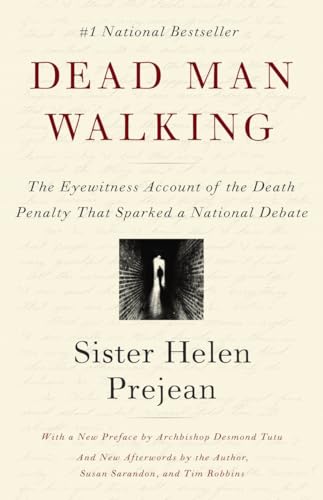
Dead Man Walking: The Eyewitness Account of the Death Penalty That Sparked a National Debate - Softcover
Inhaltsangabe
#1 NATIONAL BESTSELLER • A profoundly moving spiritual journey through our system of capital punishment and an unprecedented look at the human consequences of the death penalty • "Stunning moral clarity.” —The Washington Post Book World • Basis for the award-winning major motion picture starring Susan Sarandon and Sean Penn
"Sister Prejean is an excellent writer, direct and honest and unsentimental. . . . She almost palpably extends a hand to her readers.” —The New York Times Book Review
In 1982, Sister Helen Prejean became the spiritual advisor to Patrick Sonnier, the convicted killer of two teenagers who was sentenced to die in the electric chair of Louisiana’s Angola State Prison. In the months before Sonnier’s death, the Roman Catholic nun came to know a man who was as terrified as he had once been terrifying. She also came to know the families of the victims and the men whose job it was to execute—men who often harbored doubts about the rightness of what they were doing.
Out of that dreadful intimacy comes a profoundly moving spiritual journey through our system of capital punishment. Here Sister Helen confronts both the plight of the condemned and the rage of the bereaved, the fears of a society shattered by violence and the Christian imperative of love.
On its original publication in 1993, Dead Man Walking emerged as an unprecedented look at the human consequences of the death penalty. Now, some two decades later, this story—which has inspired a film, a stage play, an opera and a musical album—is more gut-wrenching than ever, stirring deep and life-changing reflection in all who encounter it.
Die Inhaltsangabe kann sich auf eine andere Ausgabe dieses Titels beziehen.
Über die Autorin bzw. den Autor
Helen Prejean, C. S. J., is a writer, lecturer, and community organizer who was born in Baton Rouge and has lived and worked in Louisiana all her life. Her groundbreaking firsthand account of the death penalty, Dead Man Walking, has been adapted into a movie, an opera, and a play for high schools and colleges. She is also the author of The Death of Innocents: An Eyewitness Account of Wrongful Executions. She has lectured extensively on the subject of capital punishment and has appeared on 60 Minutes, NBC’s Today Show, NPR’s Weekend Edition and Fresh Air, PBS’s Frontline, BBC World Service radio, and an NBC special series on the death penalty. She has received honorary degrees from colleges and universities across the United States. She is a member of the Congregation of St. Joseph.
www.sisterhelen.org
Von der hinteren Coverseite
In 1982, Sister Helen Prejean became the spiritual advisor to Patrick Sonnier, the convicted killer of two teenagers who was sentenced to die in the electric chair of Louisiana's Angola State Prison. In the months before Sonnier's death, the Roman Catholic nun came to know a man who was as terrified as he had once been terrifying. At the same time, she came to know the families of the victims and the men whose job it was to execute him--men who often harbored doubts about the rightness of what they were doing.
Out of that dreadful intimacy comes a profoundly moving spiritual journey through our system of capital punishment. Confronting both the plight of the condemned and the rage of the bereaved, the needs of a crime-ridden society and the Christian imperative of love, Dead Man Walking is an unprecedented look at the human consequences of the death penalty, a book that is both enlightening and devastating.
Auszug. © Genehmigter Nachdruck. Alle Rechte vorbehalten.
CHAPTER
I
When Chava Colon from the Prison Coalition asks me one January day in 1982 to become a pen pal to a death-row inmate, I say, Sure. The invitation seems to fit with my work in St. Thomas, a New Orleans housing project of poor black residents. Not death row exactly, but close. Death is rampant here-from guns, disease, addiction. Medical care scarcely exists.
I've come to St. Thomas to serve the poor, and I assume that someone occupying a cell on Louisiana's death row fits that category. I had learned that back in 1977 at a lecture by John Vodicka, one of the founders of the Louisiana Coalition on Jails and Prisons where Chava now works. I had also learned that the death penalty in the United States has always been most rigorously applied in Southern states-mostly toward those who kill whites. The Prison Coalition office is near Hope House, where I teach high-school dropouts, and Chava and I run into each other fairly often.
After he has written the name of the death-row inmate he says, "Maybe I ought to give you someone else. This guy is a loner and doesn't write. Maybe you want someone who will answer your letters."
But he's already written the name and I say, "Don't change it. Give me his name." I don't know yet that the name on this tiny slip of white paper will be my passport into an eerie land that so far I've only read about in books.
I look at the name and address that Chava gave me: Elmo Patrick Sonnier, number 95281, Death Row, Louisiana State Penitentiary, Angola.
Almost all the killings here in St. Thomas seem to erupt from the explosive mixture of dead-end futures, drugs, and guns. But when Chava describes what Sonnier has done, my blood chills. On November 4, 1977, he and his younger brother, Eddie, abducted from a lovers' lane a teenage couple, David LeBlanc and Loretta Bourque. They raped the girl, forced the young people to lie face down, and shot them in the head.
I look down at the name in horror. Do I really want to know such a man?
"He's a Cajun from St. Martinville, Louisiana," Chava says.
Which makes the murders all the more vicious, because St. Martinville, at the center of Acadiana, is one of the friendliest, most hospitable places on earth. Here and in the surrounding towns French-speaking people, mostly farmers and fishermen, cook good food, swap stories and recipes, and dance the two-step and the zydeco. They love to talk, even to strangers. If murders are prone to happen anywhere on the face of the earth, this is the place one would least expect.
I wonder what I can say to this man. What will he have to say to me?
"We have files at the office," Chava says, "if you want to read about the case."
I take the piece of paper with the name on it back to the apartment in the project where I live with five other nuns.
A year ago, in June of 1981, I had driven a small brown truck loaded with my personal possessions to the apartment on 519 St. Andrew Street and hoped to high heaven I wouldn't be shot. We were practically the only whites-all women-among one thousand five hundred residents in the six square blocks of beige brick buildings tucked between the central business district and the garden district. After my first night in the project apartment, I wrote in my journal:
"Didn't sleep much. Noisy until about 3:00 A.M. People standing on the corner talking and drinking. Feel nervous, unsettled. Heard a gunshot. Had checked when I got into bed to make sure my bed was under the windowsill in case a bullet came through.
"Is this New Orleans? I feel like I'm in another country."
I came to St. Thomas as part of a reform movement in the Catholic Church, seeking to harness religious faith to social justice. In 1971, the worldwide synod of bishops had declared justice a "constitutive" part of the Christian gospel. When you dig way back into Church teachings, you find that this focus on justice has been tucked in there all along in "social encyclicals." Not exactly coffee-table literature. The documents have been called the best-kept secret of the Catholic Church. And with good reason. The mandate to practice social justice is unsettling because taking on the struggles of the poor invariably means challenging the wealthy and those who serve their interests. "Comfort the afflicted and afflict the comfortable"-that's what Dorothy Day, a Catholic social activist said is the heart of the Christian gospel.1
In 1980 my religious community, the Sisters of St. Joseph of Medaille, had made a commitment to "stand on the side of the poor," and I had assented, but reluctantly. I resisted this recasting of the faith of my childhood, where what counted was a personal relationship with God, inner peace, kindness to others, and heaven when this life was done. I didn't want to struggle with politics and economics. We were nuns, after all, not social workers, and some realities in life were, for better or worse, rather fixed-like the gap between rich and poor. Even Jesus Christ himself had said, "The poor you will always have with you." Besides, it was all so complex and confusing-the mess the world was in-with one social problem meshed with other problems. If you tried to get a handle, say, on improving housing for poor people, you found yourself in a morass of bureaucracy and waste in government programs, racist real estate and banking policies, unemployment-a mess.
Enlightenment had come in June 1980. I can remember the moment because it changed my life. My community had assembled at Terre Haute, Indiana, to grapple with directions of our ministries for the 1980s, and the chief speaker was Sister Marie Augusta Neal, S.N.D.deN. A sociologist, she described glaring inequities in the world: two thirds of the peoples of the world live at or below subsistence level while one third live in affluence. Did we know, she asked, that the United States, which comprises about 6 percent of the world's population, consumed 48 percent of the world's goods? What were we to do about such glaring injustices? She knew her facts and I found myself mentally pitting my arguments against her challenge-we were nuns, not social workers, not political. But it's as if she knew what I was thinking. She pointed out that to claim to be apolitical or neutral in the face of such injustices would be, in actuality, to uphold the status quo-a very political position to take, and on the side of the oppressors.
But it was the way she presented the message of Jesus that caused the most radical shift in my perspective.
"The Gospels record that Jesus preached good news to the poor," she said, "and an essential part of that good news was that they were to be poor no longer." Which meant they were not to meekly accept their poverty and suffering as God's will, but, instead, struggle to obtain the necessities of life which were rightfully theirs. And Jesus' challenge to the nonpoor, she emphasized, was to relinquish their affluence and to share their resources with the dispossessed.
Something in me must have been building toward this moment because there was a flash and I realized that my spiritual life had been too ethereal, too disconnected. I left the meeting and began seeking out the poor. This brought me one year later to the St. Thomas housing development.
I had grown up in Baton Rouge, Louisiana, in the 1940s and 1950s in as solid and loving a family as one could hope for-a mother and father who lavished attention and affection on their children and a brother, Louie, and sister, Mary Ann, whom I could spar with and tease and argue with and love. We grew up in a spacious two-story house, were educated in Catholic schools, and traveled extensively across the United States, Canada, and...
„Über diesen Titel“ kann sich auf eine andere Ausgabe dieses Titels beziehen.
Weitere beliebte Ausgaben desselben Titels

Suchergebnisse für Dead Man Walking: The Eyewitness Account of the Death...

Foto des Verkäufers
Dead Man Walking: The Eyewitness Account Of The Death Penalty That Sparked a National Debate
Anbieter: Dream Books Co., Denver, CO, USA
Verkäuferbewertung 5 von 5 Sternen

Zustand: acceptable. This copy has clearly been enjoyedâ"expect noticeable shelf wear and some minor creases to the cover. Binding is strong, and all pages are legible. May contain previous library markings or stamps. Artikel-Nr. DBV.0679751319.A
Foto des Verkäufers
Dead Man Walking: The Eyewitness Account Of The Death Penalty That Sparked a National Debate
Anbieter: Dream Books Co., Denver, CO, USA
Verkäuferbewertung 5 von 5 Sternen
Zustand: good. Gently used with minimal wear on the corners and cover. A few pages may contain light highlighting or writing, but the text remains fully legible. Dust jacket may be missing, and supplemental materials like CDs or codes may not be included. May be ex-library with library markings. Ships promptly! Artikel-Nr. DBV.0679751319.G
Beispielbild für diese ISBN
Dead Man Walking: The Eyewitness Account Of The Death Penalty That Sparked a National Debate
Anbieter: Wonder Book, Frederick, MD, USA
Verkäuferbewertung 5 von 5 Sternen
Zustand: Very Good. Very Good condition. A copy that may have a few cosmetic defects. May also contain light spine creasing or a few markings such as an owner's name, short gifter's inscription or light stamp. Artikel-Nr. R08C-03321
Beispielbild für diese ISBN
Dead Man Walking: The Eyewitness Account Of The Death Penalty That Sparked a National Debate
Anbieter: Wonder Book, Frederick, MD, USA
Verkäuferbewertung 5 von 5 Sternen
Zustand: Good. Signed Copy . Signed by author on front endpage. Artikel-Nr. Y14OS-00238
Beispielbild für diese ISBN
Dead Man Walking: The Eyewitness Account Of The Death Penalty That Sparked a National Debate
Anbieter: Wonder Book, Frederick, MD, USA
Verkäuferbewertung 5 von 5 Sternen
Zustand: As New. Like New condition. A near perfect copy that may have very minor cosmetic defects. Artikel-Nr. A11T-00409
Beispielbild für diese ISBN
Dead Man Walking: The Eyewitness Account of the Death Penalty That Sparked a National Debate
Anbieter: ThriftBooks-Reno, Reno, NV, USA
Verkäuferbewertung 5 von 5 Sternen
Paperback. Zustand: Very Good. No Jacket. Former library book; May have limited writing in cover pages. Pages are unmarked. ~ ThriftBooks: Read More, Spend Less. Artikel-Nr. G0679751319I4N10
Beispielbild für diese ISBN
Dead Man Walking: The Eyewitness Account of the Death Penalty That Sparked a National Debate
Anbieter: ThriftBooks-Dallas, Dallas, TX, USA
Verkäuferbewertung 5 von 5 Sternen
Paperback. Zustand: Very Good. No Jacket. May have limited writing in cover pages. Pages are unmarked. ~ ThriftBooks: Read More, Spend Less. Artikel-Nr. G0679751319I4N00
Beispielbild für diese ISBN
Dead Man Walking: The Eyewitness Account of the Death Penalty That Sparked a National Debate
Anbieter: ThriftBooks-Atlanta, AUSTELL, GA, USA
Verkäuferbewertung 5 von 5 Sternen
Paperback. Zustand: Very Good. No Jacket. Former library book; May have limited writing in cover pages. Pages are unmarked. ~ ThriftBooks: Read More, Spend Less. Artikel-Nr. G0679751319I4N10
Beispielbild für diese ISBN
Dead Man Walking: The Eyewitness Account of the Death Penalty That Sparked a National Debate
Anbieter: ThriftBooks-Atlanta, AUSTELL, GA, USA
Verkäuferbewertung 5 von 5 Sternen
Paperback. Zustand: Very Good. No Jacket. May have limited writing in cover pages. Pages are unmarked. ~ ThriftBooks: Read More, Spend Less. Artikel-Nr. G0679751319I4N00
Beispielbild für diese ISBN
Dead Man Walking: The Eyewitness Account of the Death Penalty That Sparked a National Debate
Anbieter: ThriftBooks-Phoenix, Phoenix, AZ, USA
Verkäuferbewertung 5 von 5 Sternen
Paperback. Zustand: Very Good. No Jacket. Former library book; May have limited writing in cover pages. Pages are unmarked. ~ ThriftBooks: Read More, Spend Less. Artikel-Nr. G0679751319I4N10