
Verwandte Artikel zu God: A Biography: Pulitzer Prize Winner
Inhaltsangabe
WINNER OF THE PULITZER PRIZE
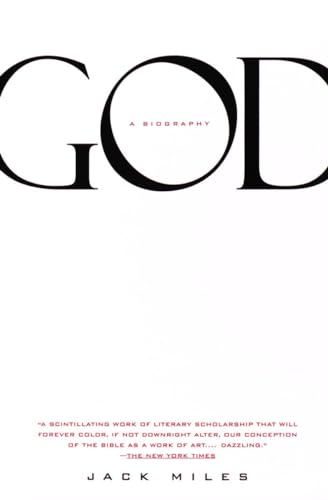
What sort of "person" is God? What is his "life story"? Is it possible to approach him not as an object of religious reverence, but as the protagonist of the world's greatest book—as a character who possesses all the depths, contradictions, and abiguities of a Hamlet? This is the task that Jack Miles—a former Jesuit trained in religious studies and Near Eastern languages—accomplishes with such brilliance and originality in God: A Biography.
Using the Hebrew Bible as his text, Miles shows us a God who evolves through his relationship with man, the image who in time becomes his rival. Here is the Creator who nearly destroys his chief creation; the bloodthirsty warrior and the protector of the downtrodden; the lawless law-giver; the scourge and the penitent. Profoundly learned, stylishly written, the resulting work illuminates God and man alike and returns us to the Bible with a sense of discovery and wonder.
Die Inhaltsangabe kann sich auf eine andere Ausgabe dieses Titels beziehen.
Über die Autorin bzw. den Autor
Jack Miles is a writer whose work has appeared in numerous national publications, including The Atlantic Monthly, the The New York Times, The Boston Globe, The Washington Post, and the Los Angeles Times, where he served for ten years as literary editor and as a member of the newspaper’s editorial board. The recipient of a Ph.D. in Near Eastern languages from Harvard University and a former Jesuit, he has been a Regents Lecturer at the University of California, director of the Humanities Center at Claremont Graduate University, and visiting professor of humanities at the California Institute of Technology. His first book, God: A Biography, won a Pulitzer Prize and has been translated into fifteen languages. Currently senior advisor to the president of the J. Paul Getty Trust, a foundation supporting art and scholarship, Dr. Miles lives with his wife and daughter in Southern California.
Auszug. © Genehmigter Nachdruck. Alle Rechte vorbehalten.
1
PRELUDE
Can God's Life Be Written?
Can a literary character be said to live a life from birth to death or otherwise to undergo a development from beginning to end? Or is a literary character-fixed on the pages of a book, trapped forever in the same few words and actions-the very opposite of a living, developing human being?
Contention on this point has shaped a century of Hamlet criticism, according to a recent survey by William Kerrigan, who calls the two contending groups the critics and the scholars. The critics, he says, dominant at the start of the century, believed in character. They believed that to talk about Hamlet the play, you had to talk about Hamlet the man: what he said, what he did, and how he changed during the time between his first and his last words onstage. The scholars, dominant in the middle of the century, took as their motto Hamlet's own line "The play's the thing." They believed that, empirically speaking, there was no Hamlet, only Shakespeare's words on the page, and that therefore one could legitimately talk only about them. If one went beyond them, it could not be into the imagined rest of Hamlet, for the rest was silence, to borrow another line from the play. One could go only into the rest of Elizabethan drama and Elizabethan society, seeking other plays that Shakespeare might have known, deepening one's knowledge of the language he spoke, and so forth.
The dean of the critics was A. C. Bradley, whose still influential Shakespearean Tragedy was published in 1904. The turning point from criticism to scholarship and from character to dramaturgy as a focus may be dated to 1933, when L. C. Knights wrote a famous essay, "How Many Children Had Lady Macbeth?" mocking Bradley's assumption-naive in Knights's view-that literary character could ever be talked about in its own right. Knights believed that Bradley's approach was perhaps appropriate for biography but certainly inappropriate for literary criticism.
For decades, Kerrigan shows, the triumph of scholarship over criticism seemed complete. Most of those now teaching and writing about Shakespeare were trained by scholars. Yet criticism never quite folded its tent, and in the last years of the century an interesting bifurcation has occurred.
On the one hand, the kind of historicism whose rise may be dated to Knights's essay has been succeeded by a "New Historicism" with intellectual debts to French thought. Broadly, where the Old Historicism sought to understand the history that was embedded in the text of the play, the New Historicism seeks to understand the play as itself embedded in history. Thus, Kerrigan writes:
Stephen Greenblatt [the best-known of the New Historicists] famously concludes his Renaissance Self-fashioning with the declaration that he had started to write a book on Renaissance individuals but discovered in the end that there are no individuals. One is somewhat amazed to learn at the beginning of his Shakespearean Negotiations that he started this book, too, in a quest for the writer's unique intensity but discovered in the end that there are no writers: "This book argues that works of art, however intensely marked by the creative intelligence and private obsession of individuals, are the products of collective negotiation and exchange.";
The reign of scholarship continues, therefore; yet, on the other hand, at least a few erstwhile scholars are surreptitiously defecting to criticism, among them Kerrigan himself. "I was trained by scholars," he writes, "and speaking of 'character development' in Hamlet makes me uneasy. But I do not know how else to describe the shift from the self-loathing Hamlet of the final two soliloquies to the beautifully calm Hamlet of Act 5." Philosophically, Bradley was a Hegelian, and the struggle between him and Knights was a literary version of the long-running contest between German (or Continental) idealism and British empiricism. But both traditions trace, ultimately, to classical antiquity, and Kerrigan ends his survey with Aristotle:
So we need to understand Hamlet's beginning and his end, and need to put them together. Modern Aristotles puzzling out the mysterious tragedy of character, we must connect beginning, middle, and end.
That's the way it's done.
THE BIOGRAPHY OF GOD
That is the way it will be done in this book. I have begun this foreword with a discussion of Hamlet because I want to situate my subject in literature. I write here about the life of the Lord God as-and only as-the protagonist of a classic of world literature; namely, the Hebrew Bible or Old Testament. I do not write about (though I certainly do not write against) the Lord God as the object of religious belief. I do not attempt, as theology does, to make an original statement about God as an extraliterary reality. I do not write as a historian and therefore do not focus, as historians do, on the successive Israelite and Jewish communities that believed in God. My interest goes not to those believing communities but, after the fashion of A. C. Bradley, to the God they believed in. And I believe with Bradley, and against Knights, that the biographical effect-the artistic suggestion of a life-is inseparable from the dramatic or literary effect itself. Unless the viewer of Hamlet can believe that Hamlet was born and will die, unless the viewer's imagination is carried offstage into the life for which there is no direct evidence onstage, the play dies with its protagonist. A character understood to have no life offstage can have no life onstage. And so it is also with God as the protagonist of the Bible.
If biography is seen narrowly as a branch of history, then there can be no biography of a nonhistorical character. But God does have a first and a last appearance in the Hebrew Bible. We see him first as the creator, outside history, prior to it, masterfully setting in motion the heavenly bodies by which historical time will be measured, We see him last as the "Ancient of Days," white-haired and silent, looking forward to the end of history from a remote and cloudy throne. This book becomes a biography of a special sort by dint of its determination to describe the middle that lies between so vigorous a beginning and so quiescent an end.
The beginning and the end of the Hebrew Bible are not linked by a single, continuous narrative. Well short of the halfway point in the text, the narrative breaks off. What then follow are, first, speeches spoken by God; second, speeches spoken either to or, in some degree, about God; third, a protracted silence; and, last, a brief resumption of the narrative before a closing coda. The narrative suspense that lasts from the Book of Genesis through II Kings is succeeded, past that point, by another kind of suspense, one more like the kind jurors experience in a courtroom as different witnesses take the stand to talk about the same person. A sequence of testimonies-each in its own distinctive voice, with its own beginning and end-can be as effective as narrative in suggesting that the person about whom the words are spoken does not stop where the words stop. This is the biographical effect in another form. And even in this form, it is an effect that can include a sense of forward movement, of "What next?"
After action yields to speech in the Hebrew Bible, however, speech yields in its turn to silence. God's last words are those he speaks to Job, the human being who dares to challenge not his physical power but his moral authority. Within the Book of Job itself, God's climactic and overwhelming reply seems to silence Job. But reading from the end of the Book of Job onward, we see that it is Job who has somehow silenced God. God never speaks again, and he is decreasingly spoken of. In the Book of Esther-a book in which, as in the Book...
„Über diesen Titel“ kann sich auf eine andere Ausgabe dieses Titels beziehen.
Weitere beliebte Ausgaben desselben Titels

Suchergebnisse für God: A Biography: Pulitzer Prize Winner

Beispielbild für diese ISBN
God A Biography
Anbieter: World of Books (was SecondSale), Montgomery, IL, USA
Verkäuferbewertung 5 von 5 Sternen

Zustand: Good. Item in good condition. Textbooks may not include supplemental items i.e. CDs, access codes etc. Artikel-Nr. 00091097465
Gebraucht kaufen
EUR 3,63
Versand gratis
Versand innerhalb von USA
Versand innerhalb von USA
Anzahl: Mehr als 20 verfügbar
Beispielbild für diese ISBN
God A Biography
Anbieter: World of Books (was SecondSale), Montgomery, IL, USA
Verkäuferbewertung 5 von 5 Sternen
Zustand: Acceptable. Item in good condition. Textbooks may not include supplemental items i.e. CDs, access codes etc. Artikel-Nr. 00065781489
Gebraucht kaufen
EUR 3,63
Versand gratis
Versand innerhalb von USA
Versand innerhalb von USA
Anzahl: 5 verfügbar
Beispielbild für diese ISBN
God: A Biography: Pulitzer Prize Winner
Verlag:
Vintage (edition Reprint), 1996
ISBN 10: 0679743685
ISBN 13: 9780679743682
Gebraucht
Paperback
Anbieter: BooksRun, Philadelphia, PA, USA
Verkäuferbewertung 5 von 5 Sternen
Paperback. Zustand: Fair. Reprint. The item might be beaten up but readable. May contain markings or highlighting, as well as stains, bent corners, or any other major defect, but the text is not obscured in any way. Artikel-Nr. 0679743685-7-1-13
Gebraucht kaufen
EUR 5,25
Versand gratis
Versand innerhalb von USA
Versand innerhalb von USA
Anzahl: 1 verfügbar
Beispielbild für diese ISBN
God: A Biography: Pulitzer Prize Winner
Anbieter: ThriftBooks-Atlanta, AUSTELL, GA, USA
Verkäuferbewertung 5 von 5 Sternen
Paperback. Zustand: Very Good. No Jacket. May have limited writing in cover pages. Pages are unmarked. ~ ThriftBooks: Read More, Spend Less. Artikel-Nr. G0679743685I4N00
Gebraucht kaufen
EUR 5,83
Versand gratis
Versand innerhalb von USA
Versand innerhalb von USA
Anzahl: 3 verfügbar
Beispielbild für diese ISBN
God: A Biography: Pulitzer Prize Winner
Anbieter: ThriftBooks-Reno, Reno, NV, USA
Verkäuferbewertung 5 von 5 Sternen
Paperback. Zustand: Very Good. No Jacket. May have limited writing in cover pages. Pages are unmarked. ~ ThriftBooks: Read More, Spend Less. Artikel-Nr. G0679743685I4N00
Gebraucht kaufen
EUR 5,83
Versand gratis
Versand innerhalb von USA
Versand innerhalb von USA
Anzahl: 3 verfügbar
Beispielbild für diese ISBN
God: A Biography: Pulitzer Prize Winner
Anbieter: ThriftBooks-Atlanta, AUSTELL, GA, USA
Verkäuferbewertung 5 von 5 Sternen
Paperback. Zustand: Very Good. No Jacket. Former library book; May have limited writing in cover pages. Pages are unmarked. ~ ThriftBooks: Read More, Spend Less. Artikel-Nr. G0679743685I4N10
Gebraucht kaufen
EUR 5,83
Versand gratis
Versand innerhalb von USA
Versand innerhalb von USA
Anzahl: 1 verfügbar
Beispielbild für diese ISBN
God: A Biography: Pulitzer Prize Winner
Anbieter: ThriftBooks-Dallas, Dallas, TX, USA
Verkäuferbewertung 5 von 5 Sternen
Paperback. Zustand: Very Good. No Jacket. May have limited writing in cover pages. Pages are unmarked. ~ ThriftBooks: Read More, Spend Less. Artikel-Nr. G0679743685I4N00
Gebraucht kaufen
EUR 5,83
Versand gratis
Versand innerhalb von USA
Versand innerhalb von USA
Anzahl: 3 verfügbar
Beispielbild für diese ISBN
God: A Biography: Pulitzer Prize Winner
Anbieter: ThriftBooks-Phoenix, Phoenix, AZ, USA
Verkäuferbewertung 5 von 5 Sternen
Paperback. Zustand: Very Good. No Jacket. May have limited writing in cover pages. Pages are unmarked. ~ ThriftBooks: Read More, Spend Less. Artikel-Nr. G0679743685I4N00
Gebraucht kaufen
EUR 5,83
Versand gratis
Versand innerhalb von USA
Versand innerhalb von USA
Anzahl: 3 verfügbar
Beispielbild für diese ISBN
God: a Biography : Pulitzer Prize Winner
Verlag:
Knopf Doubleday Publishing Group, 1996
ISBN 10: 0679743685
ISBN 13: 9780679743682
Gebraucht
Softcover
Anbieter: Better World Books: West, Reno, NV, USA
Verkäuferbewertung 5 von 5 Sternen
Zustand: Very Good. Reprint. Pages intact with possible writing/highlighting. Binding strong with minor wear. Dust jackets/supplements may not be included. Stock photo provided. Product includes identifying sticker. Better World Books: Buy Books. Do Good. Artikel-Nr. GRP68559932
Gebraucht kaufen
EUR 6,04
Versand gratis
Versand innerhalb von USA
Versand innerhalb von USA
Anzahl: 1 verfügbar
Beispielbild für diese ISBN
God: a Biography : Pulitzer Prize Winner
Verlag:
Knopf Doubleday Publishing Group, 1996
ISBN 10: 0679743685
ISBN 13: 9780679743682
Gebraucht
Softcover
Anbieter: Better World Books, Mishawaka, IN, USA
Verkäuferbewertung 5 von 5 Sternen
Zustand: Good. Reprint. Pages intact with minimal writing/highlighting. The binding may be loose and creased. Dust jackets/supplements are not included. Stock photo provided. Product includes identifying sticker. Better World Books: Buy Books. Do Good. Artikel-Nr. GRP95639195
Gebraucht kaufen
EUR 6,04
Versand gratis
Versand innerhalb von USA
Versand innerhalb von USA
Anzahl: 2 verfügbar