
Verwandte Artikel zu The Reivers: A Reminiscence (Vintage International)
Inhaltsangabe
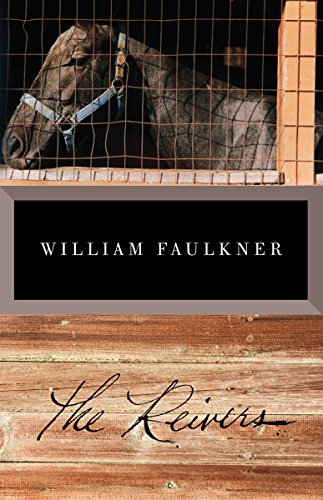
One of Faulkner’s comic masterpieces, The Reivers is a picaresque that tells of three unlikely car thieves from rural Mississippi. Eleven-year-old Lucius Priest is persuaded by Boon Hogganbeck, one of his family’s retainers, to steal his grandfather’s car and make a trip to Memphis. The Priests’ black coachman, Ned McCaslin, stows away, and the three of them are off on a heroic odyssey, for which they are all ill-equipped, that ends at Miss Reba’s bordello in Memphis. From there a series of wild misadventures ensues—involving horse smuggling, trainmen, sheriffs’ deputies, and jail.
Die Inhaltsangabe kann sich auf eine andere Ausgabe dieses Titels beziehen.
Über die Autorin bzw. den Autor
William Faulkner, one of the greatest writers of the twentieth century, was born in New Albany, Mississippi, on September 25, 1897. He published his first book, The Marble Faun, in 1924, but it is as a literary chronicler of life in the Deep South—particularly in the fictional Yoknapatawpha County, the setting for several of his novels—that he is most highly regarded. In such novels as The Sound and the Fury, As I Lay Dying, Light in August, and Absalom, Absalom! he explored the full range of post–Civil War Southern life, focusing both on the personal histories of his characters and on the moral uncertainties of an increasingly dissolute society. In combining the use of symbolism with a stream-of-consciousness technique, he created a new approach to fiction writing. In 1949 he was awarded the Nobel Prize for Literature. William Faulkner died in Byhalia, Mississippi, on July 6, 1962.
Auszug. © Genehmigter Nachdruck. Alle Rechte vorbehalten.
One
Grandfather said:
This is the kind of a man Boon Hogganbeck was. Hung on the wall, it could have been his epitaph, like a Bertillon chart or a police poster; any cop in north Mississippi would have arrested him out of any crowd after merely reading the date.
It was Saturday morning, about ten oclock. We-your great-grandfather and I-were in the office, Father sitting at the desk totting up the money from the canvas sack and matching it against the list of freight bills which I had just collected around the Square; and I sitting in the chair against the wall waiting for noon when I would be paid my Saturday's (week's) wage of ten cents and we would go home and eat dinner and I would be free at last to overtake (it was May) the baseball game which had been running since breakfast without me: the idea (not mine: your great-grandfather's) being that even at eleven a man should already have behind him one year of paying for, assuming responsibility for, the space he occupied, the room he took up, in the world's (Jefferson, Mississippi's anyway) economy. I would leave home with Father immediately after breakfast each Saturday morning, when all the other boys on the street were merely arming themselves with balls and bats and gloves-not to mention my three brothers, who being younger and therefore smaller than I, were more fortunate, assuming this was Father's logic or premise: that since any adult man worth his salt could balance or stand off four children in economic occupancy, any one of the children, the largest certainly, would suffice to carry the burden of the requisite economic motions: in this case, making the rounds each Saturday morning with the bills for the boxes and cases of freight which our Negro drivers had picked up at the depot during the week and delivered to the back doors of the grocery and hardware and farmers' supply stores, and bring the canvas sack back to the livery stable for Father to count and balance it, then sit in the office for the rest of the morning ostensibly to answer the telephone-this for the sum of ten cents a week, which it was assumed I would live inside of.
That's what we were doing when Boon came jumping through the door. That's right. Jumping. It was not really a high step up from the hallway, even for a boy of eleven (though John Powell, the head hostler, had had Son Thomas, the youngest driver, find, borrow, take- anyway, snaffle-from somewhere a wooden block as an intermediate step for me) and Boon could have taken it as he always did in his own six- foot-four stride. But not this time: jumping into the room. In its normal state his face never looked especially gentle or composed; at this moment it looked like it was about to explode right out from between his shoulders with excitement, urgency, whatever it was, jumping on across the office toward the desk and already hollering at Father: "Look out, Mr Maury, get out of the way," reaching, lunging across Father toward the lower drawer where the livery stable pistol lived; I couldn't tell whether it was Boon lunging for the drawer who knocked the chair (it was a swivel chair on casters) back or whether it was Father who flung the chair back to make himself room to kick at Boon's reaching hand, the neat stacks of coins scattering in all directions across the desk and Father hollering too now, still stomping either at the drawer or Boon's hand or maybe both:
"God damn it, stop it!"
"I'm going to shoot Ludus!" Boon hollered. "He's probably clean across the Square by now! Look out, Mr Maury!"
"No!" Father said. "Get away!"
"You wont let me have it?" Boon said.
"No, God damn it," Father said.
"All right," Boon said, already jumping again, back toward the door and out of it. But Father just sat there. I'm sure you have often noticed how ignorant people beyond thirty or forty are. I dont mean forgetful. That's specious and easy, too easy to say Oh papa (or grandpa) or mama (or grandma), they're just old; they have forgotten. Because there are some things, some of the hard facts of life, that you dont forget, no matter how old you are. There is a ditch, a chasm; as a boy you crossed it on a footlog. You come creeping and doddering back at thirty-five or forty and the footlog is gone; you may not even remember the footlog but at least you dont step out onto that empty gravity that footlog once spanned. That was Father then. Boon came jumping without warning into the office and almost knocked Father chair and all over grabbling at the drawer where the pistol was, until Father managed to kick or stomp or whatever it was his hand away, then Boon turned and went jumping back out of the office and apparently, obviously, Father thought that was all of it, that it was finished. He even finished cursing, just on principle, as though there were no urgency anywhere, heeling the chair back to the desk and seeing the scattered money which would have to be counted all over now and then he started to curse at Boon again, not even about the pistol but simply at Boon for being Boon Hogganbeck, until I told him.
"He's gone to try to borrow John Powell's," I said.
"What?" Father said. Then he jumped too, both of us, across the office and down into the hallway and down the hallway toward the lot behind the stable where John Powell and Luster were helping Gabe, the blacksmith, shoe three of the mules and one of the harness horses, Father not even taking time to curse now, just hollering "John! Boon! John! Boon!" every three steps.
But he was too late this time too. Because Boon fooled him-us. Because John Powell's pistol was not just a moral problem in the stable, it was an emotional one too. It was a .41 calibre snub-nosed revolver, quite old but in excellent condition because John had kept it that way ever since he bought it from his father the day he was twenty-one years old. Only, he was not supposed to have it. I mean, officially it did not exist. The decree, as old as the stable itself, was that the only pistol connected with it would be the one which stayed in the bottom right hand drawer of the desk in the office, and the mutual gentlemen's assumption was that no one on the staff of the establishment even owned a firearm from the time he came on duty until he went back home, let alone brought one to work with him. Yet-and John had explained it to all of us and had our confederated sympathy and understanding, a unified and impregnable front to the world and even to Father himself if that unimaginable crisis had ever arisen, which it would not have except for Boon Hogganbeck-telling us (John) how he had earned the price of the pistol by doing outside work on his own time, on time apart from helping his father on the farm, time which was his own to spend eating or sleeping, until on his twenty-first birthday he had paid the final coin into his father's hand and received the pistol; telling us how the pistol was the living badge of his manhood, the ineffaceable proof that he was now twenty-one and a man; that he never intended, declined even to imagine the circumstance in which he would ever pull its trigger against a human being, yet he must have it with him; he would no more have left the pistol at home when he came away than he would have left his manhood in a distant closet or drawer when he came to work; he told us (and we believed him) that if the moment ever came when he would have to choose between leaving the pistol at home or not coming to work himself, there would have been but one possible choice for him.
So at first his wife had stitched a neat strong pocket exactly fitting the pistol on the inside of the bib of his overalls. But John himself realised at once that this wouldn't do. Not that the pistol might fall out at some irretrievable moment, but that the shape of it was obvious through the cloth; it couldn't have been anything else but a pistol. Obvious not to us:...
„Über diesen Titel“ kann sich auf eine andere Ausgabe dieses Titels beziehen.
Suchergebnisse für The Reivers: A Reminiscence (Vintage International)

Beispielbild für diese ISBN
The Reivers A Reminiscence Vin
Anbieter: World of Books (was SecondSale), Montgomery, IL, USA
Verkäuferbewertung 5 von 5 Sternen

Zustand: Very Good. Item in very good condition! Textbooks may not include supplemental items i.e. CDs, access codes etc. Artikel-Nr. 00108841017
Gebraucht kaufen
EUR 4,07
Versand gratis
Versand innerhalb von USA
Versand innerhalb von USA
Anzahl: 1 verfügbar
Beispielbild für diese ISBN
The Reivers A Reminiscence Vin
Anbieter: World of Books (was SecondSale), Montgomery, IL, USA
Verkäuferbewertung 5 von 5 Sternen
Zustand: Acceptable. Item in acceptable condition! Textbooks may not include supplemental items i.e. CDs, access codes etc. Artikel-Nr. 00106478233
Gebraucht kaufen
EUR 4,07
Versand gratis
Versand innerhalb von USA
Versand innerhalb von USA
Anzahl: 4 verfügbar
Beispielbild für diese ISBN
The Reivers A Reminiscence Vin
Anbieter: World of Books (was SecondSale), Montgomery, IL, USA
Verkäuferbewertung 5 von 5 Sternen
Zustand: Good. Item in good condition. Textbooks may not include supplemental items i.e. CDs, access codes etc. Artikel-Nr. 00108332689
Gebraucht kaufen
EUR 4,07
Versand gratis
Versand innerhalb von USA
Versand innerhalb von USA
Anzahl: 6 verfügbar
Beispielbild für diese ISBN
The Reivers (Vintage International)
Anbieter: BooksRun, Philadelphia, PA, USA
Verkäuferbewertung 5 von 5 Sternen
Paperback. Zustand: Very Good. It's a well-cared-for item that has seen limited use. The item may show minor signs of wear. All the text is legible, with all pages included. It may have slight markings and/or highlighting. Artikel-Nr. 0679741925-11-1
Gebraucht kaufen
EUR 4,13
Versand gratis
Versand innerhalb von USA
Versand innerhalb von USA
Anzahl: 1 verfügbar
Beispielbild für diese ISBN
The Reivers (Vintage International)
Anbieter: BooksRun, Philadelphia, PA, USA
Verkäuferbewertung 5 von 5 Sternen
Paperback. Zustand: Fair. The item might be beaten up but readable. May contain markings or highlighting, as well as stains, bent corners, or any other major defect, but the text is not obscured in any way. Artikel-Nr. 0679741925-7-1
Gebraucht kaufen
EUR 4,22
Versand gratis
Versand innerhalb von USA
Versand innerhalb von USA
Anzahl: 1 verfügbar
Beispielbild für diese ISBN
The Reivers (Vintage International)
Anbieter: BooksRun, Philadelphia, PA, USA
Verkäuferbewertung 5 von 5 Sternen
Paperback. Zustand: Fair. The item might be beaten up but readable. May contain markings or highlighting, as well as stains, bent corners, or any other major defect, but the text is not obscured in any way. Artikel-Nr. 0679741925-7-1-13
Gebraucht kaufen
EUR 4,54
Versand gratis
Versand innerhalb von USA
Versand innerhalb von USA
Anzahl: 1 verfügbar
Foto des Verkäufers
The Reivers (Vintage International)
Anbieter: Dream Books Co., Denver, CO, USA
Verkäuferbewertung 5 von 5 Sternen
Zustand: acceptable. This copy has clearly been enjoyedâ"expect noticeable shelf wear and some minor creases to the cover. Binding is strong, and all pages are legible. May contain previous library markings or stamps. Artikel-Nr. DBV.0679741925.A
Gebraucht kaufen
EUR 5,45
Versand gratis
Versand innerhalb von USA
Versand innerhalb von USA
Anzahl: 1 verfügbar
Beispielbild für diese ISBN
The Reivers
Anbieter: ThriftBooks-Reno, Reno, NV, USA
Verkäuferbewertung 5 von 5 Sternen
Paperback. Zustand: Fair. No Jacket. Readable copy. Pages may have considerable notes/highlighting. ~ ThriftBooks: Read More, Spend Less. Artikel-Nr. G0679741925I5N00
Gebraucht kaufen
EUR 5,79
Versand gratis
Versand innerhalb von USA
Versand innerhalb von USA
Anzahl: 1 verfügbar
Beispielbild für diese ISBN
The Reivers
Verlag:
Knopf Doubleday Publishing Group, 1992
ISBN 10: 0679741925
ISBN 13: 9780679741923
Gebraucht
Softcover
Anbieter: Better World Books: West, Reno, NV, USA
Verkäuferbewertung 5 von 5 Sternen
Zustand: Good. Reissue. Pages intact with minimal writing/highlighting. The binding may be loose and creased. Dust jackets/supplements are not included. Stock photo provided. Product includes identifying sticker. Better World Books: Buy Books. Do Good. Artikel-Nr. 4040594-20
Gebraucht kaufen
EUR 6,01
Versand gratis
Versand innerhalb von USA
Versand innerhalb von USA
Anzahl: 1 verfügbar
Beispielbild für diese ISBN
The Reivers
Verlag:
Knopf Doubleday Publishing Group, 1992
ISBN 10: 0679741925
ISBN 13: 9780679741923
Gebraucht
Softcover
Anbieter: Better World Books, Mishawaka, IN, USA
Verkäuferbewertung 5 von 5 Sternen
Zustand: Good. Reissue. Former library copy. Pages intact with minimal writing/highlighting. The binding may be loose and creased. Dust jackets/supplements are not included. Includes library markings. Stock photo provided. Product includes identifying sticker. Better World Books: Buy Books. Do Good. Artikel-Nr. GRP74356187
Gebraucht kaufen
EUR 6,01
Versand gratis
Versand innerhalb von USA
Versand innerhalb von USA
Anzahl: 7 verfügbar